Wimbledon has always been cruel to certainty.
It lets champions walk through the gates with history on their side, then asks them to prove everything again on grass that changes by the hour, under pressure that grows heavier by the round, in front of a crowd that can sense fear before the scoreboard shows it.
Sunday at Wimbledon 2026 belonged to that old truth.
Novak Djokovic, 39 years old and still bargaining with time, passed another Roger Federer milestone by claiming his 106th Wimbledon men’s singles victory. He did not do it with total control. He did not glide through Roman Safiullin like a man untouched by age, wind, or danger. He had to solve problems, absorb discomfort, adjust his game, and lean on the part of himself that has defined two decades of Grand Slam survival.
Story at a glance

Djokovic’s 106th Wimbledon Win Was Not About Perfection
Djokovic’s 7-6(6), 6-3, 3-6, 6-3 win over Roman Safiullin gave him a number that now sits alone in Wimbledon men’s history: 106 match wins at the All England Club.
Naomi Osaka’s Win Felt Like a Door Swinging Open
If Djokovic’s win was about history, Osaka’s victory over Sabalenka was about emotional release.
Sabalenka’s Exit Leaves the Women’s Draw Without Its Top Three Seeds
The most dramatic part of Osaka’s victory is what it did to the bracket.
Muchova Ends Krejcikova’s Reign With Variety and Nerve
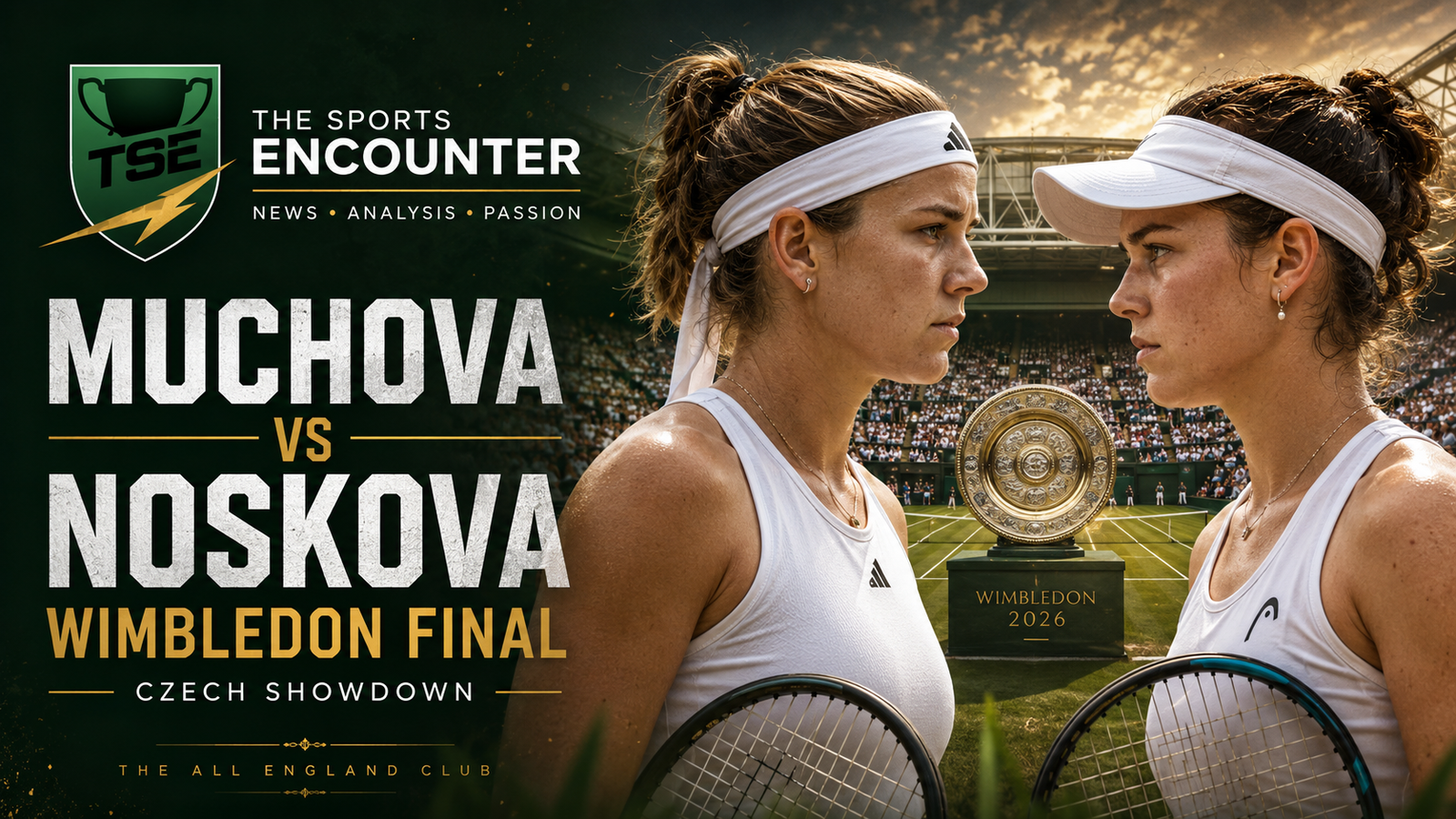
Karolina Muchova’s 7-5, 5-7, 6-3 win over Barbora Krejcikova deserves more than a footnote.
Pegula Stops Jovic and Shows Why Experience Still Matters
Jessica Pegula’s win over Iva Jovic felt like a generational checkpoint.
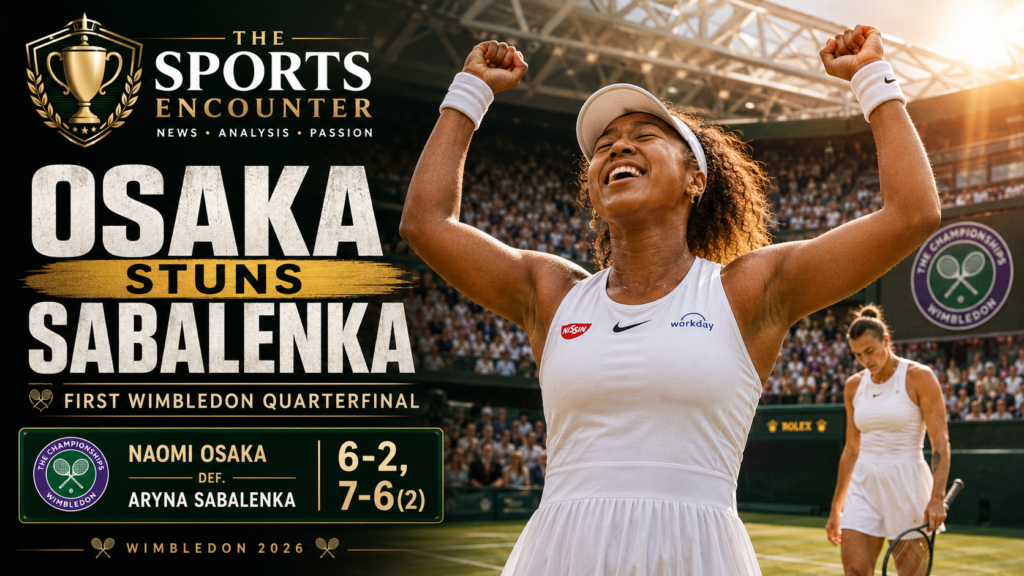
A few hours later, Naomi Osaka walked onto Centre Court against Aryna Sabalenka, the world No. 1 and title favorite, and turned the women’s draw into a storm.
Osaka won 6-2, 7-6(2), reached her first Wimbledon quarterfinal, ended Sabalenka’s 21-match Grand Slam tiebreak winning streak, and made the tournament feel wide open in a way it had not felt when the week began.
Between Djokovic’s record-breaking grit and Osaka’s fearless return to the Grand Slam spotlight, Wimbledon Day 7 became a story about two different kinds of tennis survival.
One was a legend refusing to leave.
The other was a former champion rediscovering the feeling that once made her unstoppable.
That is why this felt like the natural continuation of the chaos from Wimbledon 2026 Day 6, when Alexandra Eala stunned Iga Swiatek and Elise Mertens knocked out Elena Rybakina. Saturday cracked the draw. Sunday blew it open.
Wimbledon Day 7 Scorecard: The Main Results That Changed the Tournament
| Match | Result | Why It Mattered |
|---|---|---|
| Novak Djokovic vs Roman Safiullin | Djokovic won 7-6(6), 6-3, 3-6, 6-3 | Djokovic reached the quarterfinals and passed Federer for most men’s Wimbledon match wins |
| Naomi Osaka vs Aryna Sabalenka | Osaka won 6-2, 7-6(2) | Osaka reached her first Wimbledon quarterfinal and knocked out the women’s top seed |
| Karolina Muchova vs Barbora Krejcikova | Muchova won 7-5, 5-7, 6-3 | Muchova ended the 2024 champion’s run in an all-Czech battle |
| Jessica Pegula vs Iva Jovic | Pegula won 4-6, 6-3, 6-1 | Pegula used experience to stop the teenager and equal her best Wimbledon run |
| Heliovaara/Patten vs Pavlasek/Rikl | Heliovaara/Patten won 5-7, 6-3, 7-6(6) | The top doubles seeds survived a tense Court Two battle |
Djokovic’s 106th Wimbledon Win Was Not About Perfection
Djokovic’s 7-6(6), 6-3, 3-6, 6-3 win over Roman Safiullin gave him a number that now sits alone in Wimbledon men’s history: 106 match wins at the All England Club.
That moved him ahead of Roger Federer, whose name has felt almost inseparable from Wimbledon for more than two decades.
For many players, passing Federer at Wimbledon would be the story of a career. For Djokovic, it becomes another line in a record book that keeps expanding even when logic says it should start closing.
Yet the match itself was not a simple celebration. It was not the smooth, imperial Djokovic of old shutting down an overmatched opponent. It was more interesting than that.
Safiullin, a qualifier ranked well outside the game’s elite, played with the freedom of a man who had already stretched the tournament further than expected. He hit hard, rushed Djokovic, and made the seventh seed uncomfortable in baseline exchanges.
Djokovic admitted afterward that he did not want to stay in the rally too long, saying he had to mix things up. That line matters.
At 25, Djokovic could often win by turning a match into a suffocation chamber. He could rally until the opponent blinked, bend without breaking, and make every point feel like a test of nerve and lungs. At 39, he still owns much of that old muscle memory, but he is also more selective.
He understands that survival is not always about outlasting.
Sometimes it is about refusing to play the match on your opponent’s terms.
Against Safiullin, that meant shorter points, more serve-and-volley tennis, smarter first-serve placement, and tactical variation when the baseline exchanges became too dangerous.
The record was historic. The method was deeply human.
That was exactly why our Wimbledon 2026 title preview framed Djokovic’s challenge as more than a ranking or reputation question. His chances were always going to depend on how efficiently he could manage danger across seven rounds.
Sunday gave us the answer in real time.
He is still dangerous because he can suffer without panicking.
The First Set Was the Real Match Inside the Match
The scoreboard shows Djokovic won the first set in a tiebreak, 7-6(6). That does not capture how close it came to tilting the other way.
Safiullin had chances.
Djokovic was broken twice. The Russian qualifier pressed him from the back of the court and forced him into mistakes that would have looked strange from Djokovic in his prime. At 2-5 down, Djokovic had to save set points and claw his way back through a set that could have changed the entire emotional temperature of the match.
That is where Djokovic has built much of his mythology.
He does not always dominate danger. He survives it, absorbs it, studies it, and then slowly changes the terms of the conversation.
When the tiebreak arrived, Safiullin still had enough firepower to stay close. Djokovic had enough clarity to take the set. At Wimbledon, especially against an underdog who has started to believe, that difference can decide the match before anyone realizes it.
Safiullin did not collapse after losing the opener. He kept pushing, took the third set, and forced Djokovic to work deep into the afternoon.
Still, the first set had already revealed the central truth.
Safiullin could hurt him, but Djokovic could still find the exit door under pressure.
“Survive to Thrive”: Why Djokovic’s Quote Captured His Wimbledon
After the match, Djokovic summed up his first week with three words: “Survive to thrive.”
It is the perfect phrase for this stage of his career.
Djokovic is chasing an eighth Wimbledon title, which would pull him level with Federer’s men’s singles record at SW19. He is also chasing a standalone 25th Grand Slam title, a number that would push him even further into tennis history.
But those goals are not abstract milestones anymore. They come with physical questions, tactical adjustments, and the reality of a younger field that no longer fears his name in quite the same way older generations did.
That does not mean they are not intimidated.
It means they are willing to swing.
Safiullin swung. Others will too.
Djokovic’s challenge now is not simply to prove he is better. It is to keep proving that he can problem-solve better than everyone else across seven rounds.
That has always been his superpower, but now it carries an extra layer of drama because each difficult hold, each dropped set, each frustrated reaction, and each tactical switch feels like part of the final chapter.
Fans know what they are watching.
They are not just watching a player win tennis matches. They are watching one of the greatest athletes in modern sport keep negotiating with time in public.
Naomi Osaka’s Win Felt Like a Door Swinging Open
If Djokovic’s win was about history, Osaka’s victory over Sabalenka was about emotional release.
The women’s top seed had entered Sunday with the clearest path of any remaining favorite. Swiatek was gone. Rybakina was gone. The draw had opened around Sabalenka like an invitation.
Then Osaka closed the door on her.
The 14th seed beat Sabalenka 6-2, 7-6(2), and it was not a lucky escape or a messy upset. Osaka was sharper from the start. Her return game rattled Sabalenka. Her serve held up under pressure. Her body language was calm in the moments when Sabalenka’s frustration began to spill over.
For Osaka, this was not only a first Wimbledon quarterfinal. It was her first quarterfinal at any non-hardcourt major.
That is significant because Osaka’s greatness has often been boxed into a surface narrative. Four Grand Slam titles, all on hard courts. A game built around first-strike power, clean timing, and controlled aggression.
For years, grass and clay seemed like places where she could be dangerous, but not necessarily complete.
Sunday changed that perception.
Maybe it did not make her the favorite. It did something more interesting.
It made her feel possible again.
The tournament had already hinted at a power shift in Wimbledon 2026: What’s In Store This Year?. Osaka’s victory gave that idea a face, a roar, and a Centre Court moment.
Osaka Played the Match Sabalenka Wanted to Own
Sabalenka usually wants matches to feel like they are being played at her volume.
She wants pace, pressure, first serves, heavy returns, and the sense that every rally is tilting toward her racket.
Osaka did not let that happen.
She returned with enough depth to stop Sabalenka from settling. She attacked early without looking rushed. Most importantly, she gave Sabalenka the feeling that extra power was not going to solve the problem.
That is when frustration started to show.
The first set lasted only 32 minutes. Sabalenka’s power game misfired. Osaka broke twice and moved through the set with the kind of quiet authority that made the crowd realize the upset was no longer theoretical.
The second set was more competitive, but Osaka still looked emotionally clearer. Sabalenka fought harder, pushed it into a tiebreak, and gave herself a chance to turn the match into a third-set test.
Then Osaka played one of the cleanest pressure tiebreaks of her comeback.
Sabalenka had won 21 consecutive Grand Slam tiebreaks before Sunday.
Osaka ended that streak 7-2.
That was not just a statistical note. It was the moment the match officially changed meaning. Osaka did not only beat the top seed. She beat her in the very zone where Sabalenka had been almost untouchable.
“So Much Fun on the Court”: The Emotional Weight of Osaka’s Return
Afterward, Osaka said it had been a long time since she had “so much fun on the court.”
That line may end up being more important than the score.
Osaka’s career has never been only about trophies. It has been followed through the lens of pressure, identity, motherhood, mental health, expectation, and the strange loneliness that can come with global fame.
Tennis fans have watched her win majors, step away, return, struggle, smile, and search for rhythm again.
This win felt different because it did not look forced.
It looked like a player reconnecting with the sensation that first made her a major champion: seeing the ball early, trusting the strike, staying calm when the match gets loud, and finding joy inside the fight.
Osaka also said she wanted to reverse her recent run against Sabalenka after losing to her several times in a row. That mattered too. Great players carry private scoreboards. They remember who has had the better of them. They know when a matchup has started to lean the wrong way.
On Sunday, Osaka changed the emotional balance of that rivalry.
She walked off Centre Court not as a nostalgia story, not as a comeback brand, and not as a former champion trying to feel relevant again.
She walked off as a current threat at Wimbledon.
Sabalenka’s Exit Leaves the Women’s Draw Without Its Top Three Seeds
The most dramatic part of Osaka’s victory is what it did to the bracket.
Swiatek, the defending champion, had already been knocked out by Alexandra Eala. Rybakina, the second seed, had already lost to Elise Mertens. Sabalenka, the top seed, looked positioned to take control.
Instead, she is gone too.
That means the women’s tournament has reached the quarterfinal stage without its top three seeds. For fans, that is chaos. For the remaining players, it is opportunity. For Wimbledon, it is narrative gold.
The women’s draw now has several overlapping storylines:
Osaka’s comeback surge.
Muchova’s all-court elegance.
Pegula’s experience and hunger.
Eala’s breakout run.
Mertens’ quiet threat.
Paolini’s resilience.
Keys’ power.
Gauff’s possible path, depending on her Sunday result.
This is exactly the kind of unpredictability that makes Grand Slam second weeks addictive. The favorites are gone, but the quality is still there. The field has not become weaker. It has become more emotionally open.
For readers following The Sports Encounter’s wider tennis coverage, the pattern is now clear. Wimbledon 2026 is not moving toward a predictable coronation. It is becoming a tournament of emotional breakouts, veteran survival, and sudden opportunity.
Muchova Ends Krejcikova’s Reign With Variety and Nerve
Karolina Muchova’s 7-5, 5-7, 6-3 win over Barbora Krejcikova deserves more than a footnote.
It was an all-Czech fourth-round match between two players who know each other well, understand each other’s patterns, and carry very different kinds of grass-court threat.
Krejcikova arrived as the 2024 Wimbledon champion.
Muchova arrived as one of the most aesthetically complete players left in the draw.
By the end, Muchova had produced 50 winners and ended the former champion’s defense.
Her game is built for fans who love texture. She volleys. She changes height. She uses drop shots, angles, slices, and sudden cross-court acceleration. Against Krejcikova, she needed all of it.
The match swung. Muchova took the first set. Krejcikova roared back to take the second after winning five straight games. In the third, Muchova steadied herself and finished with a lobbed forehand winner before meeting her compatriot at the net.
Her line about Krejcikova was respectful and revealing: “She’s not a Wimbledon champion by chance.”
That quote captures why this win mattered. Muchova did not beat a fading name. She beat someone who had lifted the trophy on this surface and knew what the second week demands.
Now Muchova faces Osaka in a quarterfinal that might be the most intriguing women’s match of the tournament so far.
Osaka brings first-strike power and renewed belief.
Muchova brings variety, movement, and the kind of tennis that can make rhythm impossible.
For fans who like tactical contrast, this is exactly the matchup Wimbledon grass was built to produce.
Pegula Stops Jovic and Shows Why Experience Still Matters
Jessica Pegula’s win over Iva Jovic felt like a generational checkpoint.
Jovic, 18, came in as one of the rising faces of American women’s tennis. She had already reached a Grand Slam quarterfinal at this year’s Australian Open and looked ready to push deeper into another major.
Pegula, 32, had a different kind of pressure. She is no longer a prospect. She is a proven elite player still trying to turn consistency into a deeper Wimbledon breakthrough.
For a set, Jovic looked ready to make the match about youth. The opener was messy, full of breaks, and awkward for Pegula.
But that is where experience earns its value.
Pegula did not panic. She adjusted, improved her first-serve percentage, won quicker points, and took over.
Her 4-6, 6-3, 6-1 win equaled her best Wimbledon run and carried a quiet message: the next generation is coming, but it still has to get past players who know how to problem-solve under pressure.
Pegula’s route also strengthens the American presence in the women’s draw. With Madison Keys, Coco Gauff, and others involved in the second week, Wimbledon 2026 has become a major platform for U.S. women’s tennis.
That adds another layer to the tournament’s identity.
The women’s draw is not only open. It is diverse in style, age, geography, and emotional storyline.
What Djokovic and Osaka Shared on a Very Different Day
At first glance, Djokovic and Osaka gave Wimbledon two unrelated headlines.
One is the oldest kind of tennis story: the aging great chasing records.
The other is a comeback story: a former champion rediscovering danger and joy on a surface that had never fully embraced her.
Look closer, and the two performances were connected by something deeper.
Both players had to reject the version of themselves people expected.
Djokovic could not simply be the unbeatable baseline wall. He had to become a tactical improviser, a serve-and-volley problem-solver, a champion willing to win less beautifully because the scoreboard mattered more than rhythm.
Osaka could not simply be the hardcourt champion who once ruled New York and Melbourne. She had to prove that her power, calm, and competitive fire could travel to Wimbledon grass against the best player in the world.
Both did that.
That is why Day 7 felt emotionally rich. It was not only about who advanced. It was about players changing the story being told about them.
Djokovic’s story is often framed around numbers. Twenty-four majors. Seven Wimbledon titles. Now 106 match wins at Wimbledon.
But Sunday reminded us that numbers come from moments of discomfort, not just dominance.
Osaka’s story is often framed around what she was, what she stepped away from, and what she might become again.
Sunday made that conversation present tense.
She is not merely returning.
She is competing.
Why This Day Matters for the Second Week
The second week of Wimbledon is where storylines become legacies or regrets.
Djokovic now enters the quarterfinals with history at his back and danger ahead. He has already dropped sets in three of his first four matches. That can be read two ways.
It either means he is vulnerable, or it means he is battle-tested.
With Djokovic, both can be true.
His route from here will demand more efficiency. The younger players will have watched Safiullin push him. They will know the baseline can be attacked. They will also know that nearly beating Djokovic is not the same as beating him.
That psychological wall still exists.
Osaka enters the quarterfinals with something completely different: momentum that feels emotionally clean.
She has already beaten the top seed. She has already shown she can handle Centre Court pressure. She has already snapped a streak that gave Sabalenka confidence in the tightest moments.
Now comes the harder task.
After a career-shifting win, can she back it up?
That question is often more difficult than the upset itself. Players can rise for one giant match. Champions find a way to return the next day, reset the mind, and play the next opponent as if the previous victory has already expired.
Muchova will test that. She will not give Osaka the same rhythm Sabalenka did. She will ask different questions, use different speeds, and force Osaka to create her own tempo.
That is why the original assumptions from the Wimbledon singles and doubles title preview now look different. Several of the safest names have already been removed from the women’s draw, while Djokovic’s path is still alive but far from comfortable.
Monday’s Schedule Keeps the Chaos Alive
Sunday did not close the chapter. It handed Monday a loaded script.
Alexandra Eala returns after her stunning win over Swiatek, facing Jasmine Paolini in a match that now carries global attention. Eala has already beaten big names this season, and Paolini has openly praised how dangerous her game looks on grass.
Taylor Fritz faces Alexander Bublik in one of the men’s draw’s most unpredictable matchups. Fritz has the grass-court head-to-head confidence. Bublik has the talent and trick-shot imagination to make any match feel unstable.
Grigor Dimitrov faces Arthur Fery in a wildcard-versus-wildcard story with emotional weight. Dimitrov has spoken about living in the moment after the injury pain of last year, while Fery carries British hopes into the second week.
Jiri Lehecka takes on Alexander Zverev. Alex de Minaur faces Flavio Cobolli. Madison Keys plays Linda Noskova. Ashlyn Krueger meets Marta Kostyuk. Marie Bouzkova faces Elise Mertens.
This is not a tournament narrowing quietly toward the predictable.
It is widening into possibility.
That has been the central theme since the Wimbledon 2026 curtain-raiser: the old stage remains the same, but the power map keeps shifting.
The Fan Psychology of a Day Like This
Sports fans do not remember every fourth-round Sunday because of statistics. They remember the days when a tournament’s emotional shape changes.
Day 7 at Wimbledon 2026 did that.
Djokovic fans saw their player pass Federer in another category, but they also saw the cost of staying at the top this long. Every difficult match now contains a small fear: is this the day the great escape finally fails?
Federer fans saw another cherished Wimbledon number overtaken, and that comes with its own emotional sting. Rivalries do not end when players retire. They live in records, comparisons, arguments, and memories.
Osaka fans saw something they had been waiting to see for years: not only a big win, but visible joy. The kind of joy that makes a player dangerous because it releases the body and quiets the mind.
Sabalenka fans saw a painful missed chance. With Swiatek and Rybakina out, this looked like the tournament where she could finally push past repeated Wimbledon semifinal frustration. Instead, she leaves with another grass-court wound.
Neutral fans got what Wimbledon does best: legacy, shock, tension, beauty, frustration, and the feeling that nobody really knows what happens next.
That uncertainty is the tournament’s heartbeat.
Final Word: Djokovic Owns the Record, Osaka Owns the Shock
By the end of Sunday, Wimbledon had two defining images.
Djokovic, still standing, still adjusting, still making history, now alone above Federer on the men’s Wimbledon match-wins list.
Osaka, smiling again on Centre Court, having knocked out the world No. 1 and blown open the women’s title race.
One result looked backward and forward at once. Djokovic’s 106th Wimbledon win honored the past while keeping his chase alive.
The other felt like a reopening. Osaka’s win over Sabalenka did not erase everything she has been through, but it reminded tennis fans of the player she can still be when belief, timing, and joy arrive together.
Wimbledon loves tradition, but it thrives on disruption.
On Day 7, Djokovic protected history.
Osaka changed the future of the draw.
The second week now has exactly what every Grand Slam needs: records, danger, emotion, and enough uncertainty to keep every fan leaning forward.
For more Grand Slam analysis, follow The Sports Encounter’s Wimbledon 2026 coverage.
Continue the Wimbledon Story
 China OpenChina Open: Djokovic’s Beijing Romance Continues as Medvedev Retires, De Minaur Awaits
 China OpenChina Open 2026: Muchova Survives Osaka, Andreeva Cruises, While Bartunkova Continues to Break Through
 TennisJannik Sinner Ends 2026 Season With Knee Injury as Alexander Zverev Closes on Year-End No. 1
FAQs
How many Wimbledon matches has Novak Djokovic won?
Novak Djokovic has now won 106 men’s singles matches at Wimbledon, moving past Roger Federer for the men’s all-time Wimbledon match-wins record.
Who did Djokovic beat in the Wimbledon 2026 fourth round?
Djokovic beat Russian qualifier Roman Safiullin 7-6(6), 6-3, 3-6, 6-3 to reach the quarterfinals.
Who did Naomi Osaka beat at Wimbledon 2026?
Naomi Osaka beat world No. 1 Aryna Sabalenka 6-2, 7-6(2) in the fourth round.
Why was Osaka’s win over Sabalenka so important?
Osaka reached her first Wimbledon quarterfinal, her first non-hardcourt major quarterfinal, and ended Sabalenka’s 21-match Grand Slam tiebreak winning streak.
Who will Naomi Osaka play next?
Osaka will face Karolina Muchova in the Wimbledon quarterfinals after Muchova beat Barbora Krejcikova in three sets.
Why is the Wimbledon 2026 women’s draw wide open?
The top three women’s seeds are out: Aryna Sabalenka, Iga Swiatek, and Elena Rybakina. That leaves several contenders with a real chance to reach the final.