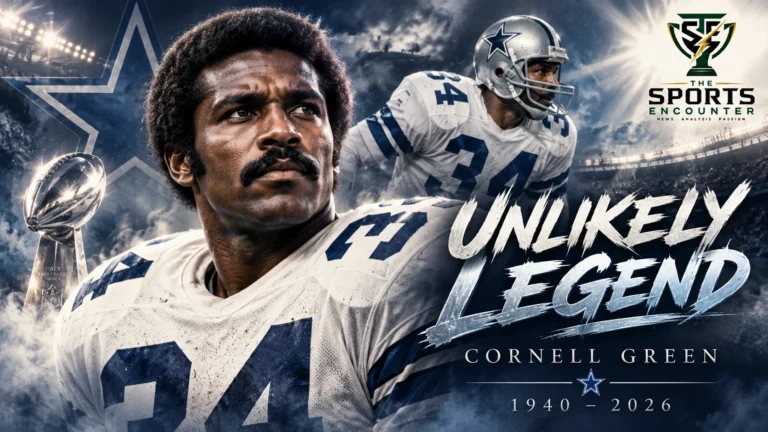
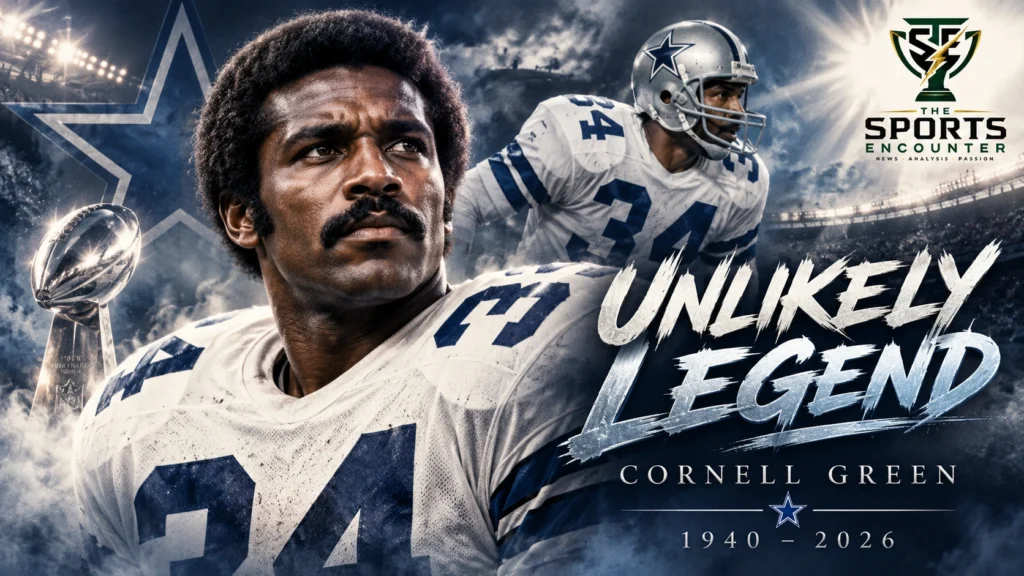
DALLAS, United States, October 21, 2026: Cornell Green, the Dallas Cowboys defensive back who never played college football yet became a five-time Pro Bowler, Super Bowl champion and foundational member of the franchise’s legendary Doomsday Defense, died Wednesday at the age of 86. The Cowboys confirmed the death of a player whose extraordinary 13-season career began with an unlikely invitation to training camp in 1962, when Green appeared destined for professional basketball rather than the NFL. He went on to play every game of his Cowboys career and retire with 34 interceptions, a mark that remains tied for fifth in franchise history.
Green’s journey from Utah State basketball star to one of Dallas’ most dependable defensive players captured the spirit of an organization learning how to identify talent beyond conventional football pathways. He spent eight seasons at cornerback before successfully moving to safety, helped the Cowboys defeat Miami 24-3 in Super Bowl VI, and later became an award-winning scout. His death closes another chapter in the story of Tom Landry’s early championship teams, but his remarkable transformation from basketball prospect to football legend remains one of the NFL’s most compelling examples of unconventional talent development.
Cornell Green Dies at 86: What the Dallas Cowboys Confirmed
The Dallas Cowboys announced Green’s death on October 21, describing the former defensive back as one of the franchise’s great players.
The team highlighted his remarkable transition from basketball to professional football, his longevity and the respect he earned during the franchise’s formative championship years.
Story at a glance
Cornell Green Dies at 86: What the Dallas Cowboys Confirmed
The Dallas Cowboys announced Green’s death on October 21, describing the former defensive back as one of the franchise’s great players.
How Did a Basketball Player With No College Football Experience Reach the NFL?
Green’s athletic background made him an unusual candidate for an NFL defensive-back position.
What Could a Basketball Rebounder Bring to the Cowboys’ Secondary?
The most interesting technical connection between Green’s two sporting careers concerns the ability to read movement and compete for space.
Cornell Green Never Missed an NFL Game Across 13 Seasons
Green’s durability became one of the defining achievements of his professional career.
Why Tom Landry Moved Green From Cornerback to Safety
Another important chapter in Green’s career began in 1970.
A cause of death was not disclosed in the official announcement.
Green was born on February 10, 1940, and died more than five decades after his final NFL season.
His playing achievements remain substantial: five Pro Bowl selections, two first-team All-Pro honors according to the Cowboys’ official retrospective, 34 interceptions and a Super Bowl championship.
Yet the most unusual detail concerns how little conventional football experience he possessed when Dallas first invited him to training camp.
| Career Detail | Cornell Green |
|---|---|
| Born | February 10, 1940 |
| Died | October 21, 2026 |
| Age | 86 |
| Birthplace | Oklahoma City, Oklahoma |
| College | Utah State University |
| College sport | Basketball |
| NFL team | Dallas Cowboys |
| NFL seasons | 1962–1974 |
| Positions | Cornerback, safety |
| Jersey number | 34 |
| Pro Bowl selections | 5 |
| Career interceptions | 34 |
| Super Bowl championships | 1, Super Bowl VI |
| Cause of death | Not publicly announced |
The Cowboys’ official tribute to Cornell Green provides the contemporary account of his death and career.
How Did a Basketball Player With No College Football Experience Reach the NFL?
Green’s athletic background made him an unusual candidate for an NFL defensive-back position.
He grew up in California, where basketball became his principal sport. He earned recognition at El Cerrito High School and Contra Costa College before transferring to Utah State.
At Utah State, he developed into one of the program’s most accomplished basketball players.
His combination of size, athleticism, rebounding ability and competitiveness made him a difficult opponent on the court.
By 1962, professional basketball appeared to offer a natural continuation of his career.
The Chicago Zephyrs selected him in the fifth round of that year’s NBA Draft.
Green had another possibility, however.
Dallas Cowboys personnel director Gil Brandt had developed an interest in athletes whose physical qualities might translate into professional football, even when they had limited experience with the sport.
Brandt’s scouting approach placed particular value on speed and athletic potential.
Green received an invitation to Cowboys training camp and decided to explore the opportunity.
The decision was remarkable because he had played only one season of football during his junior year of high school.
He had not played college football at all.
Despite that background, Green performed well enough at camp to earn a place on the Dallas roster.
The move effectively redirected the rest of his professional life.
Why Utah State’s Basketball Records Make His Football Career Even More Extraordinary
Green was already an elite college basketball player before the Cowboys approached him.
He finished his Utah State career with 1,890 points and 1,067 rebounds.
His rebounding record still stands in the university’s official historical records, an especially striking achievement given the decades that have passed.
| Basketball Achievement | Verified Record | Historical Significance |
|---|---|---|
| Utah State playing years | 1960–1962 | Three collegiate seasons |
| Career points | 1,890 | Among the school’s leading scorers |
| Career rebounds | 1,067 | Utah State career record |
| Rebounds in 1960 | 403 | School single-season record |
| Points in 1962 | 745 | One of Utah State’s highest-scoring seasons |
| All-America recognition | Two seasons | National collegiate recognition |
| NBA Draft | 1962, fifth round | Selected by Chicago Zephyrs |
| Utah State Hall of Fame | 1993 | Recognition of his basketball career |
The Utah State Athletics Hall of Fame profile confirms his basketball accomplishments and 1993 induction.
The records also explain why Dallas’ interest was a calculated evaluation of athletic ability rather than a random experiment.
Green had demonstrated timing, coordination, body control and the ability to compete physically against high-level opponents.
Those attributes do not automatically make someone an NFL defensive back. Football also requires position-specific technique, coverage knowledge, recognition of offensive formations and experience responding to rapidly developing plays.
Green’s achievement was learning those responsibilities quickly enough to succeed against professional opponents.
What Could a Basketball Rebounder Bring to the Cowboys’ Secondary?
The most interesting technical connection between Green’s two sporting careers concerns the ability to read movement and compete for space.
Basketball rebounding requires athletes to anticipate a ball’s trajectory, judge an opponent’s positioning, maintain balance and reach the ball at an advantageous moment.
Defensive-back play involves different skills, but some of the underlying athletic demands overlap.
A cornerback must track receivers, judge a quarterback’s delivery and contest catches without surrendering advantageous positioning.
Green’s basketball experience plausibly gave him a useful foundation for those tasks.
That interpretation should not be confused with a documented explanation for every part of his development. The historical evidence establishes his basketball credentials and later football success, but it does not isolate which skills contributed most to his transformation.
What can be established is that Dallas identified enough athletic potential to offer him an opportunity, and Green converted that opportunity into a lengthy NFL career.
The decision also says something about Brandt’s approach to recruitment.
During a period when most teams relied heavily on conventional football scouting networks, the Cowboys were willing to investigate athletes from other sports.
That openness helped Dallas acquire players whose backgrounds did not always fit established expectations.
Modern franchises operate with far more extensive scouting departments and performance data, but the value of identifying transferable athletic qualities remains relevant.
The financial and competitive importance of acquiring elite defensive-back talent has increased enormously. The Sports Encounter recently examined that evolution in its analysis of Christian Gonzalez and the NFL’s highest-paid cornerbacks.
Green belonged to a different economic era, when identifying an overlooked athlete could be as important as acquiring an established college football star.
Cornell Green Never Missed an NFL Game Across 13 Seasons
Green’s durability became one of the defining achievements of his professional career.
He played for Dallas from 1962 through 1974 without missing a game.
After his rookie season, he started 167 of the next 168 regular-season games.
The near-perfect starting record illustrates both his ability to maintain a place in the lineup and the confidence successive Cowboys coaching staffs placed in him.
Availability was especially important during an era when roster depth and player-management methods differed considerably from modern NFL practices.
Remaining competitive for 13 seasons required Green to adapt physically and technically as the league evolved.
Cornell Green’s NFL Career by the Numbers
| Career Measure | Record | What It Shows |
|---|---|---|
| NFL seasons | 13 | 1962–1974, all with Dallas |
| Games missed | 0 | Exceptional career-long availability |
| Starts after rookie season | 167 of 168 | 99.4% starting rate |
| Interceptions | 34 | Tied for fifth in Cowboys history as of October 2026 |
| Seasons leading Dallas in interceptions | 4 | Repeated ball-production leadership |
| Pro Bowl selections | 5 | Recognition at two different positions |
| First-team All-Pro honors | 2 in the Cowboys’ official account | Elite national recognition |
| Super Bowl appearances | 2 | Super Bowls V and VI |
| Super Bowl wins | 1 | Victory against Miami |
TSE calculation: 167 starts divided by 168 possible starts after the rookie season equals approximately 99.4%. This statistic is not a count of all games played across Green’s 13-year career.
The distinction between appearing in a game and starting it matters when examining historical records.
Green’s record shows that he remained available throughout his career while also retaining a starting role in almost every game after his first season.
The Cowboys’ current defensive backs compete in a considerably different environment, with new offensive formations, changing coverage assignments and far more sophisticated passing concepts.
Nevertheless, consistency remains one of the position’s central requirements.
TSE’s 2026 NFL power rankings examined how Dallas’ defensive weaknesses continued to limit an otherwise dangerous offense, illustrating the importance of a dependable secondary in the modern game.
Green’s career provides a historical example of the stability the Cowboys once enjoyed at the position.
Why Tom Landry Moved Green From Cornerback to Safety
Another important chapter in Green’s career began in 1970.
After spending his first eight NFL seasons primarily at cornerback, he moved to safety.
For many defensive players, such a change requires substantial tactical adjustment.
Cornerbacks usually spend much of their time responding directly to receivers and attacking routes developing near their assigned coverage areas.
Safeties frequently need a broader understanding of the defensive structure, providing support against both the pass and the run while responding to the movement of multiple offensive players.
Green successfully made the transition.
He earned additional Pro Bowl selections in 1971 and 1972, adding to the three he had received earlier at cornerback.
The move demonstrated the trust Tom Landry’s coaching staff placed in his football intelligence and positional versatility.
| Career Phase | Primary Position | Major Achievement |
|---|---|---|
| 1962 | Defensive back | Earned roster place without college football experience |
| 1962–1969 | Cornerback | Established himself as a leading Dallas defender |
| Cornerback years | Cornerback | Three Pro Bowl selections |
| 1970 | Safety | Successful positional transition |
| 1971 | Safety | Pro Bowl selection and Super Bowl VI season |
| 1972 | Safety | Fifth career Pro Bowl selection |
| 1974 | Safety | Final NFL season |
His ability to perform at two different secondary positions is a major reason he deserves to be remembered as more than an unusual basketball convert.
He developed from an athletic experiment into a trusted defender capable of adapting to the team’s tactical needs.
How Cornell Green Helped Build the Cowboys’ Doomsday Defense
Green joined Dallas at a time when the franchise was still attempting to establish itself as a serious NFL contender.
Tom Landry was building an increasingly sophisticated defensive system, while Brandt continued searching for players capable of executing it.
The Cowboys eventually developed one of professional football’s defining defensive units.
The Doomsday Defense became associated with physical play, disciplined assignments and the ability to limit opposing offenses during the franchise’s rise.
Green was part of its first generation.
He played alongside defenders who helped turn Dallas into a consistent championship contender.
His contribution came through pass coverage, interceptions and the dependability required to execute Landry’s assignments over many seasons.
Former Cowboys defender Charlie Waters later emphasized the respect Green commanded among defensive teammates.
That respect is significant because defensive football depends heavily on coordination.
One player’s missed assignment can undermine the responsibilities carried out correctly by everyone else.
A defensive back who understands coverage principles and can adapt to different situations helps the entire unit function more effectively.
The Cowboys’ later emergence as America’s Team was built partly on the championship successes and public recognition generated during Landry’s era.
Today’s Dallas franchise carries an enormous commercial identity, but much of its national following originated in the decades when Green and his teammates established a winning tradition.
The Sports Encounter examined that historical connection in its feature explaining how the Cowboys became a $17 billion sports franchise despite their modern Super Bowl drought.
Green helped create some of the early sporting achievements on which that long-term public identity developed.
Super Bowl VI: The Championship That Completed Green’s Dallas Journey
Green’s greatest team achievement came during the 1971 NFL season.
The Cowboys reached Super Bowl VI against the Miami Dolphins, seeking the championship that had eluded them the previous year.
Dallas had lost Super Bowl V to the Baltimore Colts by a single point.
The defeat left Landry’s team facing questions about its ability to finish a championship campaign.
Super Bowl VI provided the answer.
On January 16, 1972, Dallas defeated Miami 24-3 at Tulane Stadium in New Orleans.
The Cowboys controlled the contest defensively and prevented the Dolphins from scoring a touchdown.
The result delivered the franchise’s first Super Bowl title.
Green’s Championship Journey: The Key Milestones
| Milestone | Opponent or Event | Outcome and Significance |
|---|---|---|
| 1962 | Cowboys training camp | Green earns an NFL roster place |
| Mid-1960s | Dallas’ defensive rise | Green becomes an established cornerback |
| 1970 season | Super Bowl V vs Baltimore Colts | Dallas loses 16-13 |
| 1971 season | Super Bowl VI vs Miami Dolphins | Dallas wins 24-3 |
| Super Bowl VI defensive achievement | Miami’s passing attack | Dolphins held without a touchdown |
| 1974 | Final Cowboys season | Green retires after 13 seasons |
One of the most significant assignments involved Miami wide receiver Paul Warfield.
Warfield was an exceptional deep threat whose speed and receiving ability required careful defensive attention.
Former Cowboys running back Calvin Hill later credited Green with helping neutralize Warfield during the championship game.
The contribution provides a useful reminder that an important defensive performance may not always produce a large number of interceptions or tackles.
Preventing a receiver from creating decisive plays can be just as valuable.
Green’s championship achievement was therefore the culmination of a decade spent developing into a reliable defensive player.
After Football, Cornell Green Became an Award-Winning Scout
Green’s professional contribution continued after he retired following the 1974 season.
He entered scouting, initially working within the Cowboys organization before later joining the Denver Broncos.
The change created an interesting second career.
Decades earlier, Green had benefited from a scouting operation willing to identify potential in an athlete who had followed an unconventional route.
He subsequently became responsible for helping professional organizations identify talent themselves.
Scouting requires a different kind of football judgment from playing.
Evaluators must distinguish between a college player’s existing production and the underlying qualities that might translate into professional success.
They must also consider technique, athletic development, positional responsibilities, adaptability and the demands of different coaching systems.
Green’s background gave him unusual experience of that developmental process.
He understood firsthand what it meant to learn professional football without following a conventional collegiate pathway.
His scouting achievements included receiving the AFC Scout of the Year Award in 2010, according to the Cowboys’ official tribute.
That recognition adds an important dimension to his football legacy.
He had established himself as an elite player and subsequently received recognition for identifying and evaluating others.
Why Cornell Green’s Story Still Matters to Modern NFL Scouting
Green’s career invites a broader question about how football organizations recognize talent.
The NFL’s current evaluation system relies on extensive college scouting, athletic testing, game footage, statistical analysis and increasingly sophisticated performance assessments.
Yet unconventional backgrounds continue to present opportunities for teams willing to consider potential that traditional pathways may overlook.
Green’s career provides historical evidence of what can happen when a team identifies transferable athletic ability and creates an opportunity for development.
His achievement should not be reduced to the idea that a strong basketball player can automatically become a successful football player.
He needed to acquire football-specific skills, understand the defensive system and demonstrate enough consistency to retain his position for 13 seasons.
The remarkable part of the story is that he accomplished all of those things.
The Cowboys’ scouting decision in 1962 produced a player who helped deliver a championship and then remained connected to professional football through scouting.
Modern franchises place enormous financial value on identifying defensive talent, as TSE explored in its analysis of Dallas’ rise to a $15.5 billion valuation and the wider growth of NFL franchises.
Green’s story belongs to a period before today’s commercial scale, but it illustrates a principle that remains valuable: player evaluation can produce extraordinary results when organizations identify abilities others have overlooked.
Cornell Green and the Creation of America’s Team
When Green joined the Cowboys in 1962, Dallas was still a young franchise attempting to establish itself.
By the time he retired in 1974, the organization had become one of the league’s most recognizable teams.
Green’s career overlapped with the development of Tom Landry’s championship program, the emergence of the Doomsday Defense and the franchise’s first Super Bowl victory.
Those achievements helped build the national identity that Dallas would carry into later decades.
Subsequent generations added their own chapters through players such as Roger Staubach, Troy Aikman, Emmitt Smith and Michael Irvin.
Today’s supporters follow a different generation led by Dak Prescott and CeeDee Lamb.
TSE documented one example of that modern era in its September 2026 NFL report examining Prescott’s record-setting performance and the Cowboys’ changing competitive outlook.
The comparison illustrates the distance between the Cowboys of Green’s early career and the globally recognized franchise of today.
Green belonged to the generation that helped establish the club’s reputation through repeated postseason appearances and its first championship.
The financial and commercial expansion came later.
The sporting foundation was already in place.
Why His Five Pro Bowls and 34 Interceptions Still Deserve Recognition
Green’s career statistics remain impressive, particularly when considered alongside his positional versatility.
He earned recognition as a cornerback and safety, positions that require different responsibilities within a defensive structure.
His 34 interceptions remain tied for fifth on the Cowboys’ all-time list as of October 2026.
That longevity gives his record additional meaning.
Interceptions reflect an individual defender’s ability to take advantage of passing opportunities, but they do not capture the entire value of reliable coverage.
Many successful defensive plays end with a quarterback throwing elsewhere or a receiver failing to become open.
Those moments rarely appear in basic statistical summaries.
Green’s selection to the Cowboys’ 25th Anniversary Team in 1984 demonstrated how highly the franchise regarded his contribution after his retirement.
His place in team history rests on a combination of production, durability, positional flexibility and championship success.
His achievements remain especially relevant as Dallas evaluates its current defense.
TSE’s Week 4 NFL analysis explored how strong offensive performances can be undermined by defensive vulnerabilities, a problem that demonstrates the continuing importance of secondary play.
What Makes Cornell Green’s Career Historically Distinctive?
Several elements separate Green’s career from that of a conventional NFL star.
He entered professional football without playing the sport in college.
He had been selected in the NBA Draft and already possessed a substantial basketball résumé.
He successfully converted to professional football, became a five-time Pro Bowler and played every game of a 13-season career.
He then moved from cornerback to safety while continuing to earn elite recognition.
After helping Dallas win its first Super Bowl, he became an award-winning professional scout.
Each achievement would have been notable independently.
Together, they form a career that crossed two sports and two different professions within football.
His accomplishments also belong to the larger history of how the NFL developed into a major national sporting institution.
The league’s growing international reach has introduced new audiences to its historic teams and players. TSE explored that expansion in its report on the NFL’s ambition to attract millions of additional fans outside the United States.
For supporters discovering the Cowboys’ history today, Green’s career offers an unusually compelling entry point into the origins of the franchise’s championship tradition.
Continue the NFL Story
 NFLRams Change the Kicker, Cowboys Change the View: Five NFL Stories Week 5 Left Unfinished
 NFLJalen Hurts’ Blood Clots Spark NFL Medical Investigation Demand as Goodell Defends Eagles’ Decision to Let Him Play in London
 NFLNFL: Patriots Lose Both Guards, Mayfield Nears Return as LaPorta’s Contract Frustration and Cowboys’ Playoff Hopes Trigger Tension
Frequently Asked Questions About Cornell Green
When Did Cornell Green Die?
Cornell Green died on October 21, 2026, at the age of 86. The Dallas Cowboys confirmed his death that day.
What Was Cornell Green’s Cause of Death?
The Cowboys’ official announcement did not disclose a cause of death.
Did Cornell Green Play College Football?
No. Green was a basketball standout at Utah State and had played only one season of high school football before joining the Dallas Cowboys in 1962.
Was Cornell Green Drafted Into the NBA?
Yes. The Chicago Zephyrs selected him in the fifth round of the 1962 NBA Draft.
How Many Seasons Did Cornell Green Play in the NFL?
Green spent 13 NFL seasons with the Dallas Cowboys from 1962 through 1974.
How Many Pro Bowls Did Cornell Green Make?
He earned five Pro Bowl selections, three during his cornerback years and two after moving to safety.
How Many Interceptions Did Cornell Green Record?
Green recorded 34 career interceptions, tied for fifth in Dallas Cowboys history as of October 2026.
Did Cornell Green Win a Super Bowl?
Yes. He was part of the Dallas Cowboys team that defeated the Miami Dolphins 24-3 in Super Bowl VI on January 16, 1972.
Did Cornell Green Ever Miss an NFL Game?
No. According to the Dallas Cowboys, Green did not miss a game during his 13-season NFL career.
What Did Cornell Green Do After Retiring?
Green became a professional football scout, working for the Dallas Cowboys and Denver Broncos. He received the AFC Scout of the Year Award in 2010.
Cornell Green Leaves Behind a Career That Defied Expectations
Cornell Green arrived in Dallas with an accomplished basketball career and almost no competitive football experience beyond high school.
Few observers could reasonably have predicted the career that followed.
He became an elite defensive back, adapted to a new position, helped deliver the Cowboys’ first Super Bowl championship and remained available throughout 13 demanding NFL seasons.
His subsequent scouting career extended his influence into the evaluation and development of another generation of professional players.
The Cowboys have lost a member of the generation that helped establish their reputation as one of American football’s defining franchises.
Green’s record will remain in the club’s history books, alongside the championship he helped win and the honors he earned.
His larger story offers something equally enduring: an example of how opportunity, athletic adaptability and sustained dedication can produce an extraordinary career from an unconventional beginning.
For the Cowboys’ earliest championship generation, Cornell Green was one of the players who helped turn ambition into achievement.