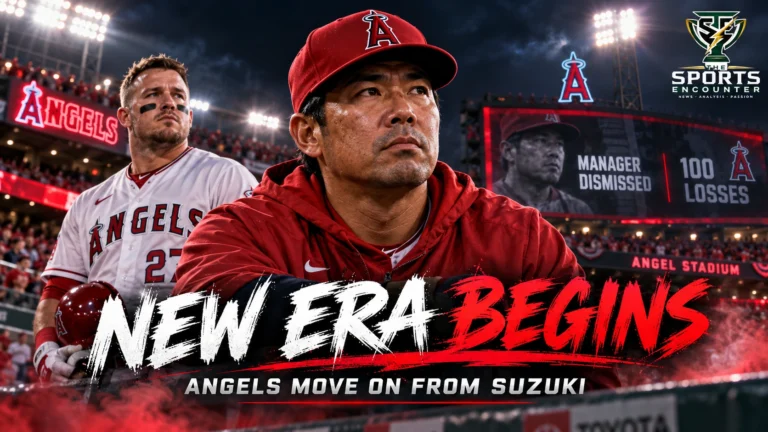
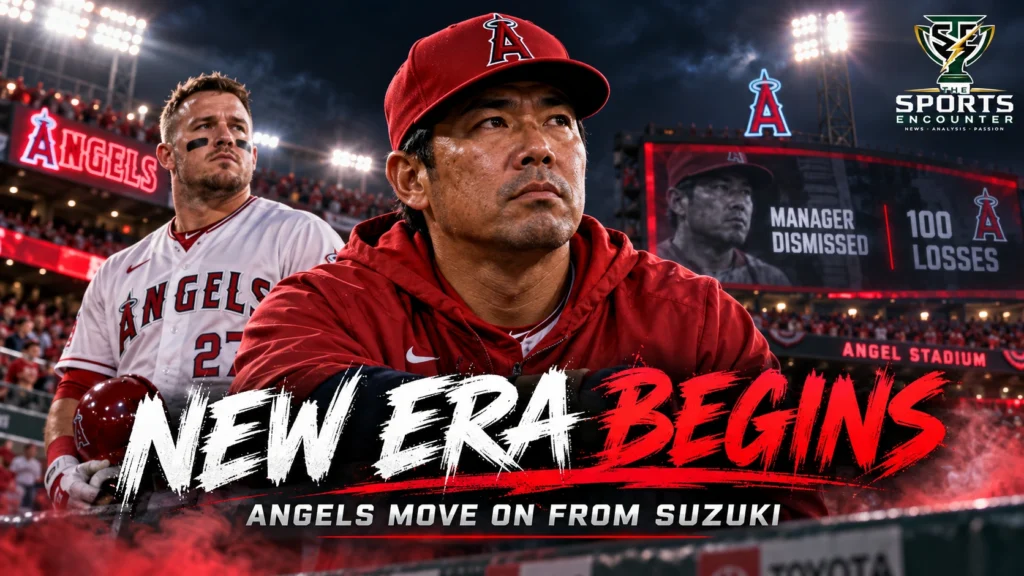
ANAHEIM, United States, October 21, 2026: Kurt Suzuki’s first season managing the Los Angeles Angels ended Wednesday with his dismissal, but the decision says considerably more about the franchise’s future than the 62-100 record that accompanied it. The Angels declined Suzuki’s contract option for 2027, ending his tenure after the first 100-loss season in club history. Incoming owner Kroenke Sports & Entertainment will help select a new manager and coaching staff as part of a sweeping organizational reset following its $4 billion agreement to purchase the franchise from Arte Moreno.
The timing makes Suzuki’s departure especially revealing. Just weeks earlier, acting general manager John Mozeliak had publicly supported retaining the former All-Star catcher, praising his communication, leadership and improvement throughout a difficult debut season. Yet the Angels have gone 11 consecutive seasons without a winning record and 12 without reaching the playoffs. With the previous general manager already dismissed, the coaching staff disrupted and the ownership transfer approaching completion in early 2027, Suzuki became another casualty of a franchise attempting to rebuild its leadership before it can realistically rebuild its fortunes.
Why Did the Los Angeles Angels Fire Kurt Suzuki After One Season?
The immediate explanation is clear: the Angels finished last in the American League West with a 62-100 record and declined the option that would have kept Suzuki in charge for another season.
But the decision also belongs to a larger change in ownership and organizational direction.
Story at a glance
Why Did the Los Angeles Angels Fire Kurt Suzuki After One Season?
The immediate explanation is clear: the Angels finished last in the American League West with a 62-100 record and declined the option that would have kept Suzuki in charge for another season.
From September Support to October Dismissal: How the Angels Changed Course
One of the more surprising aspects of Suzuki’s exit is that his immediate supervisor had recently argued for keeping him.
The Angels’ First 100-Loss Season Exposed a Problem Much Older Than Suzuki
Suzuki inherited an unsuccessful team. That context does not excuse the 2026 results, but it matters when deciding how much responsibility belongs to a first-year manager.
A $4 Billion Ownership Change Makes the Next Managerial Appointment Different
The Angels’ agreement to be acquired by Kroenke Sports & Entertainment is central to understanding the timing.
Seven Managers in Nine Seasons: Why the Angels Need More Than Another New Voice
Managerial instability has become one of the defining characteristics of the Angels since longtime manager Mike Scioscia departed after the 2018 season.
On October 21, Mozeliak confirmed that the club would begin searching for a new manager and coaching staff in coordination with Kroenke Sports & Entertainment, the group that has agreed to purchase the Angels from Moreno.
Suzuki was offered an opportunity to remain with the organization in a special assistant role. His departure from the dugout therefore does not necessarily mean the Angels want to sever their relationship with him entirely.
The distinction offers an important clue about how the organization views his contributions. Suzuki’s leadership and familiarity with the players remain valued, even as the franchise seeks a different managerial direction.
Kurt Suzuki’s Angels Dismissal: The Essential Facts
| Question | Confirmed Answer |
|---|---|
| Who was dismissed? | Kurt Suzuki, Los Angeles Angels manager |
| Decision date | October 21, 2026 |
| Time as manager | One season |
| 2026 record | 62 wins, 100 losses |
| AL West finish | Last place |
| Contract decision | 2027 option declined |
| Replacement | Not announced |
| Other role offered? | Special assistant |
| Decision-making organizations | Angels leadership and Kroenke Sports & Entertainment |
For current organizational announcements and future appointments, readers can follow the Los Angeles Angels’ official MLB website.
From September Support to October Dismissal: How the Angels Changed Course
One of the more surprising aspects of Suzuki’s exit is that his immediate supervisor had recently argued for keeping him.
On September 28, shortly after the season ended, Mozeliak spoke positively about Suzuki’s performance despite the historic number of defeats.
He credited Suzuki’s relationships with players, ability to communicate and improvement in game management.
Mozeliak also acknowledged that the decision would ultimately require direction from the incoming ownership group.
That qualification now appears particularly important.
By October 21, the Angels had declined Suzuki’s option and begun the search for a replacement.
The available reporting does not establish the private discussions that produced the final decision. It does establish that incoming ownership had an important role in determining the club’s direction.
How the Angels Reached Their 2027 Leadership Reset
| Date | Development | Consequence |
|---|---|---|
| October 2025 | Kurt Suzuki appointed manager | Former catcher receives first managerial opportunity |
| June 2026 | Perry Minasian dismissed | John Mozeliak takes interim control of baseball operations |
| August 2026 | Major pitching-coach changes | Further disruption to the on-field leadership structure |
| September 1, 2026 | Kroenke Sports & Entertainment agrees to buy Angels | Incoming ownership becomes a major factor in future decisions |
| September 27, 2026 | Angels finish 62-100 | First 100-loss campaign in franchise history |
| September 28, 2026 | Mozeliak expresses support for Suzuki | Manager’s future remains subject to ownership direction |
| October 21, 2026 | Suzuki’s option declined | Search begins for new manager and coaching staff |
| Early 2027 (expected) | Ownership transfer completed | New leadership structure can take fuller shape |
The sequence shows why Suzuki’s dismissal should be examined alongside the departure of Minasian and the impending change in ownership.
Minasian hired Suzuki after the 2025 season, describing him as the right person to lead the club. Less than a year later, neither man remained in his original position.
The Angels were already restructuring baseball operations months before Suzuki’s departure. The managerial change extends that process.
The Angels’ First 100-Loss Season Exposed a Problem Much Older Than Suzuki
Suzuki inherited an unsuccessful team. That context does not excuse the 2026 results, but it matters when deciding how much responsibility belongs to a first-year manager.
The Angels had already completed 10 consecutive losing seasons before Suzuki took charge.
In 2024, they finished 63-99, then improved to 72-90 in 2025. The 2026 campaign reversed that progress and established a new low.
Angels Regular-Season Results: 2024-2026
| Season | Wins | Losses | Win Percentage | Change in Wins |
|---|---|---|---|---|
| 2024 | 63 | 99 | .389 | Baseline |
| 2025 | 72 | 90 | .444 | +9 |
| 2026 | 62 | 100 | .383 | -10 |
Source: Official MLB season records. TSE calculated winning percentages as wins divided by 162 games, rounded to three decimal places, and year-over-year changes in wins.
The Angels won only 38.3% of their games in 2026. Their winning percentage fell by approximately 6.2 percentage points from the previous season.
Across the three seasons, they won 197 of 486 games, a combined winning percentage of approximately .405.
That longer comparison is more revealing than evaluating Suzuki’s single season in isolation.
It shows an organization struggling to sustain even modest improvement. The Angels improved by nine victories in 2025 and then lost that entire gain, plus another game, in 2026.
At the same time, a manager remains accountable for preparation, game decisions, communication and team performance. Suzuki’s inexperience and the disappointing final record made his continued employment difficult to defend purely on results.
The question is whether replacing the manager will address the problems that persisted before he arrived.
A $4 Billion Ownership Change Makes the Next Managerial Appointment Different
The Angels’ agreement to be acquired by Kroenke Sports & Entertainment is central to understanding the timing.
The ownership group, associated with Stan Kroenke, is preparing to take control from Moreno in a transaction valued at approximately $4 billion.
The sale was agreed in September, with completion expected in early 2027.
The prospective change arrives after years of disappointment during which the Angels have struggled to build a winning team despite possessing one of baseball’s most recognizable stars in Mike Trout.
Incoming ownership now has the opportunity to influence the franchise’s organizational structure, including baseball operations, coaching, player development and the resources available for future roster construction.
Those decisions will carry considerably more weight than choosing a new face for the dugout.
What the Angels’ New Ownership Must Resolve
| Area | Current Position | Unresolved Question |
|---|---|---|
| Ownership | KSE purchase agreed | When will the transaction formally close? |
| Baseball operations | John Mozeliak serving in interim leadership | Who will hold permanent decision-making authority? |
| Manager | Suzuki’s 2027 option declined | Who will lead the team next season? |
| Coaching staff | New search announced | Which existing coaches, if any, will return? |
| Player development | Organizational restructuring under way | How will prospects be developed and integrated? |
| Roster | Coming off 62-100 season | Which players form the foundation of the next competitive team? |
TSE analysis: The unresolved questions are based on the publicly reported organizational position as of October 21. They are not announcements of decisions already taken.
These questions also illustrate the potential weakness of appointing a manager before establishing the rest of the baseball leadership structure.
A new manager needs clarity about player development priorities, coaching philosophy, roster decisions and the level of authority delegated to the dugout.
If those responsibilities remain unsettled, another coaching appointment could become part of the same cycle of change that has characterized recent Angels seasons.
Seven Managers in Nine Seasons: Why the Angels Need More Than Another New Voice
Managerial instability has become one of the defining characteristics of the Angels since longtime manager Mike Scioscia departed after the 2018 season.
Brad Ausmus, Joe Maddon, Phil Nevin, Ron Washington and Suzuki have all occupied the job, with interim appointments adding to the turnover.
Suzuki was hired in part because of his understanding of the organization and his relationships with players.
He had played the final two seasons of his career for the Angels in 2021 and 2022 before serving as a special assistant in the front office.
His transition from player to executive adviser and then manager was designed to provide leadership familiar with the club’s personnel and culture.
Yet the Angels’ problems proved far too substantial for that familiarity alone to deliver a winning season.
The next appointment will be the seventh managerial change, including interim leadership, since Scioscia’s departure.
This history raises an important test for the incoming owners. Can they establish a coherent baseball strategy that survives individual managerial changes?
The strongest organizations usually align the manager, general manager, player-development leadership and coaching staff around consistent operating priorities.
Whether the Angels can build that alignment will become apparent through their next appointments and offseason decisions.
Mike Trout’s Support for Suzuki Reveals the Human Cost of Another Reset
For Mike Trout, Suzuki’s dismissal also means losing a manager who had earned his trust.
Trout and Suzuki were teammates during the latter’s final two playing seasons with the Angels.
That history helped establish a relationship built on shared experience and familiarity with the organization.
After the 2026 campaign, Trout publicly praised Suzuki for his communication and his willingness to allow the veteran outfielder to return to center field.
Trout’s comments were especially meaningful because 2026 offered a rare improvement in his availability.
He appeared in 142 games, his highest total in a decade, and produced 22 home runs, 54 RBIs and a .803 OPS.
Those numbers were below the standards of Trout’s prime, but his ability to remain on the field was an encouraging development after several injury-disrupted seasons.
Suzuki’s leadership was one part of that season, although it would be inappropriate to attribute Trout’s improved availability solely to a managerial decision.
His departure now creates another adjustment for one of the franchise’s most important players.
Mike Trout’s 2026 Season at a Glance
| Statistic | 2026 Result |
|---|---|
| Games played | 142 |
| Batting average | .242 |
| On-base percentage | .382 |
| Slugging percentage | .421 |
| OPS | .803 |
| Home runs | 22 |
| RBIs | 54 |
| Runs scored | 86 |
| Stolen bases | 11 |
Source: Official MLB player and season reporting.
Trout remains a central figure in the Angels’ future planning. However, his individual production cannot compensate for every weakness across a 26-man roster.
The next manager will inherit the task of maximizing Trout’s contribution while developing enough supporting talent to reduce the organization’s dependence on its established star.
Could Kurt Suzuki Stay With the Angels in Another Role?
Yes. The organization has offered Suzuki a special assistant position.
That would represent a return to the type of front-office work he performed before becoming manager.
His experience as a major league catcher, familiarity with pitching staffs and established relationships throughout the organization could remain useful in player development and baseball operations.
However, an offer does not establish that Suzuki has accepted the position.
No final agreement on that proposed role had been confirmed at the time of this report.
The possibility nevertheless illustrates that the Angels’ managerial decision need not be interpreted as a complete rejection of Suzuki’s professional abilities.
His 16-year major league playing career included an All-Star selection in 2014 and a World Series championship with Washington in 2019.
Those achievements remain part of his baseball credentials even though his first managerial opportunity ended unsuccessfully.
Who Could Replace Kurt Suzuki as Angels Manager in 2027?
The Angels have not announced a successor.
They have indicated that the managerial search will be conducted alongside the broader effort to establish their future baseball leadership structure.
The most important issue is the type of manager the organization intends to appoint.
After experimenting with an inexperienced manager promoted from within, the Angels may consider candidates with established managerial credentials.
They could also favor someone familiar with modern analytics, player development, pitching infrastructure or organizational rebuilding.
Those are possible selection criteria, rather than confirmed requirements or evidence that a particular candidate has been approached.
Any specific shortlist should be treated cautiously until the Angels, an identified candidate or reliable reporting establishes genuine interest.
Why the Angels’ Rebuild Must Start Above the Dugout
The change from Suzuki to another manager will attract the most immediate headlines, but baseball operations may be the more consequential area of uncertainty.
Mozeliak was appointed in June after Minasian’s dismissal. His temporary role has included overseeing baseball decisions and helping refine the franchise’s strategy.
It also placed him in an unusual position: managing daily baseball operations while consulting with both the outgoing ownership group and prospective new owners.
That arrangement may be necessary during a transaction, but long-term organizational planning requires clarity about who has final authority.
The Angels must determine the responsibilities of their future general manager, the degree of investment in scouting and development, and the framework through which major player decisions are made.
The club also has questions about improving its pitching and run production, developing young talent and establishing a deeper roster.
Its prolonged absence from the playoffs suggests the weaknesses extend across several baseball operations functions.
Replacing Suzuki may create an opportunity to establish a new direction, but whether that opportunity produces improvement will depend on the decisions that follow.
What Happens Next for the Angels and Kurt Suzuki?
The Angels have several decisions ahead before the 2027 season.
The first is appointing a new manager and establishing the coaching staff that will work alongside him.
The second is resolving the permanent leadership of baseball operations and determining Mozeliak’s future with the organization.
The third is completing the ownership transaction and establishing the investment and competitive priorities of the incoming group.
Suzuki, meanwhile, must decide whether to accept the special assistant opportunity or pursue another role elsewhere in baseball.
The club’s offseason planning will also be influenced by the status of players such as Trout, Zach Neto and Reid Detmers, alongside developing prospects who could shape the next competitive Angels team.
Those roster decisions provide a more meaningful test of the new ownership’s ambitions than an optimistic introductory news conference.
The Sports Encounter Analysis: Suzuki Leaves, but the Angels’ Biggest Questions Remain
Kurt Suzuki was handed his first managerial opportunity with a team that had already spent a decade losing more games than it won.
Twelve months later, the Angels had reached an even lower point.
His dismissal is understandable on the basis of results. A 62-100 season, the worst in franchise history, invites scrutiny of everyone involved in assembling and managing the team.
But the larger sequence matters.
Since 2024, the Angels have changed managers, dismissed their general manager, reshaped their coaching structure and agreed to sell the franchise.
That scale of disruption makes the identity of Suzuki’s replacement important, but it also makes the structure supporting that replacement essential.
The incoming owners have an opportunity to establish a consistent decision-making system rather than another short-lived solution.
For Suzuki, the season represents a painful end to an opportunity he had pursued with evident enthusiasm. For the Angels, it marks another chapter in a much longer struggle to build a sustainable winner.
The next manager will inherit the same central challenge: turning a franchise with recognizable talent and considerable resources into a team capable of competing meaningfully in October.
Continue the MLB Story
 MLBWhy Brian Cashman Gets 30th Yankees Season After 17 Years Without a World Series Title
 MLBWorld Series Tickets Hit $3,107 as Milwaukee’s 44-Year Wait Creates a Super Bowl-Sized Price Gap with Tampa Bay
 MLBBob Uecker’s Family Salutes Brewers’ Historic World Series Return: ‘He’s Right Here Cheering Alongside Us’
Frequently Asked Questions About Kurt Suzuki and the Los Angeles Angels
Was Kurt Suzuki Fired by the Los Angeles Angels?
Yes. On October 21, 2026, the Angels announced that they had declined Suzuki’s contract option for 2027 and would appoint a new manager.
What Was Kurt Suzuki’s Record as Angels Manager?
Suzuki managed the Angels to a 62-100 record in 2026, his only season in charge.
Why Did the Angels Dismiss Kurt Suzuki?
The decision followed the franchise’s first 100-loss season and came during a major organizational restructuring associated with the agreed sale of the club to Kroenke Sports & Entertainment.
Who Will Replace Kurt Suzuki in 2027?
No replacement had been announced as of October 21, 2026. The Angels are beginning a search for a new manager and coaching staff.
Who Owns the Los Angeles Angels?
Arte Moreno remains the outgoing owner while Kroenke Sports & Entertainment prepares to complete its agreed purchase, expected in early 2027.
How Much Is the Angels Ownership Deal Worth?
The reported agreement is valued at approximately $4 billion.
How Long Have the Angels Missed the MLB Playoffs?
The Angels have not reached the postseason since 2014, completing 12 consecutive seasons without a playoff appearance through 2026.
Who Is Running Angels Baseball Operations?
John Mozeliak is serving in an interim baseball operations leadership role following the June 2026 dismissal of general manager Perry Minasian.
Will Kurt Suzuki Remain With the Angels?
The club has offered him a special assistant position, but his acceptance had not been confirmed at the time of the announcement.
What Is the Most Important Next Step for the Angels?
The club must resolve its managerial and baseball operations leadership positions while preparing for the expected ownership transition and rebuilding its roster for 2027.
Official References: MLB’s record of Suzuki’s appointment, MLB’s coverage of the Minasian dismissal, and MLB’s October 2026 Angels offseason assessment.