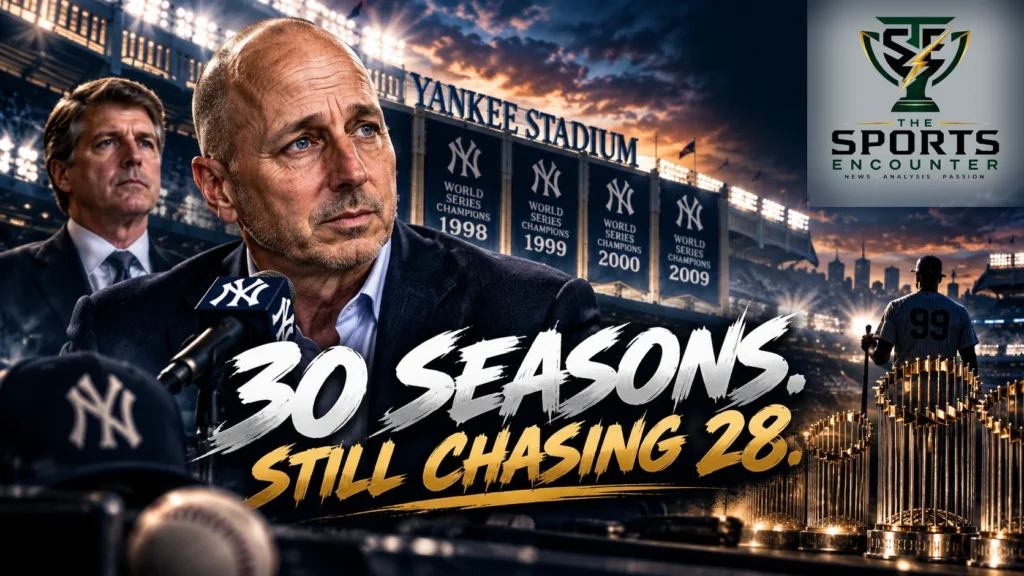
NEW YORK, United States, October 21, 2026: Brian Cashman will return as general manager of the New York Yankees for a remarkable 30th season in 2027 after confirming Wednesday that he has agreed to a new contract with the franchise. The agreement, which still requires final paperwork, extends one of baseball’s longest-running executive tenures despite another disappointing postseason exit and a World Series drought dating to 2009. For Yankees owner Hal Steinbrenner, continuity remains the preferred answer. For a demanding fan base, the pressing question is whether three decades of leadership can produce another championship.
Cashman, 59, has overseen four World Series titles, seven American League pennants and 15 AL East championships since taking charge in 1998. The Yankees have never finished a season with a losing record under his leadership. Yet they have now completed 17 consecutive seasons without winning the World Series, and their 2026 campaign ended with an American League Division Series elimination against the Tampa Bay Rays. More revealingly, New York scored 110 fewer runs than in 2025, exposing an offensive decline that injuries alone cannot make irrelevant to the franchise’s future planning.
Brian Cashman’s Yankees Contract: What Has Been Agreed?
Cashman confirmed his agreement during the Yankees’ end-of-season video news conference alongside Steinbrenner on October 21.
The general manager said the two sides had reached an agreement and needed to finish minor contractual details before everything became official.
Story at a glance
Brian Cashman’s Yankees Contract: What Has Been Agreed?
Cashman confirmed his agreement during the Yankees’ end-of-season video news conference alongside Steinbrenner on October 21.
Four World Series Titles and 17 Years Without Another: The Cashman Paradox
Few executives in modern baseball can match Cashman’s record of sustained regular-season success.
Why Hal Steinbrenner Is Keeping Cashman and Aaron Boone
Steinbrenner has chosen to preserve both principal figures in the Yankees’ baseball leadership structure.
The Yankees’ 110-Run Offensive Collapse Is the Number Cashman Cannot Ignore
The strongest argument for meaningful roster change comes from New York’s offensive statistics.
Why Tampa Bay’s ALDS Sweep Was So Damaging
The Yankees’ season ended against an opponent they knew extremely well.
“We’re locked and loaded,” Cashman said.
The comment made clear that both sides intend to continue their long relationship. However, the Yankees have not disclosed the new deal’s financial value or length.
That distinction matters. Cashman has agreed to remain in charge, but reporting an exact salary, contract duration or expiration date would be premature.
The Yankees’ official account of the agreement confirms his planned return and the outstanding documentation.
Brian Cashman Contract and Career: Key Facts
| Category | Verified Detail |
|---|---|
| General manager | Brian Cashman |
| Club | New York Yankees |
| Age | 59 |
| First season as GM | 1998 |
| Upcoming season | 2027, his 30th as GM |
| New agreement | Agreed, final wording pending |
| New contract value | Not disclosed |
| New contract duration | Not disclosed |
| World Series championships | 4 |
| American League pennants | 7 |
| AL East championships | 15 |
| Most recent World Series title | 2009 |
Cashman’s continued tenure provides the Yankees with front-office stability heading into an offseason that could involve significant roster decisions and wider uncertainty about Major League Baseball’s next collective bargaining agreement.
Four World Series Titles and 17 Years Without Another: The Cashman Paradox
Few executives in modern baseball can match Cashman’s record of sustained regular-season success.
Appointed general manager in February 1998 by George Steinbrenner, Cashman inherited an organization already positioned among baseball’s strongest teams. His first season ended with a World Series championship, followed by further titles in 1999 and 2000.
The Yankees returned to the summit in 2009, defeating the Philadelphia Phillies to claim their 27th championship.
Since then, however, baseball’s most decorated franchise has repeatedly reached October without securing another title.
That creates two legitimate ways to evaluate Cashman’s tenure.
His defenders can point to extraordinary consistency, postseason appearances in 24 of his first 29 seasons and a front office that has rarely allowed the Yankees to become uncompetitive.
His critics can reasonably ask why a franchise with such substantial resources, expectations and historical prestige has gone 17 seasons without a championship.
How Brian Cashman’s Yankees Career Has Developed
| Year or Period | Milestone | Significance |
|---|---|---|
| 1998 | Appointed general manager | Begins his leadership of baseball operations |
| 1998-2000 | Three straight World Series titles | Establishes an early championship dynasty |
| 2001 | American League pennant | Yankees reach another World Series |
| 2003 | American League pennant | Another championship opportunity ends short |
| 2009 | World Series championship | Fourth title of Cashman’s tenure |
| 2010-2023 | No World Series appearance | Extended period of postseason frustration |
| 2024 | American League pennant | Yankees return to the World Series |
| 2025 | ALDS elimination | Toronto ends New York’s championship bid |
| 2026 | ALDS elimination | Tampa Bay ends another 90-win campaign |
| 2027 | 30th GM season planned | Another opportunity to end the title drought |
It would be misleading to dismiss the entire post-2009 period as failure. The Yankees have remained consistent contenders, and their 2024 pennant demonstrated that the organization can still navigate the American League playoffs.
Yet regular-season success and championship success are different measures of performance. Cashman’s legacy is increasingly defined by the distance between them.
Why Hal Steinbrenner Is Keeping Cashman and Aaron Boone
Steinbrenner has chosen to preserve both principal figures in the Yankees’ baseball leadership structure.
Cashman will return as general manager, while Aaron Boone is expected to manage the club in 2027, his 10th season in charge and the final year of his current contract.
The owner defended their leadership during Wednesday’s news conference and argued that the roster had the quality to compete for a World Series championship.
He pointed to the injuries, roster disruptions and difficult circumstances New York navigated throughout the season.
There is substance behind that position. The Yankees won 93 games, reached the playoffs for the ninth time in 10 years and defeated the Boston Red Sox in the Wild Card Series.
But the counterargument is equally substantial: both Cashman and Boone have remained in prominent positions while the Yankees have failed to capture the ultimate prize.
Boone has taken the team to one World Series, in 2024, but has yet to win a championship as manager.
Steinbrenner’s decision therefore reflects confidence in the leadership group’s ability to construct and manage a contender. It also raises the stakes for what that group accomplishes next.
The Yankees’ 110-Run Offensive Collapse Is the Number Cashman Cannot Ignore
The strongest argument for meaningful roster change comes from New York’s offensive statistics.
The Yankees scored 849 runs during the 2025 regular season. In 2026, that number fell to 739.
That represents 110 fewer runs, a decline of approximately 13%.
Home run production also dropped from 274 to 223, while the team’s batting average fell from .251 to .235 and its on-base percentage declined from .332 to .311.
Those reductions illustrate a significant change in the team’s attacking output.
Original TSE Comparison: Yankees Offense in 2025 vs 2026
| Statistic | 2025 | 2026 | Change |
|---|---|---|---|
| Runs scored | 849 | 739 | -110 (-13.0%) |
| Home runs | 274 | 223 | -51 (-18.6%) |
| Batting average | .251 | .235 | -.016 |
| On-base percentage | .332 | .311 | -.021 |
| Regular-season wins | 94 | 93 | -1 |
TSE calculation: Percentage changes compare the 2026 totals against 2025. Runs: (739 – 849) / 849 × 100 = -13.0%. Home runs: (223 – 274) / 274 × 100 = -18.6%. Batting average and on-base percentage are shown as absolute changes. The 2026 regular-season record was 93-68.
The comparison reveals a critical detail: New York’s win total barely changed even though its offense declined substantially.
That suggests the team retained strengths elsewhere, particularly in run prevention and pitching. The Yankees allowed 601 runs in 2026, finishing with a positive run differential of 138.
They were still a successful regular-season team by most ordinary measures.
But their offensive decline became especially damaging in October, when playoff pitching reduced opportunities and individual mistakes carried greater consequences.
Why Did the Yankees’ Offense Decline?
Injuries played an important role.
Aaron Judge missed substantial time because of rib and calf injuries and was unavailable for the postseason. Giancarlo Stanton also faced injury interruptions, reducing the stability of New York’s middle-order production.
Yet attributing the entire decline to injuries would leave important roster questions unanswered.
Cashman must consider how much dependable offensive production the Yankees can generate when their biggest stars are unavailable or less effective.
That requires examining lineup depth, contact quality, on-base ability, positional balance and the contributions expected from younger players.
The team’s regular-season record proves that it retained considerable competitive strength. The postseason once again demonstrated that strength did not translate into enough timely offense.
Why Tampa Bay’s ALDS Sweep Was So Damaging
The Yankees’ season ended against an opponent they knew extremely well.
After beating Boston in the Wild Card Series, New York faced the Tampa Bay Rays in the AL Division Series.
The Rays swept the series, winning three consecutive games and ending another promising Yankees season.
The offensive performance was particularly troubling. New York managed just five runs across the three-game series, hitting .130 as a team with two home runs.
Its pitching staff, by comparison, recorded a 2.52 ERA.
Those figures reveal the central postseason imbalance.
Yankees’ 2026 ALDS: Pitching Strength vs Offensive Failure
| Measure | Yankees’ ALDS Performance | Why It Matters |
|---|---|---|
| Opponent | Tampa Bay Rays | Division rival |
| Series result | Lost 0-3 | Eliminated without winning a game |
| Total runs | 5 | 1.67 per game |
| Team batting average | .130 | Severe offensive struggles |
| Home runs | 2 | Limited power production |
| Pitching ERA | 2.52 | Relatively effective run prevention |
TSE calculation: Five runs divided by three games equals 1.67 runs per game. Series statistics are based on contemporary postseason reporting.
The difference between the pitching and hitting numbers is difficult to overlook.
New York’s pitchers gave the team a reasonable opportunity to compete. Its offense failed to generate enough production to extend the series.
The series did not turn on one defensive mistake, one controversial managerial decision or one isolated bad inning. The Yankees struggled repeatedly to turn their opportunities into runs.
That places a significant part of the offseason responsibility on roster construction.
What Must Brian Cashman Fix Before the 2027 Season?
Cashman’s return means the Yankees will approach their next roster decisions with continuity at the top of baseball operations.
Several issues require attention, although no specific signing or trade should be treated as inevitable.
1. Reduce the Offense’s Dependence on Aaron Judge
Judge remains the centerpiece of New York’s lineup, but his injury-interrupted 2026 season exposed the risks of relying too heavily on one superstar.
Cashman must evaluate whether the Yankees have enough consistent run producers elsewhere in the batting order.
2. Resolve the Center Field and Second Base Questions
Trent Grisham and Jazz Chisholm Jr. are among the players whose situations could reshape the Yankees’ offseason.
Uncertainty at center field and second base creates decisions about free agency, internal replacements and possible trades.
Any proposed solution will need to be assessed for its offensive contribution, defensive value and overall roster fit.
3. Protect the Pitching Foundation
New York’s rotation offers a stronger starting point.
The emergence of Cam Schlittler gives the organization another important young pitching asset, while its established starters provide valuable continuity.
Cashman must balance preserving that strength with finding more reliable offense.
4. Establish a Clear Plan With Aaron Boone
Boone’s return creates managerial continuity, but it also creates a new period of scrutiny.
With his contract currently due to expire after 2027, questions about the manager’s longer-term position are likely to continue unless the Yankees deliver meaningful postseason progress.
5. Prepare for Baseball’s Labor Uncertainty
The approaching expiration of MLB’s collective bargaining agreement introduces another potential complication.
A work stoppage could affect transactions, roster preparation and other offseason activities.
Cashman’s experience navigating baseball’s business environment may be particularly relevant, although the timing and outcome of future labor negotiations remain uncertain.
Is Brian Cashman’s Longevity a Strength or a Warning Sign?
Few executives in professional sports remain with the same organization long enough to encounter this kind of question after nearly three decades.
Cashman’s achievements are substantial. Four championships and consistent winning seasons provide a strong historical foundation.
But the Yankees operate under expectations shaped by a history unlike that of most other baseball teams.
A franchise with 27 World Series titles is unlikely to judge long-term success solely by playoff appearances and winning records.
The appropriate question is whether Cashman’s continued leadership gives New York the best chance to win another championship.
Steinbrenner evidently believes that it does.
The opposing interpretation is that the organization’s reliance on familiar leadership may have reduced its willingness to make more fundamental changes.
Both arguments have evidence behind them. The Yankees’ regular-season consistency supports continuity, while the championship drought justifies scrutiny.
Cashman’s next offseason should be evaluated against the specific shortcomings of the 2026 team rather than the assumption that either continuity or change automatically produces better results.
What Happens Next for the Yankees in 2027?
The immediate next step is to finalize Cashman’s contract documentation.
Attention will then turn to the Yankees’ offseason roster decisions, player health, potential departures and the organization’s approach to improving offensive production.
New York has demonstrated that it can build teams capable of winning more than 90 games.
Its next challenge is more precise: building an offense sufficiently resilient to survive injuries, withstand elite postseason pitching and support the team’s existing strengths.
For supporters following the broader baseball calendar, The Sports Encounter’s sports events calendar includes the 2026 World Series, scheduled to begin October 23.
The Yankees will be watching that championship from outside the competition for another year.
Cashman will return with the trust of ownership, a distinguished record and an unfinished ambition that has increasingly come to define the second half of his career.
Thirty seasons in charge would represent an extraordinary achievement. Whether the 30th brings the Yankees closer to a 28th World Series championship will determine how this latest extension is remembered.
Continue the MLB Story
 MLBAngels Fire Kurt Suzuki After Historic 100-Loss Season as $4bn Ownership Change Triggers a Bigger Rebuild
 MLBWorld Series Tickets Hit $3,107 as Milwaukee’s 44-Year Wait Creates a Super Bowl-Sized Price Gap with Tampa Bay
 MLBBob Uecker’s Family Salutes Brewers’ Historic World Series Return: ‘He’s Right Here Cheering Alongside Us’
Frequently Asked Questions About Brian Cashman and the Yankees
Has Brian Cashman Signed a New Yankees Contract?
Cashman confirmed on October 21, 2026, that he had reached an agreement to remain with the Yankees. Final contract wording was still being completed, and the deal had not been formally finalized.
How Long Has Brian Cashman Been Yankees General Manager?
Cashman has served as Yankees general manager since 1998. The 2027 MLB season will be his 30th in the position.
How Old Is Brian Cashman?
Cashman is 59 years old as of October 21, 2026.
How Much Is Brian Cashman’s New Contract Worth?
The Yankees have not disclosed the financial terms of Cashman’s new agreement.
How Many World Series Championships Has Cashman Won?
The Yankees have won four World Series championships during Cashman’s tenure as general manager: 1998, 1999, 2000 and 2009.
When Did the Yankees Last Win the World Series?
New York last won the World Series in 2009, defeating the Philadelphia Phillies.
Why Did the Yankees Keep Cashman After Another Playoff Exit?
Hal Steinbrenner continues to trust Cashman’s leadership and the competitiveness of the roster. The Yankees also have an established record of sustained regular-season success under his management.
Will Aaron Boone Manage the Yankees in 2027?
Yes. Boone is expected to return for his 10th season as Yankees manager, currently the final season of his existing contract.
What Happened to the Yankees in the 2026 Playoffs?
The Yankees beat the Boston Red Sox in the Wild Card Series before being swept 3-0 by the Tampa Bay Rays in the American League Division Series.
What Is the Yankees’ Biggest Challenge for 2027?
Improving offensive consistency, addressing important roster decisions and converting strong regular-season performances into deeper postseason success are among the franchise’s principal challenges.
Official Sources: The Yankees’ announcement on Cashman’s return, the October 21 leadership news conference, and the Yankees’ official standings and season record.