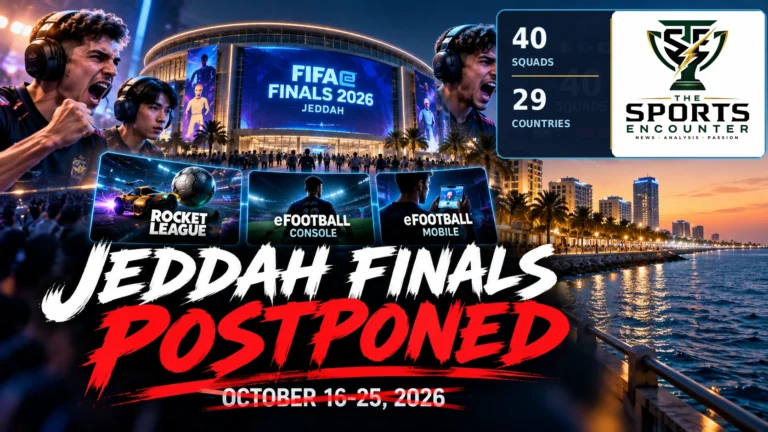
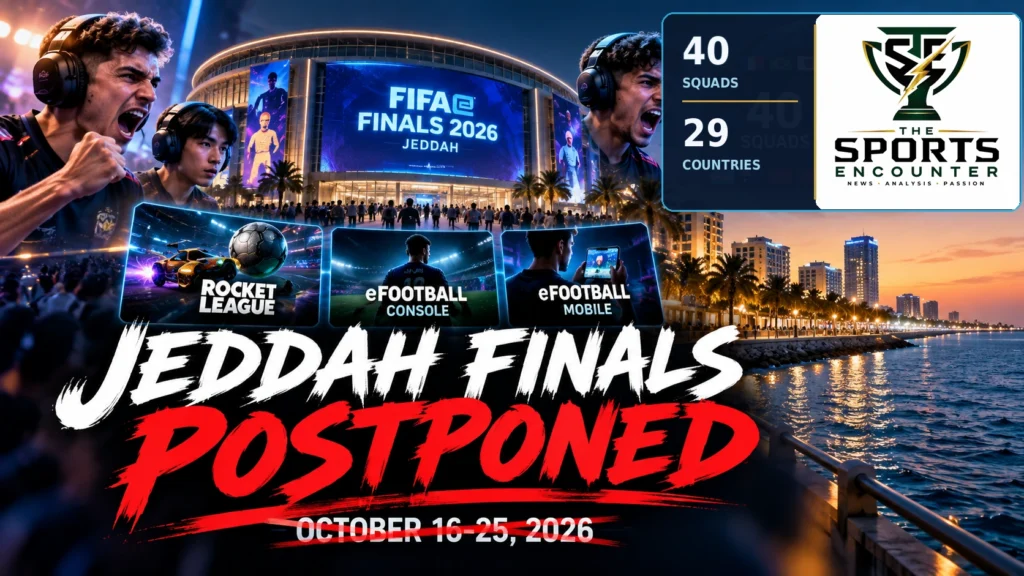
JEDDAH, Saudi Arabia, October 15, 2026: FIFA and the Saudi Esports Federation have postponed the FIFAe Finals 2026, just before the tournament’s scheduled October 16 opening in Jeddah, after escalating regional security concerns disrupted preparations for three international esports world championships. The decision affects a competition involving 40 qualified squads representing 29 countries, with the world’s leading national teams preparing to contest titles in Rocket League, eFootball Console and eFootball Mobile. No replacement dates or alternative host city have been announced.
The postponement follows deadly attacks in Saudi Arabia, including an October 10 strike on Riyadh’s international airport, and comes after Japan and Brazil withdrew their esports teams over safety concerns. FIFA’s official notice, dated October 14, attributes the decision to regional developments affecting tournament logistics. The disruption extends beyond one event: the Six Kings Slam tennis exhibition has already moved to December, Saudi Pro League fixtures have been rescheduled, and the Asian Football Confederation is assessing the circumstances surrounding the 2027 Asian Cup. For the FIFAe competitors who completed months of qualification, the immediate question is whether their earned places, competitive preparations and championship opportunities can be preserved.
Why Has FIFA Postponed the FIFAe Finals 2026 in Jeddah?
FIFA and the Saudi Esports Federation announced that the tournament could not proceed as originally scheduled following an assessment of recent developments in the region and their consequences for the operational arrangements required to stage the event.
The official FIFAe postponement announcement is dated October 14, 2026. International news agencies, including Reuters, reported the development on October 15.
Story at a glance
Why Has FIFA Postponed the FIFAe Finals 2026 in Jeddah?
FIFA and the Saudi Esports Federation announced that the tournament could not proceed as originally scheduled following an assessment of recent developments in the region and their consequences for the operational arrangements required to stage the event.
What Happened in Saudi Arabia Before FIFA’s Decision?
The immediate context is a series of attacks affecting Saudi Arabia, including a deadly strike on King Khalid International Airport in Riyadh on Saturday, October 10.
Forty Squads and Three World Titles: What Exactly Has Been Postponed?
The FIFAe Finals are international esports championships organized within FIFA’s competitive gaming ecosystem.
Which Countries Qualified for FIFAe Finals 2026?
FIFA published the qualified field after the continental championships concluded in September.
Japan and Brazil Withdrew Before the FIFAe Finals Were Postponed
One of the most consequential developments occurred before the tournament-wide decision.
That distinction matters because the decision was made public before the tournament’s scheduled October 16 opening. This was not a competition suspended after matches had begun.
Organizers had planned 10 calendar days of international esports competition, culminating in three world championship titles.
The postponement notice confirms four important facts:
- The FIFAe Finals 2026 will not take place during their originally scheduled October 16-25 window.
- Jeddah was the selected Saudi Arabian host city.
- FIFA and the Saudi Esports Federation made the postponement decision jointly.
- Further information about the event will be communicated later.
The announcement does not identify a new tournament date, confirm another venue or establish whether the event will remain in Saudi Arabia.
It also does not announce cancellation of the 2026 championships.
The accurate status, as of October 15, is postponed with replacement arrangements pending.
What Happened in Saudi Arabia Before FIFA’s Decision?
The immediate context is a series of attacks affecting Saudi Arabia, including a deadly strike on King Khalid International Airport in Riyadh on Saturday, October 10.
Reuters reported that at least 12 people were killed and more than 300 injured in that attack. Yemen’s Houthi movement claimed responsibility.
The casualty figures reflect the reporting available at that stage and should not be treated as a final verified total. Other contemporary accounts reported different death tolls as information developed.
The loss of life and injuries are the most serious consequences of the violence. The disruption to international sporting events is a separate operational consequence of the deteriorating security environment.
Jeddah, the FIFAe host city, is distinct from Riyadh, where the airport attack occurred.
FIFA’s statement did not say that the planned esports venue in Jeddah had been attacked. Nor did it attribute the postponement to damage at a specific tournament facility.
Instead, organizers identified the effect of regional developments on the logistics required to operate the championship.
For international competitions, those arrangements extend beyond the arena itself.
National delegations must travel to the host country. Players, coaches, technical officials, competition administrators, production crews and broadcasters depend on transportation, accommodation, equipment, communications and safe access to competition facilities.
The ability to deliver all those services matters when multiple world championships are due to begin within days.
FIFA has not published a detailed operational breakdown identifying which individual arrangements could no longer be completed.
It would therefore be premature to identify one airport, one flight route or one venue problem as the sole reason for the decision.
Forty Squads and Three World Titles: What Exactly Has Been Postponed?
The FIFAe Finals are international esports championships organized within FIFA’s competitive gaming ecosystem.
They are distinct from the conventional FIFA World Cup contested by national soccer teams on physical pitches.
The 2026 finals were designed to bring together leading national representatives across three separate gaming competitions.
| Championship | Qualified Squads | Original Competition Window | Status |
|---|---|---|---|
| FIFAe World Cup featuring eFootball Console | 12 | October 16-23 | Postponed |
| FIFAe World Cup featuring eFootball Mobile | 12 | October 16-23 | Postponed |
| FIFAe World Cup featuring Rocket League | 16 | October 20-25 | Postponed |
| Total | 40 | October 16-25 | New dates unconfirmed |
Source: FIFAe’s published qualification records and original competition schedule. These are the superseded tournament dates, not a revised schedule.
Although the competition contains 40 squad entries, the number of distinct participating countries is smaller because some national associations qualified in more than one gaming discipline.
FIFA had confirmed 29 unique countries in the final field.
The difference between countries and entries is important.
Counting 40 entries as 40 separate nations would incorrectly inflate the tournament’s geographic participation.
The event also represented the conclusion of a much larger international qualification process.
More than 120 countries participated in the wider 2026 FIFAe ecosystem, with regional competitions determining which national squads would reach the final stage.
That means the postponement affects the final destination of a competitive season that had already progressed through its selection and qualification phases.
Which Countries Qualified for FIFAe Finals 2026?
FIFA published the qualified field after the continental championships concluded in September.
The lineup brought together established esports powers, emerging national teams and several countries competing across multiple disciplines.
The official FIFAe qualified-nations announcement identifies the 29 countries and their 40 entries.
Rocket League: Sixteen National Teams
The Rocket League competition included Australia, Brazil, Chile, Czechia, England, France, Germany, Italy, Jordan, Morocco, the Netherlands, Oman, Puerto Rico, Saudi Arabia, South Africa and the United States.
That field combined defending champions France with several nations that had advanced through the continental qualification process.
eFootball Console: Twelve National Teams
Brazil, Indonesia, Italy, Japan, Jordan, Madagascar, Morocco, Mexico, Peru, Poland, Saudi Arabia and Türkiye had qualified for the Console championship.
Poland entered the tournament cycle as defending world champions.
eFootball Mobile: Twelve National Teams
The Mobile lineup consisted of India, Japan, Jordan, Thailand, Argentina, Brazil, Egypt, Tunisia, Mexico, Saudi Arabia, Georgia and Türkiye.
Thailand entered as defending champions.
These were the originally announced qualification lists. They should not be mistaken for a newly reconfirmed field after the postponement or the reported withdrawals of Japan and Brazil.
Japan and Brazil Withdrew Before the FIFAe Finals Were Postponed
One of the most consequential developments occurred before the tournament-wide decision.
Reuters reported that Japan and Brazil withdrew their esports teams on October 10 after assessing the situation in Saudi Arabia.
Both countries had already qualified for more than one FIFAe competition.
| Country | Originally Qualified Disciplines | Reported Development |
|---|---|---|
| Japan | eFootball Console and eFootball Mobile | National esports withdrawal reported October 10 |
| Brazil | Rocket League, eFootball Console and eFootball Mobile | National esports withdrawal reported October 10 |
The two countries accounted for five places in the originally published 40-entry field.
That figure describes their scheduled representation across the three disciplines, not an officially confirmed number of forfeited or permanently vacated qualification slots.
FIFA has not publicly confirmed how the postponement affects the eligibility of the withdrawn teams.
It has also not announced whether the original qualification places will automatically remain valid for a future staging.
Those are significant unresolved questions.
If the event returns on new dates, organizers will need to establish the participating field and communicate how the original qualification results are treated.
Whether Japan or Brazil would reconsider participation under revised arrangements remains unconfirmed.
What Happens to the Defending FIFAe World Champions?
Three national teams entered the 2026 season defending titles won in December 2025.
| Competition | 2025 World Champion | Original 2026 Opportunity |
|---|---|---|
| Rocket League | France | Defend the title against a 16-team field |
| eFootball Console | Poland | Defend the title against 11 other qualified nations |
| eFootball Mobile | Thailand | Defend the title against 11 other qualified nations |
Their 2025 titles remain unaffected by the announcement.
However, the schedule for their next world championship defense has become uncertain.
This distinction matters for players and national esports organizations.
Qualification and preparation take place over many months. Competitive gaming also develops through changing player form, team combinations, training schedules and strategic adjustments.
A postponement may alter the preparation period and the conditions under which a qualified squad eventually competes.
How extensively that happens will depend on the replacement dates, the availability of participating teams and any rules subsequently issued by FIFAe.
There is currently no verified basis to suggest that the defending champions will lose their titles or that the 2026 competition has been abandoned permanently.
Why the Original October 16-25 Schedule Cannot Simply Be Carried Forward
The published FIFAe program was structured around a sequence of group matches, knockout rounds and championship finals.
Both eFootball disciplines were scheduled to begin on October 16, with group-stage matches continuing on October 17.
The quarterfinals were planned for October 18, followed by semifinals and finals on October 23.
Rocket League was due to begin its group stage on October 20, with later elimination matches culminating in a world champion on October 25.
| Original Date | Planned Activity | Current Position |
|---|---|---|
| October 16-17 | eFootball Console and Mobile group stages | Postponed |
| October 18 | eFootball quarterfinals | Postponed |
| October 20-22 | Rocket League group stages | Postponed |
| October 23 | Both eFootball championships decided | Postponed |
| October 24-25 | Rocket League knockout rounds and final | Postponed |
The postponement does not establish that those individual dates will be shifted by an identical number of days or weeks.
Organizers may eventually announce a replacement competition window, but no such arrangement had been confirmed by October 15.
FIFA’s previously published tournament pages may continue showing the original schedule or ticket information.
Those original listings should not be interpreted as confirmation that the event will proceed on the superseded dates.
What Does the Postponement Mean for Players, National Federations and Ticket Holders?
The effects differ according to each group’s involvement.
Qualified competitors face uncertainty about when their next world championship matches will take place.
National federations must account for the availability of players, coaches and support personnel once a revised schedule is announced.
Commercial partners and broadcasters may need to review their production and promotional arrangements.
Ticket holders and traveling supporters require updated information about whether and when the event will take place.
| Stakeholder | Confirmed Situation | Outstanding Question |
|---|---|---|
| Qualified competitors | Original finals postponed | When will competition resume, and will qualification places be retained? |
| National esports associations | Original tournament dates no longer apply | How will squads and travel be organized for new dates? |
| Defending champions | 2025 titles remain established | When can the next title defense take place? |
| Ticket holders | Original event window postponed | What arrangements will apply to existing tickets? |
| Broadcasters and sponsors | Original staging plans disrupted | How will revised event commitments be managed? |
| Host organizers | FIFA and Saudi Esports Federation assessing next steps | Will Jeddah retain the event on replacement dates? |
These questions identify practical consequences and uncertainties rather than announcing financial losses, contract cancellations or refund policies that have not been verified.
FIFA’s postponement statement did not provide a confirmed ticket-refund procedure.
It also did not disclose contractual costs, compensation arrangements or the financial effect on participating national associations.
Why Jeddah’s Recent Sporting Success Makes the Decision Particularly Significant
Saudi Arabia had spent recent weeks hosting major regional sporting competitions, including Gulf Cup 27.
On October 6, the Saudi national soccer team defeated the United Arab Emirates 2-0 in Jeddah to win the Arabian Gulf Cup without conceding a goal during the tournament.
The Sports Encounter’s report on Saudi Arabia’s championship victory documented the conclusion of a successful on-field campaign at King Abdullah Sports City.
The buildup to that final also demonstrated how much international sporting events depend on travel coordination.
The UAE Football Association expanded its arrangements for traveling supporters from six charter aircraft to 12 as demand grew.
Our coverage of the Jeddah fan-flight operation illustrated the scale of the transport arrangements surrounding a major regional fixture.
Those earlier events do not establish that FIFAe could have proceeded safely under the conditions prevailing on October 15.
They provide a useful contrast: the kingdom had recently completed a significant international sporting event, while organizers now face a substantially different regional security situation.
The Gulf Cup final brought together soccer teams, supporters and officials. FIFAe had a different competition structure involving multiple national gaming delegations, three competitive disciplines and a longer championship window.
The original Gulf Cup final preview also examined the importance of stadium arrangements, international supporters and player preparation in Jeddah.
For major event organizers, successful delivery of one tournament cannot remove the need to reassess conditions before another begins.
Six Kings Slam Also Moves as Saudi Arabia’s Sporting Calendar Faces Disruption
The FIFAe postponement is not an isolated decision.
Saudi Arabia’s Six Kings Slam tennis exhibition, originally scheduled for October, has been rescheduled for December 27-30.
The event was due to feature leading men’s players, including Carlos Alcaraz and Novak Djokovic.
Its revised timing introduces questions about player availability, preseason preparation and previously arranged broadcast commitments.
TSE’s detailed investigation of the Six Kings Slam postponement examines those consequences and the difference between confirmed replacement dates and unresolved participation arrangements.
The two competitions have reached different stages of rescheduling.
Six Kings Slam organizers have announced a replacement calendar window.
FIFAe organizers have not.
That is an important distinction for anyone following the sporting impact of the regional situation.
Saudi Pro League Fixtures Rescheduled as Domestic Football Also Adjusts
The country’s domestic soccer calendar has also experienced changes.
The Saudi Pro League rescheduled three Matchweek 9 fixtures amid the wider period of disruption.
Al Riyadh against Al Hilal and Al Ittihad against Al Shabab were moved to December 19, while Al Ahli against Al Nassr was moved to March 6, 2027.
The league cited mandatory rest requirements and logistical arrangements in explaining its scheduling changes.
Those stated reasons should not be replaced with an unsupported claim that a specific attack directly caused each individual postponement.
The changes nevertheless illustrate how competition schedules can be affected when travel, recovery and operational requirements become difficult to coordinate.
Al Nassr had recently moved level with the leaders on points after Cristiano Ronaldo scored his 980th career goal against Diriyah.
Our examination of Al Nassr’s title challenge provides context for the domestic competition whose schedule is now being adjusted.
Importantly, the Saudi Pro League stated that the remaining Matchweek 9 fixtures would proceed according to the previously announced schedule.
The rescheduling of three games therefore does not mean that the entire league has been suspended.
Could Saudi Arabia’s 2027 AFC Asian Cup Also Be Postponed?
Saudi Arabia is scheduled to host the AFC Asian Cup from January 7 to February 5, 2027.
The tournament is planned across Riyadh, Jeddah and Al Khobar.
The Asian Football Confederation has indicated that a postponement until 2028 remains a possibility if circumstances require it.
However, no final decision to move the competition had been announced as of October 15.
The AFC’s official tournament scheduling announcement establishes the originally confirmed dates and host cities.
There is a substantial difference between considering a contingency and formally changing an international tournament schedule.
The former indicates that organizers are assessing potential problems.
The latter requires an actual decision, revised dates and potentially extensive consultation with participating national associations and commercial stakeholders.
The Asian Cup’s scale also differs significantly from the FIFAe Finals.
It involves 24 national soccer teams and a much longer sequence of matches across several stadiums.
Its proximity to January 2027 makes future security and logistical assessments important, but the FIFAe postponement alone does not establish what the AFC will eventually decide.
What Does FIFA’s Decision Reveal About International Tournament Planning?
The central operational problem is that a major sporting event requires many separate systems to function together.
FIFAe had already completed its qualification process, confirmed national teams and published its competitive timetable.
Those preparations established the sporting structure of the finals.
They did not remove the requirement to assess whether the event could be delivered under changing conditions.
Continue the Soccer Story
 UEFA Europa LeagueEuropa League: Bournemouth Humiliate Milan as Sociedad Hit Six and Celtic Lose Again
 UEFA Europa LeagueEuropa League: Marseille Lose Again as Leverkusen and Ferencváros Stay Perfect; Juventus Held by Rennes
 SoccerHow Amateur Athletes Can Fit Strength Training Around Their Competitive Season
The distinction becomes clearer when the process is separated into three stages.
| Stage | What Had Been Established | Position on October 15 |
|---|---|---|
| Qualification | 40 squad entries representing 29 countries | Original field announced; status under revised arrangements unconfirmed |
| Tournament preparation | Jeddah venue plans and October 16-25 program | Original staging postponed |
| Future competition | Three world championship titles intended for 2026 | Replacement dates, location and final participation details pending |
FIFA’s obligation to communicate major decisions also exists within a broader environment of scrutiny surrounding international soccer governance.
In September, FIFA President Gianni Infantino proposed changes to consultation and independent oversight following controversy over a separate commercial initiative.
TSE’s examination of FIFA’s governance proposals documented the debate over how major decisions should be reviewed and communicated.
That earlier governance controversy was unrelated to the FIFAe postponement.
However, it illustrates why clear information from governing bodies matters whenever decisions affect national associations and other stakeholders.
In this case, the immediate outstanding information is practical rather than constitutional: when the event will return, where it will be held and which qualification and participation arrangements will apply.
What Are the Commercial Consequences of Postponing FIFAe Finals?
The original FIFAe schedule included live competition, ticketed spectators and plans for digital audience engagement.
A postponement can create scheduling questions for production companies, event sponsors, broadcasters, participating associations and venue operators.
However, FIFA has not disclosed a financial estimate for the postponement.
There is also no verified public figure establishing the event’s lost ticket revenue, additional travel costs or compensation obligations.
Any precise monetary claim would therefore require further evidence.
The commercial significance can still be understood through the broader economics of live sporting events.
Competitions depend on audiences, rights agreements, sponsors and the reliable delivery of scheduled programming.
The Sports Encounter recently examined that relationship in our analysis of the global sports media-rights market.
The figures discussed in that report concern the wider sports broadcasting industry and should not be presented as a direct valuation of FIFAe rights or postponement losses.
For FIFAe, the specific costs and revised commercial terms remain unknown.
Will FIFAe Finals 2026 Be Moved Online or to Another Country?
Neither alternative has been confirmed.
Online esports competition is technically possible in certain formats, but FIFA has not announced that the 2026 finals will switch to remote play.
Doing so would require decisions about competition administration, technical conditions, connectivity, fairness and the integrity of the championship format.
Those considerations are possible operational factors, not evidence that FIFA is preparing an online replacement.
Similarly, another host country might be considered in principle, but no official proposal or selection has been publicly established.
It would be premature to identify any alternative city as the likely new venue.
Saudi Arabia remains the originally announced host country, while the future venue and dates await further communication.
What Happens Next for FIFAe Finals 2026?
The next meaningful development will be an official announcement from FIFA or the Saudi Esports Federation setting out revised arrangements.
Several questions require answers before the status of the championships becomes clear.
- Will the finals still take place during 2026?
- Will Jeddah remain the host city?
- Will the original 40 squad entries be preserved?
- What happens to the national teams that withdrew before the postponement?
- Will the competition formats and originally drawn groups remain unchanged?
- What arrangements will apply to tickets and other existing event commitments?
- When will participating associations receive a revised tournament schedule?
These are unresolved matters rather than confirmed future decisions.
FIFA’s October 14 announcement does not establish a date for the next update.
For now, the most significant fact is that three world championships involving 40 qualified squad entries can no longer proceed as planned.
The broader sporting calendar in Saudi Arabia is facing similar challenges, but different organizers have made different decisions.
The Six Kings Slam has new dates. Several Saudi Pro League matches have been rescheduled. The AFC Asian Cup remains subject to monitoring and contingency discussions.
FIFAe has not yet announced its replacement plan.
The competitive consequence is substantial: national teams that successfully completed their route to the world finals must now await confirmation of when and where they can compete for the titles they qualified to pursue.
FIFAe Finals 2026 Postponement: Frequently Asked Questions
Have the FIFAe Finals 2026 Been Cancelled?
No. FIFA and the Saudi Esports Federation announced a postponement. They have not announced that the 2026 championships have been permanently cancelled.
Why Were the FIFAe Finals 2026 Postponed?
Organizers cited recent regional developments and their impact on the logistical arrangements required to stage the competition. The announcement followed deadly attacks affecting Saudi Arabia.
When Were the FIFAe Finals Originally Scheduled?
The tournament was originally planned for October 16-25, 2026, in Jeddah, Saudi Arabia.
When Will the Rescheduled FIFAe Finals Take Place?
No replacement dates had been announced as of October 15, 2026. FIFA said additional information would be communicated later.
How Many Teams Qualified for FIFAe Finals 2026?
FIFA confirmed 40 squad entries representing 29 different countries, spread across three championship disciplines.
Which Gaming Titles Are Included in FIFAe Finals?
The three competitions are Rocket League, eFootball Console and eFootball Mobile.
Which Countries Withdrew Before the Postponement?
Reuters reported that Japan and Brazil withdrew their national esports teams on October 10 after assessing the security situation. Their status for any rescheduled event has not been confirmed.
Who Are the Defending FIFAe World Champions?
France are defending Rocket League champions, Poland are defending eFootball Console champions, and Thailand are defending eFootball Mobile champions, following their 2025 victories.
Will FIFAe Finals 2026 Still Be Held in Saudi Arabia?
Jeddah remains the originally announced venue, but FIFA has not confirmed whether it will retain the location when replacement arrangements are announced.
Has the AFC Asian Cup 2027 Also Been Postponed?
No postponement had been confirmed as of October 15. The AFC Asian Cup remains scheduled for January 7-February 5, 2027, although the Asian Football Confederation has acknowledged the possibility of delaying it if circumstances require.