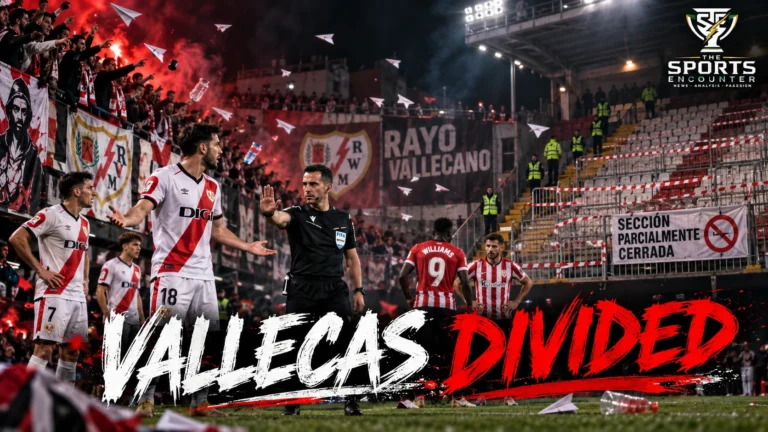
MADRID, Spain, October 14, 2026: Rayo Vallecano’s troubled return to the Estadio de Vallecas has ended with another closure, this time as punishment for the supporters’ protest that forced their La Liga match against Athletic Club to be abandoned. The Spanish Football Federation (RFEF) imposed a €6,000 fine and ordered the Madrid club to close one section of its stadium for its October 24 home game against Elche. The disciplinary ruling also warned that further disturbances could result in the entire stadium being shut.
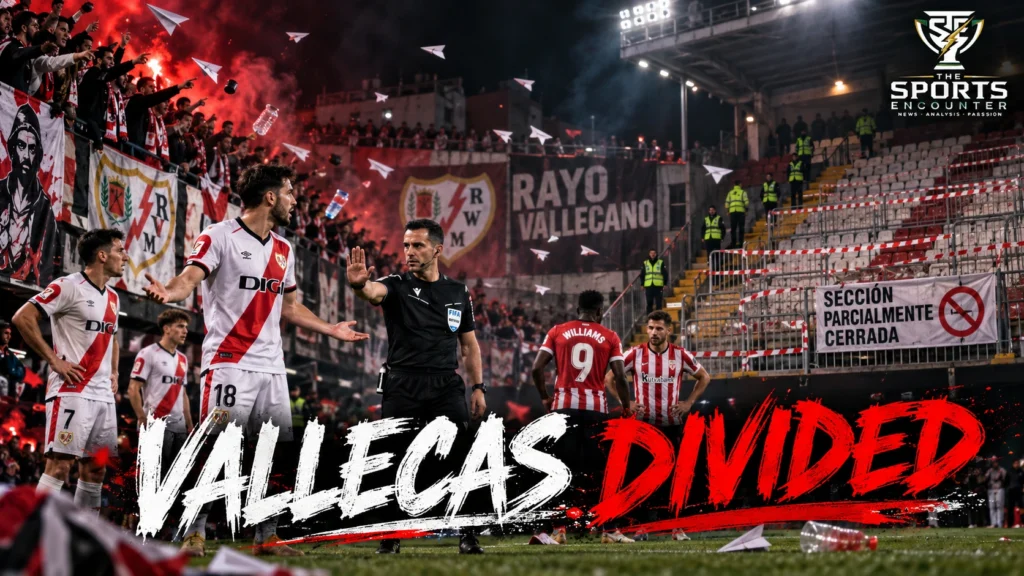
The punishment follows Saturday’s extraordinary scenes when Rayo supporters threw paper airplanes, rubber balls and other objects onto the field during a protest against club president Raúl Martín Presa. Referee José María Sánchez Martínez abandoned the game after approximately 25 minutes, with the score still 0-0. The match had been Rayo’s first league fixture at Vallecas this season after safety concerns forced three previous home games to be played in Leganés. The sanctions have now renewed the argument over stadium management, supporter grievances and who should be held responsible for a crisis that has extended well beyond one abandoned match.
What Punishment Has Rayo Vallecano Received?
The RFEF’s Disciplinary Committee announced three principal consequences on Wednesday, October 14.
First, Rayo Vallecano must pay a €6,000 fine.
Story at a glance
What Punishment Has Rayo Vallecano Received?
The RFEF’s Disciplinary Committee announced three principal consequences on Wednesday, October 14.
How Paper Airplanes Stopped Rayo vs Athletic Club After 25 Minutes
The October 10 encounter began amid unusual tension.
Why Are Rayo Vallecano Fans Protesting Against Raúl Martín Presa?
The protests cannot be explained solely by the decision to play three home games away from Vallecas.
The Vallecas Paradox: Fans Protest Stadium Safety, Then Face a Closure for Match Safety
The central contradiction in the latest controversy deserves closer examination.
What Rayo’s Three Butarque Matches Reveal About the Sporting Cost
Rayo’s temporary move to Leganés was not simply an administrative inconvenience.
Second, the club must close the stand located above the dressing rooms at the Estadio de Vallecas for one match. The measure is expected to apply when Rayo host Elche on October 24.
Third, the federation has formally warned Rayo that a repeat of similar disturbances could result in the total closure of its stadium.
The decision follows a finding that the club was responsible for a serious disturbance of order during the match, under Article 107.1 in conjunction with Article 15 of the RFEF Disciplinary Code.
The official RFEF Disciplinary Code establishes the regulatory framework for sanctions involving crowd disturbances and club responsibility.
Rayo Vallecano Stadium Ban: Key Facts
| Issue | Confirmed Position |
|---|---|
| Club | Rayo Vallecano |
| Disciplinary authority | Spanish Football Federation (RFEF) |
| Date of ruling | October 14, 2026 |
| Financial penalty | €6,000 |
| Stadium restriction | Partial closure for one match |
| Affected area | Stand above the dressing rooms |
| Scheduled affected fixture | Rayo Vallecano vs Elche, October 24 |
| Further warning | Possible complete stadium closure for repeat incidents |
| Abandoned match | Rayo Vallecano vs Athletic Club, October 10 |
| Score when abandoned | 0-0 |
| Resumption date | Not yet determined |
The committee also required Rayo to identify the specific affected seating sectors within 24 hours to facilitate enforcement.
Importantly, the decision is a partial closure. It does not order Rayo to stage the entire Elche match behind closed doors, nor does the reported disciplinary ruling impose an automatic deduction of league points.
How Paper Airplanes Stopped Rayo vs Athletic Club After 25 Minutes
The October 10 encounter began amid unusual tension.
Rayo were returning to the Estadio de Vallecas after spending their first three home league games at Butarque, the stadium of nearby Leganés.
Supporters had organized protests against Presa, whose presidency has faced persistent criticism from sections of the Rayo fanbase.
In the 13th minute, the protest moved directly onto the playing surface.
Paper airplanes and small rubber balls began landing on the field, forcing referee Sánchez Martínez to suspend play.
Stadium staff cleared the objects while announcements warned spectators that continued disruption could prevent the match from proceeding.
Play eventually resumed in the 24th minute.
Further objects were thrown almost immediately, triggering another intervention. After consultations involving match officials and security personnel, the referee abandoned the fixture.
According to the referee’s report reproduced in Spanish media, no thrown object struck a person. However, the repeated interruptions, including plastic bottles thrown during the later stages, prompted police officials to conclude that adequate conditions for continuing the match could not be guaranteed.
That distinction matters.
The abandonment followed an assessment of the risk created by repeated disturbances, rather than a confirmed injury caused by the objects.
La Liga’s official Rayo Vallecano vs Athletic Club match record lists the fixture as abandoned, with the score 0-0 and the interruption occurring around the 25th minute.
Why Did the Players Try to Calm the Crowd?
Rayo players Isi Palazón and Óscar Valentín approached supporters in an effort to prevent the situation from escalating.
They understood that continuing interruptions could end the game and create disciplinary consequences for the club.
But the demonstration had already developed into a direct challenge to Presa’s leadership.
The players were placed in a difficult position: attempting to protect the team’s opportunity to compete while recognizing that many supporters were expressing anger over issues extending far beyond that afternoon’s fixture.
Valentín subsequently appealed for dialogue among the parties involved, describing the wider situation as unsustainable.
The game never reached a normal competitive rhythm.
A fixture that should have celebrated Rayo’s return to Vallecas instead became another chapter in the dispute over the stadium and the club’s future.
Why Are Rayo Vallecano Fans Protesting Against Raúl Martín Presa?
The protests cannot be explained solely by the decision to play three home games away from Vallecas.
Presa has controlled Rayo Vallecano since 2011. Over that period, sections of the fanbase have repeatedly criticized his management of the club, relations with supporters, and the condition of important facilities.
The stadium dispute intensified those grievances during the summer of 2026.
An inspection identified serious deficiencies affecting the safety and condition of the Estadio de Vallecas. Madrid’s regional government subsequently suspended the club’s permission to use the ground while necessary issues were addressed.
That forced Rayo to relocate its early home fixtures to Butarque.
Supporters who expected to watch their team in their own neighborhood instead faced matches at another stadium, additional inconvenience, and disagreements over season-ticket arrangements.
For a club whose identity is closely connected to the working-class Madrid district of Vallecas, the relocation carried significance beyond travel time.
Rayo and Madrid’s Regional Government Disagree Over Responsibility
The dispute over the ground has involved conflicting interpretations of responsibility.
Supporters accuse Presa’s management of failing to maintain appropriate standards over an extended period.
Rayo’s leadership has challenged the regional authorities’ handling of the stadium situation and disputed the basis for continued restrictions after remedial inspections.
In a September 12 official club statement, Rayo maintained that a subsequent technical assessment established that the stadium met the requirements for hosting sporting events.
On September 14, Madrid’s regional government lifted the temporary suspension after a favorable follow-up audit showed substantial improvements.
However, reports indicated that the broader procedure concerning the stadium’s operating concession had not necessarily been resolved.
Those developments explain why the eventual reopening did not restore trust between the club’s leadership, government authorities and supporters.
The stadium had become operational again, but disagreements over how it reached that position remained.
The Vallecas Paradox: Fans Protest Stadium Safety, Then Face a Closure for Match Safety
The central contradiction in the latest controversy deserves closer examination.
Supporters have criticized the management of a stadium they believe should have been maintained to higher standards.
Their protest then contributed to a different safety problem when objects were repeatedly thrown onto the field.
The RFEF has now imposed another restriction on stadium attendance as a consequence of that disruption.
Three separate questions sit behind these events.
| Safety and Accountability Issue | Central Question | Current Position |
|---|---|---|
| Structural and operational stadium safety | Were the facilities fit to host spectators and matches? | Earlier deficiencies prompted restrictions; a favorable follow-up audit permitted reopening. |
| Matchday safety | Could players and officials continue while objects were being thrown? | Security officials advised that safe continuation could not be guaranteed. |
| Supporter rights and stadium access | Who should bear the consequences of relocations and disciplinary closures? | Supporters continue disputing the handling of the stadium and season-ticket arrangements. |
These issues should not be treated as interchangeable.
A favorable stadium inspection does not erase legitimate questions about earlier maintenance problems.
Equally, dissatisfaction with club management does not eliminate the responsibility to maintain a safe environment during matches.
Both can be true.
That is why resolving the current disciplinary case alone will not necessarily resolve the deeper relationship between Rayo and its supporters.
What Rayo’s Three Butarque Matches Reveal About the Sporting Cost
Rayo’s temporary move to Leganés was not simply an administrative inconvenience.
Playing home games away from the club’s traditional stadium changed the environment in which the team began its La Liga season.
Yet the results show that Rayo remained competitive despite those difficulties.
| Home Fixture at Butarque | Result | Points Earned |
|---|---|---|
| Rayo vs Deportivo Alavés | 1-1 | 1 |
| Rayo vs Racing Santander | 3-2 | 3 |
| Rayo vs Espanyol | 2-1 | 3 |
| Total | Two wins, one draw | 7 of 9 |
TSE calculation: Rayo earned seven of the nine available points from their three temporary home league fixtures, an average of 2.33 points per match.
That is an important distinction between the club’s sporting performance and its organizational difficulties.
Rayo demonstrated that it could win matches at Butarque. What those results cannot measure is the financial, logistical or emotional cost of playing away from Vallecas.
Its most recent victory there came against Espanyol, when Álvaro García and Adrià Pedrosa scored in a 2-1 victory examined in The Sports Encounter’s detailed match analysis.
Before that, Rayo recovered to defeat Racing Santander 3-2, one of the major results in TSE’s La Liga Matchday 4 report.
The figures show a team capable of competing despite disruption.
They also raise a question: what would consistent access to a functioning home stadium, with the club’s regular support and matchday routines, have meant for Rayo over a full season?
That remains a question rather than a measurable lost opportunity.
Why Rayo’s Stadium Crisis Comes During an Already Difficult Season
Rayo have faced demanding opposition while navigating the stadium dispute.
Barcelona defeated them 5-2 in August, although Sergio Camello scored twice and Rayo remained competitive during portions of the contest. TSE’s Barcelona vs Rayo analysis examined how the champions eventually separated themselves through Raphinha and Lamine Yamal.
Real Madrid subsequently beat Rayo 4-1 in September, with Kylian Mbappé scoring twice. That match formed part of TSE’s analysis of an eventful La Liga weekend.
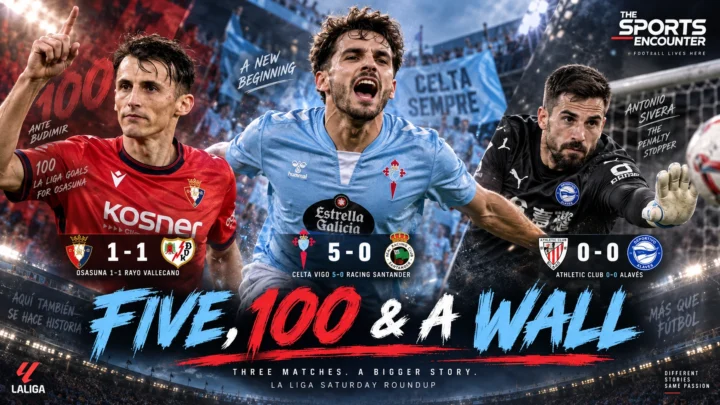
Rayo also earned a 1-1 draw at Osasuna, where Sergio Camello equalized after Ante Budimir reached 100 La Liga goals.
The match was covered in our September 19 La Liga report, alongside Athletic Club’s goalless draw with Alavés.
Those matches demonstrate how much of Rayo’s early season has unfolded under changing sporting demands.
Home-ground disruption adds another difficulty, even when the players continue producing competitive results.
Why the Abandoned Athletic Club Match Creates a Separate Problem
Wednesday’s disciplinary ruling resolves only one part of the October 10 incident.
The €6,000 fine and partial stadium closure concern Rayo’s responsibility for the disorder.
The unfinished match itself requires a separate decision.
The RFEF referred the question of resumption to the appropriate competition authority, which must determine when and under what conditions the remaining part of the fixture can be played.
No final score has been established.
No automatic victory for Athletic Club was confirmed by the October 14 disciplinary announcement.
And no verified replacement date had been established at the time of this report.
Athletic Club Have Already Faced Another Interrupted Fixture
The situation is particularly frustrating for Athletic because this is not their first disrupted league match of the season.
The club previously had a game against Levante postponed in September because heavy rain flooded the playing surface and stadium access areas in Valencia.
That incident was covered in TSE’s report on the Levante-Athletic postponement.
The two interruptions arose from entirely different circumstances.
Weather conditions prevented the Levante match from starting. Repeated crowd disturbances ended the Rayo fixture after play had begun.
Both nevertheless create additional logistical and scheduling obligations for Athletic.
The Levante match is scheduled for October 21, while the Rayo resumption remains unresolved.
For coaches and players, rearranged games can affect recovery periods, squad rotation and preparation for subsequent fixtures.
Those effects should be assessed when the final calendar becomes available rather than assumed in advance.
Rayo Supporters Reject the Punishment and Promise Further Protests
The RFEF ruling has failed to satisfy organized sections of the Rayo fanbase.
The Plataforma ADRV, representing a network of supporters’ groups, issued a statement on October 14 criticizing the partial closure.
The group argues that the protest involved supporters across all three sections of the stadium, rather than exclusively those affected by the disciplinary closure.
It regards the punishment as unfair to season-ticket holders in the designated stand.
The supporters’ organization has also criticized what it sees as an inconsistent institutional response: decisive action against the protest contrasted with what it considers years of inadequate attention to stadium maintenance problems.
These are the supporters’ allegations and assessments, not independent findings of misconduct by a particular official.
The organization has indicated that it intends to continue protesting and pursuing its claims, including requests for partial season-ticket refunds relating to home games staged at Butarque.
Why the Targeted Closure Could Deepen the Dispute
The RFEF’s reasoning focuses on match-order violations and the sectors associated with the repeated throwing of objects.
The supporters’ response focuses on collective participation in the protest and the fairness of restricting one section of the ground.
Those positions address different questions.
The committee must determine responsibility under its disciplinary framework.
Supporters are challenging the way that responsibility has been allocated and arguing that their original complaints remain unanswered.
The result is a punishment that may address future crowd conduct without necessarily reducing dissatisfaction with club leadership.
That is a significant distinction for Rayo’s next home game.
What Happens Against Elche on October 24?
Rayo’s next scheduled home La Liga match is against Elche on Saturday, October 24.
The sanctioned section of the Estadio de Vallecas is expected to remain closed for that fixture, subject to any subsequent change to the ruling.
The remainder of the stadium is not covered by the announced full-match closure of that section.
On the field, Elche represent an opponent whose early-season performances have been competitive despite inconsistent results.
Elche earned their first league victory of the campaign by beating Espanyol 3-1 while playing much of the match with 10 men.
Fer Niño scored twice in that win, which The Sports Encounter covered in its September 19 report.
The newly promoted side had previously shown resilience against Real Sociedad, recovering from a two-goal deficit before Luka Sučić scored a late winner for the visitors.
That narrow defeat was examined in TSE’s Real Sociedad-Elche analysis.
For Rayo, the match offers an opportunity to return attention to football.
Whether it also offers any relief from the confrontation between club management and supporters remains an entirely different question.
Can Rayo Vallecano Face an Even More Severe Stadium Ban?
Yes. The federation has explicitly warned that similar incidents could lead to the complete closure of the stadium.
That warning is part of the current disciplinary decision, rather than a prediction that another closure will occur.
The distinction between partial and complete closure is significant.
A partial closure prevents spectators from occupying the designated area while allowing other sections to remain available under the applicable arrangements.
A complete closure would affect access to the entire stadium for the period specified in a future ruling.
The precise consequences of any new incident would depend on its circumstances and the decision of the relevant disciplinary authority.
There is no basis for assuming that Rayo have already received a points deduction, forfeited the Athletic match, or been ordered to play all their remaining home fixtures behind closed doors.
The Sports Encounter Verdict: Punishment Cannot Resolve a Crisis of Trust by Itself
Rayo Vallecano’s punishment addresses a serious breach of matchday order.
A game was repeatedly interrupted. Players and officials could not continue under conditions considered safe by the relevant security personnel. The federation has exercised its disciplinary authority.
But the circumstances behind those interruptions remain important.
Supporters spent the opening weeks of the season watching their team play away from Vallecas because of stadium problems. They returned with grievances that had accumulated through years of disagreements over club management.
Now a section of their stadium will close again.
The underlying dispute involves more than one president, one supporters’ group or one referee’s decision. It concerns the relationship between a soccer club, its traditional home, the authorities responsible for stadium oversight and the people who attend its matches.
Rayo have demonstrated that they can compete while playing temporary home fixtures, earning seven points from nine at Butarque.
They have not demonstrated that the relationship between their leadership and supporters has recovered.
The upcoming Elche match will show how the latest restriction is enforced. The eventual completion of the Athletic Club fixture will settle an important sporting obligation.
Neither outcome, on its own, will determine whether Rayo can resolve the wider disagreements over maintenance, responsibility, season-ticket rights and institutional trust.
Vallecas has reopened once following a stadium-safety dispute. Whether it can return to being a stable, shared home for Rayo Vallecano remains the more consequential question.
Continue the La Liga Story

Frequently Asked Questions About Rayo Vallecano’s Stadium Ban
Why have Rayo Vallecano been given a stadium ban?
The Spanish Football Federation imposed a partial stadium closure after repeated throwing of objects by home supporters forced the abandonment of Rayo’s October 10 La Liga match against Athletic Club.
How much have Rayo Vallecano been fined?
Rayo Vallecano received a €6,000 fine from the RFEF Disciplinary Committee on October 14, 2026.
Which part of the Estadio de Vallecas will be closed?
The sanction affects the stand above the dressing rooms for one home match. It is a partial closure, not a blanket order to close the entire stadium.
When will Rayo Vallecano serve the partial stadium ban?
The restriction is scheduled to apply against Elche on October 24, 2026, subject to any subsequent change to the disciplinary ruling.
Why was Rayo Vallecano vs Athletic Club abandoned?
Supporters protesting against club president Raúl Martín Presa threw paper airplanes, rubber balls and other objects onto the field. After repeated interruptions and a security assessment, referee José María Sánchez Martínez abandoned the match after approximately 25 minutes.
What was the score when Rayo vs Athletic was stopped?
The match was 0-0 when it was abandoned. That is not a final result. Competition authorities must still decide how and when to resolve the unfinished fixture.
Have Rayo Vallecano been deducted points?
No points deduction was announced as part of the October 14 disciplinary ruling. The reported sanctions were a €6,000 fine, a one-match partial stadium closure and a warning about further incidents.
Why were Rayo playing home matches at Butarque?
The Estadio de Vallecas was temporarily unavailable because of earlier stadium safety and operational concerns. Rayo consequently played their first three home league fixtures at Butarque in Leganés before being allowed to return to Vallecas.
Will the Athletic Club match be replayed?
The appropriate competition authority must decide the date and conditions for completing the fixture. As of October 14, 2026, no confirmed new date or final competition decision had been established.