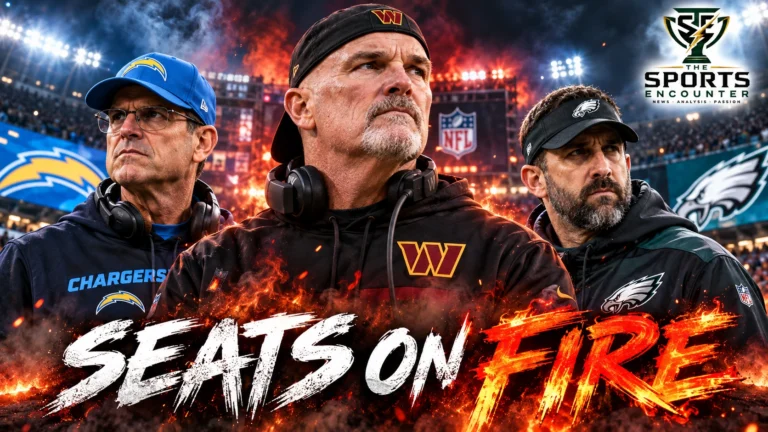
NEW YORK, United States, October 14, 2026: Dan Quinn watched the Washington Commanders waste a potential game-winning field goal against the New York Giants. Jim Harbaugh watched his Los Angeles Chargers surrender another fourth-quarter lead and fall to 0-5. Nick Sirianni watched the Philadelphia Eagles lose a game they had seemingly secured with eight seconds remaining. Five weeks into the 2026 NFL season, the coaching hot seat has become a question of something more troubling than losing: how much damage are head coaches doing to their teams’ chances of winning?
Washington’s 27-27 overtime tie, the Chargers’ 23-17 defeat to Denver, and Philadelphia’s 19-17 collapse against Jacksonville have created three distinct tests of coaching accountability. Quinn faces questions about preparation and situational control, Harbaugh about an underperforming team built to contend, and Sirianni about decisions that undermine an already struggling offense. Meanwhile, Todd Bowles has finally won a game in Tampa Bay, Tennessee remains winless under Robert Saleh, and Dallas is already making changes around Brian Schottenheimer.
The differences matter because an NFL head coach can survive a difficult schedule, a young roster, or a stretch of injuries. Repeated mistakes involving preparation, execution, and game management create a harder problem for an organization to explain.
The NFL’s official Week 5 review documents several of the decisive sequences. They provide a useful starting point for separating poor results from avoidable coaching failures.
Story at a glance
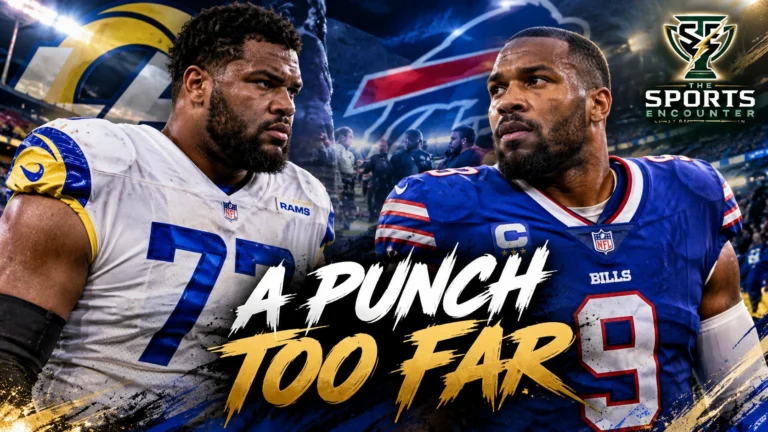
Which NFL Coaches Are Under the Most Pressure After Week 5?
The Sports Encounter’s assessment considers four factors: how far a team has fallen below reasonable expectations, whether its problems are recurring, how directly coaching decisions have contributed to losses, and whether there is a credible route to improvement.
Dan Quinn: How Washington Turned a Winnable Game Into a Coaching Crisis
Quinn entered Week 5 with something his struggling team desperately needed: the return of starting quarterback Jayden Daniels.
Jim Harbaugh: Why the Chargers’ 0-5 Start Is Harder to Explain Away
Harbaugh has a different problem.
Nick Sirianni: How Eight Seconds Exposed Philadelphia’s Decision-Making
The Eagles’ loss to Jacksonville was painful because their final offensive possession appeared to have done enough.
Todd Bowles: Did Beating Dallas Actually Cool His Hot Seat?
Bowles can point to something the other coaches in the most immediate discussion cannot: his team finally won.
Which NFL Coaches Are Under the Most Pressure After Week 5?
The Sports Encounter’s assessment considers four factors: how far a team has fallen below reasonable expectations, whether its problems are recurring, how directly coaching decisions have contributed to losses, and whether there is a credible route to improvement.
This is an independent editorial evaluation of coaching pressure as of October 14, 2026. It does not represent confirmed management decisions, inside information, or probabilities of dismissal.
| Coach | Team | Record | Biggest Concern | TSE Assessment |
|---|---|---|---|---|
| Dan Quinn | Washington Commanders | 1-3-1 | Situational errors and defensive collapses | Most immediate pressure |
| Jim Harbaugh | Los Angeles Chargers | 0-5 | Winless start and late-game execution | Severe performance crisis |
| Todd Bowles | Tampa Bay Buccaneers | 1-4 | Prolonged losing stretch despite first victory | Temporary relief |
| Nick Sirianni | Philadelphia Eagles | 2-3 | Late-game management and offensive failures | Growing accountability concerns |
| Robert Saleh | Tennessee Titans | 0-5 | Extremely limited offensive production | Structural crisis |
| Brian Schottenheimer | Dallas Cowboys | 2-3 | Defensive breakdowns and organizational adjustments | Pressure building |
| Jeff Hafley | Miami Dolphins | 0-5 | Unproductive offense during a new coaching regime | Serious results concern, greater rebuilding latitude |
The records follow the first five completed weeks. Readers can consult the official NFL standings for updated results.
There is an important distinction between this coaching-pressure assessment and TSE’s earlier NFL Week 5 power rankings. Team strength and a head coach’s employment risk are different questions. A strong organization may tolerate a temporary downturn, while a weaker one may change direction even after a few competitive performances.
Dan Quinn: How Washington Turned a Winnable Game Into a Coaching Crisis
Quinn entered Week 5 with something his struggling team desperately needed: the return of starting quarterback Jayden Daniels.
Washington had already suffered significant disruption after Daniels dislocated his left elbow during its Week 2 defeat against Dallas. TSE’s Week 2 analysis documented how that injury changed Washington’s immediate prospects.
Daniels returned against the Giants and produced 199 passing yards, 103 rushing yards, and two rushing touchdowns. Washington led 27-13 during the fourth quarter.
Then the defense surrendered two touchdown drives. New York forced overtime, where the Commanders ultimately received another opportunity to win.
After recovering a Cam Skattebo fumble, Washington advanced into realistic field-goal range. Rookie kicker Drew Stevens had made all seven of his attempts from inside 50 yards entering the decisive situation.
The Commanders had no timeouts. With the ball near the Giants’ 24-yard line, a successful spike would have stopped the clock and preserved an opportunity for a field-goal attempt.
Instead, Washington ran another offensive play. Daniels scrambled, was brought down in bounds, and the offense could not stop the clock before time expired.
The 27-27 tie left Washington at 1-3-1.
Why Quinn’s Mistake Is More Damaging Than an Ordinary Loss
The football consequences are straightforward. Washington exchanged a realistic opportunity to win for a tie without allowing its kicker to attempt the decisive play.
The coaching consequences are more complicated.
Quinn acknowledged his responsibility afterward. That matters, but accountability after a mistake does not answer why a team was unable to execute such a fundamental end-game scenario.
His defense had already surrendered a 14-point fourth-quarter advantage. The subsequent overtime failure connected two separate weaknesses: protecting a lead and controlling the final moments.
Washington’s circumstances deserve context. Its quarterback injury situation entering Week 5 left little room for additional disruption. The team also lost receiver and return specialist Jaylin Lane, whose season-ending ankle injury complicated its depth and special-teams plans.
Those absences help explain the difficulties of maintaining offensive consistency. They do not explain the failure to protect a double-digit lead or attempt a kick after reaching field-goal range.
That distinction leaves Quinn facing TSE’s most urgent coaching-accountability questions.
Can Quinn Survive Washington’s Trip to San Francisco?
The next opponent makes the situation more uncomfortable.
Washington visits the unbeaten San Francisco 49ers on Monday, October 19, before entering its Week 7 bye.
A victory would provide evidence that Quinn can restore confidence and prepare his team for a difficult assignment. Another defeat accompanied by defensive breakdowns or procedural errors would strengthen the argument that Washington’s problems are embedded in its operating habits.
There is no verified announcement that the Commanders intend to dismiss Quinn. His position atop this assessment reflects the urgency of the football problems, not knowledge of an impending personnel decision.
Jim Harbaugh: Why the Chargers’ 0-5 Start Is Harder to Explain Away
Harbaugh has a different problem.
Washington can point to an extraordinary missed opportunity. Los Angeles must explain why a team built around Justin Herbert has failed to win any of its first five games.
The Chargers entered the season with substantial expectations and a coaching staff that included offensive coordinator Mike McDaniel. Yet their offense has scored only 84 points through five games, an average of 16.8 per contest.
The 23-17 loss to Denver supplied another example of how a struggling team can manufacture additional problems for itself.
Los Angeles led 17-10 in the fourth quarter when Harbaugh elected to attempt a fourth-and-1 conversion from his own 41-yard line. The play failed.
Denver capitalized on the short field. The Broncos eventually scored 13 unanswered points, while the Chargers’ closing possessions ended in a punt, a failed fourth-down attempt, a fumble, and an interception.
The Fourth-and-1 Decision Revealed a Larger Problem
Going for a short fourth down is not inherently irresponsible. Field position, time remaining, offensive efficiency, and an opponent’s ability to score all matter.
The concern was the interaction between Harbaugh’s decision and what followed.
He acknowledged that he should have called a timeout and reconsidered the play after Denver adjusted its defensive alignment.
That is a more revealing admission than a generic complaint about execution. The coach recognized that the defense presented a problem, but the play continued anyway.
The Chargers’ early struggles were already visible when TSE examined the league’s five winless teams after Week 4. Denver’s comeback added another loss to an increasingly difficult pattern.
Does Harbaugh’s Reputation Give Him More Time?
His previous achievements should matter to any rational assessment of his future. Harbaugh has a record of building competitive teams and improving their organization.
His current assignment, however, is to turn that experience into results with the Chargers.
That means identifying why Herbert’s offense cannot consistently sustain drives, why possession-ending errors keep accumulating, and why close games repeatedly escape.
Kansas City awaits on October 18.
Another defeat would leave Los Angeles 0-6. Harbaugh’s professional reputation may provide room for patience, but it cannot supply the offensive points his team is missing.
Nick Sirianni: How Eight Seconds Exposed Philadelphia’s Decision-Making
The Eagles’ loss to Jacksonville was painful because their final offensive possession appeared to have done enough.
Jake Elliott kicked a 48-yard field goal with eight seconds remaining, giving Philadelphia a 17-16 lead in London.
The Eagles then allowed Jacksonville’s Ameer Abdullah to return the kickoff 53 yards. Cam Little made a 57-yard field goal as time expired, handing the Jaguars a 19-17 victory.
Sirianni accepted responsibility for the decision that allowed a returnable kickoff.
The defeat dropped Philadelphia to 2-3 and extended its losing streak to three games.
Why Philadelphia’s Problem Extends Beyond Special Teams
The kickoff error supplied the dramatic ending. The offense had already given Sirianni reasons for concern.
Philadelphia rushed for only 22 yards against Jacksonville. Injuries had also deprived the team of important weapons, including Saquon Barkley and DeVonta Smith.
These absences should be considered before assigning responsibility for every offensive failure. But the Eagles have struggled to establish a dependable attacking identity, leaving late-game execution increasingly important.
Philadelphia had previously survived a close encounter with Washington, a result covered in TSE’s opening-week analysis. Five weeks later, the narrow margins are turning against Sirianni.
He still has important achievements in his favor, including leading Philadelphia to a Super Bowl championship. The question is whether his current staff can make the adjustments necessary to reverse the slide.
The Carolina Panthers visit Philadelphia on October 18. An improved performance would do more to reassure observers than another round of postgame apologies.
Todd Bowles: Did Beating Dallas Actually Cool His Hot Seat?
Bowles can point to something the other coaches in the most immediate discussion cannot: his team finally won.
Tampa Bay defeated Dallas 24-16 on October 8, ending an 0-4 start and improving to 1-4.
The Buccaneers received an important contribution from rookie quarterback Jalon Daniels, while Bucky Irving rushed for 165 yards. The defense also produced the stops required to protect the result.
Bowles deserves credit for guiding his team through a difficult assignment after four consecutive defeats.
But there is a difference between stopping a losing streak and establishing a sustainable recovery.
Tampa Bay has won only three of its last 14 games across the period cited in the October 14 coaching discussion. Questions remain about quarterback availability, offensive consistency, and Bowles’ aggressive in-game choices.
Even against Dallas, declining a fourth-quarter field-goal opportunity that could have stretched the lead invited scrutiny.
Why the Steelers Game Matters More Than the Cowboys Celebration
The Buccaneers host Pittsburgh on October 18.
A second consecutive victory would produce evidence that the Dallas performance was a meaningful adjustment rather than an isolated result.
A return to the same offensive problems would quickly revive concerns over Bowles’ ability to lead a sustained turnaround.
The encouraging part for Tampa Bay is that the NFC South remains a division in which a recovery could matter. Bowles has earned some breathing room, but the next few weeks will determine whether he can keep it.
Robert Saleh and Jeff Hafley: Why Two 0-5 Teams Present Different Questions
The Tennessee Titans and Miami Dolphins have identical records. Both are 0-5. Their circumstances nevertheless require separate evaluations.
Can Robert Saleh Fix Tennessee’s 11.6-Point Offense?
The Titans have scored 58 points in five games, averaging 11.6 points. Their latest result was a 26-3 defeat to Houston.
That is a remarkable shortage of scoring in a league where even modest offensive production can keep a team competitive.
Cam Ward’s development remains central to Tennessee’s plans, but quarterbacks cannot be evaluated in isolation from protection, receiving options, run-game efficiency, and the situations created by play-calling.
Saleh must find a way to support that development while giving the Titans a more realistic chance of winning games now.
Tennessee faces Indianapolis on October 18. Another performance built around stalled possessions and minimal scoring would further weaken confidence in the current approach.
Why Miami’s Jeff Hafley May Have More Room Despite a Worse Point Differential
Miami has scored 70 points and allowed 132, producing a minus-62 point differential through five games.
Those figures describe a team struggling on both sides of the ball.
The Dolphins lost 31-24 to Cincinnati in Week 5, leaving first-year coach Jeff Hafley searching for his first victory.
Hafley has acknowledged problems in both game planning and execution. Quarterback Malik Willis has also struggled to provide consistent production, although the coach has continued to support him as the starter.
The difference is organizational timing.
Miami is at the beginning of a new coaching regime. A disappointing start does not automatically establish that a recently appointed coach has exhausted his opportunity to build the team.
The Dolphins enter their Week 6 bye without a victory, creating time to review their approach before their next game.
If the same problems continue after the bye, that rebuilding explanation becomes less convincing.
Brian Schottenheimer: Is Dallas Already Running Out of Defensive Answers?
The Cowboys’ 2-3 record does not look as alarming as the Chargers’ or Titans’ starts. Their defensive problems, however, have already prompted organizational action.
Dallas has ranked near the bottom of the NFL in yards and points allowed. Owner Jerry Jones has defended defensive coordinator Christian Parker while acknowledging the need for improvement.
The team has brought in veteran coach Mike Pettine as a senior defensive assistant, an adjustment intended to strengthen a struggling operation.
That move does not establish that Schottenheimer is about to lose his job. It does show that the organization recognizes a problem requiring intervention.
Dak Prescott and the offense have demonstrated the ability to generate points. The more difficult question is whether Dallas can prevent opponents from answering those scores consistently.
The franchise’s enormous commercial standing adds another layer of scrutiny. TSE’s investigation into the Cowboys’ $17 billion valuation and prolonged championship drought explored how the team’s financial dominance has continued despite its lack of recent Super Bowl success.
That commercial strength does not lessen football expectations.
Dallas visits Green Bay on October 18. Its defensive response will be watched as closely as the result.
The NFL Coaching Hot Seat Has Three Different Warning Signs
The most useful way to evaluate these situations is to identify the mechanism behind the pressure.
| Warning Sign | Illustrative Coaches | What Must Improve |
|---|---|---|
| Situational failures | Dan Quinn, Nick Sirianni | Clock control, special-teams choices, preparation for decisive plays |
| Repeated performance failures | Jim Harbaugh, Robert Saleh | Scoring production, offensive execution, dependable game plans |
| Organizational recovery tests | Todd Bowles, Brian Schottenheimer, Jeff Hafley | Consistency, staff adjustments, evidence of sustained improvement |
These categories overlap. Quinn’s defense has struggled beyond the Giants game. Harbaugh’s failed fourth-down decision was a situational mistake within a wider performance crisis. Bowles also faces scrutiny over in-game judgment.
That overlap is precisely why firing a coach after a single costly decision can be an inadequate response to a complicated problem.
Owners must determine whether the coach understands the underlying failures, can make practical adjustments, and still has the confidence of the people responsible for executing those plans.
A coach who identifies the correct problems and demonstrates measurable improvement has a stronger case for patience. Repeated mistakes without a credible response weaken that case.
Which Week 6 Games Could Change the NFL Coaching Debate?
The NFL’s official Week 6 schedule contains several games that could materially change the discussion before the next round of results.
| Date | Game | Coaching Question |
|---|---|---|
| October 18 | Chargers at Chiefs | Can Harbaugh prevent an 0-6 start? |
| October 18 | Steelers at Buccaneers | Can Bowles follow his first win with another? |
| October 18 | Panthers at Eagles | Can Sirianni restore offensive and situational discipline? |
| October 18 | Titans at Colts | Can Saleh produce a functioning scoring offense? |
| October 18 | Cowboys at Packers | Will Dallas show immediate defensive improvement? |
| October 19 | Commanders at 49ers | Can Quinn restore confidence before the bye? |
Miami has a bye in Week 6, giving Hafley a different opportunity to evaluate his team without preparing for an immediate game.
The next results will matter, but the manner of those results may reveal more. A narrow defeat accompanied by improved execution could support patience. Another loss defined by the same failures would be considerably harder to excuse.
Who Is Really in the Most Trouble?
Dan Quinn is TSE’s leading candidate for the most immediate scrutiny, with Jim Harbaugh facing the strongest challenge to his team’s competitive credibility.
Quinn’s Commanders have a recognizable pattern of defensive failures and just squandered an unusually clear opportunity to win. Harbaugh’s Chargers have lost five consecutive games despite entering the season with ambitions far higher than an early battle to avoid going winless.
Bowles remains vulnerable despite Tampa Bay’s first win, while Sirianni must demonstrate that Philadelphia’s damaging decisions and offensive struggles can be corrected.
Saleh faces the difficult task of rebuilding Tennessee’s offense during a winless season. Schottenheimer needs defensive improvement, and Hafley must use Miami’s bye to show that a difficult start is leading toward a more coherent team.
No dismissal is established by these results alone. The next stage depends on ownership decisions, coaching adjustments, roster availability, and what happens on the field.
For Washington and Los Angeles, the immediate evidence is particularly uncomfortable. Their head coaches are being judged against problems they are employed to solve, and October has already supplied reasons to question whether those solutions are working.
Continue the NFL Story
Frequently Asked Questions About NFL Coaches on the Hot Seat in 2026
Who is on the hottest seat in the NFL after Week 5?
The Sports Encounter places Dan Quinn under the greatest immediate scrutiny because Washington is 1-3-1 and wasted a realistic game-winning opportunity through poor overtime management. Jim Harbaugh is another leading concern after the Chargers started 0-5. These are editorial assessments, not confirmed firing decisions.
What mistake did Dan Quinn make against the New York Giants?
Washington reached field-goal range late in overtime without any timeouts. Instead of preserving a kicking opportunity by stopping the clock, the Commanders ran another play. Jayden Daniels was tackled in bounds and time expired before they could spike the ball. The game ended 27-27.
Why are the Los Angeles Chargers winless in 2026?
The Chargers have struggled to score consistently, protect advantages, and avoid damaging late-game errors. Their Week 5 defeat to Denver featured a failed fourth-down attempt from their own territory followed by further unsuccessful possessions. Los Angeles enters Week 6 at 0-5.
Is Nick Sirianni going to be fired by the Eagles?
No confirmed decision to dismiss Nick Sirianni has been established. Philadelphia is 2-3 after three straight defeats, and his handling of the closing kickoff against Jacksonville has intensified scrutiny. His immediate challenge is improving offensive production and late-game execution.
Did Todd Bowles save his job by beating the Cowboys?
Tampa Bay’s 24-16 victory over Dallas ended its four-game losing streak and reduced immediate pressure on Bowles. At 1-4, however, the Buccaneers still need sustained improvement. One victory cannot settle a question involving a longer pattern of disappointing results.
Which NFL teams remain winless after five weeks in 2026?
The Los Angeles Chargers, Miami Dolphins, and Tennessee Titans all enter Week 6 with 0-5 records. The Houston Texans and Tampa Bay Buccaneers earned their first victories in Week 5.
Does an 0-5 NFL start mean a head coach will be fired?
No. A winless start increases scrutiny, but employment decisions depend on organizational expectations, roster development, injuries, contractual considerations, team progress, and the owner’s judgment. A first-year coach may receive more time to establish a system than a veteran coach whose team has repeatedly fallen short of expectations.
When do the Commanders and Chargers play next?
The Los Angeles Chargers visit the Kansas City Chiefs on Sunday, October 18, 2026. The Washington Commanders visit the San Francisco 49ers on Monday, October 19. Both games will be important tests for coaches already facing considerable pressure.
Follow The Sports Encounter’s NFL coverage for further analysis of coaching decisions, team performances, injuries, and developments throughout the 2026 season.