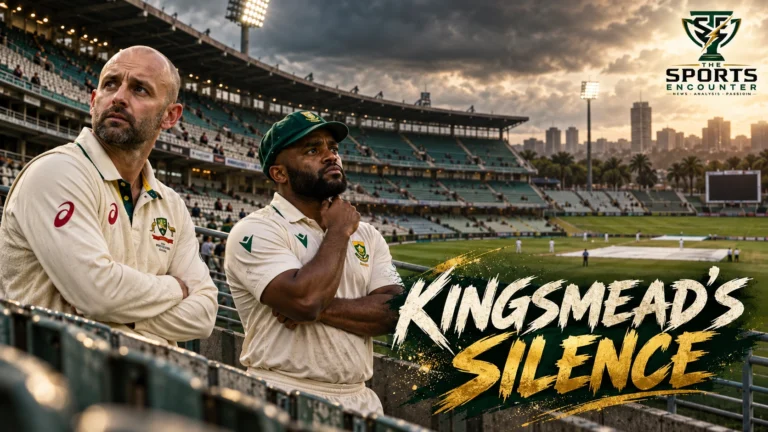
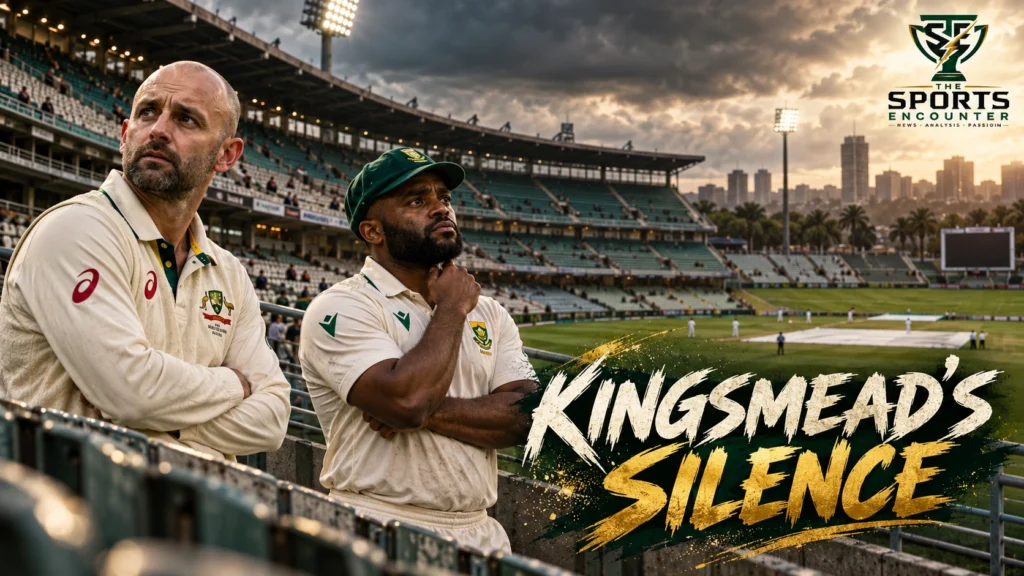
DURBAN, South Africa, October 13, 2026: South Africa had waited 641 days to host Test cricket again. They returned as the defending World Test Championship champions, facing Australia in one of international cricket’s fiercest rivalries. Yet when the opening Test began at Kingsmead on Friday, only about 3,800 spectators attended a venue capable of accommodating approximately 25,000. The crowds remained thin throughout the five-day contest, leaving players performing before large sections of empty seating and raising serious questions about Durban’s ability to attract supporters to major Test matches.
The poor attendance was striking because this was Australia’s first Test series in South Africa since the 2018 ball-tampering scandal, and both teams entered as leading World Test Championship contenders. Australia’s Nathan Lyon publicly expressed surprise at the turnout, while South African newspapers questioned why Kingsmead had been entrusted with such an important fixture. An investigation into the available evidence reveals several overlapping explanations: violent unrest in Durban immediately before the match, competition from a sold-out soccer final, weekday scheduling, repeated bad-light interruptions and long-standing difficulties attracting Test spectators. But the most troubling finding is that the empty stands were not simply caused by one bad weekend. Durban appears to have a deeper problem converting international cricket’s prestige into sustained live attendance.
Only 3,800 Spectators: The Numbers Behind Kingsmead’s Empty Stands
The first surprise is that the opening day was not nearly as well attended as some television viewers believed.
Contemporary reports placed Friday’s crowd at approximately 3,800.
Story at a glance
Only 3,800 Spectators: The Numbers Behind Kingsmead’s Empty Stands
The first surprise is that the opening day was not nearly as well attended as some television viewers believed.
Violent Unrest in Durban: The Immediate Problem Before the First Ball
One of the most significant factors surrounding the opening day had little to do with cricket.
Same City, Two Sports: Why a Soccer Final Sold Out While Kingsmead Stayed Empty
On Saturday, October 10, Durban hosted another major sporting event.
Durban’s Attendance Problem Did Not Begin in October 2026
One of the strongest findings from this investigation is that Kingsmead’s poor Test crowds are not new.
The September ODI Offers Another Warning for Kingsmead
Cricket South Africa had already received evidence of modest attendance during Australia’s earlier white-ball visit.
Kingsmead’s commonly reported capacity is around 25,000, meaning the opening-day attendance represented approximately 15.2% of that capacity.
Roughly 85% of the ground’s capacity was therefore unoccupied.
The figures are particularly disappointing when considered against the significance of the fixture.
Australia were returning to South Africa for their first Test series in the country since Sandpapergate in 2018.
South Africa had defeated Australia in the 2025 World Test Championship Final at Lord’s.
The contest brought together two of Test cricket’s leading teams at the beginning of a highly anticipated three-match series.
The Sports Encounter explored those expectations in our comprehensive preview of Australia’s first Test tour of South Africa since Sandpapergate.
Yet the atmosphere at Kingsmead did not resemble the intense reception expected from such a rivalry.
Local newspaper reporting described deserted grass banks, substantial gaps in the stands and little of the crowd energy traditionally associated with major South Africa-Australia encounters.
The on-site account published by Independent Online on October 9 reported the approximately 3,800 opening-day spectators and questioned why an occasion of such significance failed to attract more supporters.
What Happened to the Crowds on Days Two, Three, Four and Five?
The attendance problem continued after Friday.
Saturday and Sunday should have offered greater opportunities for working families, students and casual sports supporters to attend.
Instead, local journalists observed that the crowd remained sparse throughout the weekend.
Monday appeared quieter still, according to reporting from The Citizen.
The stadium continued to display large vacant sections as Australia moved toward victory on the final day.
A complete, independently reconciled five-day attendance register was not available in the published sources reviewed for this investigation.
Consequently, it would be misleading to assign precise spectator counts to each subsequent day simply by estimating the people visible in television pictures.
However, the combination of reported observations and broadcast images establishes that the problem extended beyond the opening day.
Why Tickets Sold and Spectators Attending Must Be Measured Separately
Pre-match reporting suggested that advance ticket sales for individual days had reached several thousand, with Saturday attracting particularly strong advance interest.
Those figures should not be confused with the number of spectators who actually entered Kingsmead.
A purchased ticket does not guarantee attendance.
Supporters may change their plans because of safety concerns, illness, transport disruption, weather or competing commitments.
Complimentary tickets, season packages and other allocations can also complicate comparisons between reported sales and actual turnstile counts.
Cricket South Africa has not provided a publicly reconciled set of figures sufficient to establish how much of the attendance shortfall came from unsold tickets and how much came from ticket holders who stayed away.
That distinction is central to identifying the real causes.
Violent Unrest in Durban: The Immediate Problem Before the First Ball
One of the most significant factors surrounding the opening day had little to do with cricket.
On October 8, the day before the Test began, violent anti-migrant protests affected parts of Durban.
The unrest included attacks on vehicles, burned property, damaged businesses and disruption to traffic.
Police responded to the violence, and authorities continued monitoring affected areas on the morning of October 9.
Reuters, Associated Press and local South African news organizations independently reported the disturbances.
Such circumstances could reasonably discourage spectators from travelling into the city for a full day’s entertainment.
This is particularly relevant to families, visitors unfamiliar with the affected roads and people using public transport.
The timing also matters.
The unrest occurred immediately before a Friday morning match, leaving potential spectators with little time to reassess travel plans or confirm that their intended routes were safe.
Was the Unrest Responsible for the 3,800 Opening-Day Crowd?
The security situation provides a credible explanation for some missing spectators.
However, no published survey establishes how many ticket holders abandoned their plans specifically because of the violence.
It would therefore be inaccurate to attribute the entire low turnout to the protests.
Friday was also a working and school day, making it less convenient than a weekend fixture for many potential spectators.
The combination of ordinary weekday commitments and exceptional public-order concerns may have reduced attendance substantially.
But if the unrest were the principal explanation for the whole Test, attendance should reasonably have improved once the immediate disruption subsided.
Local reports indicate that such a recovery did not materialize.
That leads to the next question.
Same City, Two Sports: Why a Soccer Final Sold Out While Kingsmead Stayed Empty
On Saturday, October 10, Durban hosted another major sporting event.
Orlando Pirates faced Mamelodi Sundowns in the MTN8 final at Moses Mabhida Stadium.
The contest was a major occasion in South African football, bringing together two heavily supported clubs in a high-stakes domestic cup final.
The Premier Soccer League confirmed that tickets were sold out before matchday.
The contrast was difficult to ignore.
One major sporting event in Durban had exhausted its ticket allocation.
Another, featuring two of the world’s leading Test cricket teams, was struggling to fill even a modest proportion of its stadium.
The Premier Soccer League’s official October 2 announcement confirms that the MTN8 final sold out ahead of the event.
What the Soccer Final Reveals About Durban’s Sports Audience
The contrast weakens the argument that Durban residents are simply unwilling to attend live sporting events.
Football clearly attracted substantial ticket demand that weekend.
But the comparison requires care.
A domestic soccer final is a concentrated, high-stakes event with a clear winner decided over one evening.
A Test match can require up to five days of attendance, and the result may remain unresolved for long periods.
The clubs also have established supporter networks capable of mobilizing fans around a final.
International cricket has a different audience structure and a different event rhythm.
Some supporters who attended the soccer final might never have considered attending the Test, regardless of its date.
Nevertheless, the simultaneous events demonstrate that cricket was competing for discretionary time, attention and entertainment spending in the same city.
That competition probably mattered most on Saturday.
It cannot explain the poor attendance throughout the remaining days.
Why a One-Evening Final May Be Easier to Sell Than Five Days of Test Cricket
A ticket to a cup final promises an easily understood experience.
The match begins at a scheduled time, produces a result and concludes within a few hours.
Test cricket asks for a different commitment.
Supporters may spend an entire day at the stadium without seeing a decisive result.
The contest can also be shortened by weather, deteriorating light or other interruptions.
Those characteristics are part of Test cricket’s competitive depth, but they complicate the task of selling the format to occasional spectators.
For cricket administrators, the challenge is making a long sporting occasion appealing without removing the tactical qualities that give it meaning.
Durban’s Attendance Problem Did Not Begin in October 2026
One of the strongest findings from this investigation is that Kingsmead’s poor Test crowds are not new.
South African sports journalists have repeatedly raised concerns about Durban’s ability to attract substantial crowds to the longest format.
The ground has a distinguished cricketing history.
It has hosted major international contests, memorable South African performances and some of Test cricket’s most extraordinary finishes.
Yet its historical importance has not consistently translated into strong contemporary attendance.
Local commentary has linked that difficulty to Cricket South Africa’s earlier decision to move the traditional Boxing Day Test away from Durban and toward Centurion.
Newlands in Cape Town and SuperSport Park in Centurion are frequently cited as stronger Test-attendance venues.
Those observations do not mean Kingsmead lacks supporters or should automatically lose its hosting rights.
They do mean that venue allocation should be informed by actual audience demand rather than reputation alone.
Why the Defending World Champions Could Not Fill Their Own Ground
South Africa’s return made the turnout especially difficult to explain.
The Proteas had not hosted a Test at home since January 2025.
They had subsequently won the World Test Championship by defeating Australia at Lord’s.
For supporters, the October series therefore offered a rare opportunity to welcome home the world champions against the very opponent they had defeated to claim the title.
The first Test also carried considerable historical interest because Australia had not played a Test series in South Africa since the 2018 ball-tampering controversy.
These circumstances should have strengthened the fixture’s appeal.
Yet strong sporting narratives did not translate into a capacity crowd.
That is the underlying commercial and cultural problem.
The sporting value of an event and the number of people willing or able to attend it are not necessarily the same.
The September ODI Offers Another Warning for Kingsmead
Cricket South Africa had already received evidence of modest attendance during Australia’s earlier white-ball visit.
On September 24, South Africa faced Australia in the first ODI at Kingsmead.
The match coincided with Heritage Day, a South African public holiday.
The reported attendance was slightly above 12,000.
That was substantially better than the approximately 3,800 spectators reported at the Test’s opening day.
But it still represented only around half of Kingsmead’s reported capacity.
The ODI was also highly entertaining.
Matthew Breetzke scored 112, Marco Jansen contributed 75 and Keshav Maharaj took 4/20 as South Africa defeated Australia by 67 runs.
TSE covered the contest in our detailed account of Maharaj’s match-changing spell after Australia reached 90 without loss.
The difference in crowds between the ODI and the Test is important.
It suggests that match format, calendar placement and the amount of time required from spectators could affect demand.
However, two events are not enough to establish a reliable attendance trend.
Cricket South Africa would need comparable figures across multiple seasons, opponents, formats and venues before drawing definitive conclusions.
Tickets Started at R50, So Was Affordability Really the Problem?
Ticket affordability is an obvious explanation whenever a stadium appears empty.
But the official listing for the opening day of the Durban Test advertised admission starting at R50.
That was a relatively inexpensive entry price for a major international sporting fixture.
It therefore weakens the suggestion that high admission prices alone explain the poor crowd.
Nevertheless, ticket prices are only one element of the total cost of attending.
The Hidden Cost of Spending a Full Day at Kingsmead
A spectator may also need to pay for transport, parking, meals and refreshments.
Families face larger combined expenses, particularly when several children accompany adults.
Stadium rules can also influence how much supporters spend after entering.
The official ticketing conditions restricted outside food and drinks, with specified exceptions for items such as sealed water and dry snacks.
Some supporters discussing Kingsmead online complained about parking, food costs, seating conditions and the difficulty of spending an entire day in exposed sections.
Such concerns may discourage occasional spectators even when general admission is inexpensive.
But those complaints are anecdotal.
They should be treated as issues requiring a proper spectator survey rather than established reasons for thousands of missing fans.
Are Heat and Stadium Comfort Part of the Problem?
Durban’s coastal climate can offer attractive conditions for cricket.
But sunshine and heat do not affect every spectator equally.
Families with young children, older spectators and people sensitive to prolonged sun exposure may place considerable value on shade, seating comfort and access to refreshments.
Different sections of Kingsmead offer different spectator experiences.
As a result, a low headline ticket price may not accurately describe the experience available to every supporter.
Cricket administrators should examine which sections sell well, which remain empty and whether comfort influences purchasing decisions.
Without that information, affordability and comfort remain credible explanations rather than quantified causes.
Bad Light Took 49 Overs Off the First Three Days’ Standard Allocation
The poor crowd was only one problem confronting the Kingsmead Test.
The other was the amount of cricket spectators actually received.
Bad light interrupted the first three days, forcing play to finish earlier than scheduled.
The opening day ended after Australia faced only 65 overs and two deliveries.
The second day concluded with South Africa 27/1 in their first innings.
Across the opening three days, the teams completed 221 overs, compared with a standard allocation of 270.
| Day | Overs Bowled | Standard Daily Allocation |
|---|---|---|
| Friday, October 9 | 65.2 | 90 |
| Saturday, October 10 | 80.4 | 90 |
| Sunday, October 11 | 75.0 | 90 |
| Total | 221 | 270 |
That amounts to a shortfall of 49 overs against the standard three-day allocation.
Not every uncompleted over can automatically be attributed to bad light, because over rates, interruptions and playing-condition adjustments also matter.
But repeated light-related stoppages were a verified and significant feature of the match.
Those interruptions affected the rhythm of the cricket and reduced the predictability of the live experience.
On the opening day, South Africa had Australia struggling at 124/6 before Matt Renshaw and Pat Cummins began their recovery.
The contest was finely balanced when play ended early.
That development was central to TSE’s opening-day report on the Australian batting collapse and the frustration caused by fading light.
Why Lost Playing Time Matters to Paying Spectators
Cricket fans who purchase a full-day ticket reasonably expect an opportunity to watch a substantial amount of play.
They understand that weather and other interruptions are possible.
But repeated early finishes at a particular venue can weaken confidence in the value of attending.
A spectator considering another day at the ground may decide that television offers a more convenient alternative when the afternoon session is uncertain.
That is a plausible consequence of repeated interruptions, although no published survey confirms how many Durban supporters made that decision.
The fourth day demonstrated how much cricket could be played when conditions permitted a longer contest.
Australia extended their advantage through Renshaw’s second-innings 82 and declared at 314/6 before reducing South Africa to 102/4.
The changing match situation was documented in TSE’s fourth-day analysis of Australia’s commanding position.
Unfortunately, the most productive phase of the Test did not produce a corresponding visible surge in spectators.
Nathan Lyon Questions the Empty Stands as Australia’s Expected Hostility Never Arrives
Australian off-spinner Nathan Lyon was the clearest player to express surprise at the attendance.
After the third day, he said he had expected a stronger turnout for a contest involving Australia and South Africa.
He also observed that the spectators had been unusually quiet.
Lyon’s reaction was significant because Australia’s previous Test tour of South Africa had been accompanied by intense hostility and controversy.
In 2018, the rivalry culminated in the ball-tampering scandal at Newlands, triggering suspensions and serious repercussions for Australian cricket.
The 2026 tour was expected to renew some of that competitive intensity.
Instead, the visiting players encountered far less crowd pressure than anticipated.
Fox Sports Australia’s reporting on Lyon’s comments documented his surprise and the subdued atmosphere around the match.
Why Crowd Atmosphere Matters in a Test Match
Home advantage in cricket is not limited to pitch conditions.
Familiar surroundings, local support and the emotional response of spectators can all contribute to the competitive environment.
An energetic crowd can increase the sense of occasion and create pressure during important passages of play.
It may also reinforce the emotional advantage traditionally associated with playing at home.
There is no reliable basis for claiming that South Africa lost the Durban Test because the stands were empty.
Australia won by 214 runs after Matt Renshaw scored 190 and 82, while Josh Hazlewood finished the contest with career-best figures of 6/49.
Those performances provide clear cricketing explanations for the result.
Nevertheless, the quiet atmosphere meant the defending champions did not enjoy the level of visible home support usually associated with such a prestigious contest.
What Did Bavuma, Cummins and Other Players Say?
South Africa captain Temba Bavuma focused his post-match comments on his team’s performance.
He acknowledged Australia’s superiority and criticized South Africa’s inability to finish strong positions, particularly after reducing the visitors to 124/6.
Australia captain Pat Cummins praised his side’s determination, Renshaw’s recovery innings and Hazlewood’s bowling.
Neither captain provided a verified explanation for the lack of spectators in the post-match remarks reviewed for this article.
Former South Africa captain Shaun Pollock separately argued for greater use of pink balls in Tests affected by poor light.
His suggestion was directed primarily at protecting playing time rather than explaining low attendance.
However, it connects with the broader question of whether cricket administrators are doing enough to deliver a predictable and worthwhile experience for spectators.
What Durban Cricket Fans Are Saying on Social Media and Forums
The attendance debate has also developed across online cricket communities.
Discussions on Reddit’s r/Cricket forum, particularly threads examining Durban’s historical Test crowds and the low turnout for Australia, included several competing explanations.
Some users identifying themselves as Durban residents emphasized the city’s long-standing attendance problem.
Others pointed toward the unrest, transport and parking arrangements, food costs, scheduling and competing sporting interests.
A number of contributors questioned whether Kingsmead should continue receiving high-profile Test matches if demand remains consistently weak.
Others defended the venue’s history and argued that one exceptionally difficult week should not determine its future.
Those contributions are valuable as indicators of public sentiment.
They are not representative survey evidence.
The identity, circumstances and attendance history of individual commenters cannot always be independently verified.
Still, the debate reveals an important distinction.
Some supporters believe Durban lacks sufficient demand for Test cricket.
Others believe the demand exists but is being undermined by the way matches are scheduled, priced, promoted or experienced.
Those are different problems requiring different solutions.
Is This a Durban Problem or a Wider Crisis for Test Cricket?
Empty stands at one ground do not establish that an entire country has lost interest in Test cricket.
The format’s popularity varies widely between venues, opponents, playing conditions and match dates.
Cricket’s broader audience also extends beyond those attending stadiums.
Television broadcasts, streaming platforms and digital coverage allow supporters to follow Test matches without visiting the ground.
No verified audience data reviewed for this investigation establishes whether the Durban Test attracted strong or weak television and streaming audiences.
The empty stands therefore demonstrate a problem with physical attendance, not necessarily a collapse in overall cricket interest.
Other Cricket Competitions Are Facing Similar Questions
The issue has already appeared elsewhere in the sport.
During The Hundred in England, television coverage revealed substantial empty seating sections at Trent Bridge despite a reported attendance of 11,988 for Trent Rockets against Birmingham Phoenix.
That case was examined in The Sports Encounter’s investigation into the gap between visible crowd density and reported attendance at The Hundred.
It provided a useful reminder that a stadium can look sparsely occupied even when thousands of spectators are present.
But Durban’s reported opening-day attendance was much smaller relative to the ground’s capacity.
The comparison also demonstrates why isolated photographs must be interpreted alongside verified attendance figures.
Broader concerns about ticket prices, event identity and the relationship between formats and spectators have also featured in TSE’s analysis of whether The Hundred’s distinctive format is helping or limiting audience growth.
Those questions are relevant to Kingsmead, even though a five-day Test and a short-form franchise match appeal to different audiences.
Continue the Cricket Story



Cricket’s Calendar Is Another Part of the Audience Equation
International cricket now operates within a crowded calendar that includes Tests, ODIs, T20 internationals and franchise competitions.
Supporters must decide which events justify their time and money.
That decision becomes particularly difficult when multiple major competitions overlap or follow one another closely.
The Sports Encounter explored those scheduling pressures in our analysis of 19 consecutive calendar days featuring scheduled Test cricket in August 2026.
The Durban experience highlights a related concern.
Having a prestigious international fixture on the calendar does not guarantee that the local audience will organize its week around attending it.
That is a marketing, scheduling and spectator-experience challenge as much as a cricketing one.
What Should Cricket South Africa Do to Bring Supporters Back?
The most constructive response would begin with evidence rather than assumptions.
Cricket South Africa and the relevant venue authorities should establish whether Kingsmead’s main problem involves low ticket sales, poor actual attendance after purchase or a combination of both.
That requires more than counting the people visible in television pictures.
1. Publish Consistent Daily Attendance and Ticketing Figures
Every major international match should have a clear attendance record distinguishing paid tickets, complimentary admissions and actual stadium entries.
Such reporting would make it possible to identify which days attract demand and where advance ticket sales fail to translate into attendance.
It would also prevent exaggerated conclusions based on television camera angles.
2. Ask Supporters Why They Stayed Away
Cricket South Africa could survey existing ticket buyers, previous Kingsmead attendees and local supporters who watched the Test remotely.
The questions should cover safety, transport, admission, food costs, seating comfort, start times, competing events and preference for different cricket formats.
Responses should be analyzed by age group, family size, location and attendance history.
The aim would be to measure the relative importance of each barrier rather than assume one explanation applies to everyone.
3. Review Durban’s Test Scheduling and Matchday Experience
Opening a Test on a Friday creates opportunities for weekend cricket, but it also means the first day overlaps with normal work and school commitments.
The timing of major soccer or rugby fixtures may create further competition.
Scheduling decisions should therefore consider the wider local sporting calendar.
Venue officials should also review parking access, safe transport options, shaded seating, family facilities and the affordability of refreshments.
These improvements cannot guarantee sellouts, but they address practical reasons that may discourage attendance.
4. Reduce Avoidable Interruptions Where Playing Conditions Permit
The repeated bad-light stoppages deserve a separate operational review.
Possible responses include earlier scheduled starts where appropriate and assessment of the ICC’s new trial permitting agreed pink-ball use in daytime Tests.
Any proposal would have to consider safety, ball behavior, competitive fairness and the existing playing conditions.
The objective should be to maximize predictable playing time without compromising the integrity of the contest.
5. Compare Kingsmead With Gqeberha and Cape Town
Australia’s second Test begins at St George’s Park in Gqeberha on October 18.
The third begins at Newlands in Cape Town on October 27.
These fixtures offer an opportunity to compare crowds across three South African venues during the same international series.
Cricket South Africa should assess daily attendance as a proportion of available capacity, rather than comparing raw spectator totals alone.
It should also account for differences in ticket prices, weekday schedules, venue sizes and local conditions.
That would help distinguish Durban’s specific problems from broader challenges affecting Test attendance nationally.
What We Still Do Not Know About Kingsmead’s Empty Stands
Several important questions remain unresolved.
| Question | What Is Established | What Remains Unknown |
|---|---|---|
| How many attended? | About 3,800 reported on Day 1; sparse crowds throughout | Verified turnstile counts for all five days |
| Did unrest affect attendance? | Violence and disruption occurred immediately before the Test | How many spectators changed plans because of it |
| Did soccer compete for spectators? | MTN8 final in Durban sold out | How many potential cricket attendees chose the final instead |
| Was the Test too expensive? | Entry-level Day 1 tickets started at R50 | Total spectator spending and price sensitivity |
| Did bad light discourage fans? | Repeated early finishes and 221 overs in the first three days | Whether interruptions reduced subsequent attendance |
| Has national cricket interest declined? | Kingsmead attendance was weak | Comparable national attendance and broadcast audience trends |
The distinction between established evidence and unanswered questions is important.
Without it, the discussion risks becoming a collection of assumptions about South African sports fans rather than a useful examination of what cricket administrators can improve.
South Africa vs. Australia Empty Stands: Frequently Asked Questions
How many people attended Day 1 of the Durban Test?
Contemporary reporting placed the opening-day attendance at approximately 3,800 spectators at Kingsmead, which has a commonly reported capacity of about 25,000.
Why were the stands empty during the South Africa-Australia Test?
The available evidence points to overlapping factors, including Durban’s historically weak Test attendance, violent unrest before the match, competing sports events, weekday commitments and repeated bad-light interruptions. Their individual contributions have not been quantified.
Was the opening day well attended?
No. Despite some broadcast images appearing to show a lively section of the crowd, reported attendance was only about 3,800, approximately 15% of the ground’s capacity.
Did the unrest in Durban affect the cricket crowd?
Violent protests occurred immediately before the match and disrupted parts of the city. They plausibly discouraged some spectators, but the number of affected ticket holders has not been established.
Which soccer match competed with the Test?
Orlando Pirates played Mamelodi Sundowns in the sold-out MTN8 final at Moses Mabhida Stadium in Durban on Saturday, October 10, 2026.
Were Kingsmead Test tickets expensive?
The official opening-day listing advertised tickets from R50. Transport, parking, food and other expenses could increase the total cost, but no survey has established affordability as the primary reason for low attendance.
What did Nathan Lyon say about the crowd?
The Australian spinner said he had expected a larger crowd for a major South Africa-Australia Test and remarked on the unusually quiet atmosphere.
How much cricket was lost during the first three days?
The teams completed 221 overs against a standard allocation of 270, a shortfall of 49 overs. Bad light repeatedly interrupted play, although not every missing over can automatically be attributed to light conditions.
Does this prove South Africans have lost interest in Test cricket?
No. The evidence establishes weak live attendance at Kingsmead. It does not establish a nationwide decline in Test cricket interest or television viewership.
Which venues host the remaining South Africa-Australia Tests?
The second Test starts at St George’s Park in Gqeberha on October 18, while the third begins at Newlands in Cape Town on October 27, 2026.
The Sports Encounter Verdict: Kingsmead Deserves Better, but History Alone Cannot Fill Seats
South Africa had everything required to create an extraordinary Test cricket occasion.
The reigning world champions were playing at home after a long absence.
Australia had returned for their first South African Test series since 2018.
The rivalry had history, controversy, elite players and important World Test Championship consequences.
Yet the atmosphere never matched the occasion.
Some of the reasons were beyond cricket’s control.
Violent unrest disrupted Durban immediately before the match.
A sold-out soccer final offered competing entertainment on Saturday.
Working days and family commitments also made attendance inconvenient for some potential supporters.
But these explanations do not adequately account for Kingsmead’s longer history of disappointing Test crowds.
They also do not explain why a venue hosting the defending world champions could attract only about 3,800 spectators on its opening day.
The simplest response would be to conclude that Durban no longer cares about Test cricket.
The evidence does not justify such a sweeping judgment.
Cricket South Africa must first establish whether the main barriers involve demand, access, scheduling, comfort, safety or the perceived value of spending an entire day at the ground.
The same investigation should distinguish spectators who never purchased tickets from those who bought tickets but stayed away.
Only then can administrators identify measures likely to improve attendance.
Australia eventually won the Test by 214 runs.
Matt Renshaw delivered a remarkable batting performance, Josh Hazlewood produced a career-best six-wicket haul, and the result reshaped the early World Test Championship standings.
Yet alongside the cricketing story, the empty stands became one of the match’s defining images.
Kingsmead’s history deserves respect.
Its future as a major Test venue deserves evidence-based planning.
Because a famous ground, two elite teams and a world championship rivalry are no longer enough to guarantee that spectators will come through the gates.