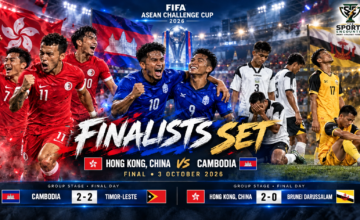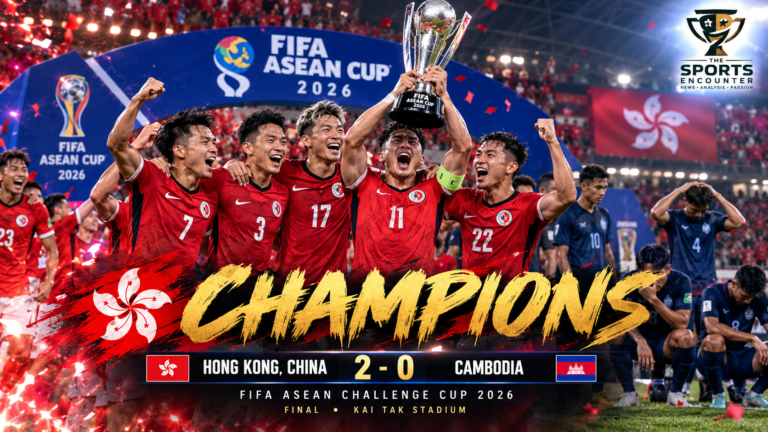
HONG KONG, China, October 3, 2026: Hong Kong, China started the FIFA ASEAN Challenge Cup as hosts.
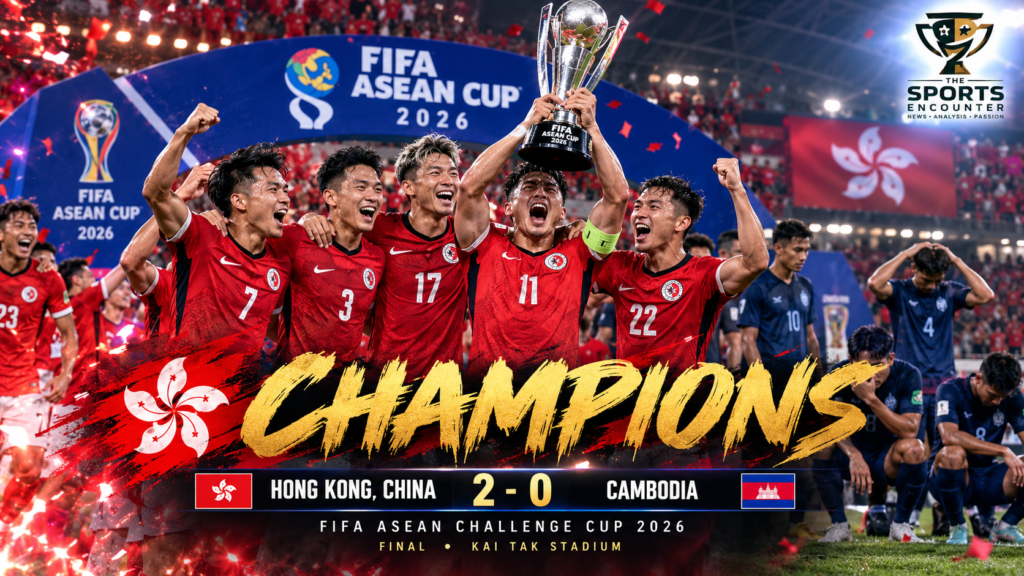
They finished it as the competition’s first champions.
Matt Orr struck four minutes before halftime and Everton Camargo converted a penalty early in the second half as Hong Kong defeated Cambodia 2-0 at Kai Tak Stadium to complete an unbeaten tournament without conceding a single goal.
The victory gave Roberto Losada’s side the inaugural FIFA ASEAN Challenge Cup trophy and completed a perfect three-match campaign.
Story at a glance
Hong Kong vs Cambodia Final at a Glance
The result completed the path outlined in The Sports Encounter’s FIFA ASEAN Cup 2026 tournament preview, where Division 2’s two group winners advanced directly to the final.
Cambodia Start With Confidence but Hong Kong Control the Bigger Chances
Cambodia had a legitimate reason to believe they could spoil the hosts’ night.
Turning Point One: Sun Minghim Finds Orr Before Halftime
Matt Orr had already scored in both of Hong Kong’s group matches.
Everton Camargo Converts the Penalty That Breaks Cambodia
Cambodia still had a route back when the second half began.
Hong Kong’s Defense Turns the Second Goal Into a Wall
The context of the second goal mattered because of what Hong Kong had already established defensively.
Three games.
Three wins.
Eight goals scored.
Zero conceded.
Cambodia arrived in the final with the confidence of having beaten Hong Kong 2-0 in a June friendly and with enough resilience to survive a difficult group stage.
This time, Hong Kong controlled the moments that mattered.
Hong Kong vs Cambodia Final at a Glance
| Match Detail | Information |
|---|---|
| Competition | FIFA ASEAN Challenge Cup 2026 |
| Stage | Final |
| Venue | Kai Tak Stadium, Hong Kong |
| Result | Hong Kong, China 2-0 Cambodia |
| Hong Kong Scorers | Matt Orr 41′, Everton Camargo 52′ pen |
| Halftime | Hong Kong 1-0 Cambodia |
| Champion | Hong Kong, China |
| Runner-up | Cambodia |
| Hong Kong Tournament Record | 3 wins from 3 |
| Goals Scored | 8 |
| Goals Conceded | 0 |
The result completed the path outlined in The Sports Encounter’s FIFA ASEAN Cup 2026 tournament preview, where Division 2’s two group winners advanced directly to the final.
Hong Kong had already established themselves as the strongest team in the competition before kickoff.
The final confirmed it.
Cambodia Start With Confidence but Hong Kong Control the Bigger Chances
Cambodia had a legitimate reason to believe they could spoil the hosts’ night.
They had already beaten Hong Kong 2-0 in June.
They had also reached the final unbeaten after defeating Myanmar and drawing with Timor-Leste.
The Sports Encounter’s final-day Challenge Cup report had identified the contrast clearly.
Hong Kong arrived through control.
Cambodia arrived through survival.
That difference became visible again in the final.
Cambodia remained competitive for most of the first half, but Hong Kong generated the more purposeful attacking moments and gradually forced the visitors deeper.
The pressure finally produced the breakthrough in the 41st minute.
Turning Point One: Sun Minghim Finds Orr Before Halftime
Matt Orr had already scored in both of Hong Kong’s group matches.
He made it three from three when the final needed a decisive moment.
Sun Minghim played the ball through the Cambodian defense and Orr finished in the 41st minute to put Hong Kong ahead.
The timing was crucial.
Cambodia had stayed within the match for almost the entire first half.
Going into halftime at 0-0 would have reinforced their defensive plan and increased the pressure on the hosts.
Instead, Hong Kong reached the interval with control of the scoreboard.
Star Performer: Matt Orr
Orr’s influence across the tournament deserves special recognition.
He scored against Laos.
He scored against Brunei.
He scored in the final.
That consistency made him Hong Kong’s most reliable attacking reference throughout the Challenge Cup.
FIFA had identified Orr as one of the key players before the final, alongside Cambodia striker Andres Nieto. FIFA
Orr won that individual battle.
Everton Camargo Converts the Penalty That Breaks Cambodia
Cambodia still had a route back when the second half began.
That route narrowed almost immediately.
Philip Chan was brought down inside the penalty area early in the second half.
After VAR intervention, Hong Kong were awarded a penalty.
Everton Camargo stepped forward.
He converted.
Hong Kong led 2-0 in the 52nd minute.
That became the final’s decisive second turning point.
Cambodia were no longer trying to find one equalizer.
They needed two goals against a team that had not conceded once throughout the tournament.
Hong Kong’s Defense Turns the Second Goal Into a Wall
The context of the second goal mattered because of what Hong Kong had already established defensively.
They beat Laos 4-0.
They beat Brunei 2-0.
They entered the final with two clean sheets.
Cambodia therefore had to do something nobody had managed in the entire competition.
Break Hong Kong’s defensive structure.
Twice.
It never happened.
Hong Kong’s clean sheet in the final completed a remarkable defensive tournament.
Three matches.
No goals conceded.
That is arguably the clearest statistical explanation for why they became champions.
Cambodia Could Not Repeat the June Blueprint
The most interesting pre-final subplot was Cambodia’s earlier 2-0 victory over Hong Kong.
That result gave Cambodia more than confidence.
It gave them evidence.
They knew they had beaten this opponent before.
Hong Kong knew it too.
FIFA’s official final preview specifically highlighted that June defeat as part of the motivation driving the hosts into the final. FIFA
This time, the competitive environment was completely different.
Hong Kong had the home crowd.
They had tournament rhythm.
They had not conceded.
And they had already solved two very different opponents.
The June result became motivation rather than baggage.
Hong Kong’s Tournament Was Built on Different Match-Winners
One of the strongest aspects of Hong Kong’s campaign was the variety of contributors.
Against Laos, four different players scored:
- Sun Minghim
- Everton Camargo
- Dudu
- Matt Orr
FIFA’s official report on that 4-0 victory showed how many attacking routes Hong Kong possessed. FIFA
Against Brunei, Philip Chan opened the scoring before Orr struck again late.
In the final, Orr and Everton supplied the goals.
That means Hong Kong did not depend entirely on one scorer or one tactical pattern.
They could attack through set pieces.
They could score from open play.
They could create through wide areas.
They could wait for opponents to tire.
They could convert from the penalty spot.
That flexibility separated them from the rest of Division 2.
Cambodia’s Run Still Represents Progress
The defeat should not erase what Cambodia achieved.
They reached the inaugural final after winning Group B.
They defeated Myanmar through Kakada Sin’s stoppage-time strike.
They then recovered from a goal down against Timor-Leste, with Andres Nieto scoring twice in the 2-2 draw that secured qualification.
The Sports Encounter tracked that journey in the Hong Kong and Cambodia final qualification report.
Cambodia also entered this tournament after showing signs of improvement during the ASEAN Championship.
Their 3-0 victory over Timor-Leste had already provided evidence that the team could turn promising spells into results.
Reaching this final added another step.
They simply met a more complete opponent.
Cambodia’s Biggest Problem Was Creating Enough Threat After Falling Behind
Cambodia’s route through the group stage had depended on patience.
Against Myanmar, one late moment was enough.
Against Timor-Leste, they recovered from an early deficit.
A final against Hong Kong demanded something different.
Once Orr scored, Cambodia needed to become more proactive.
That opened more spaces.
Once Everton made it 2-0, the visitors could no longer rely on containment and transitions alone.
Hong Kong were comfortable protecting the lead.
That exposed the gap between Cambodia being difficult to beat and Cambodia being able to take control of a final against the tournament’s strongest side.
Hong Kong Complete a Perfect FIFA ASEAN Challenge Cup
Hong Kong’s route to the trophy was emphatic.
| Match | Result |
|---|---|
| Hong Kong vs Laos | 4-0 |
| Hong Kong vs Brunei Darussalam | 2-0 |
| Hong Kong vs Cambodia | 2-0 |
Final record: Played 3, Won 3, Goals For 8, Goals Against 0.
That record tells the tournament story almost by itself.
Hong Kong were the only team that never needed a recovery.
They were never forced to chase a result.
They never conceded.
The Sports Encounter’s September 30 report had already described them as the tournament’s most complete team.
The final validated that assessment.
Roberto Losada’s Rotation Pays Off
Hong Kong’s tournament management also deserves attention.
Head coach Roberto Losada rotated heavily between the Laos and Brunei matches, protecting key players while maintaining the team’s perfect record.
FIFA highlighted that rotation before the final as a potential advantage because it allowed the hosts to enter the title match fresher. FIFA
The gamble worked.
Hong Kong did not look like a team carrying the physical cost of a compressed tournament.
They remained sharp enough to take control before halftime and immediately increase the pressure after the break.
Matt Orr Finishes as Hong Kong’s Defining Attacker
Orr’s tournament deserves to be remembered beyond the final.
His goals came in three different situations.
Against Laos, he scored from the penalty spot in stoppage time.
Against Brunei, he scored from open play in stoppage time.
Against Cambodia, he struck before halftime when the final was still balanced.
That progression matters.
The first two goals added polish to victories.
The third created one.
That makes the final arguably his most important contribution of the competition.
Everton Camargo’s Influence Goes Beyond the Second Goal
Everton also finished the tournament as one of Hong Kong’s central attacking figures.
He scored against Laos.
He created repeatedly from wide and set-piece areas.
He assisted Orr’s goal against Brunei.
He then scored from the penalty spot in the final.
Hong Kong’s attack worked because players such as Everton could shift between creator and finisher depending on the game state.
Cambodia never found a reliable way to remove that threat.
The Kai Tak Factor Became Part of Hong Kong’s Advantage
The Challenge Cup was hosted entirely in Hong Kong.
That gave Roberto Losada’s side continuity.
Same environment.
Same crowd.
No tournament travel.
Kai Tak became increasingly familiar as the competition progressed.
FIFA’s tournament framework deliberately placed the Challenge Cup in Hong Kong while Division 1 was staged in Indonesia. FIFA
Home advantage alone did not win the trophy.
Hong Kong still had to use it.
Three wins and three clean sheets suggest they did exactly that.
What Does This Title Mean for Hong Kong?
The trophy is significant because it provides something national teams outside Asia’s traditional elite often struggle to obtain.
Meaningful competitive success.
The Challenge Cup gave Hong Kong three matches carrying genuine stakes rather than another international window dominated by isolated friendlies.
Winning the first edition gives the program a benchmark.
It also gives players such as Orr, Everton, Sun Minghim and Philip Chan tournament-winning experience.
That could matter well beyond one regional trophy.
Cambodia Leave Without the Trophy but With a Stronger Baseline
Cambodia will naturally be disappointed.
They had entered the final unbeaten.
They had beaten Hong Kong earlier in the year.
They had an opportunity to become the first champions.
But their tournament should still be evaluated as progress.
They navigated a group they did not dominate.
They showed resilience.
They produced different match-winners.
They reached a FIFA-backed regional final.
The next step is developing enough attacking control to beat stronger opponents when transitions alone are not enough.
Final Verdict: Hong Kong Were the Best Team From First Match to Final
Finals sometimes reward the team that survives one decisive night.
This tournament produced a clearer champion.
Hong Kong were the best team in Division 2 from the moment they beat Laos 4-0.
They confirmed it against Brunei.
They completed it against Cambodia.
Orr scored when the final was still balanced.
Everton made the lead safer.
The defense did what it had done all tournament.
Nothing got through.
Cambodia brought resilience and the memory of a June victory.
Hong Kong brought a deeper attack, a perfect defensive record and the confidence of a team that had already solved every problem placed in front of it.
The inaugural FIFA ASEAN Challenge Cup now has its first champion.
Hong Kong, China.
Continue the Soccer Story
 SoccerVietnam Fight Back to Take Bronze-Final Spot as Philippines Upset Thailand and Pakistan Leave With Signs of Progress
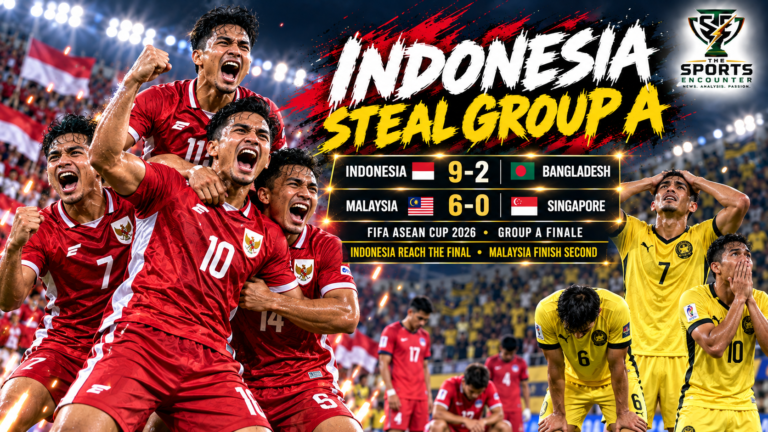 SoccerIndonesia Score Twice at the Death to Steal Group A as Malaysia’s 6-0 Singapore Rout Still Falls Short
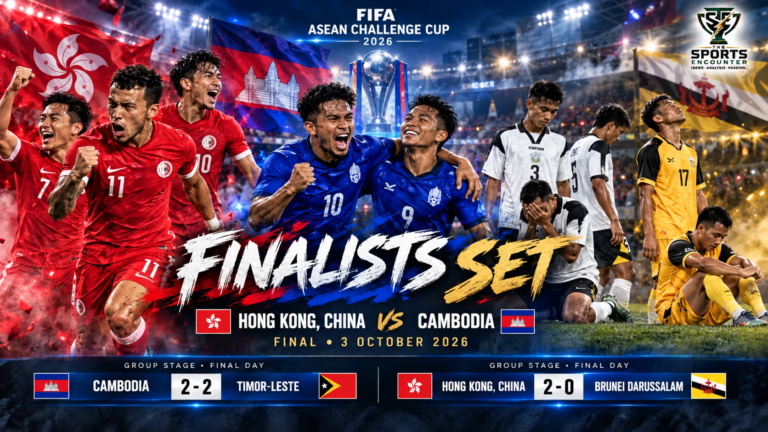 SoccerHong Kong Stay Perfect as Cambodia Survive Timor-Leste Scare to Set Up FIFA ASEAN Challenge Cup Final
FAQs
Who Won the FIFA ASEAN Challenge Cup 2026?
Hong Kong, China won the inaugural tournament after beating Cambodia 2-0 in the final.
Who Scored in Hong Kong vs Cambodia?
Matt Orr scored in the 41st minute and Everton Camargo converted a penalty in the 52nd minute.
Where Was the Final Played?
The final was played at Kai Tak Stadium in Hong Kong.
Did Hong Kong Concede Any Goals in the Tournament?
No. Hong Kong completed all three matches without conceding.
How Many Goals Did Hong Kong Score in the Tournament?
Hong Kong scored eight goals across three matches.
Who Was Hong Kong’s Star Player in the Final?
Matt Orr was one of the decisive performers after scoring the opening goal. Everton Camargo also played a major role by converting the second-half penalty.
How Did Cambodia Reach the Final?
Cambodia beat Myanmar 1-0 and drew 2-2 with Timor-Leste to win Group B with four points.
Had Cambodia Beaten Hong Kong Before the Final?
Yes. Cambodia defeated Hong Kong 2-0 in a June 2026 friendly.
Is This the First FIFA ASEAN Challenge Cup?
Yes. The 2026 competition was the inaugural edition. FIFA created the Challenge Cup as the Division 2 component of the wider FIFA ASEAN Cup structure.
FIFA
- Matt Orr and Everton Camargo Crown Unbeaten Hong Kong as First FIFA ASEAN Challenge Cup Champions
- Vietnam Fight Back to Take Bronze-Final Spot as Philippines Upset Thailand and Pakistan Leave With Signs of Progress
- Indonesia Score Twice at the Death to Steal Group A as Malaysia’s 6-0 Singapore Rout Still Falls Short
- Hong Kong Stay Perfect as Cambodia Survive Timor-Leste Scare to Set Up FIFA ASEAN Challenge Cup Final
- Thailand Take Revenge on Vietnam as Sarach and Otton Seize Control of FIFA ASEAN Cup Group B