NFL Stars vs Flag Football Specialists: Who Should Make Team USA’s 10-Man LA28 Roster?
NFL superstars have been cleared to pursue Olympic flag football, but Team USA has only 10 roster spots for LA28. From Lamar Jackson and Patrick Mahomes to Justin Jefferson, Travis Hunter and established flag specialists such as Darrell Doucette, the real battle is about fit, versatility, chemistry and who can master five-on-five football fastest.
Ten places.
That may become the most important number in American football before the Los Angeles Olympics.
NFL players have been cleared to pursue Olympic flag football at LA28. The United States possesses more elite professional football talent than any country on Earth, and some of the league’s biggest names have already expressed interest in playing for Olympic gold.
Yet Team USA cannot simply gather its most famous quarterback, running back, receivers and defensive stars and expect the medals to follow.
Olympic flag football uses a 10-player roster.
Only five players are on the field at a time.
Traditional offensive and defensive lines disappear. Blocking disappears. Flag pulling replaces tackling. The center becomes a receiving option. Space matters differently. Players capable of contributing in several roles become extraordinarily valuable.
Then comes another complication.
The United States already has world-champion flag football players.
Darrell “Housh” Doucette III and other established specialists have spent years mastering a format NFL players are only beginning to seriously explore.
So the question heading toward 2028 is much more interesting than asking which NFL superstars want to go to Los Angeles.
Which ones actually make Team USA better?
This seventh installment in The Sports Encounter’s Flag Football LA28 series examines the NFL skill sets that could translate best, the roster constraints selectors will face, and the players who currently look capable of forcing their way into America’s Olympic plans.
Team USA’s LA28 Flag Football Problem at a Glance
| Factor | Why It Matters |
|---|---|
| Olympic roster | Only 10 players |
| Players on field | Five per team |
| NFL participation | NFL players have been approved to pursue Olympic selection |
| Selection authority | USA Football selects the U.S. National Teams |
| NFL club restriction | The league framework limits participation to one player per NFL club, plus designated international-player provisions |
| Blocking | Traditional blocking is absent |
| Roster priority | Speed, route running, coverage, flag pulling, decision-making and versatility |
| Biggest selection debate | NFL talent versus experienced flag specialists |
The NFL confirmed in May 2025 that its clubs had approved player participation at LA28, while USA Football maintains the national-team selection pathway.
The distinction matters.
NFL approval gives professional stars access to the Olympic opportunity.
It does not give them Olympic roster places.
Ten Olympic Places Change Everything
An NFL roster can afford specialists.
Olympic flag football cannot.
LA28 teams will carry 10 athletes, with five players on the field at a time.
That encourages a completely different approach to squad building.
A player capable of lining up at receiver, carrying the football, defending in space and contributing near the goal line may be more valuable than somebody who is historically great at one NFL position.
This is why projecting an Olympic roster by simply ranking NFL players misses the point.
USA Football must construct a team.
The Sports Encounter’s guide to Olympic flag football tactics explains why five-on-five spacing creates different demands from conventional tackle football.
Those demands should shape every selection decision.
The Quarterback Decision Could Define Team USA
No position will attract more attention.
The United States could theoretically choose from several quarterbacks possessing extraordinary NFL credentials.
But flag football does not automatically reward the quarterback with the strongest arm or the biggest professional résumé.
The ball often has to leave quickly.
Receivers operate within compressed route combinations.
The blitzer changes timing.
Goal-line passing requires precision inside restricted space.
The quarterback also has to understand a rule set that can punish NFL habits.
That is why the selection conversation should begin with fit.
Lamar Jackson Looks Built for the Geometry of Flag Football
Lamar Jackson immediately enters any serious hypothetical Team USA discussion because he changes the dimensions of a football field.
His value would extend beyond simply running.
Defenses have spent his NFL career accounting for his movement before the play has fully developed.
Flag football magnifies the importance of space.
Five defenders cannot hide mistakes as easily as 11.
A quarterback who can manipulate defenders through movement, change throwing angles and punish aggressive pressure could force opponents into difficult choices.
Jackson’s arm also prevents defenses from treating him purely as an athlete.
There would still be an adjustment.
Olympic flag football does not provide an NFL offensive line, and familiar scramble solutions do not transfer perfectly into the international game.
Jackson would have to learn the rhythm rather than simply improvise around it.
If he did, his athletic profile could become devastating.
Patrick Mahomes Would Bring a Different Kind of Advantage
Patrick Mahomes represents another route.
Mahomes’ greatest flag-football asset may be his ability to create throwing solutions from unusual body positions.
The sport constantly asks quarterbacks to manufacture clean passing angles while pressure approaches and receivers move rapidly through open space.
Mahomes has spent his NFL career solving similar spatial problems, albeit within a very different structure.
His ability to alter arm angles, throw accurately while moving and process coverage quickly would translate naturally.
The concern would be exactly the same as with every superstar quarterback.
How much flag-specific preparation would he receive before Olympic selection?
Talent gets a player into the conversation.
Mastery of the format should determine whether he stays there.
Jayden Daniels Could Be a Fascinating 2028 Fit
Age also matters when projecting two years into the future.
Jayden Daniels belongs to a generation of quarterbacks whose athletic profile appears naturally compatible with flag football.
Quick processing, mobility and the ability to attack different levels of the field all matter.
By 2028, selectors will have far more evidence about how his game has developed.
That is important because any roster projection made in 2026 should remain provisional.
Two NFL seasons can radically change the hierarchy.
Injuries happen.
Young players improve.
Veterans decline.
Contracts change.
Some stars who currently want to play may eventually decide against it.
Others may become serious candidates after spending time in USA Football’s pathway.
And Then There Is Darrell Doucette
This is where the discussion becomes uncomfortable for anyone assuming an NFL quarterback automatically takes over Team USA.
Darrell “Housh” Doucette III already knows how to win international flag football games.
He has quarterbacked the United States at world-championship level and helped establish the American men as the international benchmark.
Our guide to the flag football stars shaping the road to LA28 explains why Doucette’s experience cannot be treated as a ceremonial footnote once NFL players enter the picture.
The quarterback decision therefore may become a referendum on what Team USA believes Olympic flag football requires.
Does superior NFL athletic talent outweigh years of flag-specific chemistry?
Can an NFL quarterback learn the format quickly enough to become genuinely better than a world champion already running the offense?
Could Team USA carry both?
With only 10 places, even that final option carries a cost.
Justin Jefferson May Have One of the Cleanest NFL-to-Flag Skill Translations
If the United States wants an NFL receiver whose game already revolves around route intelligence, body control and separation, Justin Jefferson would make obvious sense.
Flag football rewards receivers who understand where defenders are positioned and how to manipulate them.
That is Jefferson’s world.
There is another advantage.
Olympic receivers will not need to survive NFL-style collisions after every catch.
The challenge becomes creating enough space to receive the football and then making the first defender miss the flag.
Jefferson’s footwork and open-field awareness would give him an enticing foundation.
The question would again be adaptation.
Flag routes are connected to the movement of four other offensive players inside a very different geometry.
The best flag receiver does more than win his own matchup.
He helps make the entire formation work.
Ja’Marr Chase Could Turn Short Space Into a Major Problem
Ja’Marr Chase offers something slightly different.
His acceleration after the catch could become extremely valuable because a missed flag pull can immediately create open field.
Olympic flag offenses do not need every completion to travel 30 yards through the air.
A five-yard throw can become a major gain when the receiver catches the ball with leverage and defeats the first flag-pulling angle.
That makes short-area explosiveness particularly useful.
Chase also presents a compelling red-zone option because the field becomes compressed inside the no-run zone.
Separation has to happen quickly.
Strong hands, body control and immediate acceleration matter.
Tyreek Hill Helped Start the Olympic NFL Conversation
Tyreek Hill was among the NFL stars publicly connected with interest in Olympic flag football soon after the league opened the door to participation.
The attraction is obvious.
Few football players have demonstrated more ability to turn open space into panic.
Yet LA28 arrives in 2028.
Selectors cannot choose a roster based on reputation from 2025 or 2026.
Hill’s case, like that of every veteran candidate, will depend on his physical level, availability and flag-football preparation when selection actually arrives.
That principle should govern the entire process.
Olympic roster spots are too scarce for nostalgia.
Travis Hunter Represents the Kind of Player Olympic Rosters May Reward
Travis Hunter may represent the most interesting roster-building archetype.
His background as a genuine two-way football player immediately makes him relevant to a 10-man squad.
Olympic rosters reward flexibility.
A player who can contribute as a receiver and defensive back gives coaches more lineup combinations without consuming another roster spot.
That does not mean NFL two-way ability automatically becomes flag two-way ability.
Flag pulling requires technique.
Coverage spacing changes.
Contact rules alter defensive leverage.
Offensive routes operate within a different structure.
Still, the underlying principle matters.
Versatility buys roster freedom.
With only 10 selections available, that freedom could become one of USA Football’s most valuable currencies.
Defensive Backs May Be More Important Than Casual Fans Expect
The glamour will surround quarterbacks and receivers.
Olympic medals could be decided by defenders.
Flag football creates enormous amounts of open space.
Coverage mistakes become expensive quickly.
Defenders need speed, anticipation and disciplined angles.
Then they have to finish the play by pulling a flag.
That last part deserves emphasis.
An NFL defensive back can deliver a technically excellent tackle and still have to relearn how to finish in flag football.
A defender arriving too aggressively can overrun the ball carrier.
A player reaching incorrectly can miss the flag completely.
The ideal Olympic defensive back therefore requires restraint as well as athleticism.
Patrick Surtain II Has the Coverage Profile Selectors Should Study
Patrick Surtain II represents the type of elite NFL cornerback whose coverage intelligence could translate strongly.
Flag football places defenders in repeated one-on-one and space-management situations.
They must understand leverage without relying on physical disruption.
Surtain’s ability to stay connected to receivers and process route development would make him an intriguing candidate if he pursued the Olympic pathway.
The key phrase is if he pursued it.
A fantasy roster and a national-team roster are different exercises.
USA Football has to evaluate athletes who actually enter the selection process and demonstrate that they can perform within the format.
Micah Parsons Would Create an Entirely Different Defensive Question
There is also room for a player whose value comes from pressure.
Flag football’s seven-yard blitz rule creates a specialized defensive weapon.
A blitzer has to cover ground quickly enough to alter quarterback timing.
That naturally makes explosive NFL defenders intriguing.
Micah Parsons has the acceleration and closing ability that would make quarterbacks notice him before every snap.
But the position would still require learning.
A flag-football blitzer does not win through contact.
He wins by destroying time.
The objective is often to force an early throw rather than physically overwhelm a blocker, because there is no conventional blocker standing between the rusher and quarterback.
Parsons’ athletic gifts would be obvious.
His Olympic value would depend on how effectively those gifts could be translated into flag-specific pressure.
The One-Player-Per-NFL-Team Rule Creates Hidden Selection Politics
This may become one of the most fascinating roster constraints.
The NFL’s approved participation framework was built around a limit of no more than one participating player from an NFL club, alongside provisions involving designated international players representing their countries.
That means selectors cannot necessarily choose every ideal combination if multiple candidates come from the same franchise.
Imagine one NFL team has an elite quarterback and an elite receiver who both become serious Team USA candidates.
Choosing one can eliminate the other.
The question becomes comparative.
Is the quarterback’s advantage over the next-best available quarterback larger than the receiver’s advantage over another receiver?
This is roster economics without a salary cap.
Established Flag Specialists Are Competing for Real Places
The NFL conversation can easily obscure the most important fact about Team USA.
America already has elite flag football players.
The U.S. men recovered from their historic 2026 World Championship loss to American Samoa and still won the global title.
That tournament reinforced two ideas at once.
Team USA remains exceptionally strong.
It can also be beaten.
Our analysis of who can challenge Team USA at LA28 showed how rapidly the international competitive picture is developing.
Replacing established specialists simply because NFL names become available could damage the chemistry that created American success in the first place.
Why Team USA Should Probably Build a Hybrid Roster
The strongest solution may eventually sit between the two extremes.
A team consisting entirely of existing flag specialists could leave extraordinary NFL talent unused.
A team consisting entirely of NFL stars could sacrifice experience in the actual Olympic sport.
A hybrid roster offers another possibility.
Keep several established flag players who understand the system.
Add NFL athletes whose skill sets clearly solve specific problems.
Make every NFL candidate earn his role through meaningful flag competition and training rather than reputation.
That would allow USA Football to preserve institutional knowledge while raising the athletic ceiling.
Our earlier comparison of flag football and NFL football explained why this matters. The two formats share core football intelligence while demanding different habits.
A Hypothetical Team USA Roster Blueprint
This is not a prediction of the final Olympic team.
It is a roster-building model.
| Roster Function | Possible Allocation | What Team USA Needs |
|---|---|---|
| Quarterbacks | 1-2 | Rapid processing, accuracy, movement, flag-specific timing |
| Receivers/Offensive athletes | 3-4 | Separation, route intelligence, yards after catch, red-zone value |
| Two-way athletes | 2-3 | Ability to contribute offensively and defensively |
| Coverage specialists | 2-3 | Open-field coverage, anticipation, flag pulling |
| Rush specialist | 1 | Acceleration from the seven-yard blitz position |
Several players could fill more than one category.
That overlap is the point.
The more jobs one athlete can perform, the more tactical flexibility coaches gain from a tiny roster.
What an NFL Player Would Have to Prove Before LA28
Celebrity should carry almost no weight once training begins.
An NFL candidate should have to demonstrate several things.
1. Can he operate without blocking?
Much of NFL football is built around protection and physical leverage.
Flag football removes both.
2. Can he understand five-on-five spacing?
The field opens dramatically with fewer players.
Routes, coverage and quarterback reads all change.
3. Can he pull flags consistently?
Defensive reputation means little if the player repeatedly misses the mechanism that actually ends the play.
4. Can he play more than one role?
Ten roster places reward versatility.
5. Can he develop chemistry quickly?
Olympic tournaments do not provide months for combinations to develop.
6. Can he accept a smaller role?
A player who receives 150 NFL targets may become one option among several in flag football.
Olympic success requires adaptation in ego as well as technique.
LA28 Scheduling Helps the NFL Participation Plan
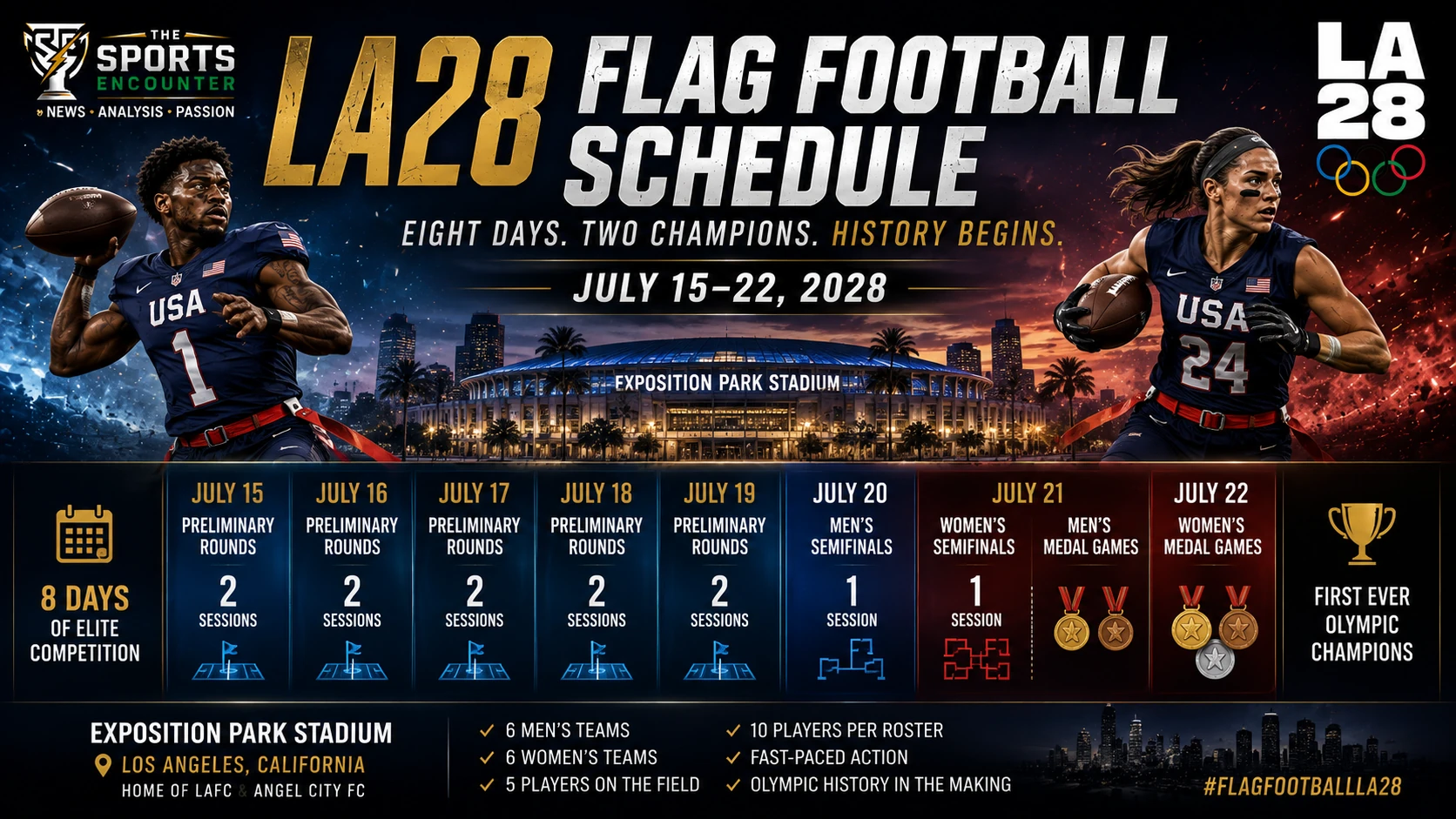
Flag football is scheduled during the first week of the Los Angeles Games, from July 15 through July 22, 2028.
That timing was welcomed because it reduces potential overlap with the heart of NFL training-camp preparation.
The schedule does not eliminate every club concern.
Teams will still think about injury risk, preparation and workload.
Yet the league has already created safeguards around Olympic participation, including provisions relating to injuries, medical standards and conflicts with NFL commitments.
That gives the project significantly more credibility than it had when Olympic flag football was first announced.
The 2026 World Championships Raised the Stakes for NFL Players
NFL stars will not be entering a ceremonial tournament.
Düsseldorf made that clear.
American Samoa defeated the U.S. men 38-32 in group play.
The Americans recovered and won the world championship, but their long unbeaten run had already disappeared.
Canada defeated the United States in the women’s final.
Mexico remains a major force.
Italy reached the men’s championship game.
Japan continues developing a technically sophisticated program.
The qualification field is deliberately small.
Our guide to how teams qualify for LA28 flag football explains why only six countries in each gender will reach the Olympic tournament.
A Team USA roster assembled primarily for marketing value would be asking for trouble.
What Would the Perfect NFL Flag Football Player Look Like?
The ideal player probably combines traits that normally belong to several NFL positions.
Receiver movement.
Defensive-back agility.
Quarterback awareness.
Open-field acceleration.
Reliable hands.
Enough humility to relearn familiar football concepts.
That last requirement may matter more than expected.
The NFL stars most likely to succeed will probably be the ones who approach flag football as a sport worth learning rather than a simplified version of their day job.
TSE Analysis: Team USA Should Make NFL Stars Beat the Flag Specialists
The United States has the luxury of choosing between two extraordinary talent pools.
That should be treated as an advantage rather than a conflict.
Established flag players deserve neither automatic roster places nor automatic displacement.
NFL players deserve the same treatment.
Put them into the pathway.
Test them.
Measure their impact.
Make the roster increasingly difficult to enter.
If Lamar Jackson learns the international game and becomes clearly more effective than every other quarterback, select him.
If an established flag quarterback remains the better option after direct competition, keep the specialist.
If Justin Jefferson, Travis Hunter or another NFL star demonstrates elite two-way Olympic value, the résumé should speak for itself.
That approach protects the integrity of the national team while still allowing the NFL’s remarkable talent to elevate it.
The Women’s Team Shows Why Flag Football Identity Matters
The NFL dominates discussion around the U.S. men because it supplies an obvious pool of professional male football stars.
The women’s tournament offers a different model.
Its leading players have built their reputations through flag football itself.
Vanita Krouch and other established U.S. players have spent years growing the international game.
The rise of women’s flag football also gives the Olympic tournament an opportunity to create stars whose fame begins within the sport rather than arriving from the NFL.
That could ultimately become one of LA28’s most important legacies.
The Selection Debate Will Become Bigger With Every NFL Season
Any 2026 shortlist should be viewed as a snapshot.
By the summer of 2028, the NFL will have produced new stars.
Some current candidates will be in different phases of their careers.
Others may decide that Olympic participation does not fit their professional plans.
Several players who barely appear in the conversation today could become obvious candidates.
Meanwhile, flag specialists will continue competing internationally and strengthening their own cases.
That gives USA Football something rare.
Two full years of evidence.
The selectors should use all of it.
Frequently Asked Questions
Can NFL players compete in flag football at the 2028 Olympics?
Yes. NFL clubs approved player participation in Olympic flag football in May 2025, allowing players to pursue selection for their national teams.
Does an NFL player automatically make Team USA?
No. USA Football is responsible for selecting and leading the U.S. National Teams. NFL players must become eligible and satisfy the national selection process.
How many players will Team USA have at LA28?
The Olympic flag football roster contains 10 athletes.
How many players are on the field?
Five players from each team compete at a time.
Could Lamar Jackson play Olympic flag football?
NFL players are eligible to pursue Olympic selection under the approved participation framework. Jackson’s mobility and passing ability make him an obvious hypothetical fit, but the final roster will depend on USA Football’s selection process and player availability.
Could Patrick Mahomes play at LA28?
Yes, provided he pursues the national-team pathway, satisfies eligibility and selection requirements, remains available and is chosen by USA Football.
Will Darrell Doucette lose his place to an NFL quarterback?
There is no automatic outcome. Doucette’s international flag-football experience gives him a strong case, while NFL quarterbacks would bring different athletic and professional strengths. The competition for Olympic roster spots should ultimately be decided through USA Football’s selection process.
Can more than one player from the same NFL team participate?
The NFL participation framework includes a limit of one player per NFL club, with separate provisions involving designated international players representing their countries.
When will Olympic flag football be played at LA28?
The competition is scheduled for July 15-22, 2028, during the first week of the Los Angeles Olympic Games.
Where can new fans learn the basic flag football rules?
Start with The Sports Encounter’s complete guide to flag football rules, scoring and LA28.
Ten Places Could Create the Hardest Team USA Selection in Los Angeles
The United States will probably enter its home Olympics with the deepest available football talent pool in the tournament.
That does not make the selection easy.
It makes it brutal.
World champions are already inside the program.
NFL superstars are approaching from outside it.
The Olympic roster contains room for only 10.
Every selection will therefore answer a question about what USA Football believes matters most.
Experience?
Raw athletic ability?
Versatility?
Flag-specific technique?
Professional pedigree?
Chemistry?
The strongest Team USA will probably require pieces of all six.
That is why the next two years should be treated as an audition rather than a coronation.
Los Angeles does not need the ten most famous American football players.
It needs the ten players who can become the best flag football team.
Follow The Sports Encounter’s NFL coverage as the Olympic selection picture develops, along with every installment of our Flag Football LA28 series.

Breaking News
Jhon Durán Double Powers Celtic Past LASK 3-0 in Champions League Playoff
Celtic moved within touching distance of the Champions League league phase after a 3-0 first-leg win over LASK, powered by a Camilo Durán brace and Benjamin Nygren’s opener.
Celtic have taken a commanding step toward the 2026-27 UEFA Champions League group phase after beating LASK 3-0 at Celtic Park, with Camilo Durán scoring twice and Benjamin Nygren producing another decisive performance on a night when the Scottish champions combined ruthless finishing with enough defensive warning signs to keep the tie alive.
Nygren opened the scoring in the 26th minute before Durán struck in the 38th and 67th minutes, giving Celtic a three-goal advantage ahead of the second leg in Austria on August 25.
The scoreline looks emphatic. The match itself was more complicated.
LASK threatened repeatedly, had two first-half efforts ruled out for offside and created enough opportunities to remind Celtic that qualification is not complete. The difference came in the penalty areas, where Celtic were clinical and LASK were not.
That combination leaves Martin O’Neill’s side in an excellent position, but it also gives the return leg a clear tactical question: can Celtic control the tie rather than simply defend their lead?
For more global club football, transfers and match analysis, follow The Sports Encounter’s soccer coverage.
Celtic vs LASK: Match Summary
| Detail | Information |
|---|---|
| Competition | UEFA Champions League 2026-27 Playoff, First Leg |
| Match | Celtic vs LASK |
| Date | August 19, 2026 |
| Venue | Celtic Park |
| Result | Celtic 3-0 LASK |
| Halftime | Celtic 2-0 LASK |
| Scorers | Benjamin Nygren 26′, Camilo Durán 38′, 67′ |
| Second Leg | August 25, 2026 |
| Second-Leg Venue | Oberösterreich Arena, Austria |
| Aggregate Score | Celtic lead 3-0 |
The result and goalscorers are confirmed by the official UEFA Champions League match center, while LASK’s official match page also records the 3-0 first-leg defeat and the same scoring sequence.
Nygren Gives Celtic the Breakthrough
Celtic needed someone to change the rhythm of a tense opening period, and Benjamin Nygren delivered.
The Swedish midfielder struck in the 26th minute to give the hosts control at a point when LASK had already shown they could threaten.
That goal mattered beyond the scoreboard.
Celtic had started with energy, but LASK were willing to play forward and attack space rather than sit deep and survive. The Austrian side’s early ambition meant Celtic needed a moment capable of changing the emotional direction of the game.
Nygren provided it.
He has already shown an ability to arrive in important attacking areas this season, and this was another example of why he has become one of Celtic’s most reliable scoring threats from midfield.
The broader European club landscape is changing quickly this summer, something The Sports Encounter has also tracked through major moves such as Rodri’s transfer from Manchester City to Barcelona and Guglielmo Vicario’s move to Juventus.
Durán Turns Control Into a Serious Advantage
If Nygren’s opener settled Celtic, Durán’s first goal changed the tie.
The Colombian forward made it 2-0 in the 38th minute, giving Celtic the cushion they needed before halftime.
His second arrived in the 67th minute and effectively transformed a strong home win into a result that places LASK under enormous pressure.
Durán’s brace was the defining individual performance of the night.
He did more than finish chances.
His movement stretched LASK’s defensive line, his willingness to attack space gave Celtic an outlet when the game opened up, and his intensity without the ball helped prevent the visitors from building comfortably through midfield.
Martin O’Neill praised the forward after the match, highlighting the complete nature of his contribution rather than only the goals.
That matters because Celtic did not sign Durán simply to provide occasional moments of brilliance. They need a forward who can influence European ties over 90 minutes, particularly when matches become physical and transitional.
Durán’s Two Goals Changed the Mathematics
The first Durán goal gave Celtic halftime control.
The second changed the return leg.
A 2-0 first-leg lead would still have left LASK with a realistic route back into the tie in Austria. At 3-0, the equation becomes much harder.
LASK now need at least three unanswered goals in the second leg simply to force extra time.
That does not make Celtic safe.
It does, however, allow O’Neill to approach the return match from a position of tactical strength rather than uncertainty.
LASK Were More Dangerous Than the Score Suggests
This is the part Celtic cannot ignore.
LASK created chances.
They also had two first-half efforts ruled out for offside, and there were periods when their direct attacking play caused real problems.
Samuel Adeniran’s physical presence gave Celtic’s center-backs work throughout the evening, while LASK repeatedly tried to exploit space before Celtic could reset defensively.
The 3-0 scoreline therefore reflects Celtic’s finishing efficiency more clearly than complete territorial dominance.
That is why O’Neill’s caution after the match made sense.
The tie is heavily tilted toward Celtic, but the return leg cannot become a passive exercise in defending the aggregate score.
LASK’s official schedule confirms that the second leg will be played on August 25 at 9:00 PM local time at the Oberösterreich Arena. The fixture is listed through the club’s official second-leg match page.
Colby Donovan Gives Celtic Another Reason to Believe
While Durán and Nygren supplied the headline moments, Colby Donovan produced one of the most important supporting performances.
The young right-back stepped into a high-pressure Champions League playoff and handled the occasion with remarkable composure.
His passing was crisp, his positioning held up under pressure, and he continued to push forward rather than retreat into a purely defensive role.
That performance matters because elite European qualification often exposes squad depth more brutally than domestic football.
Celtic cannot rely on the same eleven players throughout a long campaign.
Donovan’s display suggested they may have another option capable of handling significant minutes if required.
Celtic’s European Timing Could Hardly Be Better
The Scottish champions arrived at this tie in strong attacking form.
They had already produced convincing domestic performances before facing LASK, and several of their attacking players entered the playoff with confidence.
That matters in August, when Champions League qualification often arrives before teams have completely settled into the new season.
Across Europe, clubs are still adjusting to new players, new managers and new tactical ideas. The Sports Encounter has been following that uncertainty through our Serie A 2026-27 season preview and our analysis of José Mourinho’s return to Real Madrid.
Celtic’s advantage is that their key attacking pieces already look sharp enough to decide important matches.
Why the Champions League League Phase Matters So Much
The sporting reward is obvious.
Qualifying for the league phase puts Celtic back among Europe’s biggest clubs and guarantees a schedule filled with elite opponents.
The financial consequences are also substantial.
Champions League qualification brings prize money, broadcast revenue, matchday income and commercial exposure that can shape a club’s entire season.
That money affects recruitment.
It affects contract decisions.
It affects how aggressively Celtic can strengthen before the transfer window closes.
UEFA confirms that the 2026-27 qualifying process concludes on August 26, with seven league-phase places being decided through qualification. The competition structure and qualifying pathway are available through UEFA’s official Champions League qualifying guide.
Celtic Need to Resist the Temptation to Protect the Lead Too Early
The most dangerous approach in Austria would be to treat the tie as finished.
A three-goal advantage creates security, but it can also create hesitation.
Teams protecting large first-leg leads often retreat too early, concede territory and allow opponents to build belief.
Celtic should have enough attacking quality to avoid that trap.
If they continue pressing selectively and threaten LASK in transition, the Austrian side will have to balance ambition with defensive risk.
That is the position Celtic want.
The first goal in the second leg could effectively end the contest.
If Celtic score it, LASK would need four.
If LASK score it, the atmosphere changes immediately.
European Football Is Entering a High-Pressure August
The Champions League playoff round arrives at a particularly intense point in the club calendar.
Teams are trying to qualify for Europe while still completing transfer business and adjusting tactical structures.
That pressure is visible across the continent.
The Sports Encounter recently examined how Premier League refereeing and VAR transparency will change in 2026-27, while major clubs continue reshaping squads before domestic campaigns fully settle.
Saudi clubs are also influencing the European market, highlighted by Al-Hilal’s reported £38 million bid for Ollie Watkins.
Celtic’s immediate concern is more straightforward.
They have 90 minutes left to protect one of the most valuable advantages they will hold all season.
First-Leg Turning Points
26th Minute: Nygren Breaks the Tension
LASK had shown enough threat to make Celtic Park uncomfortable, but Nygren’s opener shifted the momentum toward the hosts.
38th Minute: Durán Makes It 2-0
The Colombian’s first goal gave Celtic control before halftime and forced LASK to reconsider how aggressively they could chase the game.
67th Minute: Durán Creates a Three-Goal Cushion
The second Durán goal became the night’s decisive moment because it changed the return leg from a recovery opportunity into a major uphill battle for LASK.
LASK’s Disallowed Goals
The offside decisions prevented the visitors from gaining the reward their attacking play occasionally threatened to produce. They also offered Celtic a warning about what could happen if the second leg becomes too passive.
TSE Player Ratings
| Player | Rating | Assessment |
|---|---|---|
| Camilo Durán | 9/10 | Two goals, constant movement and the performance that changed the tie. |
| Benjamin Nygren | 8.5/10 | Opened the scoring and gave Celtic the breakthrough they desperately needed. |
| Colby Donovan | 8/10 | Composed under pressure and confident moving forward from right-back. |
| Cameron Carter-Vickers | 7.5/10 | Handled a difficult physical contest and helped preserve the clean sheet. |
| Kieran Tierney | 8/10 | Provided quality from the left and contributed to Celtic’s attacking control. |
What Celtic Need in Austria
Celtic do not need another spectacular night.
They need control.
The ideal second-leg performance would involve:
- Managing the opening 20 minutes without conceding momentum.
- Keeping enough attacking threat to prevent LASK from committing everyone forward.
- Avoiding unnecessary fouls around the penalty area.
- Using possession to slow the game when necessary.
- Looking aggressively for the away goal that could effectively finish the tie.
If Celtic execute those basics, their three-goal cushion should be enough.
What LASK Must Change
LASK’s route back into the playoff begins with efficiency.
They created enough at Celtic Park to believe they can score in Austria.
The problem is that chances alone mean very little when the opponent scores three times.
The Austrian champions now need an almost perfect balance between aggression and defensive discipline.
They cannot spend the entire second leg attacking recklessly because Celtic’s pace and movement would punish the spaces left behind.
But they also cannot wait.
That tension will shape the return match.
Celtic Are Close, but the Tie Is Not Finished
Three goals at Celtic Park have changed the entire qualification picture.
Nygren gave Celtic control.
Durán gave them separation.
The clean sheet gave them insurance.
Now the job is to make sure those advantages survive the trip to Austria.
There is a wider lesson here too.
Champions League qualification is rarely decided by reputation. It is decided by moments, finishing and the ability to handle pressure before the season has fully settled.
Celtic handled those moments better on Wednesday night.
That is why they are now 90 minutes away from the league phase.
Readers following club football across Europe and Asia can also explore The Sports Encounter’s coverage of the AFC Champions League Elite draw, where another group of major clubs are preparing for their own continental tests.
Final Word
Celtic’s 3-0 victory gives them exactly what every team wants from a Champions League playoff first leg: margin for error.
Durán’s double will dominate the headlines, and rightly so.
Nygren’s opener was equally important because it changed the emotional direction of the match before LASK could convert their early pressure into something tangible.
The performance was convincing without being flawless.
That distinction should keep Celtic focused.
LASK created enough to remain dangerous. Celtic finished enough to leave them desperate.
Next Tuesday in Austria, Celtic do not need another statement.
They only need to finish what they started.
Frequently Asked Questions
What was the Celtic vs LASK score?
Celtic beat LASK 3-0 in the first leg of their UEFA Champions League playoff at Celtic Park on August 19, 2026.
Who scored for Celtic against LASK?
Benjamin Nygren scored in the 26th minute, while Camilo Durán scored twice in the 38th and 67th minutes.
When is LASK vs Celtic second leg?
The second leg is scheduled for August 25, 2026 at the Oberösterreich Arena in Austria.
What is the aggregate score between Celtic and LASK?
Celtic lead 3-0 on aggregate after the first leg.
How many goals does LASK need in the second leg?
LASK need at least three unanswered goals to level the aggregate score and force extra time. If Celtic score in Austria, LASK’s task becomes significantly harder.
Who was Celtic’s best player against LASK?
Camilo Durán produced the defining performance with two goals, while Benjamin Nygren and Colby Donovan were also among Celtic’s strongest performers.
Are Celtic already through to the Champions League league phase?
No. Celtic still have to complete the second leg in Austria. Their 3-0 advantage places them in a very strong position, but qualification is not official until the playoff is completed.
Breaking News
Saudi Arabia Transfers 25% Stakes in Four Football Giants as Privatization Push Enters New Phase
Saudi Arabia has begun transferring the remaining nonprofit stakes in four of its biggest football clubs, pushing Al-Nassr, Al-Ittihad, Al-Ahli and Al-Hilal deeper into the Kingdom’s evolving privatization strategy.
Saudi Arabia has begun transferring the remaining 25 percent stakes held by nonprofit entities in Al-Nassr, Al-Ittihad, Al-Ahli and Al-Hilal to the Public Investment Fund, marking another major step in the Kingdom’s effort to reshape the ownership and governance of its biggest football clubs.
The Ministry of Sport said the process had started after the completion of the required regulatory procedures. The boards of directors of the nonprofit entities connected with the four clubs are also being dissolved as part of the transition.
The change matters because those nonprofit bodies had retained 25 percent stakes when Saudi Arabia reorganized the four clubs under a PIF-led model in 2023. PIF took 75 percent stakes at the time, providing the financial and institutional foundation for one of the most aggressive football expansion projects in the world.
Three years later, the structure is changing again.
The development should not be read as a simple permanent move toward 100 percent PIF ownership across all four clubs. Al-Hilal are already following a different path after PIF signed a binding agreement in April 2026 for Kingdom Holding Company to acquire a 70 percent controlling stake in Al-Hilal Club Company.
The broader direction is becoming clearer. Saudi Arabia is moving its leading football clubs toward more commercial ownership models, stronger corporate governance and greater private-sector participation.
Saudi Club Ownership Shake-Up at a Glance
| Club | 2023 Ownership Structure | Latest Development |
|---|---|---|
| Al-Nassr | PIF 75%, nonprofit entity 25% | Nonprofit 25% stake being transferred to PIF |
| Al-Ittihad | PIF 75%, nonprofit entity 25% | Nonprofit 25% stake being transferred to PIF |
| Al-Ahli | PIF 75%, nonprofit entity 25% | Nonprofit 25% stake being transferred to PIF |
| Al-Hilal | PIF 75%, nonprofit entity 25% | Nonprofit stake transfer begins alongside separate Kingdom Holding transaction |
The ownership structures above reflect the 2023 framework and subsequent officially announced transactions. Al-Hilal requires separate treatment because of the Kingdom Holding agreement announced in April 2026.
What Saudi Arabia Is Changing
The fresh development concerns the remaining 25 percent stakes held by nonprofit foundations associated with Saudi Arabia’s four highest-profile clubs.
Those organizations formed part of the original ownership model created when the Kingdom launched the Sports Clubs Investment and Privatization Project.
The Saudi Press Agency’s official announcement of the original privatization project confirms that the initiative was launched in June 2023 as part of a broader effort to increase investment in Saudi sport and move clubs toward more commercially sustainable structures.
PIF subsequently acquired 75 percent stakes in Al-Hilal, Al-Nassr, Al-Ittihad and Al-Ahli, while the nonprofit foundations retained the remaining 25 percent.
The transfer of those remaining stakes removes another layer from that original structure.
It also gives Saudi authorities greater flexibility as they determine what the long-term ownership model for each club should eventually look like.
The 2023 Model Was Always Part of a Larger Transformation
The 2023 restructuring became best known internationally because of what followed in the transfer market.
Saudi clubs began recruiting players with global recognition while simultaneously expanding their commercial reach, infrastructure and international profile.
Cristiano Ronaldo had already transformed Al-Nassr’s visibility, while the arrival of other elite names dramatically increased attention around the Saudi Pro League.
The Sports Encounter has followed Ronaldo’s late-career evolution closely, including our detailed look at Cristiano Ronaldo’s World Cup career, records and final tournament.
That global attention created an obvious commercial opportunity for Saudi football.
The more difficult challenge has always been converting international visibility into durable football businesses.
Why the Remaining 25% Stakes Matter
The nonprofit stakes were never merely symbolic.
They represented a distinct governance layer inside club companies that were otherwise controlled by PIF.
Transferring those holdings can simplify ownership, reduce administrative overlap and make future transactions easier to structure.
That becomes particularly important if private investors eventually acquire larger stakes in individual clubs.
Saudi Arabia has already demonstrated that privatization is moving from policy language into actual transactions.
On August 12, the Ministry of Sport announced that five more clubs, Al-Riyadh, Abha, Al-Fateh, Al-Tai and Al-Shoulla, were being offered for investment under the continuing privatization initiative.
The Saudi Press Agency’s official report on the five-club investment offering provides further evidence that private-sector ownership is becoming a central part of the Kingdom’s sports strategy.
Al-Hilal Are Already Showing What the Next Phase Can Look Like
Al-Hilal provide the strongest example of where this process could eventually lead.
On April 16, PIF announced a binding agreement for Kingdom Holding Company to acquire 70 percent of Al-Hilal Club Company.
The transaction valued Al-Hilal’s total share capital at an enterprise value of SAR 1.4 billion.
The official PIF announcement on the Al-Hilal-Kingdom Holding agreement states that the fund will remain a shareholder after completion and describes the transaction as part of its strategy to maximize returns and redeploy capital within the Saudi economy.
That is a crucial point.
PIF’s role in Saudi football increasingly looks less like permanent ownership and more like institutional transformation followed by value realization.
Al-Hilal’s Transformation Is Already Visible on the Football Side
The ownership story is unfolding at the same time as Al-Hilal continue making aggressive sporting decisions.
The Riyadh club are currently pursuing Aston Villa striker Ollie Watkins, with The Sports Encounter reporting on Al-Hilal’s reported £38 million bid for Ollie Watkins.
That pursuit illustrates the scale at which Saudi clubs continue to operate despite the ownership model itself evolving.
The Saudi Pro League’s next stage therefore involves two processes happening simultaneously.
Clubs are still trying to compete aggressively for elite talent, while the institutions behind those clubs are being restructured for a more commercially mature future.
Why Al-Nassr Could Become the Most Globally Valuable Test Case
Few clubs would generate more international attention from a future ownership transaction than Al-Nassr.
Ronaldo turned the Riyadh club into a globally recognized football brand almost overnight.
His influence extends beyond match results.
Al-Nassr now possess commercial reach through sponsorships, social media, merchandising, international tours and global broadcast interest that would have been difficult to imagine before his arrival.
That creates a fundamentally different investment proposition.
A potential buyer would not simply be acquiring a Saudi football club. It would be acquiring an internationally visible sports property with a huge digital audience.
The Sports Encounter has also examined Ronaldo’s extraordinary ability to remain relevant deep into his career through our analysis of Ronaldo’s continued profile as an active Al-Nassr player after his final World Cup.
Al-Ahli Bring Something Different: Continental Dominance
Al-Ahli enter this ownership transition from arguably the strongest sporting position of the four clubs.
They have won consecutive AFC Champions League Elite titles and begin the 2026-27 campaign attempting to complete an unprecedented three-peat in the modern era.
The Sports Encounter recently analyzed their next continental challenge in Al-Ahli vs Al-Ain and the expanded AFC Champions League Elite draw.
That success gives Al-Ahli a commercial story that goes beyond domestic popularity.
Continental champions gain international visibility, stronger sponsorship leverage and a broader audience across Asia.
Those factors matter when investors assess football clubs as long-term assets.
Al-Ittihad Offer Traditional Power and a Major Market
Al-Ittihad’s investment appeal comes from a different source.
The Jeddah club possesses one of Saudi Arabia’s deepest traditional supporter bases and represents a major sporting market on the Red Sea coast.
That kind of heritage is difficult to manufacture.
Modern football investors increasingly evaluate clubs across several dimensions:
- Supporter loyalty
- Stadium demand
- Merchandising potential
- Sponsorship revenue
- Digital audience
- International competition
- City and regional economics
Al-Ittihad therefore offer a different investment profile from Al-Nassr’s Ronaldo-driven global visibility or Al-Ahli’s recent continental dominance.
The Saudi Pro League Is Moving Beyond Its Superstar Phase
The first phase of Saudi football’s transformation was easy to understand.
The world’s biggest names arrived, global attention followed and television audiences increased.
The next phase is considerably more complex.
Saudi clubs now have to prove that the attention can produce sustained commercial value.
That requires stronger revenues, clearer governance and more disciplined investment decisions.
Recent Saudi interest in younger elite players reinforces that shift.
The Sports Encounter explored that changing recruitment philosophy in our analysis of Saudi Arabia’s long-running interest in Vinicius Jr.
Vinicius represented exactly the type of player Saudi football increasingly wants: globally recognizable, commercially valuable and still in his prime.
That story later evolved when Vinicius committed his future to Real Madrid, but the Saudi interest itself demonstrated how the market had changed.
Private Ownership Could Create Stronger Club Identities
A future in which Saudi Arabia’s leading clubs are controlled by different private owners could also change the competitive character of the league.
Different ownership groups bring different priorities.
Some may prefer superstar transfers.
Others may focus on academies, data-led recruitment, infrastructure or commercial expansion.
That strategic separation could eventually give each club a clearer football identity.
It could also reduce questions associated with several direct competitors sharing the same majority shareholder.
PIF’s New Strategy Helps Explain the Timing
The restructuring also fits PIF’s broader strategic direction.
In April 2026, PIF approved its strategy for 2026-30, moving from what it described as a period of rapid growth toward a phase focused more heavily on sustained value creation.
The strategy emphasizes maximizing long-term returns, improving investment efficiency and increasing private-sector participation.
That language closely matches what is now happening in Saudi football.
Clubs were transformed, capital was deployed and commercial value was created.
The next stage increasingly involves bringing private investors into assets whose foundations have already been strengthened.
Saudi Arabia Is Already Creating a Football Ownership Market
The privatization project is no longer limited to the country’s four biggest teams.
Saudi authorities have steadily moved additional clubs into acquisition or investment processes.
That creates something that barely existed in Saudi football a few years ago: a genuine market for club ownership.
As more investors enter, club valuations should become easier to benchmark.
That could eventually give Saudi football clearer commercial measurements around:
- Club enterprise values
- Revenue multiples
- Sponsorship growth
- Matchday income
- Player asset values
- Media rights
- International commercial reach
Those metrics will ultimately determine whether the Saudi football project becomes economically sustainable.
The Timing Matters Because Saudi Clubs Are Becoming More Important in Asia
Saudi Arabia’s leading clubs are also increasingly central to Asian football.
Al-Ahli are defending continental champions.
Al-Hilal remain one of the region’s most powerful clubs.
Al-Nassr bring Ronaldo’s enormous international audience into AFC competition.
The expanded AFC Champions League Elite gives Saudi clubs an even larger platform.
The Sports Encounter’s coverage of the 2026-27 AFC Champions League Elite draw explains how the competition has expanded to 32 teams, with the final stages again scheduled for Saudi Arabia.
That continental visibility increases the value of successful Saudi clubs to future owners.
Saudi Football’s Global Strategy Extends Beyond Clubs
The Kingdom’s football ambitions also connect with its broader international sporting strategy.
Saudi Arabia’s national team competed at the 2026 FIFA World Cup, while the country continues preparing for the long-term development of its football ecosystem.
The Sports Encounter followed Saudi Arabia throughout the World Cup, including its tactical challenge against elite opponents in our World Cup Day 11 preview featuring Saudi Arabia.
Club investment, national-team development, infrastructure and global sporting events increasingly sit inside the same long-term strategy.
What PIF Has Already Changed at Al-Hilal
The official Al-Hilal transaction announcement provides useful evidence of what PIF believes it has achieved during its ownership period.
PIF pointed to improvements in:
- Governance
- Operational performance
- Infrastructure
- Sponsorship revenue
- Merchandise sales
- Matchday revenue
- Overall commercial value
Those are precisely the areas that influence a football club’s attractiveness to private investors.
The Al-Hilal transaction therefore offers a possible blueprint.
PIF enters, restructures the asset, strengthens governance and commercial performance, and later sells part of its holding while retaining an economic interest.
The Hardest Test Comes After the Superstar Spending
The next few years will tell us far more about the Saudi football project than the first transfer boom did.
Recruiting famous players creates headlines.
Building profitable football companies is considerably harder.
Saudi clubs will now be judged by measurable commercial indicators rather than only sporting ambition.
Can they continue growing sponsorship income?
Can they convert global social-media followers into paying supporters?
Can matchday and hospitality revenue grow?
Can broadcasters justify higher rights fees?
Can clubs become valuable enough for private investors to generate long-term returns?
Those questions sit at the heart of the current ownership restructuring.
TSE Ownership Scorecard
| Development | Status |
|---|---|
| Original PIF ownership model | 75% PIF, 25% nonprofit foundations |
| Clubs covered | Al-Nassr, Al-Ittihad, Al-Ahli and Al-Hilal |
| Remaining nonprofit stakes | Being transferred as part of latest restructuring |
| Nonprofit boards | Being dissolved under the transition |
| Al-Hilal private ownership transaction | 70% Kingdom Holding agreement announced in April 2026 |
| Al-Hilal enterprise value in transaction | SAR 1.4 billion |
| Broader privatization program | Active across multiple Saudi clubs |
| Long-term objective | Greater private investment, stronger governance and sustainable commercial growth |
What Happens Next?
The immediate process involves completing the ownership and governance restructuring around the nonprofit stakes.
The more important developments will come afterward.
Al-Hilal already have a major private ownership transaction moving through the regulatory process.
That inevitably raises questions about whether Al-Nassr, Al-Ittihad and Al-Ahli could eventually follow similar paths.
No specific private buyers for those clubs should be treated as confirmed unless official agreements emerge.
But Saudi Arabia’s direction is increasingly difficult to miss.
The country is trying to build football clubs that can attract investment because of their commercial value rather than depending indefinitely on state-backed spending.
Why This Story Matters
Saudi football’s international transformation has usually been explained through players.
The ownership story may ultimately matter more.
Transfers can increase a club’s profile for a few seasons.
A successful ownership model can determine its direction for decades.
Saudi Arabia now appears to be testing whether the enormous attention generated since 2023 can be converted into valuable, commercially sustainable football companies.
If that works, the Saudi Pro League’s influence on global football will become much harder to dismiss as a temporary spending cycle.
Final Word
Saudi Arabia’s football transformation is entering a more complicated and potentially more important phase.
The first stage brought capital, elite players and global attention.
The next stage is about ownership, governance, commercial value and sustainability.
Transferring the remaining nonprofit stakes connected with Al-Nassr, Al-Ittihad, Al-Ahli and Al-Hilal removes another piece of the structure created in 2023.
Al-Hilal have already provided the first major indication of where the process can lead through their Kingdom Holding agreement.
Now attention turns toward Saudi Arabia’s other football giants.
If Al-Nassr, Al-Ittihad and Al-Ahli eventually attract major private owners of their own, the most consequential chapter of Saudi football’s revolution may end up taking place away from the transfer window.
It may happen in the boardroom.
Frequently Asked Questions
What is changing with Al-Nassr, Al-Ittihad, Al-Ahli and Al-Hilal?
The remaining 25 percent stakes associated with nonprofit foundations are being transferred as Saudi Arabia restructures the ownership framework created around the four clubs in 2023.
How were the four clubs owned after the 2023 restructuring?
PIF acquired 75 percent stakes in Al-Hilal, Al-Nassr, Al-Ittihad and Al-Ahli, while nonprofit foundations retained the remaining 25 percent.
Does PIF now permanently own 100% of the four clubs?
No. The situation should not be described that way. Al-Hilal already have a separate transaction under which Kingdom Holding Company agreed to acquire 70 percent of the club. The broader Saudi strategy also increasingly emphasizes private investment and capital recycling.
How much is Al-Hilal valued at under the Kingdom Holding agreement?
PIF’s official announcement placed an enterprise value of SAR 1.4 billion on Al-Hilal’s total share capital.
Why is Saudi Arabia privatizing football clubs?
The broader Sports Clubs Investment and Privatization Project aims to attract private capital, improve governance, strengthen commercial performance and make Saudi sports organizations more financially sustainable.
Could Al-Nassr be sold to a private investor?
The wider privatization strategy makes future private investment possible, but no specific sale or buyer should be treated as confirmed without an official announcement.
Why does Al-Hilal have a different ownership situation?
PIF and Kingdom Holding Company signed a binding agreement in April 2026 for Kingdom Holding to acquire 70 percent of Al-Hilal Club Company, making Al-Hilal the clearest example so far of the next stage of Saudi football privatization.
How does this affect the Saudi Pro League?
The restructuring could eventually create more independent ownership models, stronger commercial competition between clubs and greater pressure for teams to generate sustainable revenue rather than rely mainly on capital injections.
Breaking News
NFL Injury Update: Jayden Higgins Lost for 2026 as Chargers and Eagles Face Major Week 1 Questions
The Texans have lost Jayden Higgins for the entire 2026 season, while the Chargers wait for clarity on Tyler Biadasz’s knee injury and the Eagles face uncertainty over Jonathan Greenard’s Week 1 availability.
Three teams entered August 19 thinking about the final stretch of preseason preparation.
By the end of the day, Houston had lost a young receiver for the season, Los Angeles was confronting uncertainty at the center of its offensive line, and Philadelphia was openly questioning whether one of its biggest offseason defensive additions would be ready for Week 1.
Jayden Higgins has suffered a torn ACL and is expected to miss the entire 2026 season. Chargers center Tyler Biadasz has sustained ACL damage and additional injuries to his left knee, leaving his timetable unclear. Eagles edge rusher Jonathan Greenard remains on the physically unable to perform list with a pectoral injury and could miss the start of the regular season.
The injuries are different in severity, timing and roster impact, but together they underline the same uncomfortable reality of NFL August.
Training camp can reshape a season before Week 1 ever arrives.
Follow The Sports Encounter’s NFL coverage for continuing injury, roster and preseason developments around the league.
NFL Injury Update: August 19 at a Glance
| Player | Team | Position | Injury | Current Outlook |
|---|---|---|---|---|
| Jayden Higgins | Houston Texans | Wide receiver | Torn ACL | Expected to miss entire 2026 season |
| Tyler Biadasz | Los Angeles Chargers | Center | ACL damage plus additional left-knee injuries | Out indefinitely, further evaluation pending |
| Jonathan Greenard | Philadelphia Eagles | Edge rusher / linebacker | Pectoral injury | Could miss Week 1 and potentially more time |
The contrast between the three cases matters. Higgins already has the clearest and most damaging diagnosis. Biadasz still requires further medical assessment before Los Angeles can establish a recovery plan. Greenard has avoided a newly reported setback, but Philadelphia is running out of preparation time before the regular season begins.
Jayden Higgins’ Torn ACL Changes Houston’s Receiving Plan
The most definitive blow came in Houston.
Jayden Higgins suffered a torn ACL during a red-zone drill in Tuesday’s joint practice with the Las Vegas Raiders and is expected to miss the entire 2026 season.
For a 23-year-old receiver entering his second NFL campaign, the timing is brutal.
Higgins had already established himself as a meaningful part of the Texans’ offense during his rookie year. NFL statistics show he recorded 41 receptions for 525 yards and six touchdowns in 17 regular-season games after Houston selected him in the second round of the 2025 NFL Draft. NFL.com lists his full rookie production.
He also contributed during the postseason, including six catches for 59 yards against New England in the AFC Divisional Round.
Houston was entering 2026 expecting another developmental jump.
That plan is gone.
Why Higgins’ Loss Hurts More Than the Raw Numbers Suggest
Higgins gave Houston something difficult to replace internally.
At 6-foot-4 and 214 pounds, he offered size on the perimeter and inside the red zone. Six touchdowns as a rookie already showed how effectively he could convert limited opportunities near the goal line.
The Texans do not simply lose 525 receiving yards.
They lose a developing target whose role could have expanded considerably in Year 2.
Young receivers often make one of their biggest jumps between their first and second seasons because route timing improves, quarterback trust grows and the offense begins using them in more specialized situations.
Houston will never get to see what that jump looked like in 2026.
Nico Collins Now Carries Even More Weight
Nico Collins was already the focal point of Houston’s passing attack.
Higgins’ absence pushes even more responsibility toward him.
The Texans also have Tank Dell returning, alongside Xavier Hutchinson, Jaylin Noel and Justin Watson.
That group still gives Houston options.
The problem is role distribution.
Replacing Higgins’ snaps is one task. Replacing the specific things he did well is another.
Houston needs someone who can win in traffic, threaten defensive backs with size and provide another credible scoring option when coverage tilts toward Collins.
Dell offers explosiveness and separation, but he is a different type of receiver.
Noel and Hutchinson may now receive larger opportunities than originally expected.
Houston’s Depth Will Be Tested Earlier Than Expected
Training camp depth charts often look deep until a major injury forces the next player into a role he was not originally expected to handle.
That is now Houston’s reality.
The Sports Encounter previously identified Texans safety Reed Blankenship among the NFL’s most underrated offseason additions. Houston’s defense may indeed be stronger, but the offense now has to absorb one of the preseason’s most damaging injuries.
TSE Analysis: Houston Should Resist Overloading One Receiver
The natural response would be to push more targets toward Collins.
That can work in individual games.
It becomes dangerous as an entire offensive philosophy.
Defenses know how to tilt coverage toward a dominant receiver. Houston will need variety to prevent Collins from seeing constant brackets and safety help.
Dell’s return becomes more important. Noel’s development matters more. Tight ends and running backs may also need to absorb additional short-area targets.
The best response to losing Higgins is not finding another Higgins.
It is redistributing the offense intelligently enough that opponents cannot identify where his missing production must come from.
Tyler Biadasz Injury Creates a Different Kind of Crisis for the Chargers
Houston knows exactly what it has lost.
The Chargers are still trying to determine the full extent of their problem.
Center Tyler Biadasz suffered damage to his ACL along with additional injuries to his left knee during Tuesday’s joint practice with San Francisco.
The 28-year-old went down after getting tangled during the play, with 49ers defensive tackle Sebastian Valdez falling across his lower body.
Biadasz remained on the ground while trainers evaluated him and ultimately could not put weight on his left leg before leaving the field on a medical cart.
Further testing and specialist consultations are expected to establish the full diagnosis and treatment plan.
For now, he is out indefinitely.
The Chargers Signed Biadasz to Stabilize This Exact Position
That context makes the injury particularly painful.
Los Angeles signed Biadasz in March specifically to give Justin Herbert an experienced center in front of a relatively young offensive line.
The Chargers officially announced his arrival earlier this year after he agreed to a three-year contract.
Biadasz brought substantial experience.
He started 49 games for Dallas from 2021 through 2023 before adding 31 regular-season starts across two seasons with Washington. He also earned Pro Bowl recognition with the Cowboys in 2022.
Los Angeles was buying reliability.
Now it may have to begin the season without it.
Center Injuries Affect More Than One Blocking Assignment
The center’s value is easy to underestimate because most fans naturally watch quarterbacks, receivers and tackles first.
Inside an offense, the position carries far more responsibility.
Centers identify fronts, communicate protection adjustments, handle interior pass rushers and establish clean exchanges with the quarterback on every snap.
When a veteran center disappears, the disruption spreads.
The replacement must block.
He must also communicate.
That difference makes Biadasz’s injury more consequential than simply losing one offensive lineman.
Jake Slaughter Is Suddenly in the Spotlight
Rookie Jake Slaughter replaced Biadasz after the injury.
The 23-year-old was a second-round pick out of Florida and now faces the possibility of being pushed into a major role much earlier than expected.
There is talent there.
There is also a massive experience gap.
The Chargers entered camp with a line that included Rashawn Slater, Joe Alt and several veterans, as outlined in the team’s official offensive-line training camp preview.
Replacing Biadasz would force Los Angeles to change the center of that structure.
Justin Herbert Feels the Consequences Too
Any instability in the middle of the offensive line immediately becomes a quarterback issue.
Edge pressure can sometimes be avoided by stepping up.
Interior pressure removes that escape route.
It also disrupts timing faster because the shortest path to the quarterback runs directly through the middle.
For Herbert, continuity with his center matters before the snap as much as after it.
If Slaughter takes over, every remaining practice rep becomes valuable.
Biadasz Injury Makes Jacksonville’s Faalele Trade Look Even More Understandable
Across the NFL, teams are already reacting aggressively to offensive-line problems.
Jacksonville’s decision to acquire Daniel Faalele from the Giants after Patrick Mekari’s back surgery offers a useful comparison.
The Jaguars did not wait for their depth issue to become a September emergency.
That same urgency may now confront Los Angeles.
The Sports Encounter has also examined how offensive-line injuries drive late roster moves through our broader analysis of overlooked NFL roster additions.
If Biadasz faces an extended absence, the Chargers may need more than an internal promotion.
Jonathan Greenard Could Miss Philadelphia’s Season Opener
Philadelphia’s concern is different because Jonathan Greenard’s injury did not occur this week.
The concern comes from the calendar.
Greenard remains on the physically unable to perform list after suffering a pectoral injury during a weightlifting session before training camp.
Eagles defensive coordinator Vic Fangio acknowledged Wednesday that he is concerned Greenard may not be ready for the start of the regular season.
Philadelphia opens against Washington on September 13.
That leaves little more than three weeks for Greenard to receive clearance, rebuild conditioning and become comfortable enough within Fangio’s defense to handle regular-season snaps.
The Eagles placed Greenard on the PUP list when training camp opened.
The PUP Decision Could Become Critical
The next roster decision carries real consequences.
If Greenard remains on the PUP list when Philadelphia establishes its initial 53-man roster, he must miss at least the first four regular-season games.
That makes the next few weeks more than a rehabilitation window.
They could determine whether Philadelphia loses its major offseason pass-rush acquisition for one game or an entire opening block of the season.
Greenard Was One of Philadelphia’s Biggest Offseason Bets
The Eagles paid heavily to acquire him.
Philadelphia traded third-round selections in 2026 and 2027 to Minnesota for Greenard and later signed him to a four-year, $98 million contract with $50 million guaranteed.
The Eagles’ official 2026 transaction log confirms the April trade.
This was not a depth acquisition.
Philadelphia expected Greenard to become a significant part of Fangio’s pass rush.
That is why uncertainty around Week 1 matters.
Greenard’s Recent Injury History Adds Another Layer
The pectoral issue does not exist in isolation.
Greenard was limited to 12 games last season and underwent shoulder surgery during the offseason.
He had previously established himself as a major edge threat, recording double-digit sacks in consecutive seasons with Houston in 2023 and Minnesota in 2024.
Last year was more difficult.
He finished with three sacks, 38 tackles and 12 quarterback hits.
Across his career, Greenard has accumulated 38 sacks, 217 tackles, 75 quarterback hits and eight forced fumbles.
Philadelphia invested in the possibility that he could regain his earlier level.
First, he has to get healthy enough to play.
Greenard Sounded Optimistic Earlier This Summer
Before training camp, Greenard had discussed his recovery from shoulder surgery and said he felt confident in Philadelphia’s plan to bring him back gradually.
The Eagles published Greenard’s comments in July, when he was working toward full participation.
The subsequent pectoral injury altered that timeline.
That is another reminder of how difficult NFL rehabilitation can be.
Returning from one injury does not protect a player from another.
Philadelphia Has More Flexibility Than Houston or Los Angeles
Of the three teams dealing with these injuries, Philadelphia may be best positioned to absorb a short absence.
The Eagles still have Nolan Smith, Jalyx Hunt and other edge options within Fangio’s defense.
That does not make Greenard replaceable.
It means Philadelphia can survive a limited absence more easily than Houston can replace Higgins for an entire season or Los Angeles can casually remove its starting center.
The Sports Encounter previously highlighted Philadelphia’s roster depth while examining Dontayvion Wicks among the offseason’s underrated signings.
Depth is now being tested on the other side of the ball.
Which Injury Hurts the Most?
| Player | Immediate Severity | Team Impact | Replacement Difficulty |
|---|---|---|---|
| Jayden Higgins | Very high | Lost for entire 2026 season | High because of size, red-zone role and Year 2 upside |
| Tyler Biadasz | Potentially very high | Starting center out indefinitely | High because of protection calls and veteran experience |
| Jonathan Greenard | Moderate to high | Week 1 and early-season availability uncertain | Manageable short term, significant if absence extends |
TSE Analysis: Higgins Is the Biggest Confirmed Loss, Biadasz Could Become the Most Disruptive
Higgins’ injury is currently the most damaging because there is no uncertainty about his season.
It is effectively over before it begins.
Houston must rework its receiver rotation for 17 games.
Biadasz presents a different danger.
If further testing confirms a major long-term knee injury, his absence could alter the mechanics of the Chargers’ entire offense.
A starting center affects protection, communication and quarterback comfort on every offensive snap.
Greenard’s situation remains the least catastrophic for now because he could still return early in the season.
The risk grows considerably if Philadelphia has to keep him on PUP through roster cuts.
Joint Practices Are Becoming an Uncomfortable Part of the Story
Two of these injuries occurred during joint practices.
Higgins was injured against Las Vegas.
Biadasz went down against San Francisco.
That does not automatically make joint practices unsafe or unnecessary.
Teams value them because starters can receive controlled competitive repetitions without the same exposure associated with preseason games.
The problem is that controlled does not mean risk-free.
Players still collide.
Bodies still fall awkwardly.
Ligaments do not care whether the snap occurs on Sunday afternoon or Tuesday morning.
The Sports Encounter has been following the way injuries reshape preseason planning through its wider NFL news coverage.
Why August Injuries Can Hurt More Than Midseason Injuries
The calendar creates a particular kind of damage.
A September injury removes a player from a roster that has already established roles.
An August injury forces teams to establish those roles again.
Coaches have to redistribute repetitions.
Young players are promoted earlier than expected.
Quarterbacks lose timing partners.
Offensive linemen lose communication partners.
Defensive coordinators lose planned packages.
The emotional effect also matters because teams have spent months preparing around players who suddenly disappear just before the real games begin.
What Houston Must Do Next
The Texans do not have the luxury of waiting for Higgins’ return.
Their 2026 receiving rotation must now be built without him.
Expect Collins to remain the centerpiece while Dell’s role becomes even more important.
Noel, Hutchinson and Watson should receive additional opportunities through the final weeks of camp.
Houston may also examine the veteran market if it believes the current group lacks enough size or red-zone reliability.
What the Chargers Must Do Next
Los Angeles first needs medical clarity.
The difference between a partial ACL injury, multiple ligament damage and a complete tear can radically change treatment and recovery expectations.
Until doctors complete the evaluation, any return timetable would be premature.
Football planning cannot wait indefinitely, though.
Slaughter needs first-team repetitions immediately.
The front office also has to determine whether another veteran center or interior lineman should be added before Week 1.
What Philadelphia Must Do Next
The Eagles face a deadline rather than a diagnosis.
Greenard has to progress quickly enough for Philadelphia to decide whether activating him before final roster cuts makes sense.
That decision must balance urgency against reinjury risk.
Rushing an edge defender with a pectoral problem into regular-season contact would solve little if it creates a longer absence.
Philadelphia built enough defensive depth to be patient for a short period.
The calculation becomes harder if Greenard’s rehabilitation stretches beyond September.
Three Injuries, Three Very Different Seasons Suddenly at Risk
Higgins was supposed to take his second-year step.
Biadasz was supposed to become the veteran stabilizer in front of Herbert.
Greenard was supposed to arrive in Philadelphia and immediately strengthen a championship-caliber defense.
August has complicated all three plans.
Houston already knows it must move on without Higgins.
The Chargers are waiting to learn how much of their offensive-line plan has been disrupted.
Philadelphia is watching the calendar as closely as Greenard’s rehabilitation.
That is the unforgiving side of the NFL preseason.
Depth charts can look complete in July.
By late August, one practice rep can force an entire organization to redraw them.
Frequently Asked Questions
What happened to Jayden Higgins?
Houston Texans wide receiver Jayden Higgins suffered a torn ACL during a red-zone drill in a joint practice with the Las Vegas Raiders. He is expected to miss the entire 2026 season.
How did Jayden Higgins perform as a rookie?
Higgins caught 41 passes for 525 yards and six touchdowns in 17 regular-season games during the 2025 season.
Who will replace Jayden Higgins for Houston?
Houston is expected to rely more heavily on Nico Collins and returning receiver Tank Dell, with Jaylin Noel, Xavier Hutchinson and Justin Watson competing for larger roles.
What is Tyler Biadasz’s injury?
Biadasz sustained ACL damage and additional injuries to his left knee during a Chargers joint practice with the San Francisco 49ers. He remains out indefinitely while undergoing further evaluation.
Who could replace Tyler Biadasz?
Rookie second-round pick Jake Slaughter stepped in after Biadasz left practice and is the most immediate internal option.
Will Jonathan Greenard play in Week 1?
That remains uncertain. Eagles defensive coordinator Vic Fangio has expressed concern that Greenard may not be ready for Philadelphia’s September 13 opener against Washington.
What happens if Greenard stays on the PUP list?
If he remains on PUP when Philadelphia sets its initial 53-man roster, Greenard must miss at least the first four regular-season games.
Where can fans follow NFL injury updates?
Readers can follow The Sports Encounter’s NFL section for continuing injury reports, roster changes, signings and preseason analysis.
-
Cricket3 weeks agoIs The Hundred Losing Its Oomph Among English Cricket Fans?
-
Editor's Choice2 weeks agoPremier League 2026–27 Curtain Raiser: Fixtures, Teams, Title Contenders, Transfers and Season Predictions
-
Editor's Choice3 weeks agoUS Open 2026 Curtain-Raiser: Players, Schedule, Title Contenders, New York Storylines and Everything Fans Need to Know