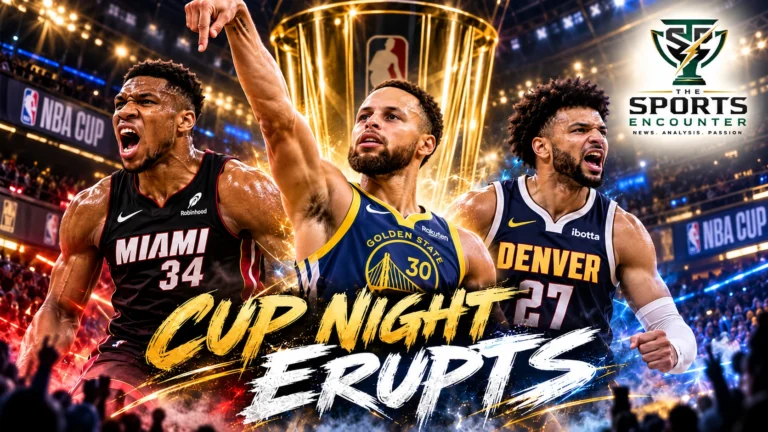
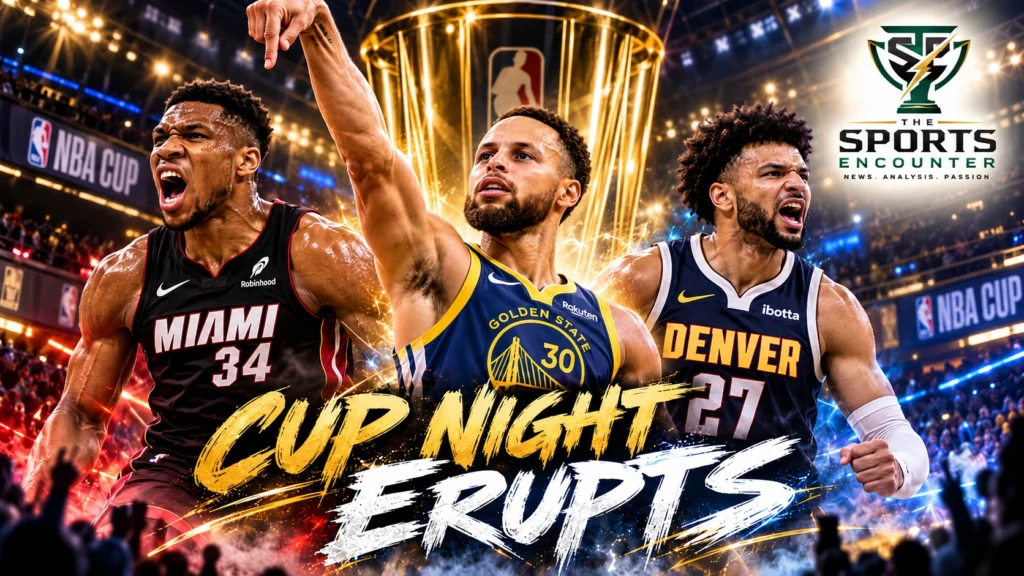
NEW YORK, United States, October 31, 2026: Stephen Curry and the Golden State Warriors completed a remarkable turnaround against the Los Angeles Lakers on Friday, recovering from a 23-point first-quarter deficit to win 112-95 as the 2026 Emirates NBA Cup began with 10 group-stage games across the league. Miami produced the night’s highest score in a 145-125 victory over Indiana, powered by a Giannis Antetokounmpo triple-double, while Jamal Murray scored 39 points and Christian Braun added 31 as Denver defeated Phoenix 127-120.
Dallas ended Houston’s unbeaten start with a 116-111 victory, Philadelphia edged defending NBA champion New York 98-93, and Minnesota recorded the night’s largest winning margin in a 127-101 demolition of the Los Angeles Clippers. Boston, Detroit, Orlando and Washington also opened their group campaigns with victories. Beyond the individual performances, the results delivered an early reminder of the NBA Cup’s unforgiving format: each group game matters, point differential can determine qualification, and an extraordinary first quarter offers little protection against a team capable of changing the contest before the final buzzer.
TL;DR: The Biggest Stories From NBA Cup Opening Night
- Warriors 112, Lakers 95: Golden State recovered after trailing 38-15 at the end of the first quarter.
- Heat 145, Pacers 125: Giannis Antetokounmpo completed a triple-double as Miami delivered the night’s highest team score.
- Nuggets 127, Suns 120: Jamal Murray scored 39 and Christian Braun contributed 31, with both making seven three-pointers.
- Mavericks 116, Rockets 111: Dallas handed previously unbeaten Houston its first defeat.
- 76ers 98, Knicks 93: Philadelphia earned a five-point victory over the defending NBA champions.
- Timberwolves 127, Clippers 101: Minnesota produced the night’s largest winning margin at 26 points.
- Other winners: Boston, Detroit, Orlando and Washington began their NBA Cup campaigns successfully.
NBA Cup October 30, 2026: Complete Results and Group Standings Impact
| Winner | Loser | Final Score | Margin | Group |
|---|---|---|---|---|
| Washington Wizards | Charlotte Hornets | 95-79 | 16 | East C |
| Philadelphia 76ers | New York Knicks | 98-93 | 5 | East B |
| Boston Celtics | Chicago Bulls | 125-111 | 14 | East C |
| Orlando Magic | Toronto Raptors | 121-114 | 7 | East A |
| Detroit Pistons | Brooklyn Nets | 110-94 | 16 | East A |
| Dallas Mavericks | Houston Rockets | 116-111 | 5 | West A |
| Miami Heat | Indiana Pacers | 145-125 | 20 | East B |
| Minnesota Timberwolves | LA Clippers | 127-101 | 26 | West B |
| Golden State Warriors | Los Angeles Lakers | 112-95 | 17 | West C |
| Denver Nuggets | Phoenix Suns | 127-120 | 7 | West A |
The 10 contests produced 2,214 combined points, an average of 221.4 per game.
Read next Five NBA Plays That Defined October 2026: Tatum’s Buzzer-Beater, Thompson’s Block, and More
Story at a glance
NBA Cup October 30, 2026: Complete Results and Group Standings Impact
The 10 contests produced 2,214 combined points, an average of 221.4 per game.
Warriors vs Lakers: How Golden State Turned a 23-Point Deficit Into a 17-Point Victory
Golden State Warriors 112, Los Angeles Lakers 95
Giannis Antetokounmpo’s Triple-Double Powers Miami’s 145-Point Explosion
Miami Heat 145, Indiana Pacers 125
Jamal Murray and Christian Braun Combine for 70 as Nuggets Defeat Suns
Denver Nuggets 127, Phoenix Suns 120
Dallas Hands Houston Its First Defeat in Five-Point Thriller
Dallas Mavericks 116, Houston Rockets 111
Miami scored the most points with 145, while Charlotte finished with the fewest at 79. Minnesota’s 26-point victory over the Clippers produced the largest margin of the night.
Philadelphia’s victory over New York and Dallas’ victory over Houston were the closest finishes, with both decided by five points.
These statistics are calculated directly from the confirmed final scores. They do not depend on unverified possession-level or player-tracking information.
Warriors vs Lakers: How Golden State Turned a 23-Point Deficit Into a 17-Point Victory
Golden State Warriors 112, Los Angeles Lakers 95
The first quarter belonged almost entirely to Los Angeles.
The Lakers scored 38 points and restricted Golden State to just 15, creating a 23-point advantage after only 12 minutes.
For the Warriors, it was the kind of opening period that can destroy a game before it has properly begun.
Their offense lacked rhythm, the Lakers were converting their opportunities, and the scoreboard reflected the difference.
But Golden State refused to accept the direction of the contest.
By halftime, the game was tied 53-53.
That required an extraordinary 38-15 second quarter, reversing the exact scoring margin from the opening period.
Stephen Curry Leads the Warriors’ Recovery
Curry’s outside shooting and offensive leadership were central to Golden State’s response.
His ability to create space beyond the three-point line forced the Lakers to reconsider their defensive positioning.
That changed the nature of the contest.
When defenders must extend farther from the basket, the offense gains additional opportunities to attack inside or move the ball toward open teammates.
For Golden State, the adjustment created a more productive attacking environment after the disastrous opening quarter.
For Los Angeles, the challenge became containing Curry without surrendering too many opportunities elsewhere.
The Warriors ultimately won by 17 points.
That means the margin changed by 40 points after the first quarter.
The 40-Point Turnaround Explained
| Measure | Lakers | Warriors |
|---|---|---|
| First-quarter points | 38 | 15 |
| Second-quarter points | 15 | 38 |
| Halftime score | 53 | 53 |
| Second-half points | 42 | 59 |
| Final score | 95 | 112 |
| Points after first quarter | 57 | 97 |
Golden State outscored Los Angeles 97-57 during the final three quarters.
That is the most revealing statistic of the game.
The Warriors did not merely recover from an awful start. They outplayed the Lakers by 40 points over the remaining 36 minutes.
There is also a wider lesson for Los Angeles.
A team built around the offensive brilliance of Luka Dončić must still maintain defensive organization, bench production and ball security when its leading scorer is not controlling every possession.
The defeat will intensify questions about the Lakers’ long-term championship prospects.
For additional context, The Sports Encounter previously examined the 2026–27 NBA title race and the competition facing established contenders.
Golden State’s victory was an important result, but one comeback cannot establish that all the Warriors’ early-season problems have disappeared.
It does demonstrate that the team’s attacking potential remains formidable when its offense begins functioning effectively.
Giannis Antetokounmpo’s Triple-Double Powers Miami’s 145-Point Explosion
Miami Heat 145, Indiana Pacers 125
Miami needed a convincing performance.
The Heat had struggled during the opening stages of their season, and the arrival of Giannis Antetokounmpo had not immediately delivered the consistency supporters expected.
Against Indiana, however, Miami’s offense produced an emphatic response.
Antetokounmpo finished with 31 points and 10 assists, completing a triple-double.
The NBA’s game materials display conflicting rebound totals of 17 and 18, so the precise rebounding figure should be reconciled against the finalized box score before publication.
Bam Adebayo scored 27 points, while Klay Thompson contributed 25.
The three players provided different threats that Indiana struggled to contain.
Why Miami’s Offensive Balance Matters
Giannis is most dangerous when he can attack the basket without facing several defenders waiting inside the paint.
Thompson’s outside shooting creates spacing by forcing opponents to defend the perimeter.
Adebayo provides another interior option while contributing through movement and passing.
Against the Pacers, those strengths combined to produce a formidable offense.
Thompson made seven three-pointers, while Adebayo converted 11 of his 14 field-goal attempts.
Indiana scored 125 points, a total normally sufficient to compete for victory.
Miami still won by 20.
That contrast illustrates how efficiently the Heat generated offense.
Indiana’s Injury Problems Complicate the Result
The Pacers entered the game with a severely restricted rotation.
Obi Toppin was a late withdrawal because of back soreness, leaving Indiana with 11 available players.
That reduced the flexibility available to the coaching staff as Miami increased its pressure.
Quenton Jackson scored 24 points, while Andrew Nembhard contributed 22.
Those performances showed Indiana’s ability to generate offense despite the absences.
But the Pacers could not consistently restrict Miami’s scoring.
The NBA’s official game analysis documents the Heat’s 145-125 victory, key contributions and important scoring sequences.
Jamal Murray and Christian Braun Combine for 70 as Nuggets Defeat Suns
Denver Nuggets 127, Phoenix Suns 120
Denver’s victory was built around two exceptional perimeter performances.
Jamal Murray scored 39 points, while Christian Braun added 31.
The pair combined for 70 points, accounting for approximately 55.1% of Denver’s scoring.
Both made seven three-pointers.
That gave Denver 42 points from their combined successful three-point attempts alone.
The shooting performance posed a problem Phoenix could not solve.
Murray’s Efficiency Gives Denver the Edge
Murray converted 10 of 18 field-goal attempts, including seven of nine from beyond the arc.
He also contributed eight rebounds and five assists.
Braun made 11 of 16 field-goal attempts and seven of nine three-pointers.
The two players therefore combined to shoot 14-for-18 from three-point range.
That is an exceptional 77.8% conversion rate from beyond the arc.
It was not simply the number of shots Denver made. It was how efficiently Murray and Braun converted them.
Phoenix’s Resistance Falls Short
Miles Bridges scored 24 points and collected 10 rebounds for Phoenix.
Dillon Brooks added 22 points.
The Suns remained competitive, but Denver’s offensive production proved enough to secure a seven-point victory.
Brooks’ role in Phoenix’s developing identity had already attracted attention after his contract extension.
The Sports Encounter examined that decision in our analysis of his three-year, $73 million agreement.
Friday’s result demonstrates the challenge facing Phoenix.
Individual scoring contributions can keep the Suns competitive, but opponents with multiple efficient perimeter options can still overwhelm their defensive structure.
Denver’s official NBA game analysis confirms Murray’s and Braun’s performances and the decisive scoring patterns.
Dallas Hands Houston Its First Defeat in Five-Point Thriller
Dallas Mavericks 116, Houston Rockets 111
Houston arrived in Dallas as one of the league’s unbeaten teams.
The Rockets had won their first five games and appeared increasingly confident in their ability to combine attacking production with defensive pressure.
Dallas ended that run.
The Mavericks produced enough offense to secure a five-point victory and deliver an early warning to a Western Conference rival.
The result is significant for two reasons.
First, it prevented Houston from beginning its season 6-0.
Second, it gave Dallas an early group-stage victory against a team that had already established impressive regular-season momentum.
Why Ending an Unbeaten Start Matters
An unbeaten start can create confidence, but it can also conceal weaknesses that become apparent against opponents capable of imposing different tactical demands.
Houston’s previous victories demonstrated its strengths.
Dallas’ win demonstrated that those strengths do not guarantee a result against another competitive Western Conference team.
For the Mavericks, the challenge is to build on the victory rather than allow it to become an isolated performance.
The Western Conference’s depth has been one of the central themes of The Sports Encounter’s NBA coverage and championship analysis.
Houston’s first defeat should not fundamentally change its season outlook, but it gives the coaching staff a useful opportunity to examine how the team responds under pressure.
Philadelphia Defeats Champion Knicks in Another Close Finish
Philadelphia 76ers 98, New York Knicks 93
The 76ers earned one of the night’s most significant victories against the defending NBA champions.
Philadelphia held New York to 93 points and won by five.
Unlike the high-scoring contests involving Miami and Denver, this matchup required more sustained defensive discipline.
The victory was especially meaningful because New York entered the season as the league’s reigning champion.
The Knicks ended a 53-year championship drought in June, and the expectations surrounding the team have changed accordingly.
That historic achievement was documented in The Sports Encounter’s report on New York’s championship-clinching victory.
The Difference Between Championship Reputation and Present Form
A championship is an achievement that cannot be taken away.
But defending a title requires teams to solve new challenges across a different season.
Opponents study the champions more closely, personnel situations change, and familiar tactics may become less effective.
Philadelphia’s victory demonstrates why past success cannot substitute for execution in the present.
The Knicks must continue developing their offense while maintaining the defensive quality that helped them win their championship.
The challenge of protecting a lead against strong opponents was also evident during the 2026 NBA Finals, particularly in New York’s decisive late-game performance against San Antonio.
Friday’s result is not a verdict on the Knicks’ title defense.
It is, however, an early reminder of how difficult repeating as champions can become.
Boston Scores 125 as Chicago’s Defensive Problems Continue
Boston Celtics 125, Chicago Bulls 111
Boston established a decisive early advantage against Chicago.
The Celtics scored 44 points in the opening quarter and added 34 in the second.
They reached halftime leading 78-49.
That 29-point advantage forced Chicago to spend the remainder of the game attempting to repair the damage.
Payton Pritchard led Boston with 30 points.
The Bulls improved after halftime and scored 62 points in the final two quarters, compared with Boston’s 47.
But the recovery was not enough.
Boston’s First-Half Advantage Decides the Match
| Period | Chicago | Boston | Boston Margin |
|---|---|---|---|
| First quarter | 25 | 44 | +19 |
| Second quarter | 24 | 34 | +10 |
| Halftime | 49 | 78 | +29 |
| Second half | 62 | 47 | -15 |
| Final | 111 | 125 | +14 |
Chicago actually outscored Boston by 15 points after halftime.
That detail is important because it prevents the game from being described as four quarters of uninterrupted Celtics domination.
Boston won through the size of its opening-half advantage and the ability to protect enough of it through the final two periods.
Minnesota Overwhelms Clippers by 26 as Roster Depth Pays Off
Minnesota Timberwolves 127, LA Clippers 101
Minnesota produced the largest margin of victory on Friday.
The Timberwolves scored 127 points and held the Clippers to 101.
Jaden McDaniels was among Minnesota’s important contributors, while the team secured a convincing opening group-stage victory.
The result offers evidence of why Minnesota’s roster structure has attracted attention.
The Timberwolves have invested in supporting players capable of complementing their leading scorers through defense, mobility and efficient offensive decisions.
The Sports Encounter previously analyzed that strategy in our report on Ayo Dosunmu’s five-year, $112 million contract.
Against the Clippers, the outcome demonstrated the value of collective execution.
Minnesota’s victory was not merely another regular-season result.
The 26-point margin also gave the Timberwolves a strong opening point differential in West Group B.
Orlando Bounces Back Against Toronto
Orlando Magic 121, Toronto Raptors 114
Orlando secured an important seven-point road victory against Toronto.
The result came just two days after the Raptors had defeated the Magic 129-99.
That made Friday’s meeting particularly interesting.
Orlando had to return to the same opponent with the memory of a 30-point defeat still fresh.
This time, the Magic scored 121 points and held Toronto to 114.
The result illustrates the importance of adjustments during a regular-season schedule that can bring opponents together several times in a short period.
A heavy defeat may expose tactical weaknesses.
But it also provides information that a coaching staff can use to prepare a better response.
Orlando’s victory does not necessarily mean every weakness has been solved.
It does mean the Magic found a more effective approach in the rematch.
Detroit Improves to 5-1 as Brooklyn Remains Winless
Detroit Pistons 110, Brooklyn Nets 94
Detroit continued its encouraging early-season form with a 16-point victory in Brooklyn.
The Pistons improved to 5-1.
The Nets fell to 0-5.
Detroit’s defense restricted Brooklyn to 94 points, keeping the home team below the century mark.
That defensive performance matters because not every victory requires an exceptional offensive output.
Strong teams need to win in different ways.
Detroit showed it could control a game through defensive pressure and enough consistent scoring to preserve the advantage.
Brooklyn’s problems are becoming increasingly difficult to dismiss as a short-term scoring issue.
The Nets have struggled to translate individual contributions into team victories.
Those problems must be viewed alongside the organization’s wider roster changes.
The Sports Encounter covered one aspect of that development in our report on Brooklyn’s acquisition of Moritz Wagner and the wider Eastern Conference injury picture.
Friday’s result further strengthened the contrast between Detroit’s promising start and Brooklyn’s difficult opening.
Washington Holds Charlotte to 79 Points
Washington Wizards 95, Charlotte Hornets 79
Washington recorded one of the night’s most convincing defensive performances.
The Wizards restricted Charlotte to 79 points, the lowest team total across all 10 games.
Trae Young contributed 21 points, seven rebounds and nine assists.
Charlotte’s Brandon Miller scored 19 points.
The Hornets began with 26 points in the opening quarter but managed only 13 during the third.
That scoring collapse helped Washington establish a decisive advantage.
The game provides a useful contrast to Miami’s high-scoring victory.
The Heat succeeded by overwhelming Indiana offensively.
The Wizards succeeded by preventing Charlotte from scoring efficiently.
Both approaches produced comfortable wins, demonstrating the different ways an NBA team can control a game.
NBA Cup Opening Night: The Numbers That Matter Most
| Measure | October 30 Result | Significance |
|---|---|---|
| Games completed | 10 | Opening group-stage slate |
| Total points | 2,214 | Combined scoring across all games |
| Average combined score | 221.4 | Offensive production per matchup |
| Highest team score | Miami, 145 | 20-point win over Indiana |
| Lowest team score | Charlotte, 79 | 16-point defeat in Washington |
| Largest victory margin | Minnesota, 26 | Strong early point differential |
| Smallest victory margin | 5 | Philadelphia and Dallas wins |
| Largest confirmed comeback | Golden State, from 23 down after Q1 | 40-point change in margin |
| Highest verified individual points total | Jamal Murray, 39 | Denver’s victory over Phoenix |
These figures capture the range of Friday’s basketball.
There were high-scoring wins, defensive victories, close contests and a dramatic comeback.
The opening night therefore provided a broader picture of the league than any individual performance could offer.
NBA Cup Group Stage: The First Winners and Point Differentials
The Emirates NBA Cup places teams into six groups, three in each conference.
Each team plays four group-stage games.
Group winners and designated wild-card teams advance to the knockout rounds, with point differential among the applicable tiebreakers.
Consequently, the size of a victory can matter beyond the immediate result.
| Group | Opening Winners | Opening Point Differentials |
|---|---|---|
| East A | Detroit, Orlando | +16, +7 |
| East B | Miami, Philadelphia | +20, +5 |
| East C | Washington, Boston | +16, +14 |
| West A | Denver, Dallas | +7, +5 |
| West B | Minnesota | +26 |
| West C | Golden State | +17 |
These are opening-night results and calculated differentials, not final NBA Cup group standings.
Minnesota begins with the strongest positive differential from Friday’s games.
Miami’s 20-point victory also gives the Heat a useful early advantage in East Group B.
Golden State’s 17-point victory is particularly valuable because it emerged from a game the Warriors appeared to be losing heavily after one quarter.
But no team has secured qualification after one group game.
The remaining fixtures will determine whether these opening victories become the foundations of knockout-round campaigns.
Five Questions Raised by the NBA Cup’s Opening Night
Can Golden State Avoid the Slow Starts That Nearly Destroyed Its Lakers Game?
The Warriors deserve praise for their comeback, but trailing by 23 after one quarter is not a sustainable formula for success.
More consistent early defense and better shot selection will be necessary against elite opponents.
Can Miami Repeat Its Offensive Performance Against Stronger Defenses?
Giannis, Adebayo and Thompson offer Miami several scoring options.
The challenge is producing efficient offense consistently while maintaining the defensive standard required to compete for a championship.
Is Denver’s Perimeter Shooting Sustainable?
Murray and Braun combined to make 14 of 18 three-point attempts.
That is exceptional efficiency, but it is unlikely to be repeated every game.
Denver must continue generating high-quality shots even when its conversion rate falls closer to normal levels.
Will Houston Respond Positively to Its First Defeat?
The Rockets’ 5-0 start demonstrated their potential.
Dallas showed they could be beaten.
Houston’s response will provide a better indication of its resilience than the opening winning streak alone.
Can the Knicks Defend Their Championship Against Improving Eastern Rivals?
Philadelphia’s victory illustrated the difficulty facing New York.
Other teams have adjusted their rosters and developed new approaches.
The Knicks’ title defense will depend on maintaining the consistency that helped them win the 2026 championship.
The Sports Encounter examined that competitive environment in our analysis of Oklahoma City’s roster and salary-cap decisions, which highlights the difficult choices even successful teams face when attempting to remain competitive.
Continue the NBA Story
 NBAFive NBA Plays That Defined October 2026: Tatum’s Buzzer-Beater, Thompson’s Block, and More
 NBAJokić Reaches 200 Triple-Doubles, Flagg Ends Thunder’s Perfect Start as Curry Scores 44 in NBA Drama
 NBAEmirates NBA Cup 2026: Ultimate Guide to 30 Teams, Groups, Rules, Prize Money, and the Indianapolis Final
Frequently Asked Questions About NBA Cup October 30 Results
How Many NBA Games Were Played on October 30, 2026?
Ten NBA Cup group-stage games were completed on Friday, October 30, 2026.
Who Won the Lakers vs Warriors Game?
Golden State defeated Los Angeles 112-95 after trailing 38-15 at the end of the first quarter.
Who Scored the Most Points?
Jamal Murray scored 39 points for Denver against Phoenix.
What Was the Heat vs Pacers Score?
Miami defeated Indiana 145-125, with Giannis Antetokounmpo recording a triple-double.
Did Houston Lose Its Unbeaten Record?
Yes. Dallas defeated Houston 116-111, ending the Rockets’ five-game winning start.
Did the New York Knicks Win?
No. Philadelphia defeated the defending champions 98-93.
Which Team Won by the Largest Margin?
Minnesota defeated the LA Clippers by 26 points, winning 127-101.
Do NBA Cup Group Games Count Toward the Regular Season?
Yes. NBA Cup group games also count toward the regular-season standings.
Final Analysis: The NBA Cup Has Already Exposed the Difference Between Talent and Execution
The opening night of the 2026 NBA Cup provided 10 results, but the strongest story was not simply which teams won.
It was how they won.
Golden State recovered from one of the worst opening quarters imaginable and turned a 23-point deficit into a 17-point victory.
Miami overwhelmed Indiana through balanced scoring and the extraordinary all-round influence of Giannis Antetokounmpo.
Denver relied on two exceptional perimeter performances from Murray and Braun.
Dallas showed that an unbeaten opponent can be defeated through disciplined execution.
Philadelphia again demonstrated that the defending champions can be challenged.
Minnesota made a statement through its 26-point victory, while Boston established an advantage so large that Chicago’s second-half improvement could not erase it.
Detroit and Washington showed that defensive control remains valuable in a league increasingly associated with high-scoring performances.
Orlando responded to a heavy defeat by beating the same opponent two days later.
Those results offer different lessons, but one principle connects them.
Talent creates possibilities. Execution determines outcomes.
The NBA Cup is particularly unforgiving because teams have limited opportunities to recover from defeats during group play.
Every result now matters.
Every positive point differential provides a potential advantage.
And every team must demonstrate that its best performances can be repeated.
For Golden State, Friday was the story of a spectacular escape. For the rest of the NBA, it was an early warning that the Cup will reward teams capable of making the right adjustments when a game begins slipping away.
For continuing basketball coverage, player features and championship analysis, visit The Sports Encounter’s NBA news section and explore our coverage of LeBron James’ changing international and professional legacy.
Follow the official NBA scoreboard for full match details, box scores and highlights from the October 30 schedule.