Key Takeaways
- Kanazawa’s appearance was part of the 2026 IFBB World Fitness and Bodybuilding Championships, scheduled for October 29 through November 2 in the Spanish coastal town of Santa Susanna.
- The event forms part of the IFBB’s official 2026 World Championships program.
- Kanazawa won the over-85 category at Japan’s national Masters championships in Hiroshima on August 30, 2026.
- Toshisuke Kanazawa left Santa Susanna without a podium finish, but the result does not diminish the extraordinary length of his competitive journey.
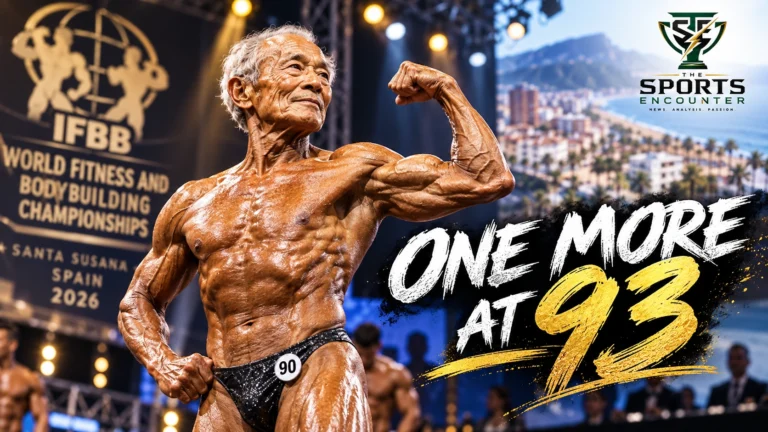
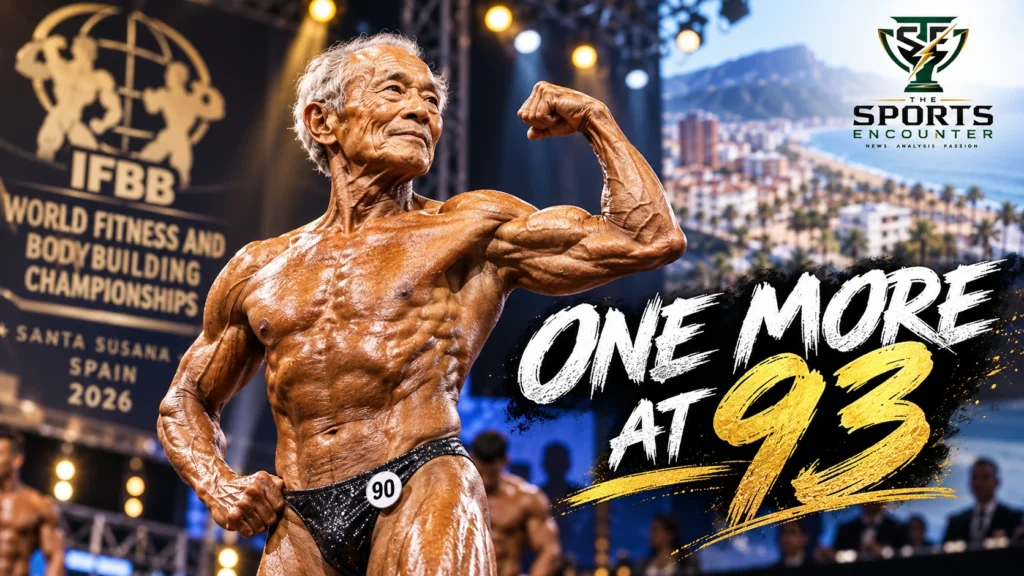
SANTA SUSANNA, Spain, October 30, 2026: Toshisuke Kanazawa walked onto the stage at the IFBB World Fitness and Bodybuilding Championships on Friday carrying something his younger rivals could not match: 90 years of life and a competitive ambition that refuses to expire. The Japanese bodybuilding veteran competed in the Masters men’s fit bodybuilding division for athletes aged 50 and over in Santa Susanna, Spain. He finished outside the podium positions, but has already identified another extraordinary target: returning to competition at 93.
Kanazawa’s latest international appearance follows his 19th Japanese national bodybuilding title, earned in Hiroshima shortly before his 90th birthday. He has been competing across generations, overcoming retirement and returning to the sport decades after his first success. The contrast in Spain was striking. While younger competitors pursued medals, Kanazawa was testing how far a sporting career can extend when the desire to compete survives the customary retirement age. His next challenge, should he pursue it, would come in 2029.
Toshisuke Kanazawa at 90: The Essential Facts
Kanazawa’s appearance was part of the 2026 IFBB World Fitness and Bodybuilding Championships, scheduled for October 29 through November 2 in the Spanish coastal town of Santa Susanna. His Friday appearance attracted attention because of the enormous difference between his age and the minimum age for his Masters division.
Story at a glance
Toshisuke Kanazawa at 90: The Essential Facts
Kanazawa’s appearance was part of the 2026 IFBB World Fitness and Bodybuilding Championships, scheduled for October 29 through November 2 in the Spanish coastal town of Santa Susanna. His Friday appearance attracted attention because of the enormous difference between his age and the minimum age for his Masters division.
Why Competing Against 50-Year-Olds Makes His Appearance Extraordinary
The most revealing statistic from Kanazawa’s Spanish appearance is not a score or judging total. It is the potential age difference within the competition itself.
From Mr. Japan to a World Stage at 90
Kanazawa’s story stretches back to the early 1960s. He became a prominent Japanese bodybuilding champion long before organized fitness competitions developed the international visibility they enjoy today.
His 19th Japanese Title Gives the Spain Result a Different Meaning
Kanazawa won the over-85 category at Japan’s national Masters championships in Hiroshima on August 30, 2026. That victory was reported as his 19th national bodybuilding title.
The Discipline Behind Kanazawa’s Extraordinary Competitive Longevity
Kanazawa has described a long-standing commitment to exercise, nutritional consistency and purposeful preparation.
Read next Chase and Warrican Wreck Bangladesh as West Indies Claim Advantage on Day Three of Dhaka Test
| Detail | Verified Information |
|---|---|
| Athlete | Toshisuke Kanazawa |
| Nationality | Japanese |
| Age | 90 |
| Competition | 2026 IFBB World Fitness and Bodybuilding Championships |
| Location | Santa Susanna, Spain |
| Appearance date | October 30, 2026 |
| Division | Masters men’s fit bodybuilding, over 50 |
| Result | Outside the podium positions |
| National titles reported | 19 |
| Next competitive ambition | Another appearance at age 93 |
The event forms part of the IFBB’s official 2026 World Championships program. The schedule establishes the tournament’s dates and setting, while contemporary event reporting confirms Kanazawa’s participation on October 30.
Why Competing Against 50-Year-Olds Makes His Appearance Extraordinary
The most revealing statistic from Kanazawa’s Spanish appearance is not a score or judging total. It is the potential age difference within the competition itself.
His division admitted athletes aged 50 and over. At 90, Kanazawa was four decades beyond that entry threshold.
The 40-Year Gap Behind the Headlines
| Age Comparison | Years | What It Reveals |
|---|---|---|
| Minimum Masters division age | 50 | Entry threshold, not the age of a specific opponent |
| Kanazawa’s age | 90 | Age at the October 2026 championship |
| Gap above the minimum age | 40 | 90 minus 50 |
| Age targeted for another contest | 93 | Three years beyond his present age |
| Calendar year of that potential appearance | 2029 | Projection, not an officially scheduled entry |
TSE statistical insight: Kanazawa was 80 percent older than the division’s minimum qualifying age, calculated as the 40-year difference divided by 50. This measures the gap between his age and the entry threshold. It does not establish the exact ages of his individual competitors or their performance levels.
Those distinctions matter. Bodybuilding is judged on physical presentation, conditioning, muscular development and other division-specific criteria. Greater age does not automatically produce a competitive advantage or disadvantage that can be quantified from the age difference alone.
But the comparison illuminates the scale of Kanazawa’s commitment. His body has experienced four additional decades of aging beyond the minimum age at which an athlete can enter this division.
Sport regularly produces discussions about competitive longevity. Novak Djokovic’s attempt to sustain elite tennis at 39 illustrates how recovery, preparation and experience increasingly shape decisions late in an athletic career. Kanazawa’s circumstances are different, but the underlying question is familiar: how long can an athlete continue pursuing meaningful competition?
From Mr. Japan to a World Stage at 90
Kanazawa’s story stretches back to the early 1960s. He became a prominent Japanese bodybuilding champion long before organized fitness competitions developed the international visibility they enjoy today.
His career included Mr. Japan titles in 1960 and 1963, an appearance in the Mr. Universe competition in 1967 and a return to competitive bodybuilding after an earlier retirement.
That return is crucial to understanding his longevity. His career did not progress uninterrupted from youth to old age. He stepped away and later resumed competitive bodybuilding around age 50.
The Milestones That Explain His Remarkable Career
| Year or Period | Milestone | Significance |
|---|---|---|
| 1936 | Born in Japan | Beginning of a sporting life extending across nine decades |
| 1960 | Won Mr. Japan | Established his national bodybuilding credentials |
| 1963 | Won another Mr. Japan title | Confirmed his standing among Japan’s leading bodybuilders |
| 1967 | Competed at Mr. Universe | Part of his early international bodybuilding history |
| Around age 50 | Returned after an earlier retirement | Opened a second competitive chapter |
| 2022 | Appeared at the World Championships in Spain at 86 | Demonstrated his sustained international ambitions |
| August 2026 | Won his 19th Japanese national title | Continued domestic success shortly before turning 90 |
| October 30, 2026 | Competed in Santa Susanna at 90 | Returned to international competition without a podium finish |
| 2029, potentially | Hopes to compete at 93 | An expressed ambition, subject to future decisions and eligibility |
The timeline reveals a distinction that is easy to miss when viewing only the photographs from Spain. Kanazawa’s 2026 appearance was the continuation of a comeback that began decades earlier, not an isolated attempt by an elderly newcomer.
His 19th Japanese Title Gives the Spain Result a Different Meaning
Kanazawa won the over-85 category at Japan’s national Masters championships in Hiroshima on August 30, 2026. That victory was reported as his 19th national bodybuilding title.
He had celebrated his 90th birthday the previous day.
Two months later, he was preparing to face a considerably broader international field in Spain.
The national and international competitions should not be treated as interchangeable. Their fields, eligibility divisions and judging circumstances differ, and a domestic title does not guarantee an international podium finish.
How His Two Major 2026 Appearances Compare
| Category | Hiroshima, August 2026 | Santa Susanna, October 2026 |
|---|---|---|
| Competition | All Japan Masters Fitness Championships | IFBB World Fitness and Bodybuilding Championships |
| Level | National | International |
| Location | Hiroshima, Japan | Santa Susanna, Spain |
| Kanazawa’s age | 90 | 90 |
| Reported category | Men aged 85 and over | Masters men’s fit bodybuilding, over 50 |
| Outcome | First place | Outside podium positions |
| Career significance | 19th reported national title | Another international appearance |
The distinction explains why his Spanish performance deserves analysis even without a medal. Moving from an over-85 national category to an international Masters field beginning at 50 changes the competitive context considerably.
There is no verified basis for claiming that one particular judging score or opponent caused his non-podium result. The complete individual judging breakdown was not available for independent inspection at the time this report was prepared.
The Discipline Behind Kanazawa’s Extraordinary Competitive Longevity
Kanazawa has described a long-standing commitment to exercise, nutritional consistency and purposeful preparation.
He says his regular diet has included traditional Japanese foods such as brown rice, natto and miso soup since approximately age 50.
He also attributes his continued fitness and good health to those habits.
That personal explanation is an important part of his story, but it is not scientific proof that those foods caused his longevity or competitive success. Genetics, training history, overall nutrition, recovery, medical circumstances and many other factors can influence long-term health and athletic performance.
What His Training History Tells Us
Earlier reporting on Kanazawa describes a routine built around regular resistance training, with adjustments for his age and recovery needs.
His preparation suggests that consistency has been more important to his career than brief bursts of extreme effort.
That interpretation also helps explain why elite athletes often place increasing emphasis on recovery and workload management as their careers progress.
For comparison, Jannik Sinner’s planned return following an injury-related absence illustrates the importance of managing physical readiness even for a considerably younger champion.
Kanazawa’s achievements remain unusual, however. No responsible comparison should suggest that a 90-year-old athlete’s training program is automatically appropriate for the general population.
What Does Sports Science Say About Strength Training After 65?
Kanazawa’s competitive ambitions naturally raise a broader question: can older people continue developing or maintaining strength through exercise?
Public-health guidance supports regular physical activity and muscle-strengthening work in later life, adjusted to individual capabilities.
The World Health Organization recommends muscle-strengthening activity for older adults on at least two days each week. It also emphasizes physical activity that helps preserve balance, functional ability and independence.
The US Centers for Disease Control and Prevention’s older-adult activity guidance similarly identifies aerobic exercise, strengthening and balance training as important components of healthy aging.
Public-Health Guidelines Versus Elite Bodybuilding
| Activity | Public-Health Recommendation for Older Adults | Relevance to Kanazawa’s Story |
|---|---|---|
| Moderate aerobic activity | 150–300 minutes weekly under WHO guidance | Supports general health and physical functioning |
| Vigorous aerobic activity | 75–150 minutes weekly as an alternative | Not automatically suitable for every individual |
| Muscle strengthening | At least two days weekly | Supports preservation of muscle strength and function |
| Balance-focused activity | Three or more days weekly under WHO multicomponent guidance | Can help support functional capacity and fall prevention |
| Elite bodybuilding competition | Not a general public-health requirement | Represents an unusually demanding personal sporting pursuit |
The recommendations provide a useful distinction between remaining physically active and pursuing international bodybuilding competition at 90.
Kanazawa’s extraordinary example can encourage older adults to explore appropriate movement and strengthening activities. It should not be interpreted as medical advice to begin intense bodybuilding without individualized professional guidance.
Why Retirement Means Something Different to Every Athlete
Kanazawa’s plan to consider another contest at 93 raises one of sport’s most personal questions: who decides when an athlete’s career should end?
Some athletes retire while they remain physically capable of competing. Others continue until injuries, declining performance or personal circumstances make further participation impractical.
The Sports Encounter recently explored that contrast in Lucas Pinheiro Braathen’s retirement and return to skiing, where athlete autonomy became a defining part of the story.
Another example is David Goffin’s farewell to professional tennis, a decision that brought a successful career to a deliberate close.
Meanwhile, Olympic swimming champion Florent Manaudou’s retirement at 35 illustrates how an athlete can leave after decades of elite achievement without trying to extend competition indefinitely.
Kanazawa has chosen another path, although his stated ambition still leaves room for a final decision about retirement.
Sporting Longevity Is About More Than the Number of Birthdays
The public conversation around older athletes can sometimes confuse endurance with invulnerability.
Surviving decades of competition does not make an athlete immune to illness, injury or the normal physiological changes associated with aging.
Indeed, some sporting careers end because continuing would create unacceptable medical risks.
Jenny Simpson’s transition away from running following a serious heart diagnosis demonstrates how health can determine an athlete’s future regardless of competitive ambition.
And Alexander Blockx’s injury-related retirement during the US Open shows how quickly physical limitations can change even a promising competitive campaign.
These examples are not direct medical comparisons with Kanazawa. They establish the broader principle that an athlete’s desire to continue and their ability to compete safely are separate considerations.
Why Kanazawa’s Next Three Years Could Become His Most Interesting Chapter
Kanazawa’s latest comments suggest that he is considering a final appearance at 93, after which he may retire from competitive bodybuilding.
That ambition would take his story into 2029.
Three years can be a relatively short interval in the career of a young professional athlete. At 90, it represents a substantial additional period of preparation, physical maintenance and adaptation.
His future participation will depend on his own choices, health, eligibility and the available competition calendar. There is no verified entry for a 2029 event, and no official announcement establishing a confirmed farewell competition.
For now, the goal is meaningful because Kanazawa has already demonstrated a willingness to return to the international stage after succeeding domestically.
How Kanazawa Challenges Traditional Definitions of Sporting Achievement
Sport usually evaluates excellence through victories, records, medals and rankings.
By that conventional measure, Kanazawa’s Spanish appearance ended without the result he would have wanted.
But assessing this performance only through its placing would overlook the unusual career that brought him there.
His 2026 national title offered evidence that he could still win within an age-specific category. His international appearance tested that ambition against a broader Masters field.
The difference between those two experiences is the central sporting lesson of his latest campaign: achievement depends partly on what level of competition an athlete chooses to enter.
That idea also appears in The Sports Encounter’s examination of World Athlete of the Year contenders, where performances across disciplines require thoughtful comparison rather than one universal statistical measure.
Kanazawa is not being presented as a stronger competitor than champions decades younger than him. His accomplishment is that he continues to challenge himself through organized competition at an age almost never associated with such ambitions.
What Comes Next for Toshisuke Kanazawa?
There are three developments worth following.
First, the eventual availability of the complete official classification from the 2026 championships would clarify his exact position and the composition of his competitive field.
Second, his continued training and any future Japanese Masters appearances may show whether he intends to maintain his current competitive schedule.
Third, an official entry or personal announcement will eventually establish whether his proposed appearance at 93 becomes a concrete event.
For now, the fact that Kanazawa is considering another competition at all is enough to make his story remarkable.
Continue the Athletics Story
 AthleticsPeres Jepchirchir Provisionally Suspended Over EPO Finding: Sydney Marathon Victory Faces Scrutiny
 AthleticsNew York’s 2042 Winter Olympics Dream Faces a Five-Hour Journey and a Billion-Dollar Question
 AthleticsFrom Sugar Ray’s Fight Purses to Ronaldo’s $300 Million: The 46-Year Race for Sport’s Biggest Payday
Frequently Asked Questions About Toshisuke Kanazawa
How old is Toshisuke Kanazawa?
Toshisuke Kanazawa is 90 years old as of October 2026. He celebrated his 90th birthday in August.
Where did Kanazawa compete in October 2026?
He competed at the IFBB World Fitness and Bodybuilding Championships in Santa Susanna, Spain, on October 30.
Did Toshisuke Kanazawa win the 2026 World Championships?
No. He competed in a Masters division but finished outside the podium positions. His precise final placing was not independently established from a complete official classification.
How many Japanese national bodybuilding titles has he won?
Kanazawa has been credited with 19 national titles, including his victory at the All Japan Masters championships in Hiroshima in August 2026.
When did Kanazawa first become Mr. Japan?
He won a Mr. Japan title in 1960 and another in 1963.
Did Kanazawa compete internationally before 2026?
Yes. His earlier international history includes a Mr. Universe appearance in 1967 and a World Championships appearance in Spain in 2022.
What foods does Toshisuke Kanazawa eat?
He has described a traditional Japanese diet that includes brown rice, natto and miso soup. His belief that this diet supports his health is personal testimony, not a scientifically established explanation for his longevity.
Will Kanazawa compete again at age 93?
He has expressed an ambition to make another competitive appearance at 93, potentially in 2029. No such entry has been officially confirmed.
Can people start strength training in their 80s or 90s?
Many older adults can benefit from appropriately adapted strengthening activity, but exercise selection and intensity should reflect personal health, mobility, prior training and professional medical guidance when needed. Elite bodybuilding is not the standard recommendation for older adults.
The Sports Encounter Verdict: The Stage Still Matters
Toshisuke Kanazawa left Santa Susanna without a podium finish, but the result does not diminish the extraordinary length of his competitive journey.
He won bodybuilding titles when the sport looked very different, retired, returned, accumulated further honors and reached the international stage at 90.
His latest challenge also invites a useful reconsideration of sporting achievement. A medal measures performance within a competition. Longevity reveals the sustained commitment required to remain capable of entering that competition in the first place.
Kanazawa has already spent decades proving he belongs in bodybuilding. Whether he returns at 93 will be determined by the years ahead.
For now, the 90-year-old Japanese champion has given the sport a compelling story whose final chapter may still be unwritten.