


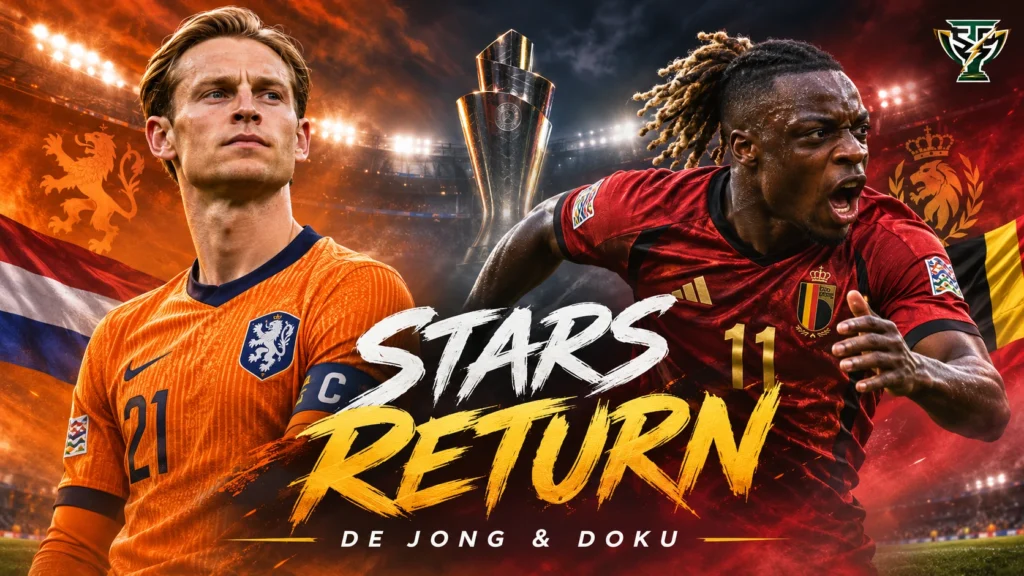
AMSTERDAM, Netherlands, November 6, 2026: Frenkie de Jong has returned to the Netherlands squad for the first time since the 2026 World Cup, while Jérémy Doku is back with Belgium as two European heavyweights prepare for decisive UEFA Nations League fixtures. Dutch coach Xavi Hernández included Barcelona midfielder De Jong in his 25-man selection for matches against Greece and Germany, while Belgium coach Mark van Bommel recalled Manchester City winger Doku in a 26-player group that will face Türkiye and Italy. Both announcements, made Friday, November 6, restore important attacking and midfield options at a moment when qualification for the March 2027 quarterfinals is still at stake.
Yet the two countries enter the final international window of 2026 in dramatically different positions. The Netherlands lead League A Group 2 with eight points, level with Greece and three ahead of Germany, making De Jong’s return especially valuable before two direct encounters with qualification rivals. Belgium are third in Group A1 with six points, four behind France and one behind Italy, and must recover from a damaging 4-1 defeat in Paris. Doku’s pace and individual attacking ability could provide the spark Belgium need, but restoring one player will not automatically repair the collective weaknesses exposed during the opening four matches.
Why Frenkie de Jong and Jérémy Doku’s Returns Matter Before the Nations League Deciders
The announcements share a headline, but the reasons they matter are quite different.
De Jong returns to a Dutch team unbeaten in four Nations League matches under Xavi, but one that has repeatedly struggled to control games throughout the full 90 minutes.
The Netherlands have scored seven goals and conceded five across their four fixtures. They have also conceded at least once in every game.
Belgium’s problem is more immediate. The Red Devils have lost twice to France, and their third-place position means the final two matches could determine whether their Nations League campaign continues into the knockout rounds.
Doku is returning to an attack that contains plenty of experience, including Kevin De Bruyne and Romelu Lukaku, but has not produced consistent results against the group’s strongest opposition.
| Key Detail | Netherlands | Belgium |
|---|---|---|
| Returning star | Frenkie de Jong | Jérémy Doku |
| Club | Barcelona | Manchester City |
| Head coach | Xavi Hernández | Mark van Bommel |
| Squad size | 25 | 26 |
| Nations League group | League A, Group 2 | League A, Group 1 |
| Current position | First, level on points with Greece | Third, behind France and Italy |
| Points after four matches | 8 | 6 |
| Next opponent | Greece, November 13 | Türkiye, November 12 |
| Final group opponent | Germany, November 16 | Italy, November 15 |
Both teams have enough individual ability to reach the quarterfinals, but the closing fixtures will test whether their returning stars can improve how their respective teams function together.
Why Has Xavi Recalled Frenkie de Jong to the Netherlands Squad?
De Jong has not represented the Netherlands since the World Cup, where their campaign ended in the Round of 32 against Morocco.
The Barcelona midfielder has recovered sufficiently to return to club action, allowing Xavi to select him for the first time during his tenure as Dutch national-team coach.
That reunion is particularly interesting because the pair previously worked together at Barcelona.
Xavi knows De Jong’s strengths in possession, especially his ability to receive the ball under pressure, carry it forward and connect deeper midfield positions with attacking players.
Those qualities could help the Netherlands solve a problem that has appeared repeatedly during the current campaign: the team can dominate passages of possession without always converting that control into a stable performance.
The Dutch have fought back from difficult situations against Greece and Serbia. They have also produced promising attacking combinations while remaining vulnerable when opponents break through their midfield.
De Jong offers a potential solution through his ability to advance possession without forcing unnecessary long passes.
He is not a defensive cure by himself. If the Netherlands lose the ball with too many players ahead of it, their back line can still be exposed.
But De Jong can help Xavi control the pace of matches, particularly when opponents press aggressively.
The connection between coach and player has been part of the Dutch rebuild since the federation appointed Xavi following the World Cup. The Sports Encounter’s analysis of Xavi’s appointment through 2030 explained why De Jong could become an important part of his tactical plans.
How Can De Jong Change the Netherlands Midfield Against Greece and Germany?
De Jong joins a midfield group that includes Teun Koopmeiners, Tijjani Reijnders, Quinten Timber, Guus Til, Joey Veerman and Gjivai Zechiël.
There is considerable technical ability in that department, but each player offers a different balance of movement, passing, physicality and defensive positioning.
The main question is where Xavi will use De Jong.
One possibility is a deeper midfield position from which he can collect the ball from central defenders and carry possession through the first line of pressure.
Another is a more progressive role alongside a midfielder who remains behind the ball to provide defensive security.
Neither setup has been officially confirmed.
Against Greece, patient buildup could be particularly important because the visitors have demonstrated their ability to defend compactly and compete with stronger opponents.
Against Germany, the Netherlands may encounter more aggressive pressing and faster transitions.
De Jong’s ability to escape pressure could therefore become especially useful in Berlin.
However, a successful return should be measured by more than his passing accuracy.
Can he help the Dutch maintain control after scoring? Can he reduce unnecessary turnovers? Can the midfield give its defenders better protection?
Those are the questions that will determine whether his comeback produces more than an encouraging individual performance.
Netherlands’ Unbeaten Nations League Record Is Less Comfortable Than It Looks
The Netherlands opened their Nations League campaign with a 1-1 draw against Germany in Amsterdam.
They then defeated Serbia 2-1 before drawing 2-2 away to Greece and beating Serbia again by the same 2-1 scoreline.
Eight points from four matches is a respectable return, particularly during the beginning of a new coaching cycle.
But there is a significant difference between remaining unbeaten and consistently controlling opponents.
| Date | Netherlands Match | Result | Main Consequence |
|---|---|---|---|
| September 24 | Netherlands vs Germany | 1-1 | Xavi begins with a draw |
| September 27 | Serbia vs Netherlands | 1-2 | First victory under Xavi |
| October 1 | Greece vs Netherlands | 2-2 | Dutch recover from two goals behind |
| October 4 | Netherlands vs Serbia | 2-1 | Netherlands move level with Greece on eight points |
The team’s first victory came against Serbia, where Mexx Meerdink scored twice. TSE’s September 27 Nations League report examined that result alongside Greece’s surprise victory over Germany.
In Greece, the Dutch fell two goals behind before recovering to draw 2-2. Xavi subsequently accepted responsibility for the team’s poor first half and the tactical choices that contributed to it.
The fourth match against Serbia was another close contest.
Teun Koopmeiners scored, Serbia equalized and Joshua Zirkzee provided the winner. Our October 4 roundup examined how the victory moved the Netherlands to the top of Group A2.
That match also marked Virgil van Dijk’s 100th senior international appearance, demonstrating the balance of established experience and newer attacking options within Xavi’s squad.
The Dutch remain unbeaten, but the defensive record provides a warning ahead of Greece and Germany.
Netherlands Nations League Group A2 Table: Why Greece and Germany Are Dangerous
The Netherlands and Greece are level on eight points, with Germany only three behind.
Serbia have lost all four matches and can no longer catch the two leading teams.
| Position | Team | P | W | D | L | GF | GA | GD | Points |
|---|---|---|---|---|---|---|---|---|---|
| 1 | Netherlands | 4 | 2 | 2 | 0 | 7 | 5 | +2 | 8 |
| 2 | Greece | 4 | 2 | 2 | 0 | 5 | 3 | +2 | 8 |
| 3 | Germany | 4 | 1 | 2 | 1 | 3 | 2 | +1 | 5 |
| 4 | Serbia | 4 | 0 | 0 | 4 | 3 | 8 | -5 | 0 |
The standings demonstrate why De Jong’s return matters.
If the Netherlands defeat Greece on November 13, they will reach 11 points and secure qualification for the quarterfinals. Greece would remain on eight, and Germany could reach no more than 11. Even if Germany win both remaining games, the Netherlands would hold the relevant head-to-head advantage over Germany after having at least drawn their earlier meeting and secured the necessary result in the remaining fixture, or would qualify in second behind Germany.
A draw against Greece would leave more uncertainty entering the Germany match.
A defeat would also be damaging because Greece would move three points clear and leave the Dutch potentially competing directly with Germany for the other qualification place.
Official competition tables and the tiebreaking framework are available through UEFA’s Nations League standings.
What Has Changed in Xavi’s Netherlands Squad?
De Jong is the most notable returnee, but he is not the only player coming back into the picture.
Donyell Malen also returns after missing previous international matches through injury.
The Roma forward provides another attacking option alongside Cody Gakpo, Justin Kluivert, Noa Lang, Crysencio Summerville, Brian Brobbey, Mexx Meerdink and Ruben van Bommel.
There are also important absences.
Ryan Gravenberch, Jeremie Frimpong, Jorrel Hato and Nathan Aké are unavailable through injury, reducing the squad’s options in midfield and defense.
Those absences explain why Xavi cannot simply place De Jong into a familiar structure and expect every problem to disappear.
The coach must decide how to balance the returned midfielder with the players available around him.
Netherlands’ 25-Man Squad by Position
| Position | Players | Number |
|---|---|---|
| Goalkeepers | Bart Verbruggen, Mark Flekken, Robin Roefs | 3 |
| Defenders | Virgil van Dijk, Denzel Dumfries, Ian Maatsen, Lutsharel Geertruida, Jan Paul van Hecke, Jurriën Timber, Micky van de Ven | 7 |
| Midfielders | Frenkie de Jong, Teun Koopmeiners, Tijjani Reijnders, Guus Til, Quinten Timber, Joey Veerman, Gjivai Zechiël | 7 |
| Forwards | Ruben van Bommel, Brian Brobbey, Cody Gakpo, Justin Kluivert, Noa Lang, Donyell Malen, Mexx Meerdink, Crysencio Summerville | 8 |
| Total | Netherlands November 2026 squad | 25 |
The selection is confirmed in the Royal Dutch Football Association’s November 6 announcement.
Why Jérémy Doku’s Return Is So Important for Belgium
Belgium’s decision to recall Doku carries a different urgency.
The Manchester City winger last represented Belgium at the World Cup, where illness affected his participation.
He then missed the first four matches of Belgium’s Nations League campaign in September and October.
His absence deprived the Red Devils of one of their most direct attacking players.
Doku can accelerate past defenders, carry possession into dangerous areas and create opportunities when opponents defend with numbers around their penalty area.
Those qualities can be particularly useful when Belgium need to break down a compact defense.
The winger also provides a different dimension from the more measured distribution associated with De Bruyne and Tielemans.
Belgium’s attack is strongest when its creators can combine with players willing to stretch opponents horizontally and vertically.
Doku gives Van Bommel another way to do that.
But direct running is not the same as guaranteed end product.
The winger must connect effectively with the striker and supporting midfielders. Belgium will also need to protect the space behind him when he advances.
His return is a significant boost, but it cannot remove the need for collective defensive improvement.
Belgium’s World Cup Exit and Nations League Results Explain the Pressure on Van Bommel
Belgium’s international year has been marked by sharply contrasting performances.
At the World Cup, the team defeated the United States 4-1 in the Round of 16, with Charles De Ketelaere scoring twice. TSE’s report on Belgium eliminating the United States examined the attacking performance that carried them forward.
Their campaign ended in the quarterfinals against Spain, where a late Mikel Merino goal decided a 2-1 defeat. Our account of the Belgium-Spain quarterfinal reconstructed how two rebounds allowed Spain to progress.
Those results provided evidence of both Belgium’s potential and its limitations.
Under Van Bommel, the Nations League began with an impressive 2-0 victory over Italy.
But Belgium then lost 1-0 at home to France.
A 3-0 win against Türkiye restored some momentum before France inflicted a 4-1 defeat in Paris.
| Date | Belgium Fixture | Result | Points After Match |
|---|---|---|---|
| September 25 | Italy vs Belgium | 0-2 | 3 |
| September 28 | Belgium vs France | 0-1 | 3 |
| October 2 | Belgium vs Türkiye | 3-0 | 6 |
| October 5 | France vs Belgium | 4-1 | 6 |
Belgium have scored six goals and conceded five across four matches.
Five of their six points have not come through fine margins or fortunate draws. They have won two games convincingly enough to keep a positive goal difference, but losses to France have damaged their position.
The challenge is converting the attacking quality evident in their better performances into reliable results against strong opponents.
Belgium’s Group A1 Standings: Why Doku Returns With Little Room for Error
France lead the group with ten points, Italy are second with seven and Belgium have six.
Türkiye remain without a point.
| Position | Team | P | W | D | L | GF | GA | GD | Points |
|---|---|---|---|---|---|---|---|---|---|
| 1 | France | 4 | 3 | 1 | 0 | 7 | 2 | +5 | 10 |
| 2 | Italy | 4 | 2 | 1 | 1 | 8 | 5 | +3 | 7 |
| 3 | Belgium | 4 | 2 | 0 | 2 | 6 | 5 | +1 | 6 |
| 4 | Türkiye | 4 | 0 | 0 | 4 | 2 | 11 | -9 | 0 |
The table illustrates why Belgium’s next two matches have become particularly important.
Van Bommel’s players will be favored to compete strongly against Türkiye, having defeated them 3-0 in October.
But a victory in Izmir would not automatically secure qualification.
Belgium must also consider Italy’s results, particularly the Italians’ November 12 home match against France.
If Belgium defeat Türkiye and Italy lose to France, Belgium would move to nine points and Italy would remain on seven before their final head-to-head meeting.
That would put the Red Devils in a strong position, although the final match would still matter.
If Italy beat France while Belgium also win, Italy would reach ten points and Belgium nine.
Belgium would then need a positive result against Italy to improve their chance of taking a top-two position.
These are conditional outcomes rather than predictions.
The central point is that Belgium cannot control every element of the qualification race through its own results alone while France and Italy also compete for the two available positions.
Who Else Is in Belgium’s 26-Man Squad?
Doku is the headline returnee, but Van Bommel has made other important selections.
Mexico-based striker Hugo Cuypers has received a surprise call-up, while 20-year-old Josué Kongolo joins the senior squad for the first time after progressing from Belgium’s under-21 setup.
Kongolo’s inclusion follows Koni De Winter’s refusal of a call-up, which Van Bommel attributed to the player’s dissatisfaction at spending previous international matches on the bench.
Zeno Debast is unavailable through injury, and Matías Fernández-Pardo is among those omitted after illness disrupted his recent preparation.
Belgium have also left out Malick Fofana and Loïs Openda.
The selections reflect Van Bommel’s attempt to combine established players with younger alternatives while addressing fitness and availability concerns.
| Position | Belgium Players | Number |
|---|---|---|
| Goalkeepers | Jari De Busser, Senne Lammens, Mike Penders, Maarten Vandevoordt | 4 |
| Defenders | Timothy Castagne, Maxim De Cuyper, Josué Kongolo, Brandon Mechele, Nathan Ngoy, Kyriani Sabbe, Joaquin Seys, Arthur Theate | 8 |
| Midfielders | Kevin De Bruyne, Mandela Keita, Roméo Lavia, Nicolas Raskin, Youri Tielemans, Hans Vanaken | 6 |
| Forwards | Hugo Cuypers, Charles De Ketelaere, Jérémy Doku, Mika Godts, Romelu Lukaku, Dodi Lukebakio, Diego Moreira, Leandro Trossard | 8 |
| Total | Belgium November 2026 squad | 26 |
The inclusion of Doku alongside De Bruyne, Lukaku, De Ketelaere and Trossard gives Belgium several possible attacking combinations.
But finding the most effective combination is not simply a matter of fielding every recognizable name.
The World Cup demonstrated that Belgium could produce excellent performances with different tactical setups. TSE’s Belgium-Senegal knockout preview examined how the team’s attacking options could alter its approach depending on the opposition.
That flexibility could become important against Italy, whose defensive structure may demand more patience than Belgium will need against Türkiye.
How Could Doku Fit Alongside Kevin De Bruyne and Romelu Lukaku?
Doku’s greatest strength is his willingness to attack defenders directly.
That makes him a potentially valuable partner for De Bruyne, whose passing range can create opportunities before opposing defenses settle.
When De Bruyne receives the ball in midfield, Doku can offer an outlet in a wide position.
If the defender follows him, space may appear for another attacker moving inside.
If the defender holds position, Doku can attempt to advance toward the penalty area.
Lukaku also benefits from accurate service into dangerous positions, whether through low crosses, cutbacks or passes delivered into spaces around central defenders.
But Belgium’s attacking shape must preserve its defensive balance.
Too many players advancing simultaneously can leave the midfield exposed when possession changes.
That vulnerability became particularly apparent against France, where Belgium conceded four goals.
The successful formula may therefore depend on how Van Bommel combines direct attacking movement with sufficient defensive protection.
Doku could improve Belgium’s ability to create chances, but qualification will also require a more dependable collective performance without the ball.
What Do the Netherlands and Belgium Need to Reach the Nations League Quarterfinals?
The top two teams in each League A group advance to the quarterfinals in March 2027.
Neither Netherlands nor Belgium have mathematically secured their place after four matches.
Their immediate routes toward qualification differ sharply.
| Question | Netherlands | Belgium |
|---|---|---|
| Current points | 8 | 6 |
| Current group position | 1st | 3rd |
| First November opponent | Greece | Türkiye |
| Final opponent | Germany | Italy |
| Most important immediate result | Victory against Greece | Victory against Türkiye |
| Main qualification threat | Greece and Germany | France and Italy |
| Key returned player | De Jong | Doku |
| Principal tactical opportunity | Improve midfield control | Increase attacking penetration |
| Biggest concern | Conceding in every group game | Defensive vulnerability against top opponents |
For the Netherlands, beating Greece would settle the most immediate question about quarterfinal qualification. The final Germany fixture could then determine their finishing position.
For Belgium, the priority is to collect three points against Türkiye and enter the Italy fixture with qualification still within reach.
Readers can follow the complete international schedule through UEFA’s official team-by-team Nations League fixture list.
Upcoming Netherlands and Belgium Nations League Fixtures
| Date | Fixture | Venue | Kickoff, CET |
|---|---|---|---|
| November 12 | Türkiye vs Belgium | Izmir, Türkiye | 18:00 |
| November 13 | Netherlands vs Greece | Johan Cruijff ArenA, Amsterdam | 20:45 |
| November 15 | Belgium vs Italy | Brussels, Belgium | 20:45 |
| November 16 | Germany vs Netherlands | Olympiastadion, Berlin | 20:45 |
These fixtures bring several of the most interesting coaching questions into direct competition.
Xavi must decide how quickly to reintroduce De Jong while maintaining the relationships developed during the midfielder’s absence.
Van Bommel must determine whether Doku should immediately start or be introduced gradually after missing the previous Nations League windows.
Neither decision has been confirmed.
The Netherlands and Belgium are not facing the same opponents or competing in the same group, but both coaches need their returning players to contribute without disrupting the collective structure.
Why These Returns Matter Beyond the 2026 Nations League
The closing international window also forms part of preparations for Euro 2028.
The Netherlands are building a new cycle under Xavi following their disappointing World Cup elimination by Morocco.
Their earlier campaign included a group-stage victory over Tunisia, but the Round of 32 exposed weaknesses that had not disappeared despite positive attacking results.
Our World Cup Day 15 report examined how the Netherlands topped their group before facing the knockout challenge.
De Jong’s return gives Xavi an opportunity to develop the midfield relationships likely to shape the next major tournament.
Belgium face a different rebuilding question.
The Red Devils still have experienced figures who were important during earlier international cycles, but their younger players must gradually accept greater responsibility.
Doku is part of that transition.
His World Cup experience already demonstrated how he could influence elite opposition, even when Belgium’s campaign ended painfully against Spain.
Belgium’s broader development will depend on whether that attacking ability can be incorporated into a more reliable system.
That is why this November window matters even if either team ultimately misses the Nations League quarterfinals.
The results will provide evidence about which players and tactical relationships can form the foundation of the next European Championship campaign.
Frequently Asked Questions
Why has Frenkie de Jong returned to the Netherlands squad?
De Jong has returned to club action following injury problems and has been selected by Xavi Hernández for the Nations League fixtures against Greece and Germany.
When did Frenkie de Jong last play for the Netherlands?
He last represented the national team during the 2026 FIFA World Cup, before the Dutch were eliminated by Morocco.
Who is the current Netherlands national-team coach?
Xavi Hernández became head coach in 2026 and is contracted through the 2030 World Cup.
Who will the Netherlands play in November 2026?
The Netherlands host Greece on November 13 and visit Germany on November 16 in the Nations League.
Why is Jérémy Doku back in Belgium’s squad?
The Manchester City winger is available again after missing Belgium’s opening four Nations League group matches.
Who is Belgium’s current head coach?
Mark van Bommel is leading Belgium during the November 2026 international window.
Who will Belgium play in November?
Belgium visit Türkiye on November 12 and host Italy on November 15.
How many points do the Netherlands have?
They have eight points from four matches and lead Group A2, level with Greece.
How many points does Belgium have?
Belgium have six points after four matches and are third in Group A1, behind France and Italy.
Have the Netherlands or Belgium qualified for the quarterfinals?
No. Neither team has mathematically secured qualification as of November 6, 2026.
How do teams qualify for the Nations League quarterfinals?
The top two teams from each of the four League A groups advance to the quarterfinals in March 2027.
Final Verdict: De Jong Brings Control, Doku Brings Pace, but Qualification Demands More
Frenkie de Jong and Jérémy Doku are returning to international squads at a moment when their countries need different things.
The Netherlands require greater control in midfield and improved defensive stability. De Jong’s familiarity with Xavi and his ability to advance possession under pressure could help address both concerns.
Belgium need to recover momentum and create more attacking problems for opponents. Doku’s speed, direct running and ability to beat defenders can provide those qualities.
But neither return guarantees success.
The Netherlands must still navigate difficult matches against Greece and Germany, while Belgium have to overcome Türkiye and Italy to maintain a realistic route toward the quarterfinals.
Both sides possess experienced internationals, talented younger players and coaches attempting to establish a dependable tactical identity.
The next two matches will reveal whether those ingredients can produce the results required.
For De Jong, the opportunity is to become the midfield reference point of Xavi’s Netherlands.
For Doku, it is to help Belgium rediscover the attacking threat that made them so dangerous during their better World Cup performances.
Their returns have strengthened the squads. Whether they can help deliver qualification remains the question that November must answer.