


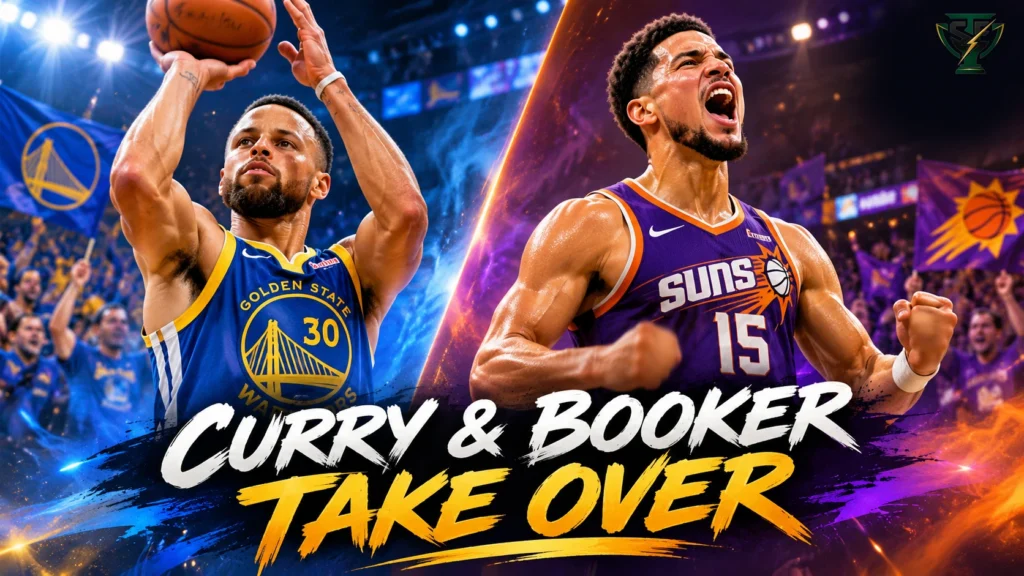
SAN FRANCISCO, United States, November 5, 2026: Stephen Curry delivered another second-half masterclass as the Golden State Warriors defeated the Miami Heat 120-100 on Thursday night, extending their winning streak to six games after an alarming 0-3 start to the 2026-27 NBA season. Curry scored 29 points, including 22 after halftime, and hit six three-pointers as Golden State transformed a closely contested game into a convincing victory at Chase Center. Draymond Green contributed a season-high 11 assists, while rookie Yaxel Lendeborg added 17 points, eight rebounds and six assists. Miami, despite double-doubles from Giannis Antetokounmpo and Bam Adebayo, could not recover from a decisive third-quarter surge.
Earlier in Phoenix, Devin Booker scored 30 points and Dillon Brooks added 24 as the Suns defeated the Orlando Magic 117-104 to end a four-game losing streak. Phoenix converted 17 of 34 three-point attempts and punished Orlando’s 25 turnovers, scoring 36 points from those mistakes. Wendell Carter Jr. impressed with 27 points and 13 rebounds for the Magic, but his efforts could not prevent another defeat. The two Thursday results shared a striking pattern: both winning teams established control during the third quarter, turning competitive first halves into substantial advantages that their opponents could not overcome.
NBA Results November 5, 2026: Both Thursday Games and Final Scores
Only two games were scheduled on Thursday, and both produced victories for the home teams in the Western Conference.
| Match | Final Score | Winning Margin | Leading Scorer | Key Outcome |
|---|---|---|---|---|
| Orlando Magic at Phoenix Suns | Phoenix 117, Orlando 104 | 13 points | Devin Booker, 30 | Phoenix ended a four-game losing streak |
| Miami Heat at Golden State Warriors | Golden State 120, Miami 100 | 20 points | Stephen Curry, 29 | Golden State earned its sixth straight victory |
Both results illustrated the importance of maintaining intensity after halftime. Phoenix built its largest advantage early in the fourth quarter, while Golden State overwhelmed Miami after the teams went into the break tied.
For continuity with the previous night, The Sports Encounter’s November 4 NBA roundup covered Victor Wembanyama’s remarkable 52-point performance and the other major results from Wednesday.
Stephen Curry Scores 29 as Golden State Warriors Beat Miami Heat 120-100
Golden State’s sixth consecutive victory was not as straightforward as the final score suggests.
Miami started aggressively, building a double-digit advantage during the opening minutes. The Heat led 29-26 after the first quarter, taking advantage of Golden State’s slow offensive start.
Curry initially struggled to find his shooting rhythm. He made just one of his first eight field-goal attempts and was two of ten at halftime.
That ordinarily creates problems for a team heavily reliant on its veteran superstar.
But Golden State’s supporting players helped maintain contact.
Draymond Green distributed the ball effectively, while Will Richard provided an early contribution after receiving his second start of the season. Richard scored the Warriors’ opening two baskets, both created by Green assists.
The second quarter remained competitive, with neither team establishing a decisive advantage. Green eventually found Curry with a long pass for a transition basket, helping Golden State move ahead during the final stages of the half.
Miami responded, and the teams went into halftime tied at 53.
It was an important moment. The Heat had enjoyed periods of offensive control, but the Warriors had survived Curry’s difficult shooting start without falling behind.
Curry’s Third-Quarter Explosion Changes Everything
The Warriors’ response after halftime was decisive.
Miami briefly moved ahead 61-58, but Golden State quickly seized control through an extended scoring run.
Curry provided the attacking momentum, scoring 14 points in the third quarter and hitting three three-pointers.
Golden State outscored Miami 38-23 during the period, turning a tied halftime score into a 91-76 lead.
The Warriors’ 26-9 surge during the quarter exposed Miami’s difficulties defending the perimeter and controlling possession when Golden State accelerated the pace.
By the beginning of the fourth, the game had changed completely.
Miami had entered the second half with a realistic opportunity to win. Fifteen minutes later, the Heat were facing a double-digit deficit against an opponent increasingly comfortable with the rhythm of the game.
Golden State added 29 points in the final quarter and prevented Miami from mounting a significant comeback.
Curry finished with 29 points on 9-of-19 shooting, including six makes from 12 three-point attempts. He also converted all five of his free throws.
His performance was particularly impressive because of the contrast between his first and second halves. Having scored seven points before halftime, Curry contributed 22 afterward.
Golden State did not require him to play excessive minutes in the closing stages once the result was secure.
His latest performance continued a productive stretch that included a dramatic comeback against the Lakers in the NBA Cup. Our report on Curry overturning a 23-point Lakers lead provides another example of his ability to change a game’s momentum.
Draymond Green’s 11 Assists Give Golden State More Than Curry’s Shooting
Although Curry dominated the scoring headlines, Green’s playmaking was equally important to the structure of Golden State’s offense.
The veteran forward finished with 11 assists, his highest total of the season.
That contribution helped the Warriors generate scoring opportunities without requiring Curry to create every basket through individual shooting.
Green’s understanding of spacing, timing and off-ball movement remains a central part of Golden State’s identity.
He can initiate plays from the perimeter, find cutters moving toward the basket and recognize when defenses are overcommitting to Curry.
Those decisions become especially valuable when an opponent begins by defending the Warriors’ leading scorer successfully.
Golden State also received 17 points, eight rebounds, six assists and three steals from Lendeborg.
The young forward’s all-around contribution demonstrated how the Warriors can remain competitive when their supporting players provide more than occasional scoring bursts.
Georges Niang added 13 points from the bench, and Golden State’s reserves combined for 53 points.
That bench production was another important factor in the victory.
Instead of depending entirely on Curry’s second-half shooting, Golden State received meaningful contributions across its rotation.
The team’s ability to win without Curry earlier in the season had already been evident. TSE’s November 1 roundup examined Lendeborg’s impact during the Warriors’ victory over the Clippers.
Miami’s Giannis Antetokounmpo, Davion Mitchell and Bam Adebayo Cannot Stop Warriors
Miami’s leading performers produced respectable individual numbers, but the team could not match Golden State’s collective output after halftime.
Davion Mitchell led the Heat with 22 points and eight assists.
Giannis Antetokounmpo contributed 20 points and 14 rebounds, while Bam Adebayo recorded 18 points and ten rebounds.
The combined contributions gave Miami opportunities to compete inside the paint and generate offense through different players.
However, Antetokounmpo scored only four points in the second half, illustrating how effectively Golden State restricted one of Miami’s most influential attacking options after halftime.
Mitchell’s scoring and playmaking were not enough to compensate for the Heat’s defensive struggles during Golden State’s decisive run.
The result was especially disappointing because Miami had been competitive throughout the opening half.
Rather than being overwhelmed immediately, the Heat lost control when the Warriors increased their defensive pressure and Curry rediscovered his shooting touch.
Klay Thompson Returns to Chase Center as a Miami Player
There was another emotional dimension to the contest.
Klay Thompson returned to Chase Center as a member of the Miami Heat, facing the franchise with which he established one of the greatest shooting partnerships in NBA history.
The former Golden State star did not produce a major scoring performance, finishing with three points.
His presence nevertheless provided a reminder of how significantly the Warriors’ roster has changed since their championship years.
Thompson’s move to Miami followed a period of uncertainty over his career. TSE previously examined the possibility of Thompson joining the Heat after his time in Dallas.
On Thursday, however, the attention returned to Curry, Green and the Warriors’ increasingly impressive current lineup.
Golden State Warriors vs Miami Heat: Quarter-by-Quarter Scorecard
| Team | Q1 | Q2 | Q3 | Q4 | Total |
|---|---|---|---|---|---|
| Miami Heat | 29 | 24 | 23 | 24 | 100 |
| Golden State Warriors | 26 | 27 | 38 | 29 | 120 |
| Golden State quarter differential | -3 | +3 | +15 | +5 | +20 |
Leading Individual Performances
| Player | Team | Points | Rebounds | Assists | Additional Contribution |
|---|---|---|---|---|---|
| Stephen Curry | Warriors | 29 | 1 | 4 | Six three-pointers |
| Yaxel Lendeborg | Warriors | 17 | 8 | 6 | Three steals |
| Draymond Green | Warriors | 2 | 5 | 11 | Season-high assists |
| Georges Niang | Warriors | 13 | 4 | 3 | Bench scoring |
| Davion Mitchell | Heat | 22 | 2 | 8 | Four three-pointers |
| Giannis Antetokounmpo | Heat | 20 | 14 | 4 | Double-double |
| Bam Adebayo | Heat | 18 | 10 | 0 | Double-double |
Statistics: Official NBA game records, November 5, 2026.
Devin Booker’s 30 Points Help Phoenix Suns End Four-Game Losing Streak
In Thursday’s other game, the Phoenix Suns delivered an important response to their recent struggles.
They defeated Orlando 117-104, snapping a four-game losing streak behind an efficient offensive performance from Booker and Brooks.
Phoenix had entered the matchup after another disappointing home loss to Portland. The Suns needed both a victory and evidence that their offensive structure could produce more consistent results.
Booker answered with 30 points and eight assists, shooting 11-of-22 from the field and four-of-eight from three-point range.
Brooks complemented him with 24 points on 9-of-16 shooting, including four makes from six attempts beyond the arc.
The two combined for 54 points and eight successful three-pointers.
That production proved particularly important against an Orlando team that received a strong performance from its starting center.
Wendell Carter Jr. scored 27 points while making ten of his 12 field-goal attempts, adding 13 rebounds.
But the Magic could not match Phoenix’s perimeter scoring or protect possession effectively enough to remain competitive.
The victory also provided a positive result for Brooks after the Suns committed to him with a substantial contract extension earlier in the year. TSE’s examination of Brooks’ $73 million extension discussed his expected influence in Phoenix.
Booker and Brooks Transform Phoenix’s Third Quarter
Orlando opened the game aggressively and initially put pressure on Phoenix.
The Suns responded, taking a 33-26 advantage after the first quarter.
Booker set the tone through efficient shooting and effective ball distribution.
He scored 23 points in the opening half, making eight of his 13 field-goal attempts and three of four three-pointers.
A three-pointer just before halftime helped Phoenix establish a 63-51 lead.
That 12-point advantage gave the Suns room to control the second half, but it was their third-quarter performance that effectively decided the contest.
Booker and Brooks connected on consecutive three-pointers during the period, extending Phoenix’s advantage to 78-60.
The Suns eventually led 96-73 after three quarters.
Orlando had been outscored 33-22 in the third, leaving the Magic facing a 23-point deficit entering the final period.
Phoenix continued to extend its advantage early in the fourth.
Collin Gillespie’s three-pointer with 9:20 remaining gave the Suns a 30-point lead, their largest of the night.
Although Orlando outscored Phoenix 31-21 in the final quarter, the comeback was insufficient to threaten the result.
The victory was valuable in the context of Phoenix’s difficult start. The Suns had recently suffered a heavy defeat against Portland, a result examined in TSE’s report on Damian Lillard’s Portland return.
Thursday’s performance demonstrated that Phoenix could produce a more balanced offensive display when its leading scorers received sufficient support.
Orlando’s 25 Turnovers Cost More Than Carter Jr.’s 27 Points Could Recover
The most damaging statistic for Orlando was not its field-goal percentage.
It was the number of possessions the Magic surrendered.
Orlando committed 25 turnovers, and Phoenix converted those mistakes into 36 points.
That total is significant because the Suns won by only 13 points.
It would be misleading to assume that all 36 points disappear if Orlando simply makes fewer mistakes, because possessions and scoring opportunities interact in complex ways.
Nevertheless, the comparison illustrates how heavily turnovers influenced the contest.
Carter Jr.’s 27 points and 13 rebounds were outstanding, particularly given his efficient shooting.
Franz Wagner added 15 points, eight rebounds and 15 assists, demonstrating the playmaking responsibilities he carried throughout the game.
Tristan da Silva contributed 18 points from the bench, while Desmond Bane also scored 15.
But Orlando’s offensive production was undermined by its inability to retain possession.
Wagner himself committed six turnovers, while the Magic repeatedly allowed Phoenix to convert defensive opportunities into points.
The difference between the teams was particularly evident beyond the arc.
Phoenix shot 17-of-34 from three-point range, an even 50%.
Orlando made 13 of 38, approximately 34.2%.
Those four additional Phoenix three-pointers were worth 12 points, almost the entire final winning margin.
Orlando had already experienced defensive difficulties earlier in the season, including a 132-125 defeat against Atlanta. Our report on the Hawks-Magic contest examined how Orlando’s attempted comeback was ultimately unsuccessful.
Phoenix Suns vs Orlando Magic: Quarter-by-Quarter Scorecard
| Team | Q1 | Q2 | Q3 | Q4 | Total |
|---|---|---|---|---|---|
| Orlando Magic | 26 | 25 | 22 | 31 | 104 |
| Phoenix Suns | 33 | 30 | 33 | 21 | 117 |
| Phoenix quarter differential | +7 | +5 | +11 | -10 | +13 |
Leading Individual Performances
| Player | Team | Points | Rebounds | Assists | Additional Contribution |
|---|---|---|---|---|---|
| Devin Booker | Suns | 30 | 1 | 8 | Four three-pointers |
| Dillon Brooks | Suns | 24 | 1 | 1 | Four three-pointers |
| Miles Bridges | Suns | 18 | 13 | 5 | Double-double |
| Luke Kennard | Suns | 12 | 1 | 5 | Three three-pointers |
| Wendell Carter Jr. | Magic | 27 | 13 | 2 | 10-of-12 field goals |
| Tristan da Silva | Magic | 18 | 2 | 1 | Four three-pointers |
| Franz Wagner | Magic | 15 | 8 | 15 | Four steals |
| Desmond Bane | Magic | 15 | 6 | 0 | Three three-pointers |
Statistics: Official NBA box score for Orlando at Phoenix, November 5, 2026.
Why Thursday’s Third Quarters Decided Both NBA Games
The two victories shared an interesting statistical pattern.
Both Golden State and Phoenix outscored their opponents by double digits in the third quarter.
Golden State’s 15-point third-quarter advantage against Miami was particularly significant because the teams had been tied at halftime.
Phoenix’s 11-point third-quarter advantage over Orlando built on an already favorable position and effectively removed the visitors’ opportunity to recover.
| Game | Halftime Score | Third-Quarter Score | Lead After Q3 | Defining Factor |
|---|---|---|---|---|
| Heat at Warriors | 53-53 | Warriors 38-23 | Warriors by 15 | Curry’s 14-point quarter |
| Magic at Suns | Suns 63-51 | Suns 33-22 | Suns by 23 | Booker-Brooks perimeter shooting and Orlando turnovers |
Across the two games, the winning teams combined to outscore their opponents 71-45 in the third quarter.
That 26-point differential represents the most revealing collective statistic from Thursday’s doubleheader.
Golden State also showed why its current winning streak is more encouraging than its early-season defeats suggested.
Earlier in October, Curry had already demonstrated his scoring ability during a 44-point performance in a night of major NBA results. TSE’s October 29 roundup documented that performance alongside other league developments.
The difference now is that the Warriors are combining Curry’s individual brilliance with increasingly productive support from Green, Lendeborg and their bench.
Phoenix, meanwhile, must demonstrate that its victory over Orlando is more than a temporary interruption to a difficult start.
What Happens Next for the Warriors, Heat, Suns and Magic?
Both Thursday winners return to action on Saturday, November 7.
Golden State host Orlando, giving the Magic an immediate opportunity to recover from their defeat in Phoenix.
The Suns host Houston, a matchup that will provide another examination of their defensive consistency and perimeter shooting.
| Team | Next Scheduled Game | Date | Immediate Challenge |
|---|---|---|---|
| Golden State Warriors | vs Orlando Magic | November 7 | Extend the six-game winning streak |
| Orlando Magic | at Golden State Warriors | November 7 | Reduce turnovers against another dangerous offense |
| Phoenix Suns | vs Houston Rockets | November 7 | Build on the victory that ended their losing streak |
| Miami Heat | at Sacramento Kings | November 8 | Recover from the second-half defensive collapse |
These fixtures also highlight the different pressures facing the teams.
Golden State are building momentum, while Phoenix need consistency after a difficult opening stretch.
Orlando must address its possession problems, and Miami need to find a way to maintain defensive discipline when opponents increase their offensive pressure.
Readers can follow the developing season through The Sports Encounter’s NBA hub, which brings together league coverage, results, analysis and ongoing storylines.
Frequently Asked Questions About the November 5 NBA Games
Which NBA teams played on November 5, 2026?
Four teams played in two games. Phoenix Suns hosted Orlando Magic, and Golden State Warriors hosted Miami Heat.
Did Golden State beat Miami?
Yes. The Warriors defeated the Heat 120-100 at Chase Center for their sixth consecutive victory.
How many points did Stephen Curry score against Miami?
Curry scored 29 points, including 22 in the second half, and made six three-pointers.
How many assists did Draymond Green record?
Green finished with 11 assists, his highest total of the 2026-27 season to that point.
How did Giannis Antetokounmpo perform for Miami?
Antetokounmpo recorded 20 points and 14 rebounds, but Golden State limited him to four points after halftime.
Who won Orlando Magic vs Phoenix Suns?
Phoenix won 117-104, ending a four-game losing streak.
How many points did Devin Booker score?
Booker scored 30 points and recorded eight assists, hitting four three-pointers.
Why did Orlando lose to Phoenix?
Orlando committed 25 turnovers, which Phoenix converted into 36 points. The Suns also shot 50% from three-point range.
Who led Orlando’s scoring?
Wendell Carter Jr. scored 27 points and grabbed 13 rebounds, shooting ten of 12 from the field.
When do Golden State and Orlando play next?
The Warriors host the Magic on Saturday, November 7, 2026.
Final Verdict: Curry and Booker Delivered, but Third-Quarter Control Won the Night
Thursday’s NBA doubleheader belonged to Stephen Curry and Devin Booker, but neither victory can be explained through individual scoring alone.
Golden State’s sixth straight win demonstrated how effective the Warriors can become when Curry’s shot-making is supported by Green’s passing and contributions throughout the rotation.
Phoenix’s victory revealed a different formula. Booker and Brooks delivered the points, but the Suns’ ability to force turnovers and convert those mistakes made Orlando’s impressive individual performances insufficient.
Both teams built their decisive advantages in the third quarter.
That was the difference between the winners and their opponents. Golden State and Phoenix adjusted, accelerated and maintained control when the games were still competitive.
For the Warriors, the result strengthens a remarkable recovery from three consecutive defeats to open the season.
For the Suns, it provides a much-needed interruption to a four-game losing streak.
Miami and Orlando, meanwhile, leave Thursday with different concerns but a common lesson: competitive first halves mean little if possession, defensive structure and scoring discipline disappear after the break.
Official NBA sources: Golden State Warriors’ November 5 game report; Miami Heat vs Golden State Warriors official NBA box score; Orlando Magic vs Phoenix Suns official NBA box score.