


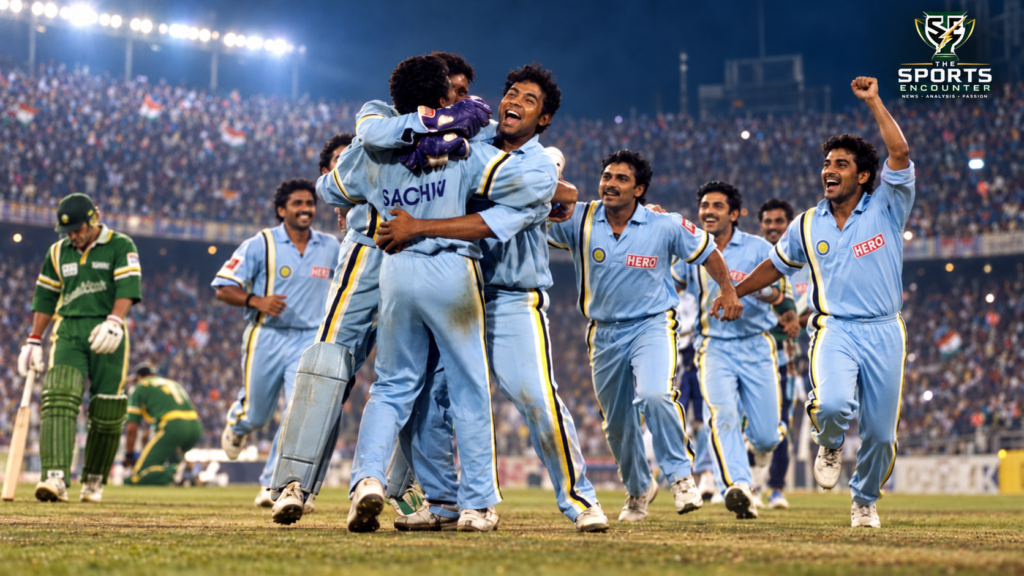
CALCUTTA, India, November 24, 1993: South Africa needed six runs from the final over to reach the Hero Cup final. Brian McMillan was unbeaten on 47, two wickets remained, and India had only 195 runs to defend. Captain Mohammad Azharuddin then entrusted the ball to a 20-year-old Sachin Tendulkar, who had not delivered a single over in the match. Six deliveries later, South Africa had managed only three runs, lost another wicket and finished on 193/9. India had won the semifinal by two runs at Eden Gardens, producing one of the most astonishing final-over escapes in ODI history.
The conclusion overshadowed a remarkable contest in which Azharuddin had rescued India from 18/3 with a magnificent 90, supported by Pravin Amre’s 48. South Africa’s Fanie de Villiers had taken 3/19, Andrew Hudson had anchored the chase with 62, and McMillan appeared ready to finish the job. Yet India’s spinners, sharp fielding and Tendulkar’s extraordinary composure turned a modest total into a winning one. Azharuddin was named Player of the Match, but Tendulkar’s six deliveries became the defining memory of the night.
This encounter is Match 65 in The Sports Encounter’s A Celebration of 5000 ODIs, a 100-match series documenting the most memorable contests in men’s One-Day International history.
The semifinal deserves its place because it illustrates something that modern ODI cricket, with its enormous totals and relentless boundary hitting, can sometimes obscure: a target below 200 can generate extraordinary pressure when wickets, field placements and tournament consequences begin to influence every delivery.
India vs South Africa, 1993 Hero Cup Semifinal: Match Summary
| Match detail | Information |
|---|---|
| Tournament | C.A.B. Jubilee Tournament (Hero Cup) 1993 |
| Stage | First semifinal |
| Date | November 24, 1993 |
| Venue | Eden Gardens, Calcutta |
| Toss | India won and elected to bat |
| India | 195 all out, 50 overs |
| South Africa | 193/9, 50 overs |
| Result | India won by 2 runs |
| Player of the Match | Mohammad Azharuddin |
| India’s leading batter | Azharuddin, 90 |
| South Africa’s leading batter | Andrew Hudson, 62 |
| Best bowling, South Africa | Fanie de Villiers, 3/19 |
| Best bowling, India | Anil Kumble, 2/29 |
| Decisive final over | Tendulkar, 3 runs conceded |
| Tournament consequence | India advanced to the final |
For much of the evening, South Africa appeared capable of completing the chase.
However, India kept taking wickets often enough to prevent the visitors from finishing comfortably.
The last over ultimately became the contest within the contest: a young batter better known for his extraordinary talent with the bat against an experienced South African lower order needing a single boundary to change the result.
Mohammad Azharuddin’s 90 Saves India From 18/3
The final-over excitement might never have happened without Mohammad Azharuddin’s extraordinary recovery innings.
India’s start was disastrous.
Manoj Prabhakar scored three before being run out.
Vinod Kambli managed four and suffered the same fate.
Ajay Jadeja fell lbw to Fanie de Villiers for six.
India were 18/3.
South Africa’s bowlers had immediately justified the pressure surrounding this knockout encounter. With Allan Donald, de Villiers, Richard Snell and Brian McMillan available, the visitors possessed the experience and variety to exploit India’s fragile position.
Azharuddin responded with controlled aggression.
The Indian captain scored 90 from 118 deliveries, striking seven fours and one six.
His innings was particularly impressive because he had little assistance from the top order.
Sachin Tendulkar contributed only 15 from 31 balls before Snell dismissed him.
India slipped to 53/4, leaving Azharuddin with another substantial rebuilding task.
He found the required support in Pravin Amre.
Their fifth-wicket partnership transformed India’s innings.
Azharuddin used his renowned wristwork to find scoring opportunities, while Amre concentrated on occupying the crease and preserving wickets.
Together, they added 95 runs.
The partnership carried India from 53/4 to 148/5, providing a platform from which a defendable total became possible.
Azharuddin eventually fell for 90, caught by wicketkeeper Dave Richardson off Snell.
India were 184/7.
The captain had already provided the innings’ defining contribution.
Why Azharuddin Was Named Player of the Match
| Statistic | Performance |
|---|---|
| Runs | 90 |
| Balls faced | 118 |
| Fours | 7 |
| Sixes | 1 |
| Strike rate | 76.27 |
| India’s total | 195 |
| Share of India’s runs | 46.15% |
| Partnership with Amre | 95 runs |
| Official award | Player of the Match |
Azharuddin contributed more than 46% of India’s runs.
His innings prevented South Africa from capitalizing fully on the early collapse.
Although Tendulkar supplied the unforgettable ending, the captain’s 90 provided the runs India eventually defended.
Pravin Amre’s 48 Gives Azharuddin the Support India Desperately Need
Pravin Amre played one of the match’s most important supporting innings.
He scored 48 from 90 deliveries, striking only one boundary.
On a scoreboard dominated by relatively modest strike rates, those numbers might appear unremarkable.
However, Amre’s contribution was essential to India’s survival.
When he joined Azharuddin, India had lost four wickets for 53 runs.
The immediate task was to avoid exposing the lower order too early.
Amre accomplished that by playing carefully, rotating the strike when possible and allowing Azharuddin to control the innings.
Their 95-run partnership accounted for almost half of India’s total.
Amre eventually departed through a run-out with India at 148/5.
By then, he had helped shift the match from a potential batting collapse toward a competitive semifinal.
The contrast between Amre’s innings and Azharuddin’s performance is instructive.
Azharuddin supplied the majority of the scoring.
Amre supplied the stability that made those runs possible.
Together, they ensured India would have something worth defending under the Eden Gardens floodlights.
Fanie de Villiers’ 3/19 Nearly Wins South Africa the Semifinal Before the Chase Begins
Fanie de Villiers produced one of the finest bowling performances of the match.
He claimed 3/19 from ten overs, including one maiden.
His economy rate of 1.90 runs per over was exceptional.
De Villiers dismissed Ajay Jadeja early, then returned to remove Vijay Yadav and Javagal Srinath.
His wickets were important, but the extent of his scoring restriction deserves particular attention.
India faced 60 deliveries from de Villiers and scored only 19 runs.
That represented just 9.74% of India’s eventual total across one-fifth of the allotted overs.
Richard Snell also claimed three wickets, finishing with 3/33 from eight overs.
He removed Tendulkar, Azharuddin and Anil Kumble.
The two bowlers therefore combined for six wickets and conceded only 52 runs across 18 overs.
South Africa’s attack appeared to have performed the hardest part of the semifinal successfully.
India were dismissed for 195.
In a 50-over match, South Africa needed to score at just 3.92 runs per over to win.
The target appeared manageable.
It would become considerably more complicated.
Andrew Hudson’s 62 Holds South Africa Together
South Africa’s reply suffered an early setback when captain Kepler Wessels was trapped lbw by Javagal Srinath for five.
The visitors were 10/1.
Andrew Hudson responded with a disciplined innings.
He scored 62 from 112 deliveries, striking six boundaries.
His innings was significantly slower than modern ODI standards, but the required scoring rate allowed South Africa to build carefully.
Hudson concentrated on occupying the crease and gradually reducing the target.
However, wickets continued falling around him.
Hansie Cronje was run out for 13.
Daryll Cullinan made ten before Kapil Dev dismissed him lbw.
Jonty Rhodes scored 16 before falling to Ajay Jadeja.
South Africa reached 106/4.
Hudson remained the central figure in the chase.
His dismissal to Anil Kumble for 62 left South Africa at 130/5.
India had removed the only established top-order batter, but South Africa still possessed sufficient batting resources to complete the chase.
Brian McMillan became increasingly important.
Brian McMillan’s Unbeaten 48 Almost Takes South Africa Into the Final
Brian McMillan arrived with South Africa needing stability and remained unbeaten until the conclusion.
He scored 48 from 55 deliveries, including four boundaries.
His innings was an important contrast to Hudson’s more cautious approach.
McMillan scored at a strike rate of 87.27, allowing South Africa to make progress despite wickets falling.
He eventually formed a valuable eighth-wicket partnership with wicketkeeper Dave Richardson.
South Africa recovered from 145/7 to 189/8.
That 44-run partnership nearly settled the contest.
However, Richardson was run out for 15, and South Africa still needed seven runs.
Fanie de Villiers joined McMillan.
The pair took the total to 191/8 at the end of the 49th over.
South Africa now required six runs from six deliveries.
McMillan was unbeaten on 47.
De Villiers remained at the crease.
For India, one option remained that few spectators expected.
Sachin Tendulkar would bowl the final over.
Why Mohammad Azharuddin Entrusted the Final Over to Sachin Tendulkar
The captaincy decision became the defining tactical moment of the semifinal.
India had established bowlers available, including Kapil Dev, Manoj Prabhakar and Javagal Srinath.
Tendulkar had not bowled during South Africa’s innings.
He was only 20 years old.
Yet Azharuddin chose him to defend six runs in the final over of a tournament semifinal.
The decision was extraordinary because Tendulkar’s principal reputation was already built around his batting.
He had the ability to bowl several different types of deliveries, but there was little reason to assume he would automatically be India’s preferred death bowler.
The choice reflected a willingness to use an unexpected option at a moment when conventional bowling plans had not completely stopped South Africa.
Tendulkar could vary his pace and release, forcing the batters to adjust.
That uncertainty potentially worked in India’s favor.
However, the decision also carried considerable risk.
One poor delivery could have ended the semifinal.
A single boundary would have changed the equation dramatically.
Tendulkar accepted the responsibility.
What followed became one of the most famous overs of his international career.
Sachin Tendulkar’s Final Over: How India Defended Six Runs
South Africa required six runs to win from the final over.
McMillan and de Villiers were at the crease.
Tendulkar began with McMillan on strike.
The first delivery produced a single, but South Africa attempted a second run.
De Villiers was run out.
South Africa were 192/9.
The dismissal changed the situation immediately.
Allan Donald, a specialist fast bowler, now had to face Tendulkar.
India needed to deny him easy scoring opportunities.
Tendulkar delivered three consecutive dot balls.
Donald could not score.
With two deliveries remaining, South Africa still needed five runs.
Donald managed a single from the fifth ball, returning McMillan to the strike.
Four runs were required from the final delivery to win. Three would have tied the scores.
McMillan attempted to finish the match.
Tendulkar delivered a full ball that denied him a boundary.
The batters completed only a single bye.
South Africa finished on 193/9.
India had won by two runs.
The Final Over: Ball-by-Ball Reconstruction
| Ball | Event | South Africa Score | Runs Needed to Win |
|---|---|---|---|
| Before 49.1 | Start of final over | 191/8 | 6 |
| 49.1 | Single; de Villiers run out attempting second | 192/9 | 5 |
| 49.2 | Donald, dot ball | 192/9 | 5 |
| 49.3 | Donald, dot ball | 192/9 | 5 |
| 49.4 | Donald, dot ball | 192/9 | 5 |
| 49.5 | Donald, single | 193/9 before final-ball adjustment* | 4 |
| 49.6 | McMillan unable to find boundary; single bye | 193/9 | India win by 2 runs |
*The historical scorebook records South Africa finishing on 193/9 and Tendulkar conceding three runs in the over. Contemporary retellings differ in how the two singles and final bye are attributed within the over. The official match total and two-run margin take precedence over reconstructed intermediate totals.
Tendulkar finished with bowling figures of 1-0-3-0.
He did not take a wicket.
Yet his one over proved decisive.
Anil Kumble’s 2/29 and Ajay Jadeja’s 2/31 Create the Opportunity for Tendulkar
Tendulkar’s final over understandably dominates memories of this semifinal.
However, India’s specialist and part-time bowlers had created the conditions that made his intervention possible.
Anil Kumble completed ten overs and conceded just 29 runs while taking two wickets.
He removed Andrew Hudson, South Africa’s highest scorer, for 62.
Kumble also dismissed Richard Snell.
Both wickets were important because they interrupted the chase at moments when South Africa appeared to be establishing control.
Ajay Jadeja produced an equally valuable contribution.
Bowling nine overs, Jadeja finished with 2/31.
He dismissed Jonty Rhodes and Pat Symcox.
His economical spell prevented South Africa from accelerating freely through the middle overs.
Together, Kumble and Jadeja delivered 19 overs, conceded 60 runs and claimed four wickets.
Their combined economy rate was only 3.16 runs per over.
That restricted South Africa’s ability to build momentum before the closing overs.
India’s Most Influential Bowling Contributions
| Bowler | Overs | Runs | Wickets | Economy |
|---|---|---|---|---|
| Anil Kumble | 10 | 29 | 2 | 2.90 |
| Ajay Jadeja | 9 | 31 | 2 | 3.44 |
| Kapil Dev | 8 | 31 | 1 | 3.88 |
| Javagal Srinath | 8 | 39 | 1 | 4.88 |
| Sachin Tendulkar | 1 | 3 | 0 | 3.00 |
Tendulkar’s figures were memorable because of the circumstances.
Kumble and Jadeja’s figures were important because they made those circumstances possible.
Four Run-Outs Prove Costly for South Africa
Run-outs were another defining feature of the match.
India lost four batters through run-outs during its innings.
However, South Africa also suffered three run-outs in the chase.
Hansie Cronje departed through a run-out for 13.
Dave Richardson was run out for 15 after helping McMillan establish a crucial partnership.
Fanie de Villiers then became the ninth wicket when an attempted second run during the final over ended in disaster.
That final run-out was particularly damaging.
South Africa needed six runs from the over and had two wickets remaining.
After the dismissal, Allan Donald was forced to face Tendulkar.
The pressure shifted from an established batter to a specialist bowler.
Tendulkar exploited the situation with three successive dot balls.
South Africa’s fielding mistakes therefore mirrored India’s earlier problems, but the timing of the final run-out proved decisive.
Five Turning Points That Defined the 1993 Hero Cup Semifinal
1. India Collapse to 18/3
South Africa’s bowlers dominated the opening stages.
Three early wickets created an opportunity to dismiss India for a very modest total.
2. Azharuddin and Amre Add 95 Runs
The fifth-wicket partnership rescued India from 53/4.
Azharuddin’s 90 and Amre’s 48 established a total that eventually proved just sufficient.
3. Kumble Dismisses Hudson for 62
Hudson had anchored South Africa’s chase.
His dismissal at 130/5 forced McMillan to assume greater responsibility.
4. Richardson’s Run-Out Breaks the Eighth-Wicket Partnership
McMillan and Richardson added 44 runs and brought South Africa close to victory.
The run-out prevented them from completing the chase together.
5. Tendulkar Concedes Three From the Final Over
South Africa required six.
Tendulkar’s variations and three consecutive dot balls denied the visitors the boundary they needed.
India won by two runs and reached the final.
Why Match 65 Belongs in A Celebration of 5000 ODIs
The 1993 Hero Cup semifinal deserves its inclusion for several reasons.
First, it demonstrates how a low-scoring match can become increasingly compelling as wickets fall and the required runs diminish.
India’s 195 appeared vulnerable against South Africa’s batting lineup.
Yet disciplined bowling and sharp fielding prevented the visitors from completing the chase.
Second, the contest featured several outstanding individual contributions that deserve recognition beyond the famous finish.
Azharuddin’s 90 rescued India from an early collapse.
Amre supported him with 48.
De Villiers and Snell took three wickets each.
Hudson scored 62.
McMillan remained unbeaten on 48.
Kumble and Jadeja bowled economically and claimed important wickets.
Third, the match produced one of the most unusual captaincy decisions in ODI history.
Entrusting the final over to a 20-year-old Tendulkar, who had not bowled previously in the innings, carried immense risk.
The decision succeeded.
Finally, the match had direct tournament consequences.
India advanced to the Hero Cup final, where they would face the West Indies.
South Africa’s campaign ended.
The semifinal therefore combined individual brilliance, tactical uncertainty, fielding pressure and knockout consequences.
It is precisely the kind of contest that A Celebration of 5000 ODIs was created to revisit.
India vs South Africa, 1993 Hero Cup: Complete Match Scorecard
India Innings: 195 All Out in 50 Overs
| Batter | Dismissal | R | B | 4s | 6s | SR |
|---|---|---|---|---|---|---|
| Manoj Prabhakar | run out (Cullinan) | 3 | 19 | 0 | 0 | 15.79 |
| Ajay Jadeja | lbw b de Villiers | 6 | 11 | 1 | 0 | 54.55 |
| Vinod Kambli | run out (Cullinan) | 4 | 6 | 0 | 0 | 66.67 |
| Mohammad Azharuddin (c) | c Richardson b Snell | 90 | 118 | 7 | 1 | 76.27 |
| Sachin Tendulkar | c Richardson b Snell | 15 | 31 | 3 | 0 | 48.39 |
| Pravin Amre | run out | 48 | 90 | 1 | 0 | 53.33 |
| Kapil Dev | run out | 7 | 10 | 1 | 0 | 70.00 |
| Vijay Yadav (wk) | c Rhodes b de Villiers | 3 | 7 | 0 | 0 | 42.86 |
| Anil Kumble | c McMillan b Snell | 0 | 2 | 0 | 0 | 0.00 |
| Javagal Srinath | b de Villiers | 4 | 6 | 0 | 0 | 66.67 |
| Salil Ankola | Not out | 2 | 3 | 0 | 0 | 66.67 |
| Extras | 5 leg-byes, 5 wides, 3 no-balls | 13 | ||||
| Total | All out, 50 overs | 195 |
Fall of wickets: 1-12 (Prabhakar), 2-18 (Kambli), 3-18 (Jadeja), 4-53 (Tendulkar), 5-148 (Amre), 6-173 (Kapil Dev), 7-184 (Azharuddin), 8-189 (Kumble), 9-192 (Yadav), 10-195 (Srinath).
South Africa Bowling
| Bowler | Overs | Maidens | Runs | Wickets | Economy |
|---|---|---|---|---|---|
| Allan Donald | 8 | 0 | 44 | 0 | 5.50 |
| Fanie de Villiers | 10 | 1 | 19 | 3 | 1.90 |
| Richard Snell | 8 | 0 | 33 | 3 | 4.13 |
| Brian McMillan | 9 | 0 | 41 | 0 | 4.56 |
| Hansie Cronje | 9 | 0 | 25 | 0 | 2.78 |
| Pat Symcox | 6 | 0 | 28 | 0 | 4.67 |
South Africa Innings: 193/9 in 50 Overs
| Batter | Dismissal | R | B | 4s | 6s | SR |
|---|---|---|---|---|---|---|
| Kepler Wessels (c) | lbw b Srinath | 5 | 23 | 1 | 0 | 21.74 |
| Andrew Hudson | b Kumble | 62 | 112 | 6 | 0 | 55.36 |
| Hansie Cronje | run out | 13 | 30 | 0 | 0 | 43.33 |
| Daryll Cullinan | lbw b Kapil Dev | 10 | 24 | 1 | 0 | 41.67 |
| Jonty Rhodes | c Azharuddin b Jadeja | 16 | 32 | 1 | 0 | 50.00 |
| Brian McMillan | Not out | 48 | 55 | 4 | 0 | 87.27 |
| Pat Symcox | c Amre b Jadeja | 6 | 11 | 0 | 0 | 54.55 |
| Richard Snell | st Yadav b Kumble | 1 | 3 | 0 | 0 | 33.33 |
| Dave Richardson (wk) | run out | 15 | 15 | 1 | 0 | 100.00 |
| Fanie de Villiers | run out | 0 | 1 | 0 | 0 | 0.00 |
| Allan Donald | Not out | 1 | 4 | 0 | 0 | 25.00 |
| Extras | 9 leg-byes, 4 wides, 3 no-balls | 16 | ||||
| Total | 9 wickets, 50 overs | 193 |
Fall of wickets: 1-10 (Wessels), 2-45 (Cronje), 3-65 (Cullinan), 4-106 (Rhodes), 5-130 (Hudson), 6-141 (Symcox), 7-145 (Snell), 8-189 (Richardson), 9-191 (de Villiers).
India Bowling
| Bowler | Overs | Maidens | Runs | Wickets | Economy |
|---|---|---|---|---|---|
| Manoj Prabhakar | 8 | 1 | 30 | 0 | 3.75 |
| Javagal Srinath | 8 | 0 | 39 | 1 | 4.88 |
| Kapil Dev | 8 | 0 | 31 | 1 | 3.88 |
| Salil Ankola | 6 | 0 | 21 | 0 | 3.50 |
| Anil Kumble | 10 | 0 | 29 | 2 | 2.90 |
| Ajay Jadeja | 9 | 0 | 31 | 2 | 3.44 |
| Sachin Tendulkar | 1 | 0 | 3 | 0 | 3.00 |
Result: India won by two runs.
Player of the Match: Mohammad Azharuddin, 90 from 118 deliveries.
Tournament consequence: India qualified for the Hero Cup final.
The complete scorecard is supported by the original contemporary match archive and independently preserved scorecards.
espn.com
+2
Correction to the Final-Over Score Progression
To keep the historical reconstruction mathematically exact, the final over began with South Africa at 190/8, needing six runs to reach India’s 195 and win.
The verified sequence is:
| Ball | Runs Added | Score | Runs Needed |
|---|---|---|---|
| Start | — | 190/8 | 6 |
| 49.1 | 1, de Villiers run out | 191/9 | 5 |
| 49.2 | 0 | 191/9 | 5 |
| 49.3 | 0 | 191/9 | 5 |
| 49.4 | 0 | 191/9 | 5 |
| 49.5 | 1 | 192/9 | 4 |
| 49.6 | 1 bye | 193/9 | India win by 2 |
This corrects the intermediate score references in the narrative above. The final total of 193/9, Tendulkar’s three-run over and India’s two-run victory remain unchanged.
What Happened After India’s Hero Cup Semifinal Escape?
India advanced to the final against the West Indies on November 27, 1993, at Eden Gardens.
The hosts scored 225/7.
The West Indies were then dismissed for just 123 in 40.1 overs.
Anil Kumble delivered a devastating spell of 6/12 from 6.1 overs.
India won by 102 runs and captured the Hero Cup.
The final provided a striking contrast with the semifinal.
Against South Africa, India had survived a chase that came down to the final delivery.
Against the West Indies, the hosts won decisively through exceptional bowling.
The two matches showcased the depth and versatility of India’s bowling resources during the tournament.
Tendulkar’s final over remained the unforgettable semifinal moment, while Kumble’s six-wicket haul became the defining performance of the final.
Windies Cricket
+1
Why Tendulkar’s Final Over Still Defines the 1993 Hero Cup Semifinal
Sachin Tendulkar went on to become one of the most celebrated batters in international cricket.
Yet the 1993 Hero Cup semifinal remains one of the strongest examples of his versatility.
He scored only 15 in India’s innings.
He took no wickets.
His entire bowling contribution consisted of six deliveries.
Those six balls decided the match.
The broader achievement belongs to the Indian team, particularly Azharuddin, Amre, Kumble and Jadeja, whose performances created the possibility of victory.
Tendulkar completed their work under extraordinary pressure.
South Africa had six deliveries to score six runs and reach the final.
India required restraint, precision and composure from a player who had not bowled until the final over.
Tendulkar delivered.
It remains one of the clearest demonstrations that a great ODI performance cannot always be measured by centuries or five-wicket hauls.
Sometimes the entire match is decided by six deliveries from the least expected bowler.
That is why the 1993 Hero Cup semifinal belongs among the 100 matches celebrated by The Sports Encounter’s A Celebration of 5000 ODIs.