


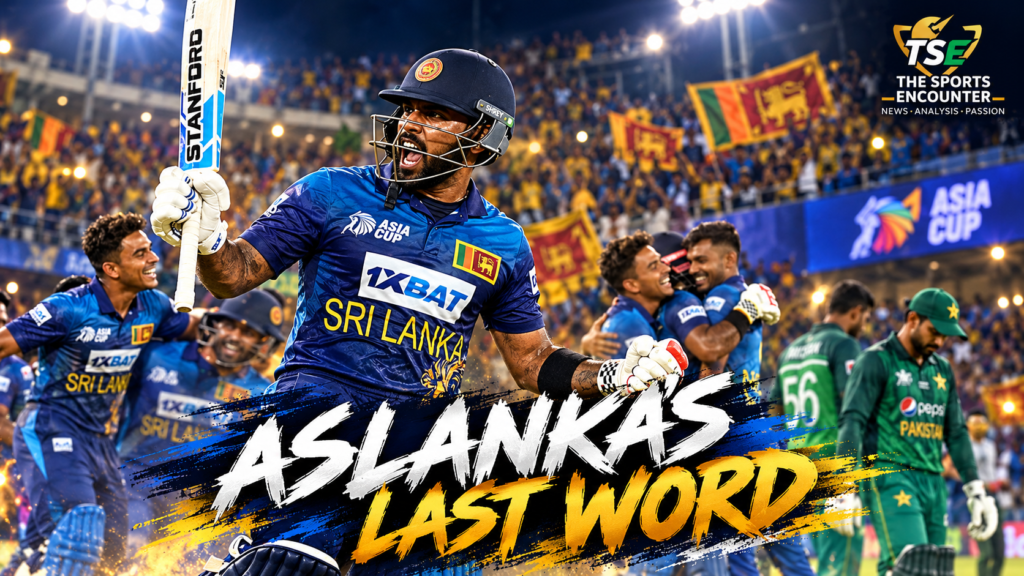
COLOMBO, Sri Lanka, September 14, 2023: Pakistan were one delivery away from keeping their Asia Cup final hopes alive. Shaheen Shah Afridi had removed two Sri Lankan batters in the penultimate over, and debutant Zaman Khan had forced the hosts to the final ball with two runs still required. Then Charith Asalanka calmly worked the last delivery toward fine leg, completed two runs and sent R. Premadasa Stadium into celebration. Sri Lanka reached 252/8 from 42 overs to defeat Pakistan by two wickets under the DLS method and advance to the 2023 Asia Cup final against India.
For much of the chase, Sri Lanka had appeared comfortable. Kusal Mendis struck 91 from 87 deliveries, Sadeera Samarawickrama added 48, and Pakistan’s 252/7 seemed within reach. Yet Iftikhar Ahmed’s three wickets and Shaheen’s devastating late double strike nearly overturned the contest. Mohammad Rizwan’s unbeaten 86 and his 108-run partnership with Iftikhar had earlier rescued Pakistan’s innings, but Asalanka’s unbeaten 49 ultimately settled a match that neither side could control until the final delivery.
The encounter takes its place as Match 64 in The Sports Encounter’s A Celebration of 5000 ODIs, a collection examining 100 unforgettable One-Day Internationals.
Its inclusion reflects the match’s extraordinary competitive stakes, Sri Lanka’s apparent control, Pakistan’s late recovery and a conclusion in which the difference between reaching a continental final and being eliminated was decided by the final ball.
Sri Lanka vs Pakistan 2023 Asia Cup: Match Summary
| Match detail | Information |
|---|---|
| Tournament | Asia Cup 2023 |
| Stage | Super Four, fifth match |
| Date | September 14, 2023 |
| Venue | R. Premadasa Stadium, Colombo |
| Toss | Pakistan elected to bat |
| Match duration | 42 overs per side, rain-adjusted |
| Pakistan | 252/7 in 42 overs |
| Sri Lanka | 252/8 in 42 overs |
| DLS target | 252 |
| Result | Sri Lanka won by 2 wickets |
| Winning delivery | Final ball |
| Player of the Match | Kusal Mendis |
| Highest scorer, Pakistan | Mohammad Rizwan, 86* |
| Highest scorer, Sri Lanka | Kusal Mendis, 91 |
| Best bowling, Pakistan | Iftikhar Ahmed, 3/50 |
| Best bowling, Sri Lanka | Matheesha Pathirana, 3/65 |
| Qualification consequence | Sri Lanka advanced to the final |
The encounter effectively served as a semifinal because India had already qualified for the tournament’s championship match.
Pakistan needed victory to reach the final.
Sri Lanka needed to win to defend their continental title against India.
Rain complicated both innings, eventually reducing the contest to 42 overs per side.
Those interruptions made scoring-rate management and wicket preservation particularly important.
Mohammad Rizwan’s Unbeaten 86 Rescues Pakistan From 130/5
Pakistan’s innings looked in serious trouble midway through the contest.
Fakhar Zaman departed for four, while captain Babar Azam made 29 before Dunith Wellalage had him stumped by Kusal Mendis.
Abdullah Shafique provided valuable stability, scoring 52 from 69 deliveries.
However, his dismissal left Pakistan at 100/3.
Mohammad Haris contributed just three before Matheesha Pathirana removed him.
Mohammad Nawaz briefly supported Rizwan but was dismissed for 12.
Pakistan had slipped to 130/5 after 27.4 overs.
In a rain-reduced contest, the situation demanded immediate acceleration.
Rizwan responded with one of his finest innings of the tournament.
He scored an unbeaten 86 from 73 balls, striking six fours and two sixes.
His performance combined controlled accumulation with increasingly aggressive strokeplay during the closing overs.
The most important development was his partnership with Iftikhar Ahmed.
Together, they added 108 runs from 78 deliveries.
That partnership transformed Pakistan’s prospects.
A total below 220 had appeared possible when Nawaz departed.
Rizwan and Iftikhar instead carried Pakistan toward 250.
Mohammad Rizwan’s Contribution
| Statistic | Performance |
|---|---|
| Runs | 86 not out |
| Balls faced | 73 |
| Fours | 6 |
| Sixes | 2 |
| Strike rate | 117.81 |
| Partnership with Iftikhar | 108 |
| Pakistan’s total | 252/7 |
| Share of Pakistan’s runs | 34.13% |
Rizwan contributed more than one-third of Pakistan’s runs.
His innings also ensured the middle-order collapse did not become a decisive weakness.
Without his acceleration, Sri Lanka’s chase would have required considerably less risk.
Iftikhar Ahmed’s 47 Changes Pakistan’s Innings, Then His Bowling Nearly Changes the Result
Iftikhar Ahmed was arguably Pakistan’s most influential all-round performer.
He scored 47 from 40 deliveries, including four boundaries and two sixes.
His batting provided essential support during Rizwan’s recovery.
The pair’s 108-run partnership lifted Pakistan from 130/5 to 238/6.
Iftikhar attacked Sri Lanka’s bowlers at a stage when Pakistan desperately needed boundaries.
His dismissal to Pathirana in the 41st over did little to undermine the value of his contribution.
Pakistan had already established a competitive total.
Iftikhar subsequently returned with the ball and came remarkably close to turning the match in Pakistan’s favor.
His off-spin produced 3/50 from eight overs.
He dismissed Sadeera Samarawickrama, Kusal Mendis and captain Dasun Shanaka.
The wicket of Mendis was particularly important.
Sri Lanka’s leading batter had scored 91 and appeared capable of carrying the chase to a comfortable conclusion.
Iftikhar removed him with the score at 210/4.
That breakthrough gave Pakistan an opportunity to attack the remaining batters.
His dismissal of Shanaka added further pressure.
Iftikhar therefore played important roles in both halves of the contest.
He helped Pakistan recover from a difficult batting position and subsequently provided crucial wickets during the chase.
Matheesha Pathirana’s 3/65 Restricts Pakistan Despite an Expensive Spell
Matheesha Pathirana was Sri Lanka’s leading wicket-taker.
The young fast bowler claimed 3/65 from eight overs.
His economy rate of 8.12 reflected Pakistan’s late acceleration, but his wickets prevented the visitors from retaining all their batting resources for the closing stages.
Pathirana dismissed Abdullah Shafique for 52.
He then removed Mohammad Haris for three.
Later, he dismissed Iftikhar Ahmed for 47.
Those wickets came at different stages of the innings and interrupted Pakistan’s attempts to establish partnerships.
Pramod Madushan supported Pathirana with 2/58.
He removed Fakhar Zaman early before returning to dismiss Shadab Khan.
Dunith Wellalage claimed the important wicket of Babar Azam, while Maheesh Theekshana dismissed Mohammad Nawaz.
Sri Lanka’s bowling attack successfully reduced Pakistan to 130/5.
However, Rizwan and Iftikhar’s partnership ensured the early control did not translate into a modest total.
Sri Lanka’s Bowling Performance
| Bowler | Overs | Maidens | Runs | Wickets | Economy |
|---|---|---|---|---|---|
| Pramod Madushan | 7 | 1 | 58 | 2 | 8.29 |
| Maheesh Theekshana | 9 | 0 | 42 | 1 | 4.67 |
| Dasun Shanaka | 3 | 0 | 18 | 0 | 6.00 |
| Dunith Wellalage | 9 | 0 | 40 | 1 | 4.44 |
| Matheesha Pathirana | 8 | 0 | 65 | 3 | 8.12 |
| Dhananjaya de Silva | 6 | 0 | 28 | 0 | 4.67 |
The most revealing comparison is between Pathirana and Sri Lanka’s spinners.
Pathirana took three wickets but conceded more than eight runs per over.
Theekshana and Wellalage combined to concede 82 from 18 overs while taking two wickets.
That control was particularly valuable before Pakistan’s late acceleration.
Kusal Mendis’ 91 Puts Sri Lanka on Course for the Asia Cup Final
Sri Lanka’s chase initially followed a relatively comfortable pattern despite the early dismissal of Kusal Perera.
Perera contributed 17 from just eight deliveries before being run out by Shadab Khan.
Pathum Nissanka then helped stabilize the innings, scoring 29 from 44 deliveries.
However, Kusal Mendis was the batter who truly transformed the contest.
Mendis scored 91 from 87 deliveries, striking eight fours and one six.
His innings maintained the required scoring rate while limiting the pressure created by Pakistan’s bowlers.
The wicketkeeper-batter displayed particular confidence against spin.
He rotated the strike effectively and punished deliveries that offered width or insufficient length.
His partnership with Sadeera Samarawickrama was the decisive phase of Sri Lanka’s successful chase.
Together, they added 100 runs for the third wicket.
Sri Lanka advanced from 77/2 to 177/3.
The partnership placed the hosts firmly ahead in the contest.
Pakistan needed wickets quickly to prevent Sri Lanka from completing the chase comfortably.
Mendis continued attacking after Samarawickrama’s dismissal.
He eventually fell for 91, caught by Mohammad Haris off Iftikhar Ahmed.
Sri Lanka were 210/4.
His dismissal reopened a contest that had appeared increasingly settled.
Why Kusal Mendis Was Player of the Match
| Statistic | Performance |
|---|---|
| Runs | 91 |
| Balls | 87 |
| Fours | 8 |
| Sixes | 1 |
| Strike rate | 104.60 |
| Partnership with Samarawickrama | 100 |
| Sri Lanka’s total | 252/8 |
| Share of Sri Lanka’s runs | 36.11% |
Mendis scored more than 36% of Sri Lanka’s runs.
His contribution was particularly significant because he established the scoring platform that allowed Sri Lanka to remain competitive despite the late collapse.
Although Asalanka produced the winning runs, Mendis had done much of the work required to keep the chase within reach.
He was deservedly named Player of the Match.
Sadeera Samarawickrama’s 48 Creates the Partnership Pakistan Cannot Break
Sadeera Samarawickrama played an equally important supporting role.
His 48 came from 51 deliveries and included four boundaries.
He joined Mendis after Sri Lanka lost their second wicket at 77.
At that stage, Pakistan still had an opportunity to put the hosts under pressure.
Samarawickrama resisted that opportunity.
His batting was controlled and calculated.
He concentrated on maintaining the required scoring rate while allowing Mendis to attack more aggressively.
Their partnership added 100 runs and consumed enough overs to place Sri Lanka in a commanding position.
Samarawickrama eventually fell to Iftikhar, stumped by Mohammad Rizwan.
His dismissal began Pakistan’s recovery.
However, the runs he contributed had already made Sri Lanka’s target considerably more manageable.
In hindsight, the partnership between Mendis and Samarawickrama was among the match’s most important phases.
It provided the foundation upon which Asalanka eventually completed the victory.
Charith Asalanka’s Unbeaten 49 Turns Pakistan’s Late Fightback Into Heartbreak
Charith Asalanka produced the most important finishing performance of the match.
His unbeaten 49 came from 47 deliveries, featuring three fours and one six.
When Mendis departed at 210/4, Sri Lanka still needed 42 runs.
The target remained achievable, but Pakistan sensed an opportunity.
Iftikhar continued taking wickets, and Shaheen Shah Afridi returned for a devastating late spell.
Asalanka was left to manage an increasingly tense chase.
Sri Lanka lost captain Shanaka for two.
Dhananjaya de Silva then fell to Shaheen for five.
Dunith Wellalage departed for a first-ball duck.
Suddenly, Sri Lanka were 243/7 with only 11 deliveries remaining.
The game had changed completely.
Pakistan were now within reach of a remarkable victory.
Asalanka had to control the strike, preserve wickets and continue finding runs against Pakistan’s fast bowlers.
His task became even more difficult when Pramod Madushan was run out during the final over.
Sri Lanka were 246/8.
With two deliveries remaining, six runs were required.
Asalanka responded with a boundary.
He then calmly collected the two runs required from the final delivery.
Sri Lanka had won.
Asalanka’s Decisive Contribution
| Statistic | Performance |
|---|---|
| Runs | 49 not out |
| Balls | 47 |
| Fours | 3 |
| Sixes | 1 |
| Strike rate | 104.26 |
| Sri Lanka at the eighth wicket | 246/8 |
| Runs needed from final two balls | 6 |
| Penultimate delivery | Four |
| Final delivery | Two |
| Result | Sri Lanka won by 2 wickets |
Asalanka’s composure was exceptional.
Pakistan had produced the wickets necessary to revive its chances.
However, Asalanka retained enough control to finish the chase without taking an unreasonable risk on the last delivery.
Shaheen Shah Afridi’s Double Strike Almost Produces an Extraordinary Pakistan Escape
Shaheen Shah Afridi came close to delivering one of Pakistan’s most memorable late-match recoveries.
Sri Lanka were well placed at 210/4 when Mendis departed.
Iftikhar’s wickets kept Pakistan alive, but Shaheen’s return created the real possibility of victory.
With Sri Lanka requiring 12 from the final two overs, Shaheen dismissed Dhananjaya de Silva and Dunith Wellalage from successive deliveries in the 41st over.
The wickets reduced Sri Lanka to 243/7.
Only nine runs were required, but Pakistan now needed three wickets rather than allowing Sri Lanka to complete a routine chase.
Shaheen conceded only four runs in the over.
That left Sri Lanka needing eight from the final six deliveries.
Pakistan had recovered an opportunity that appeared lost.
Shaheen finished with 2/52 from nine overs.
His figures alone cannot fully explain the importance of his late spell.
He removed two batters at the precise moment Sri Lanka were attempting to finish the contest.
The wickets exposed the lower order and handed Zaman Khan a realistic chance of defending the final eight runs.
Zaman Khan’s Final Over: Six Deliveries From a Place in the Final
Pakistan’s hopes rested on Zaman Khan, making his ODI debut.
Sri Lanka required eight runs from six balls.
Asalanka was the established batter.
At the other end stood the lower order.
Zaman began with a dot ball and continued building pressure.
Sri Lanka then managed a single, a run-out followed, and Asalanka retained the strike with the match still unresolved.
By the time the penultimate delivery arrived, Sri Lanka needed six runs from two balls.
A wicket or two dot balls would have sent Pakistan into the final.
Asalanka instead found the boundary, edging the ball past the wicketkeeper and short third-man region for four.
The equation was reduced to two runs from one delivery.
Zaman delivered the final ball.
Asalanka worked it toward fine leg and completed the winning second run.
Sri Lanka had reached the final.
Pakistan’s remarkable late recovery had ended in defeat.
Zaman finished with 0/39 from six overs, but the figures do not convey the pressure he faced as a debutant attempting to defend eight runs in a virtual semifinal.
Five Turning Points That Defined the Colombo Thriller
1. Pakistan Recover From 130/5 Through Rizwan and Iftikhar
Pakistan appeared likely to finish with an inadequate total before Rizwan and Iftikhar added 108 runs.
Their partnership transformed the innings and gave Pakistan a competitive target to defend.
2. Mendis and Samarawickrama Add 100 for the Third Wicket
Sri Lanka’s third-wicket partnership put the hosts in control.
Pakistan struggled to create wickets during this phase, allowing Sri Lanka to maintain the required scoring rate.
3. Iftikhar Removes Mendis for 91
Mendis was Sri Lanka’s dominant batter.
His dismissal at 210/4 exposed the middle order and gave Pakistan an opportunity to regain control.
4. Shaheen Takes Two Wickets in Two Balls
Shaheen dismissed Dhananjaya de Silva and Wellalage from successive deliveries in the penultimate over.
Sri Lanka were reduced to 243/7, and Pakistan suddenly had a realistic chance of victory.
5. Asalanka Scores Six Runs From the Final Two Balls
With six required from two deliveries, Asalanka struck a boundary and then completed two runs from the final ball.
Sri Lanka qualified for the Asia Cup final.
Pakistan were eliminated.
How Rain and DLS Changed the Match
The weather played an important role in shaping the encounter.
Pakistan won the toss and chose to bat.
Initially, the match was reduced to 45 overs per side.
Another interruption shortened it further to 42 overs per innings.
Pakistan eventually scored 252/7.
Sri Lanka were given a DLS target of 252.
Under the Duckworth-Lewis-Stern method, the target reflected the revised playing conditions, including the overs available after the interruptions.
Sri Lanka therefore needed 252 from 42 overs.
The target became particularly demanding once Pakistan began taking late wickets.
Although the required scoring rate remained achievable, the increasing risk of dismissal transformed the final overs into a battle of nerves.
The result is officially recorded as a two-wicket DLS victory.
Why Match 64 Belongs in A Celebration of 5000 ODIs
The match stands out because both teams appeared to have established decisive advantages at different stages.
Pakistan recovered from 130/5 through Rizwan and Iftikhar.
Sri Lanka then controlled the chase through Mendis and Samarawickrama.
Pakistan responded with crucial wickets from Iftikhar and Shaheen.
Finally, Asalanka completed the chase from the last ball.
The match also carried exceptional tournament consequences.
Sri Lanka advanced to the final against India.
Pakistan’s Asia Cup campaign ended.
The emotional significance of that outcome adds considerable weight to the final-ball finish.
For Sri Lankan supporters, Asalanka’s winning runs represented an extraordinary escape after their team had nearly surrendered a commanding position.
For Pakistan, the defeat was painful because the bowlers had created a genuine opportunity to win despite Sri Lanka’s strong position for much of the chase.
The game therefore deserves recognition as one of the finest ODI contests of the 2023 Asia Cup.
Its inclusion alongside Match 63, Shoaib Malik’s last-over victory against Afghanistan in the 2018 Asia Cup also highlights the contrasting fortunes Pakistan have experienced in high-pressure continental encounters.
Against Afghanistan in 2018, Pakistan found a way to finish the chase.
Against Sri Lanka in 2023, Pakistan came agonizingly close to defending its total before Asalanka delivered the decisive runs.
Sri Lanka vs Pakistan 2023 Asia Cup: Complete Match Scorecard
Pakistan Innings: 252/7 in 42 Overs
| Batter | Dismissal | R | B | 4s | 6s | SR |
|---|---|---|---|---|---|---|
| Abdullah Shafique | c Madushan b Pathirana | 52 | 69 | 3 | 2 | 75.36 |
| Fakhar Zaman | b Madushan | 4 | 11 | 0 | 0 | 36.36 |
| Babar Azam (c) | st Mendis b Wellalage | 29 | 35 | 3 | 0 | 82.86 |
| Mohammad Rizwan (wk) | Not out | 86 | 73 | 6 | 2 | 117.81 |
| Mohammad Haris | c & b Pathirana | 3 | 9 | 0 | 0 | 33.33 |
| Mohammad Nawaz | b Theekshana | 12 | 12 | 2 | 0 | 100.00 |
| Iftikhar Ahmed | c Shanaka b Pathirana | 47 | 40 | 4 | 2 | 117.50 |
| Shadab Khan | c Mendis b Madushan | 3 | 3 | 0 | 0 | 100.00 |
| Shaheen Shah Afridi | Not out | 1 | 1 | 0 | 0 | 100.00 |
| Mohammad Wasim Jr. | Did not bat | |||||
| Zaman Khan | Did not bat | |||||
| Extras | 13 wides, 1 no-ball, 1 leg-bye | 15 | ||||
| Total | 7 wickets, 42 overs | 252 |
Fall of wickets: 1-9 (Fakhar Zaman, 4.2), 2-73 (Babar Azam, 15.6), 3-100 (Abdullah Shafique, 21.4), 4-108 (Mohammad Haris, 23.6), 5-130 (Mohammad Nawaz, 27.4), 6-238 (Iftikhar Ahmed, 40.3), 7-243 (Shadab Khan, 41.2).
Sri Lanka Bowling
| Bowler | Overs | Maidens | Runs | Wickets | Economy |
|---|---|---|---|---|---|
| Pramod Madushan | 7 | 1 | 58 | 2 | 8.29 |
| Maheesh Theekshana | 9 | 0 | 42 | 1 | 4.67 |
| Dasun Shanaka | 3 | 0 | 18 | 0 | 6.00 |
| Dunith Wellalage | 9 | 0 | 40 | 1 | 4.44 |
| Matheesha Pathirana | 8 | 0 | 65 | 3 | 8.12 |
| Dhananjaya de Silva | 6 | 0 | 28 | 0 | 4.67 |
Sri Lanka Innings: 252/8 in 42 Overs
| Batter | Dismissal | R | B | 4s | 6s | SR |
|---|---|---|---|---|---|---|
| Pathum Nissanka | c & b Shadab Khan | 29 | 44 | 4 | 0 | 65.91 |
| Kusal Perera | run out (Shadab Khan) | 17 | 8 | 4 | 0 | 212.50 |
| Kusal Mendis (wk) | c Mohammad Haris b Iftikhar Ahmed | 91 | 87 | 8 | 1 | 104.60 |
| Sadeera Samarawickrama | st Rizwan b Iftikhar Ahmed | 48 | 51 | 4 | 0 | 94.12 |
| Charith Asalanka | Not out | 49 | 47 | 3 | 1 | 104.26 |
| Dasun Shanaka (c) | c Nawaz b Iftikhar Ahmed | 2 | 4 | 0 | 0 | 50.00 |
| Dhananjaya de Silva | c Wasim b Shaheen Afridi | 5 | 7 | 0 | 0 | 71.43 |
| Dunith Wellalage | c Rizwan b Shaheen Afridi | 0 | 1 | 0 | 0 | 0.00 |
| Pramod Madushan | run out (Zaman Khan/Rizwan) | 1 | 3 | 0 | 0 | 33.33 |
| Matheesha Pathirana | Not out | 0 | 0 | 0 | 0 | — |
| Maheesh Theekshana | Did not bat | |||||
| Extras | 5 wides, 1 bye, 4 leg-byes | 10 | ||||
| Total | 8 wickets, 42 overs | 252 |
Fall of wickets: 1-20 (Kusal Perera, 3.2), 2-77 (Pathum Nissanka, 13.2), 3-177 (Sadeera Samarawickrama, 29.4), 4-210 (Kusal Mendis, 35.1), 5-222 (Dasun Shanaka, 37.4), 6-243 (Dhananjaya de Silva, 40.4), 7-243 (Dunith Wellalage, 40.5), 8-246 (Pramod Madushan, 41.4).
Pakistan Bowling
| Bowler | Overs | Maidens | Runs | Wickets | Economy |
|---|---|---|---|---|---|
| Shaheen Shah Afridi | 9 | 0 | 52 | 2 | 5.78 |
| Zaman Khan | 6 | 1 | 39 | 0 | 6.50 |
| Mohammad Wasim Jr. | 3 | 0 | 25 | 0 | 8.33 |
| Mohammad Nawaz | 7 | 0 | 26 | 0 | 3.71 |
| Shadab Khan | 9 | 0 | 55 | 1 | 6.11 |
| Iftikhar Ahmed | 8 | 0 | 50 | 3 | 6.25 |
Result: Sri Lanka won by two wickets under the DLS method, reaching the target on the final delivery.
Player of the Match: Kusal Mendis, 91 from 87 deliveries.
Tournament consequence: Sri Lanka qualified for the Asia Cup final against India. Pakistan were eliminated.Full scorecard cross-checked against the historical match record and the official cricket-board accounts.
Cricbuzz
+2
What Happened After Sri Lanka’s Victory?
Sri Lanka advanced to face India in the September 17, 2023 Asia Cup final.
However, their tournament ended in disappointment when India dismissed them for just 50 and completed a ten-wicket victory.
Mohammed Siraj claimed 6/21 in the final.
That result provided a striking contrast with Sri Lanka’s dramatic qualification against Pakistan.
The hosts had shown exceptional resilience to reach the championship match, but India’s bowling attack overwhelmed them three days later.
For Pakistan, the semifinal defeat brought an end to a tournament that had promised considerably more.
Injuries to important fast bowlers had complicated Pakistan’s preparations, and the side had struggled to maintain consistency against stronger opponents.
The final-ball defeat to Sri Lanka became the defining moment of their elimination.
Why Asalanka’s Last-Ball Escape Still Matters
Some ODI matches deserve recognition because of their records.
Others stand out because of individual brilliance.
Sri Lanka’s victory over Pakistan in the 2023 Asia Cup combined outstanding performances with the highest possible tournament stakes.
Mendis played the innings that established Sri Lanka’s chase.
Samarawickrama provided the support required to maintain control.
Iftikhar’s all-round performance kept Pakistan competitive.
Shaheen’s two wickets in two deliveries then brought Pakistan within touching distance of the final.
Asalanka supplied the composure required to finish the contest.
With two runs needed from the last ball, he avoided the temptation to attempt an extravagant boundary and instead collected the runs available.
Sri Lanka had survived.
Pakistan’s hopes were over.
That extraordinary final delivery is why the contest deserves its place in A Celebration of 5000 ODIs.