


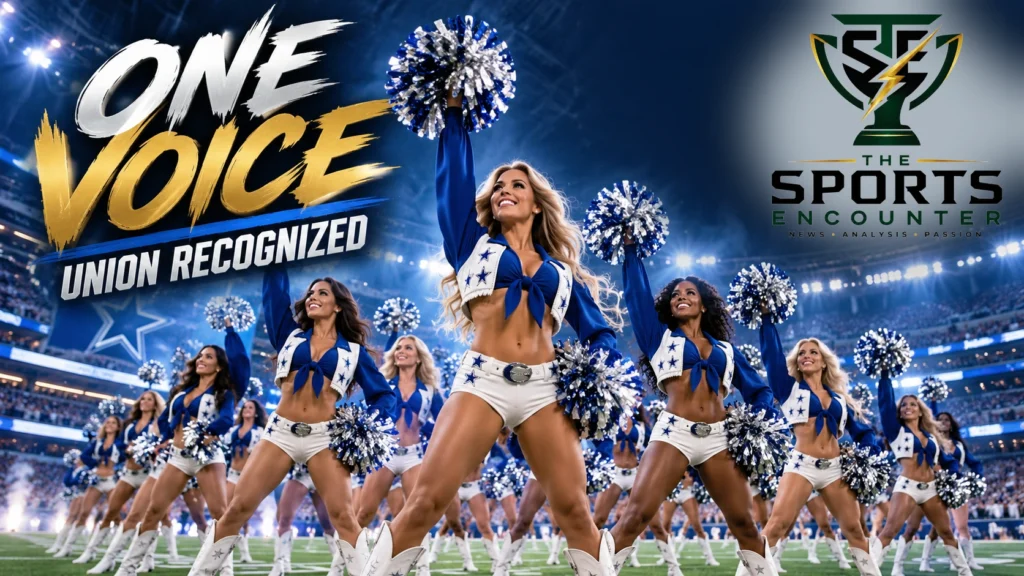
DALLAS, United States, October 23, 2026: The Dallas Cowboys have agreed to recognize the Dallas Cowboys Cheerleaders Association (DCCA) as the official collective bargaining representative of their cheerleading squad, marking a major development in a years-long campaign for better compensation and working conditions. The NFL franchise and the newly formed association announced the agreement in a joint statement Friday, clearing the way for formal negotiations involving one of the most recognizable performance groups in professional sports.
The announcement follows a 2019 wage settlement, a reported 400% pay increase in 2025 and growing public scrutiny through Netflix’s America’s Sweethearts: Dallas Cowboys Cheerleaders. It also creates an unusual business contrast: the Cowboys carry an estimated $17 billion franchise valuation, yet members of their celebrated cheerleading squad have spent years challenging their compensation and employment arrangements. Union recognition gives the dancers formal collective representation, although it does not mean a new labor contract, additional benefits or another pay increase has already been secured.
Dallas Cowboys Recognize Cheerleaders’ Union After Years of Negotiations
The Cowboys and DCCA confirmed their agreement on October 23 following discussions about the association’s request for recognition.
Under the arrangement, the Dallas Cowboys Cheerleaders Association becomes the squad’s recognized representative for collective bargaining.
In their joint statement, the parties described the performers as an important part of the Cowboys organization and acknowledged the international appeal of the squad.
“The Dallas Cowboys Cheerleaders are an esteemed part of the Cowboys organization,” the statement said.
The parties also recognized the dancers’ talent, dedication and the continuing worldwide demand for places on the squad.
The announcement establishes an important change in how the cheerleaders can negotiate employment terms.
Rather than relying entirely on individual discussions or informal collective requests, the recognized association can represent members in bargaining with the organization.
The agreement does not establish that negotiations have produced a completed collective bargaining agreement.
Specific contract terms, including future wage rates, benefits, scheduling protections and dispute-resolution procedures, have not been publicly confirmed as part of Friday’s announcement.
The Associated Press report on the Dallas Cowboys cheerleaders’ union recognition confirms the joint announcement and the history of compensation disputes preceding it.
What Does Union Recognition Mean for Dallas Cowboys Cheerleaders?
The central development is the Cowboys’ acceptance of the DCCA as the workers’ collective bargaining representative.
In the United States, eligible workers covered by federal labor law can obtain union representation through an election or, in qualifying circumstances, through voluntary employer recognition based on demonstrated employee support.
Once an employer recognizes a union as the representative of an appropriate bargaining unit, the parties have obligations to negotiate in good faith over employment terms covered by the law.
That does not guarantee agreement on every proposal.
It also does not automatically create new compensation levels or benefits.
What Changes Immediately and What Still Requires Negotiation?
| Issue | Status after October 23 | What it means |
|---|---|---|
| Union recognition | Confirmed | The Cowboys recognize DCCA as the squad’s bargaining representative. |
| Collective representation | Confirmed | Workers have a formal representative for negotiations. |
| New collective bargaining agreement | Not announced | Specific new contract terms have not been established publicly. |
| Additional pay increase | Not announced | No new wage increase was confirmed in Friday’s agreement. |
| Health insurance or expanded benefits | Not confirmed | Any changes depend on existing arrangements and future negotiations. |
| Working conditions | Potential bargaining subject | The parties may address scheduling and other employment conditions. |
| First contract signing date | Not announced | No verified deadline for a completed agreement is available. |
The difference between recognition and a completed contract is essential.
Recognition establishes who speaks for the workers during bargaining. The collective bargaining process determines what the resulting agreement contains.
For the Dallas Cowboys cheerleaders, the next phase will be important because compensation has already improved substantially through earlier advocacy.
The association’s longer-term influence will depend on the terms eventually negotiated and how effectively those terms are implemented.
How the Dallas Cowboys Cheerleaders’ Pay Dispute Developed
The road to Friday’s recognition stretches back several years.
In 2018, former Cowboys cheerleader Erica Wilkins filed a wage-related lawsuit challenging compensation practices.
Wilkins argued that the demanding nature of the work was not reflected adequately in the pay received by squad members.
Her case brought greater public attention to an issue that had often remained outside mainstream NFL coverage.
Fans regularly saw the cheerleaders performing before games, during breaks and at promotional events.
The amount of work behind those appearances received considerably less attention.
The lawsuit was settled in 2019.
One consequence was an increase in the squad’s reported per-game payment from $200 to $400.
Hourly compensation for certain duties was also increased under the settlement arrangements.
That improvement was substantial, but the compensation debate did not end.
The cheerleaders continued raising concerns about what their time, preparation and performances were worth within the Cowboys’ larger entertainment operation.
Timeline: From Wage Disputes to Union Recognition
| Year | Development | Significance |
|---|---|---|
| 2018 | Erica Wilkins files a wage-related lawsuit. | Draws attention to cheerleader compensation and working conditions. |
| 2019 | Cowboys settle the case; reported game-day compensation rises from $200 to $400. | Establishes an important wage improvement. |
| 2024 | Netflix launches America’s Sweethearts. | Brings the squad’s working lives to a larger audience. |
| 2025 | Cheerleaders disclose a reported 400% compensation increase. | Represents another major improvement after collective advocacy. |
| June 2026 | Third season of the Netflix documentary is released. | Keeps the squad and its professional demands in the public spotlight. |
| October 23, 2026 | Cowboys agree to recognize DCCA. | Establishes formal collective bargaining representation. |
The timeline shows that union recognition was not the first successful effort to improve compensation.
It followed several years of advocacy, litigation and direct negotiations.
What changed Friday was the formal structure through which the cheerleaders can pursue future agreements.
What Did the Reported 400% Pay Raise Actually Mean?
Compensation became a central storyline during the second season of Netflix’s documentary.
Several performers discussed the pressures of balancing squad commitments with other jobs and personal financial responsibilities.
The season eventually featured the announcement of a major raise.
Cheerleaders described a 400% pay increase as a significant achievement following their efforts to obtain better terms.
Subsequent reporting identified an increase for some veteran performers from approximately $15 per hour to $75 per hour.
That change deserves careful explanation because percentage increases can be misleading when the underlying figures are not distinguished.
A 400% increase means the new amount is five times the original amount.
For example, increasing an hourly rate from $15 to $75 adds $60, equivalent to 400% of the original $15.
The new rate is therefore 500% of the original rate, while the increase itself is 400%.
Dallas Cowboys Cheerleaders: Reported Compensation Milestones
| Compensation measure | Earlier amount | Later amount | Increase |
|---|---|---|---|
| Per-game compensation following 2019 settlement | $200 | $400 | 100% |
| Reported hourly compensation for some veterans following 2025 raise | Approximately $15/hour | Approximately $75/hour | 400% |
TSE calculation: ($400 – $200) / $200 = 100%. For the reported hourly rates, ($75 – $15) / $15 = 400%. The rows measure different payment categories and periods. They must not be combined into a single annual salary estimate or treated as proof that every cheerleader receives identical compensation.
The distinction matters because the squad’s compensation can involve game-day appearances, rehearsals, promotional work and other contractual arrangements.
Without verified individual contracts and complete schedules, it would be inaccurate to calculate a universal annual salary from one reported hourly rate.
The same caution applies to claims that every performer received an identical financial benefit.
The reported increase was nevertheless substantial and represents an important part of the history leading to Friday’s union recognition.
Why the Netflix Documentary Changed the Public Conversation
The Dallas Cowboys cheerleaders have been famous for decades.
However, their public image traditionally focused on performances, uniforms, auditions and the privilege of representing one of the NFL’s most recognizable franchises.
Netflix’s America’s Sweethearts: Dallas Cowboys Cheerleaders presented a more detailed account of the women behind that image.
The documentary followed auditions, training, performances and personal responsibilities.
It also examined the demanding preparation required to earn and retain a position on the squad.
Many members described balancing their cheerleading responsibilities with other employment and personal commitments.
The second season placed particular attention on compensation discussions.
That gave the pay dispute an audience far beyond NFL fans or people already familiar with professional dance.
The documentary’s third season, released in June 2026, continued following the squad through its demanding professional schedule.
Netflix’s official America’s Sweethearts series hub documents the program, its three seasons and the attention given to the squad’s working lives.
The documentary did not independently establish the union.
The organizing effort belonged to the workers themselves.
But public visibility helped make compensation and working conditions subjects of national discussion.
The Bigger Question: Why Did One of Sports’ Most Famous Entertainment Groups Need Union Representation?
The Cowboys cheerleaders occupy an unusual position within professional sports.
They are performers, but their work is connected to a major professional sports franchise.
They represent a globally recognized brand, but their employment arrangements have historically differed from those of the NFL players whose games they help present.
The distinction matters because sports entertainment depends on several groups of workers beyond the athletes competing on the field.
Broadcast crews, stadium employees, production teams, performers and event staff all contribute to the final product.
Professional cheerleaders also maintain demanding training schedules.
They rehearse choreography, prepare for public appearances, perform at games and participate in promotional activities connected to the team.
Some responsibilities involve preparation that audiences never see.
For years, the central dispute was whether the compensation and employment protections available to the cheerleaders adequately reflected those expectations.
The Cowboys’ decision to recognize the DCCA gives those discussions a formal collective bargaining structure.
Why the Cowboys’ $17 Billion Valuation Makes the Agreement Significant
The financial scale of the Dallas Cowboys makes Friday’s announcement particularly noteworthy.
In September 2026, Forbes estimated the franchise’s value at $17 billion.
That made Dallas the world’s most valuable professional sports franchise and extended its lead over other NFL teams.
The Sports Encounter examined how the organization achieved that valuation in its analysis of the Cowboys’ $17 billion commercial empire.
The franchise’s value reflects far more than its on-field results.
Dallas benefits from an enormous national audience, commercial partnerships, stadium-related activities, licensing and the wider economics of NFL ownership.
Its cheerleading squad forms part of the organization’s entertainment identity.
That makes the compensation debate commercially relevant, even though the cheerleaders’ labor costs represent only one part of a much larger business.
It is important not to confuse franchise valuation with available cash or annual operating profit.
A $17 billion estimate does not mean the Cowboys hold $17 billion in cash that can be distributed among employees.
However, the valuation provides context for the scale of the organization and the visibility of the work performed under its brand.
Earlier in the year, Sportico estimated the Cowboys’ value at $15.5 billion.
TSE covered that assessment in its report on soaring NFL franchise values.
The difference between the two figures reflects separate valuation studies and methodologies. It should not be interpreted as a confirmed $1.5 billion increase within a few weeks.
Both estimates reinforce the same point: the Cowboys operate at the highest commercial level of professional sports.
The Hidden Business Connection: Cheerleaders Are Part of the Cowboys’ Global Brand
The importance of the squad extends beyond home games at AT&T Stadium.
The Dallas Cowboys have become one of the NFL’s most recognizable international brands.
The cheerleaders contribute to that identity through performances, promotional events and appearances connected to the franchise.
In September, the squad traveled to Brazil for the Cowboys’ international game against the Baltimore Ravens.
The event took place at Maracanã Stadium in Rio de Janeiro and included the cheerleaders as part of the broader NFL entertainment program.
Baltimore won 34-31, but the game attracted a record 24.9 million U.S. viewers for an NFL international fixture.
The Sports Encounter examined those numbers in its analysis of the Cowboys-Ravens game and the NFL’s Rio television breakthrough.
The audience figure measures the game broadcast, not the specific commercial contribution of the cheerleaders.
Nevertheless, their involvement illustrates the wide range of activities through which the Cowboys present their brand internationally.
The NFL’s global strategy has also expanded considerably.
The league is pursuing new audiences through international games, commercial partnerships and local development programs.
TSE examined those ambitions in its report on the NFL’s plan to attract 50 million additional international fans.
As sports franchises build larger international entertainment businesses, the employment arrangements surrounding those businesses may attract increasing attention.
The DCCA agreement is particularly relevant because it concerns workers who participate directly in the presentation and promotion of one of the NFL’s strongest brands.
Could Union Recognition Change More Than the Cheerleaders’ Pay?
Compensation remains central to the discussion, but collective bargaining can address a broader range of workplace issues.
Potential subjects include rehearsal schedules, compensation for appearances, required preparation, travel arrangements and workplace procedures.
Health benefits and other employment protections may also become topics for negotiation.
These are possible bargaining subjects, not confirmed demands or agreed contract provisions in the Dallas case.
Public reporting has previously raised questions about whether improved game-day compensation was accompanied by adequate health coverage.
However, Friday’s announcement does not establish which additional benefits the DCCA will seek or what the Cowboys will ultimately agree to provide.
The bargaining process will determine those matters.
There is also a distinction between the Cowboys cheerleaders’ association and the NFL Players Association.
The NFLPA represents professional football players under a separate collective bargaining framework.
The DCCA is the newly recognized representative of the cheerleaders.
The two groups have different functions, bargaining interests and contractual arrangements.
What Federal Labor Law Says About Voluntary Union Recognition
The United States National Labor Relations Board explains that an employer may voluntarily recognize a union when the applicable requirements for employee support are met.
A formal election is not the only possible route to collective representation.
Once a union is properly recognized, the employer and the workers’ representative must negotiate over applicable terms and conditions of employment.
The parties must bargain in good faith, although that obligation does not mean either side is required to agree to every proposal.
The National Labor Relations Board’s official guide to union representation explains voluntary recognition and the basic legal framework.
For the DCCA, that makes recognition a procedural milestone with practical significance.
The association now has a formal role in negotiating the employment arrangements affecting the squad.
The next measure of progress will be the substance of any agreement reached.
Dallas Cowboys Cheerleaders Are Not the First NFL Squad to Unionize
Friday’s announcement is significant, but it should not be described as the first unionization of professional NFL cheerleaders.
That distinction belongs to the Buffalo Jills, the former cheerleading squad of the Buffalo Bills.
In 1995, the Jills won a ruling from the National Labor Relations Board allowing them to pursue collective representation.
The dancers subsequently voted to join the National Football League Cheerleaders Association.
Their effort followed disputes concerning compensation and control over professional appearances.
The union did not become a permanent fixture of the Bills organization.
The Jills were eventually disbanded in 2014 amid litigation involving former members who alleged unpaid work and inappropriate treatment.
The earlier case demonstrates that union recognition alone does not guarantee a lasting agreement or the continuation of a particular employment structure.
It also provides an important historical comparison.
More than three decades after the Jills’ organizing campaign, another NFL cheerleading squad has obtained formal recognition.
NFL Cheerleader Unionization: Historical Comparison
| Year | Squad | Development |
|---|---|---|
| 1995 | Buffalo Jills | NLRB ruling permits unionization; cheerleaders vote to join a union. |
| 2014 | Buffalo Jills | Squad is disbanded amid litigation over employment practices. |
| 2026 | Dallas Cowboys Cheerleaders | Cowboys voluntarily recognize the DCCA as bargaining representative. |
The cases involve different employers, legal circumstances and periods in NFL history.
They should not be treated as identical.
What connects them is the recurring effort by professional cheerleaders to gain greater influence over their employment terms.
Why Athlete and Performer Compensation Has Become a Wider Sports Issue
The Cowboys cheerleaders’ agreement arrives during a period of growing attention to how professional sports organizations distribute commercial revenue.
Across the industry, athletes and other workers have sought greater influence over compensation, welfare and employment arrangements.
The scale of sports broadcasting revenue is one reason those questions continue attracting attention.
Global sports media rights reached an estimated $65.8 billion in 2026, with major American leagues accounting for a substantial portion of the market.
The Sports Encounter examined that development in its investigation into the global sports broadcasting economy.
That revenue does not belong entirely to individual clubs, and it cannot be compared directly with an individual worker’s pay.
However, it demonstrates the commercial scale of the industry in which employment negotiations take place.
The same broader debate is visible in professional tennis.
Leading players have pushed for greater participation in decisions involving tournament revenues, scheduling and welfare.
TSE examined those negotiations in its analysis of the Grand Slam Player Advisory Council and tennis revenue-sharing campaign.
The tennis campaign and the DCCA’s union recognition follow different legal and organizational structures.
Nevertheless, both involve workers seeking a formal role in decisions affecting their professional lives.
The Sports Pay Gap Extends Beyond Elite Players
Public discussions about sports income frequently concentrate on major player contracts and endorsement deals.
The world’s highest-paid athletes can earn tens or hundreds of millions of dollars annually.
But those figures describe an exceptionally small group at the financial summit.
The broader sports workforce includes many people whose compensation is substantially lower and whose employment arrangements may be less secure.
The Sports Encounter examined that contrast in its historical investigation into the world’s highest-paid athletes and the continuing financial gap in women’s sports.
The Cowboys cheerleaders occupy a distinctive place within this wider discussion.
They are internationally recognizable performers connected to the world’s most valuable sports franchise.
Yet members have previously described the need to maintain other employment while meeting the squad’s demanding commitments.
The lesson is not that cheerleaders and NFL players must receive identical compensation.
Their roles, contractual arrangements and the economic structures supporting them are different.
The more useful question is whether the terms governing the cheerleaders’ work accurately reflect their responsibilities, required commitments and contribution to the organization’s operations.
Formal collective bargaining creates a process for addressing that question.
What Does the Union Announcement Mean for Jerry Jones and the Cowboys?
The decision comes during another complicated NFL season for Dallas.
Owner Jerry Jones remains under pressure to improve the team’s on-field performance after a difficult start to the 2026 campaign.
The Cowboys entered Week 7 with two victories and four defeats, although the unusually competitive NFC East left them within reach of the division’s leading teams.
TSE examined Jones’ comments about the team’s prospects and potential roster moves in its NFL Week 7 injury and team-management report.
The cheerleaders’ union recognition is a separate organizational issue.
It does not depend on the team’s record or change the competition standings.
However, the decision contributes to the wider assessment of how the Cowboys manage a business whose activities extend far beyond football operations.
Jones has helped build Dallas into an enormous commercial enterprise.
The franchise’s entertainment identity has become part of that success.
Friday’s announcement indicates that the organization is prepared to recognize a formal bargaining representative for one of its most visible performance groups.
Whether the eventual agreement becomes a broader example for other NFL teams remains to be seen.
Could Other NFL Cheerleading Squads Follow Dallas?
The Cowboys’ decision could attract attention from cheerleaders elsewhere in the league.
Dallas has an unusually prominent profile, and changes involving its cheerleading squad receive national and international coverage.
Other workers may examine the agreement when considering their own employment arrangements.
However, no general NFL-wide unionization agreement has been announced.
The recognition of DCCA does not automatically give other squads collective bargaining representation.
Any organizing effort would depend on the circumstances of the workers involved, the applicable legal framework and the decisions of those workers and employers.
The Buffalo Jills’ experience also demonstrates that the path from recognition to a sustainable employment arrangement is not always straightforward.
The stronger conclusion is that Dallas has created another example of formal cheerleader representation within professional football.
Whether it produces a wider movement will depend on future developments rather than the announcement alone.
What Happens Next for the Dallas Cowboys Cheerleaders Association?
The immediate priority is collective bargaining.
Several developments will determine how much Friday’s recognition changes the working lives of squad members.
1. The First Collective Bargaining Agreement
A completed agreement would establish the negotiated terms between the Cowboys and DCCA.
The date of any first contract has not been publicly confirmed.
2. Future Compensation Arrangements
The agreement may address pay for rehearsals, games, promotional appearances and other duties.
No new rate has been announced as part of Friday’s recognition.
3. Health and Workplace Benefits
Benefits remain an important area to monitor because previous reporting raised questions about healthcare coverage.
Any additions or changes must be confirmed through the eventual agreement.
4. Scheduling and Required Appearances
Professional cheerleading requires substantial preparation beyond public performances.
Negotiations could clarify scheduling responsibilities, required appearances and related employment expectations.
5. Implementation and Enforcement
Once a contract is agreed, its practical value will depend on how its terms are implemented and how disagreements are handled.
Those are the developments that will show whether union recognition delivers lasting workplace changes.
Dallas Cowboys Cheerleaders Union: Frequently Asked Questions
Have the Dallas Cowboys cheerleaders officially unionized?
Yes. On October 23, 2026, the Dallas Cowboys agreed to recognize the Dallas Cowboys Cheerleaders Association as their cheerleading squad’s collective bargaining representative.
What is the Dallas Cowboys Cheerleaders Association?
The DCCA is the newly recognized association that represents Dallas Cowboys cheerleaders in collective bargaining with the organization.
Have the cheerleaders signed a new union contract?
No completed collective bargaining agreement was announced as part of Friday’s recognition. Formal representation has been established, while specific contract terms remain subject to bargaining.
How much did Dallas Cowboys cheerleaders receive before the 2019 settlement?
Contemporary reporting identified a per-game payment of $200, which increased to $400 following the 2019 settlement.
Did the Dallas Cowboys cheerleaders receive a 400% pay raise?
Yes. Squad members reported a 400% pay increase in 2025. Subsequent reporting identified hourly rates for some veteran performers rising from approximately $15 to $75.
Does the new union guarantee health insurance?
No. Friday’s announcement did not confirm any new health insurance arrangement or other specific benefit changes.
Did Netflix help the cheerleaders secure better pay?
The Netflix documentary brought wider attention to the squad’s working lives and compensation discussions. The pay campaign and union organizing were undertaken by the cheerleaders themselves.
Were the Cowboys cheerleaders the first NFL squad to unionize?
No. The Buffalo Jills obtained the right to unionize in 1995 and voted to join the National Football League Cheerleaders Association.
What is the Dallas Cowboys franchise worth in 2026?
Forbes estimated the Cowboys’ value at $17 billion in September 2026, making Dallas the world’s most valuable professional sports franchise.
The Sports Encounter Verdict: Recognition Is the Milestone, the Contract Will Be the Test
The Dallas Cowboys cheerleaders have achieved something that previous generations of performers spent years pursuing.
They now have formal collective bargaining representation recognized by the organization they work for.
The agreement follows a long history of compensation concerns and several important improvements.
A lawsuit helped produce higher game-day payments in 2019. Further advocacy contributed to a reported 400% increase in 2025. A successful documentary brought the working lives of the cheerleaders into millions of homes.
Friday adds a new level of formal representation to that history.
But recognition must be distinguished from the substance of a negotiated contract.
The association still faces the practical work of securing terms that reflect the responsibilities, working conditions and professional expectations of its members.
For the Cowboys, the agreement comes at a time when the franchise’s commercial influence has never been greater.
The organization is valued at approximately $17 billion and continues expanding its international presence.
Its cheerleaders form part of that commercial identity, representing the team before audiences far beyond Arlington, Texas.
Their recognition raises an important question about the future of professional sports entertainment: how should workers whose performances help sustain valuable sporting brands participate in decisions about their compensation and working conditions?
The DCCA’s recognition does not settle that question for the entire NFL.
It gives one highly visible group a formal opportunity to negotiate its own answers.
The next meaningful milestone will be a completed agreement and evidence of what changes for the people whose work helped make the Dallas Cowboys Cheerleaders an internationally recognized name.