


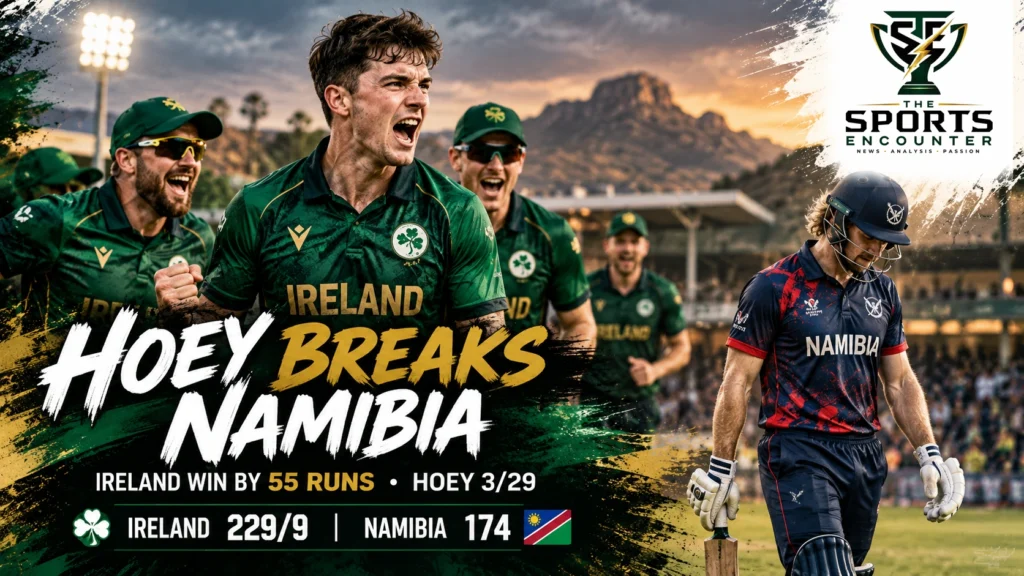
WINDHOEK, Namibia, October 22, 2026: Ireland and Namibia were separated by just one run after the first ten overs of their innings on Thursday. By the time the contest ended at Windhoek’s High Performance Oval, the difference had grown to 55 runs and an emphatic Irish victory. Gavin Hoey’s 3/29, supported by two wickets each from Jai Moondra and George Dockrell, dismantled Namibia’s pursuit of 230 after Paul Stirling’s 56 had helped Ireland reach 229/9 in the first ODI of their five-match series.
Namibia looked capable of making the chase competitive at 55/1 after ten overs, almost mirroring Ireland’s 56/0 at the same stage. But Hoey removed Louren Steenkamp and Jan Frylinck, Curtis Campher dismissed Zane Green, and Dockrell accounted for captain Gerhard Erasmus and JJ Smit as the hosts collapsed to 110/7. Ruben Trumpelmann’s entertaining 50 from 43 balls delayed the finish before Liam McCarthy bowled him with Namibia all out for 174 in 37.5 overs. Ireland secured its first ODI victory since May 2025 and took a 1-0 series lead.
Namibia vs Ireland First ODI: Match Result and Key Performances
| Match Detail | Information |
|---|---|
| Match | Namibia vs Ireland, 1st ODI |
| Date | October 22, 2026 |
| Venue | High Performance Oval, Windhoek |
| Toss | Namibia won and elected to field |
| Ireland | 229/9 in 50 overs |
| Namibia | 174 all out in 37.5 overs |
| Result | Ireland won by 55 runs |
| Player of the Match | Gavin Hoey, 3/29 |
| Ireland’s leading batter | Paul Stirling, 56 from 71 balls |
| Namibia’s leading batter | Ruben Trumpelmann, 50 from 43 balls |
| Namibia’s leading bowler | Jan Nicol Loftie-Eaton, 4/36 |
| Series standing | Ireland lead 1-0 |
| Next match | October 24, Windhoek |
For Ireland, the victory represented a welcome change after a difficult stretch in the 50-over format. For Namibia, it continued a frustrating pattern: periods of competitive cricket undone by a damaging loss of wickets.
The result also marked the first men’s ODI meeting between the countries, according to Cricket Namibia’s official pre-series announcement.
How Did Ireland Defend 229 After Namibia Matched Its Opening Start?
The most revealing statistic came from comparing the innings after ten overs.
Ireland had reached 56 without losing a wicket. Namibia were 55/1.
Both sides had scored at virtually the same rate, and neither innings had yet produced a commanding position.
The difference emerged when the bowling sides began operating through the middle overs.
Ireland advanced from 56/0 to 175/3 between overs 11 and 40, adding 119 runs while protecting seven wickets for the closing phase.
Namibia also added 119 runs after its first ten overs, but lost all nine remaining wickets in just 27.5 overs.
The runs were identical. The cost in wickets was drastically different.
The Statistical Story: Similar Runs, Very Different Wicket Losses
| Phase | Ireland | Namibia | What Changed |
|---|---|---|---|
| First 10 overs | 56/0 | 55/1 | Just one run separated the teams |
| Overs 11-40 | 119/3 | 119/9 in 27.5 overs | Namibia lost six more wickets than Ireland in the corresponding passage |
| Overs 41-50 | 54/6 | Not reached | Ireland had enough wickets to complete its 50 overs |
| Final Total | 229/9 in 50 overs | 174 all out in 37.5 overs | Ireland won by 55 runs |
TSE statistical discovery: Namibia scored 119 runs after its opening ten overs at approximately 4.28 runs per over, slightly faster than Ireland’s 3.97 during overs 11-40. Yet the hosts lost nine wickets while Ireland lost only three.
Calculation: Ireland scored 119 runs across 30 overs, or 3.97 per over. Namibia scored 119 across 27 overs and five balls, equivalent to 167 legal deliveries: 119 × 6 ÷ 167 = 4.28. These are innings-phase run rates, including extras.
The comparison exposes the real reason the chase failed. Namibia’s problem was not a complete inability to score. It was the repeated loss of batters before partnerships could grow.
Hoey Strikes Twice Before Dockrell Breaks Namibia’s Middle Order
Namibia’s opening partnership initially put Ireland under pressure.
Michael van Lingen and Louren Steenkamp added 48 runs before Jai Moondra provided the first breakthrough in the ninth over, having van Lingen caught behind by Lorcan Tucker for 23 from 22 balls.
The dismissal mattered because Ireland had been unable to separate the openers while Namibia was scoring at a healthy rate.
Hoey then took control of the next passage.
With his first wicket at 10.1 overs, he removed Steenkamp for 26 from 38 deliveries, George Dockrell completing the catch.
Hoey followed by dismissing Jan Frylinck for nine from six balls, with Tucker taking another catch.
Namibia had moved from 48 without loss to 68/3. A promising start had become an immediate rebuilding exercise.
Campher increased the pressure by bowling Zane Green for four, leaving Namibia 74/4 at the end of the 14th over.
The home side required a substantial partnership from Erasmus and Loftie-Eaton, but the recovery never developed.
A run-out involving Harry Tector and Tucker ended Loftie-Eaton’s innings for nine. Dockrell then trapped Erasmus lbw for 22 before having JJ Smit caught by Campher for nine.
At 110/7 in the 25th over, Namibia still required 120 runs.
Trumpelmann offered late resistance, but seven wickets had already fallen and Ireland could attack the remaining batters without allowing the chase to dictate the field placements.
Namibia’s Collapse: The Decisive Wickets
| Score | Over | Dismissed Batter | How the Wicket Fell |
|---|---|---|---|
| 48/1 | 8.3 | Michael van Lingen, 23 | c Tucker b Moondra |
| 55/2 | 10.1 | Louren Steenkamp, 26 | c Dockrell b Hoey |
| 68/3 | 12.2 | Jan Frylinck, 9 | c Tucker b Hoey |
| 74/4 | 13.6 | Zane Green, 4 | b Campher |
| 93/5 | 19.4 | Jan Nicol Loftie-Eaton, 9 | run out (Tector/Tucker) |
| 105/6 | 22.4 | Gerhard Erasmus, 22 | lbw b Dockrell |
| 110/7 | 24.1 | JJ Smit, 9 | c Campher b Dockrell |
| 147/8 | 30.5 | Waldo Smith, 6 | c McBrine b Hoey |
| 156/9 | 33.1 | Bernard Scholtz, 1 | b Moondra |
| 174 all out | 37.5 | Ruben Trumpelmann, 50 | b McCarthy |
The first four wickets fell for just 26 runs after the opening stand reached 48.
By 24.1 overs, Namibia had surrendered seven wickets for 62 additional runs.
That is the period which decided the match.
Why Gavin Hoey Deserved Player of the Match
Hoey finished with 3/29 from nine overs, bowling 39 dot balls and conceding only 3.22 runs per over.
His contribution extended beyond the number of wickets.
He dismissed both batters involved in Namibia’s early rebuilding effort, then returned to remove Waldo Smith as Trumpelmann attempted to revive the chase.
The dismissal of Steenkamp was especially valuable because the opener had already occupied the crease for 38 deliveries.
Frylinck’s wicket prevented Namibia from quickly rebuilding after that loss, while Smith’s dismissal removed another potential partner for Trumpelmann.
Hoey’s performance continued a productive ODI spell against African and Asian opponents.
In August, the leg-spinner produced 4/34 against Afghanistan in Belfast and helped Ireland almost defend 206 after contributing to a remarkable ninth-wicket recovery with Jai Moondra.
That previous contest ended in defeat when Rashid Khan guided Afghanistan to a three-wicket victory.
The Sports Encounter’s analysis of Rashid Khan’s match-winning performance against Ireland explains how Hoey’s four wickets nearly transformed the result.
Windhoek provided a different ending.
This time, Ireland’s bowlers converted their pressure into victory, and Hoey’s contributions were rewarded with the Player of the Match award.
George Dockrell and Jai Moondra Supply the Supporting Wickets
Although Hoey collected the principal individual award, Ireland’s success relied on important contributions from bowlers operating around him.
Moondra removed van Lingen before Namibia’s opening partnership could develop into a more substantial position.
His final figures of 2/27 from eight overs included 36 dot balls, representing 75 percent of his 48 legal deliveries.
Dockrell then delivered the defining middle-order intervention.
His dismissal of Erasmus removed Namibia’s captain and one of the batters most capable of controlling a long chase.
Removing Smit shortly afterward left Trumpelmann with the lower order and sharply reduced Namibia’s options.
Dockrell ended with 2/22 from four overs.
The performance also carried historical significance. A match update attributed to Cricket Ireland reported that his two wickets took him to 327 international wickets across formats, making him the leading wicket-taker in Ireland men’s international cricket.
That all-format figure should be distinguished from his ODI-only tally. Dockrell also moved to within one wicket of Kevin O’Brien’s Irish ODI record of 114.
There was another notable selection detail. Ireland were without Mark Adair, and Moondra took the new ball in his absence. The younger bowler responded by giving Ireland the initial breakthrough.
These contributions illustrate why Hoey’s performance cannot be understood in isolation. Moondra broke the opening partnership, Dockrell removed the captain and a dangerous all-rounder, and Hoey repeatedly attacked the developing partnerships.
Paul Stirling’s 56 Gives Ireland a Platform Despite Loftie-Eaton’s Four Wickets
Ireland’s batting had its own periods of uncertainty.
Stirling and Andy Balbirnie began with a 70-run opening partnership after Namibia won the toss and elected to field.
Stirling played the more substantial innings, scoring 56 from 71 deliveries with eight fours and a six.
Balbirnie contributed 20 from 25 balls before Bernard Scholtz removed him in the 13th over.
Stirling reached his half-century from 58 deliveries but fell to Loftie-Eaton at 95/2 in the 21st over.
The Irish captain’s innings carried additional importance because he had returned from a recent leg injury and struggled for substantial ODI scores earlier in 2026.
It was his first ODI half-century since February 2025 and his first international fifty after a sequence of 17 innings without reaching the milestone.
Cade Carmichael then helped Ireland build toward a competitive total with 45 from 80 balls, while Harry Tector and Lorcan Tucker each contributed 28.
Ireland reached 175/3 after 40 overs, a position from which it might have hoped for a stronger finish.
Loftie-Eaton prevented that acceleration.
His 4/36 from nine overs included the wickets of Stirling, Tector, Tucker and George Dockrell.
Ireland lost six wickets for 54 runs in its final ten overs, finishing on 229/9.
Loftie-Eaton therefore deserves considerable credit for keeping Namibia’s target manageable.
The hosts’ failure to convert that bowling effort into a victory ultimately came from the batting collapse rather than an inability to restrict Ireland.
Ireland’s Full Batting Scorecard: 229/9 in 50 Overs
| Batter | Dismissal | R | B | 4s | 6s | SR |
|---|---|---|---|---|---|---|
| Andy Balbirnie | c Brassell b Scholtz | 20 | 25 | 3 | 0 | 80.00 |
| Paul Stirling (c) | c van Lingen b Loftie-Eaton | 56 | 71 | 8 | 1 | 78.87 |
| Cade Carmichael | lbw b Smit | 45 | 80 | 4 | 0 | 56.25 |
| Harry Tector | c Scholtz b Loftie-Eaton | 28 | 42 | 1 | 1 | 66.67 |
| Lorcan Tucker (wk) | c Smit b Loftie-Eaton | 28 | 36 | 2 | 1 | 77.78 |
| Curtis Campher | b Trumpelmann | 17 | 19 | 1 | 0 | 89.47 |
| George Dockrell | st Green b Loftie-Eaton | 0 | 7 | 0 | 0 | 0.00 |
| Andy McBrine | Not out | 8 | 10 | 0 | 0 | 80.00 |
| Gavin Hoey | b Smit | 0 | 3 | 0 | 0 | 0.00 |
| Liam McCarthy | b Brassell | 8 | 6 | 0 | 1 | 133.33 |
| Jai Moondra | Not out | 2 | 1 | 0 | 0 | 200.00 |
| Extras | 4 byes, 7 leg-byes, 6 wides | 17 | — | — | — | — |
| Total | 229/9 in 50 overs | 229 | 300 | 19 | 4 | 4.58 RR |
Fall of wickets: 70/1 (Balbirnie, 12.3), 95/2 (Stirling, 20.5), 149/3 (Tector, 32.2), 176/4 (Carmichael, 40.3), 200/5 (Tucker, 43.4), 204/6 (Dockrell, 45.2), 214/7 (Campher, 47.4), 217/8 (Hoey, 48.3), 227/9 (McCarthy, 49.5).
Namibia’s Bowling Scorecard: Loftie-Eaton Leads the Resistance
| Bowler | O | M | R | W | Econ | Dots |
|---|---|---|---|---|---|---|
| Ruben Trumpelmann | 10 | 0 | 41 | 1 | 4.10 | 41 |
| JJ Smit | 10 | 0 | 47 | 2 | 4.70 | 38 |
| Bernard Scholtz | 10 | 0 | 37 | 1 | 3.70 | 39 |
| Jack Brassell | 9 | 0 | 44 | 1 | 4.89 | 34 |
| Jan Nicol Loftie-Eaton | 9 | 0 | 36 | 4 | 4.00 | 24 |
| Waldo Smith | 2 | 0 | 13 | 0 | 6.50 | 6 |
Wides: Trumpelmann 5, Brassell 1. No no-balls were recorded. Loftie-Eaton’s four wickets made him Namibia’s most successful bowler, while Scholtz conceded only 37 runs across his ten overs.
Namibia’s Full Batting Scorecard: 174 All Out in 37.5 Overs
| Batter | Dismissal | R | B | 4s | 6s | SR |
|---|---|---|---|---|---|---|
| Michael van Lingen | c Tucker b Moondra | 23 | 22 | 3 | 0 | 104.55 |
| Louren Steenkamp | c Dockrell b Hoey | 26 | 38 | 4 | 1 | 68.42 |
| Jan Frylinck | c Tucker b Hoey | 9 | 6 | 2 | 0 | 150.00 |
| Gerhard Erasmus (c) | lbw b Dockrell | 22 | 31 | 2 | 1 | 70.97 |
| Zane Green (wk) | b Campher | 4 | 7 | 0 | 0 | 57.14 |
| Jan Nicol Loftie-Eaton | run out (Tector/Tucker) | 9 | 21 | 0 | 0 | 42.86 |
| JJ Smit | c Campher b Dockrell | 9 | 17 | 0 | 0 | 52.94 |
| Ruben Trumpelmann | b McCarthy | 50 | 43 | 4 | 3 | 116.28 |
| Waldo Smith | c McBrine b Hoey | 6 | 19 | 0 | 0 | 31.58 |
| Bernard Scholtz | b Moondra | 1 | 5 | 0 | 0 | 20.00 |
| Jack Brassell | Not out | 4 | 18 | 0 | 0 | 22.22 |
| Extras | 3 byes, 3 leg-byes, 5 wides | 11 | — | — | — | — |
| Total | 174 all out in 37.5 overs | 174 | 227 | 15 | 5 | 4.59 RR |
Fall of wickets: 48/1 (van Lingen, 8.3), 55/2 (Steenkamp, 10.1), 68/3 (Frylinck, 12.2), 74/4 (Green, 13.6), 93/5 (Loftie-Eaton, 19.4), 105/6 (Erasmus, 22.4), 110/7 (Smit, 24.1), 147/8 (Waldo Smith, 30.5), 156/9 (Scholtz, 33.1), 174/10 (Trumpelmann, 37.5).
Ireland’s Bowling Scorecard: Nine Wickets Shared Across Five Bowlers
| Bowler | O | M | R | W | Econ | Dots |
|---|---|---|---|---|---|---|
| Jai Moondra | 8 | 0 | 27 | 2 | 3.38 | 36 |
| Liam McCarthy | 5.5 | 0 | 43 | 1 | 7.37 | 18 |
| Curtis Campher | 5 | 0 | 22 | 1 | 4.40 | 19 |
| Gavin Hoey | 9 | 0 | 29 | 3 | 3.22 | 39 |
| Andy McBrine | 6 | 0 | 25 | 0 | 4.17 | 17 |
| George Dockrell | 4 | 0 | 22 | 2 | 5.50 | 16 |
Other wicket: Loftie-Eaton run out by Harry Tector and Lorcan Tucker. Ireland conceded five wides and no no-balls. Moondra bowled two wides, while McCarthy, Campher and Dockrell conceded one each.
Hoey’s combination of three wickets and 39 dot balls made him the outstanding bowler, but Moondra’s 36 dot deliveries gave Ireland another important source of control.
Trumpelmann’s 50 Reveals Both Namibia’s Fight and Its Missed Opportunity
Ruben Trumpelmann’s half-century provided the innings’ strongest late attacking passage.
Coming in at No. 8, he struck four boundaries and three sixes, reaching 50 from 42 deliveries before falling for 50 from 43.
His innings included aggressive scoring against Ireland’s spinners and a pair of late boundaries off McCarthy.
Trumpelmann had also bowled his full ten overs, taking 1/41, giving Namibia an unusually substantial contribution from one of its specialist pace bowlers.
Yet his innings began after the main batting lineup had lost control of the chase.
At 110/7, Namibia needed 120 more runs with only three wickets remaining.
Even a powerful fifty from Trumpelmann could not fully repair that damage.
His effort nevertheless reflected the fighting qualities Namibia have shown against stronger opponents in previous months.
During the August 2026 African T20I Tri-Series, Namibia produced an important victory against South Africa through contributions from Jan Frylinck, Trumpelmann and JJ Smit.
The Sports Encounter’s report on Namibia’s 18-run victory over South Africa documents that earlier success.
Namibia also came close to completing a demanding 229-run chase against South Africa in September’s T20I tri-series, carrying the contest to the final delivery.
That performance, examined in The Sports Encounter’s account of Namibia’s dramatic chase, provides an interesting contrast to Thursday’s defeat.
The formats and match circumstances were different. The common lesson is that Namibia can generate runs under pressure, but needs more consistent contributions before its lower order is forced into emergency rescue work.
Namibia’s Recent ODI Problems Remain Despite Loftie-Eaton’s Four Wickets
Ireland’s victory cannot be separated from Namibia’s difficult recent experience against higher-ranked opposition.
South Africa completed a 3-0 ODI series sweep in Namibia during September, exposing weaknesses in the home side’s batting and its ability to control long partnerships.
The Sports Encounter’s report on Jordan Hermann’s 150 in the opening ODI examined the consequences of allowing a top-order batter to dominate.
The second ODI against South Africa highlighted another early batting collapse, while the series finale confirmed the 3-0 sweep.
Those matches offer useful context for Namibia’s latest defeat.
Against Ireland, Namibia did several things well. Loftie-Eaton’s four wickets restricted the visitors, Scholtz bowled economically, and the openers gave the chase a promising start.
The larger problem emerged when Namibia had to absorb the pressure of losing a batter.
After the opening partnership ended, further wickets arrived before the team could restore control.
That sequence resembles some of the difficulties Namibia experienced against South Africa, although the specific bowling attacks and match conditions differed.
The 2027 World Cup cycle gives Namibia a clear reason to address those weaknesses.
In its official announcement of the Ireland series, Cricket Namibia described the fixtures as an opportunity to test the national side against higher-ranked international opposition.
Why Ireland’s Win Matters Before the 2027 World Cup
For Ireland, Thursday’s victory was more than a useful opening result.
The side entered the series after a difficult ODI run, including a 4-0 defeat to Afghanistan during the home summer.
The Sports Encounter previously documented the consequences of Afghanistan’s victory over Ireland that secured direct 2027 World Cup qualification.
Ireland’s current program is intended to provide competitive preparation ahead of the qualification pathway for the 2027 tournament in Southern Africa.
Cricket Ireland’s October 9 tour announcement outlined the importance of playing meaningful international matches in African conditions, with experienced internationals and emerging players both included.
The opening victory delivered encouraging evidence in several areas.
Stirling returned to form with a half-century. Carmichael spent 80 deliveries at the crease. Hoey demonstrated that Ireland’s spin resources can take wickets during the middle overs, while Moondra provided an effective new-ball option.
Dockrell’s experience also proved valuable at a decisive stage of the chase.
There are still shortcomings to address.
Ireland’s late batting collapse cost six wickets in the final ten overs, preventing the visitors from finishing with the stronger total their earlier platform had promised.
The opening bowlers also allowed Namibia to reach 48 without loss, exposing a period of limited early control.
Those issues matter because stronger opponents may be better positioned to exploit such openings.
But after a prolonged period without an ODI victory, Ireland had something concrete to build upon.
When Is the Second Namibia vs Ireland ODI?
The two sides meet again in Windhoek on October 24, with Ireland holding a 1-0 lead in the five-match series.
The second game provides Namibia with an immediate opportunity to correct the batting mistakes exposed in the opening match.
Ireland, meanwhile, must decide whether to retain the same bowling balance and how to improve its death-over scoring.
Remaining Ireland Tour of Namibia 2026 Fixtures
| Match | Date | Venue | Status |
|---|---|---|---|
| 1st ODI | October 22 | High Performance Oval, Windhoek | Ireland won by 55 runs |
| 2nd ODI | October 24 | FNB Namibia Cricket Ground, Windhoek | Scheduled |
| 3rd ODI | October 27 | High Performance Oval, Windhoek | Scheduled |
| 4th ODI | October 30 | FNB Namibia Cricket Ground, Windhoek | Scheduled |
| 5th ODI | November 1 | FNB Namibia Cricket Ground, Windhoek | Scheduled |
The dates and venues follow the official Cricket Ireland series schedule.
The October 24 match should reveal whether Namibia can protect its middle order more effectively and whether Ireland’s spinners can reproduce Thursday’s control.
Namibia vs Ireland First ODI: Frequently Asked Questions
Who Won the First Namibia vs Ireland ODI on October 22, 2026?
Ireland won by 55 runs at the High Performance Oval in Windhoek, defending 229/9 and dismissing Namibia for 174.
Who Was Player of the Match?
Gavin Hoey won the award for taking three wickets for 29 runs in nine overs.
How Many Runs Did Paul Stirling Score?
The Ireland captain scored 56 from 71 deliveries, including eight fours and one six.
Who Took the Most Wickets for Namibia?
Jan Nicol Loftie-Eaton took four wickets for 36 runs in nine overs, dismissing Stirling, Harry Tector, Lorcan Tucker and George Dockrell.
What Did Ruben Trumpelmann Score?
Trumpelmann made 50 from 43 balls, striking four fours and three sixes before Liam McCarthy bowled him.
Why Did Namibia Lose Despite a Strong Opening Partnership?
Namibia fell from 48/0 to 110/7 as Ireland’s spinners and supporting bowlers repeatedly broke partnerships. The hosts never recovered enough to challenge the 230-run target.
How Many Wickets Did George Dockrell Take?
Dockrell took 2/22 from four overs, dismissing captain Gerhard Erasmus and JJ Smit.
When Is the Next Namibia vs Ireland ODI?
The second ODI is scheduled for October 24, 2026, at the FNB Namibia Cricket Ground in Windhoek.
Who Leads the Five-Match Series?
Ireland lead 1-0 after winning the opening fixture by 55 runs.
Ireland’s 229 Was Enough Because Namibia Could Not Protect Its Wickets
The scoreboard might suggest Ireland dominated from the beginning, but the first ten overs tell a different story.
Namibia matched Ireland’s scoring almost perfectly. Its bowlers had already done enough to keep the target achievable, and the opening partnership gave the hosts a platform from which to compete.
The contest changed when Ireland’s bowlers began taking wickets in clusters.
Hoey made the decisive incisions. Moondra broke the opening stand, Dockrell removed two experienced middle-order batters, and McCarthy completed the victory by dismissing Trumpelmann.
For Namibia, Trumpelmann’s fifty and Loftie-Eaton’s four wickets showed that the side possesses players capable of troubling strong opponents. Those performances were not enough to compensate for seven wickets falling before the 25th over was completed.
Ireland leave the opening match with renewed confidence, a series lead and a potentially important bowling combination ahead of the 2027 World Cup qualification campaign.
Namibia have another opportunity on October 24. Their challenge is straightforward: retain the attacking intent that produced 55 runs in ten overs, while giving their middle order enough stability to finish what the openers begin.