


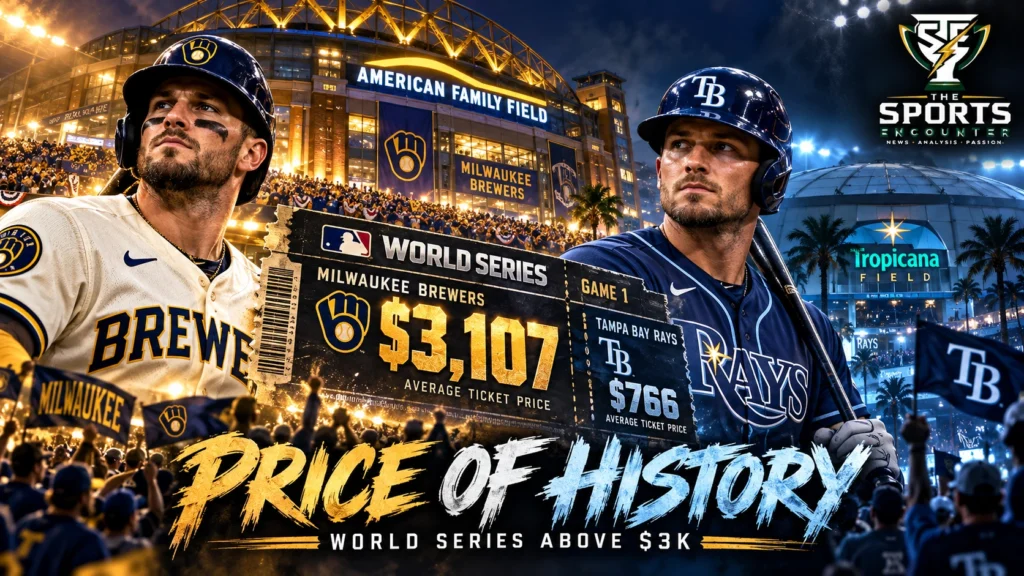
MILWAUKEE, United States, October 22, 2026: The Milwaukee Brewers have waited 44 years to host another World Series, and their supporters are being quoted a staggering $3,107 just to get through the gates for Friday’s opening game against the Tampa Bay Rays. That October 20 resale-market entry price, tracked by TicketData.com, was only $254 below the $3,361 reported shortly before Super Bowl LX. Yet fans seeking entry to Game 3 of the same championship series in St. Petersburg faced a considerably lower quoted price of $766. Baseball’s biggest event has produced one of the sport’s most extraordinary geographical ticket-price divides.
The gap reflects the emotion surrounding an unusual World Series matchup. Milwaukee returns to the Fall Classic for the first time since 1982 after sweeping the two-time defending champion Los Angeles Dodgers, while Tampa Bay has reached its third World Series seeking the title that eluded it in 2008 and 2020. Neither franchise has ever lifted the trophy. The Brewers’ historic homecoming, limited access to the opening games and the prospect of a first championship have transformed Friday’s contest into an exceptionally expensive occasion. But the numbers also reveal something important about the ticket market: where a game is played can influence its resale price as dramatically as what is at stake.
World Series Game 1 Tickets Hit $3,107: What Are Fans Actually Paying?
TicketData.com recorded a get-in price of $3,107 for Game 1 at American Family Field by midday Tuesday, October 20.
The figure had briefly reached $3,169 on Monday night, shortly after Tampa Bay defeated the Cleveland Guardians to claim the American League pennant. Although the price subsequently eased, it remained 14% higher than three days earlier.
Game 2 in Milwaukee was almost as expensive, with the lowest quoted resale asking price reaching $2,748.
The contrast emerged when the series shifted to Tampa Bay.
Game 3 at Tropicana Field was listed at $766, Game 4 at $823 and a possible Game 5 at $791.
These figures are snapshots from a ticket-tracking service, rather than official club ticket prices. A get-in price refers to the least expensive resale listing observed within the tracked inventory. It does not represent the average cost of attending, the final price paid by every buyer or the face value originally charged by the teams.
2026 World Series Ticket Prices: Game-by-Game Breakdown
| Game | Date | Host City | Reported Get-In Price |
|---|---|---|---|
| Game 1 | October 23 | Milwaukee | $3,107 |
| Game 2 | October 24 | Milwaukee | $2,748 |
| Game 3 | October 26 | St. Petersburg | $766 |
| Game 4 | October 27 | St. Petersburg | $823 |
| Game 5* | October 28 | St. Petersburg | $791 |
| Game 6* | October 30 | Milwaukee | $2,133 |
| Game 7* | October 31 | Milwaukee | $2,529 |
Source: TicketData.com figures reported October 20, 2026. All amounts are U.S. dollars and reflect reported resale-market entry asking prices at that time. Games marked * will be played only if necessary. Prices can change, and consistent inclusion of fees has not been independently established.
Milwaukee accounts for all four of the most expensive potential games in the series. Even a possible Game 6 carried a higher reported entry price than any of Tampa Bay’s scheduled home dates.
There is a powerful historical explanation behind the demand, although the available price data alone cannot establish how much of the difference comes from fan sentiment, ticket availability, seller behavior or other market factors.
Why Are Brewers World Series Tickets Four Times More Expensive Than Rays Tickets?
The most revealing calculation compares Friday’s opener in Milwaukee with Monday’s Game 3 in St. Petersburg.
Both belong to the same championship series. Both feature the same two teams competing for the same trophy. Yet their quoted resale-market entry prices differ dramatically.
Milwaukee’s Game 1 ticket was $2,341 more expensive than the cheapest reported ticket for Game 3.
In proportional terms, the Milwaukee price was approximately 4.06 times as high, or 305.6% greater.
Original TSE Analysis: The Milwaukee-Tampa Bay Ticket Gap
| Comparison | Reported Prices | Difference | Ratio |
|---|---|---|---|
| Game 1 vs Game 3 | $3,107 vs $766 | $2,341 | 4.06 times |
| Game 1 vs Game 4 | $3,107 vs $823 | $2,284 | 3.78 times |
| Game 2 vs Game 3 | $2,748 vs $766 | $1,982 | 3.59 times |
| Game 6 vs Game 4 | $2,133 vs $823 | $1,310 | 2.59 times |
| Game 7 vs Game 3 | $2,529 vs $766 | $1,763 | 3.30 times |
TSE calculations based on the October 20 TicketData figures. Difference = higher listed price minus lower listed price. Ratio = higher listed price divided by lower listed price, rounded to two decimals. These are asking-price comparisons, not measured transaction values or estimates of the total cost of attendance.
The Game 1 comparison demonstrates how strongly resale pricing can vary by venue and game position within the same championship.
Milwaukee is hosting the opening game of a World Series for the first time in 44 years. Tampa Bay, although chasing an equally historic first title, has already appeared in two previous World Series.
That distinction may influence how supporters value attending each game. Milwaukee’s opener offers an opportunity that several generations of local fans have never experienced.
Another factor is the nature of the opening night itself. Game 1 is guaranteed, and its significance is fixed regardless of how the series develops. Later games may gain or lose importance depending on the result of earlier contests.
For Game 7, the situation is different. If the championship reaches a deciding contest, demand could change substantially. Its current listing is a price for a conditional event, not evidence that the game will take place.
From $1,809 to $3,107: Is This the Most Expensive World Series Ticket Ever?
The October 20 figure creates the possibility of a new World Series resale-price record under TicketData’s reported get-in-price comparisons.
The service identified Game 4 of the 2016 World Series between Cleveland and the Chicago Cubs as the previous benchmark, with an entry price of $1,809 approximately 90 minutes before first pitch.
That game was played at Wrigley Field during the Cubs’ attempt to end a championship drought dating to 1908.
The historical parallel is striking. Both situations involve unusually long waits and the powerful emotional value of witnessing a franchise reach baseball’s biggest stage.
But the comparisons also require care. The 2016 figure was measured shortly before first pitch, while the 2026 number was recorded several days before the opening game.
Different observation times, inventory levels, resale platforms and fee treatments can affect the figures.
World Series Ticket Price Benchmarks
| Year | World Series Game | Reported Get-In Price | Context |
|---|---|---|---|
| 2016 | Game 3, Cubs vs Cleveland | $1,609 | Wrigley Field championship return |
| 2016 | Game 4, Cubs vs Cleveland | $1,809 | Previous TicketData benchmark |
| 2019 | Game 3, Astros vs Nationals | $1,584 | Washington’s first World Series home game |
| 2025 | Game 7, Dodgers vs Blue Jays | $1,377 | Deciding game in Toronto |
| 2026 | Game 1, Rays vs Brewers | $3,107 | October 20 quoted resale entry price |
Source: Historical TicketData comparisons reported October 20, 2026. The figures represent observations at different points before their respective games and should not be treated as inflation-adjusted or fully standardized transaction prices.
Using those reported figures, Milwaukee’s Game 1 asking price stands approximately 71.8% above the $1,809 benchmark from 2016.
That difference demonstrates how extreme the current listing has become. However, a definitive record claim should await a comparable measurement closer to first pitch.
World Series Tickets Near Super Bowl Prices, but What Does the Comparison Prove?
The Super Bowl comparison provides another way to understand the scale of Milwaukee’s ticket market.
TicketData reported that the get-in price for Super Bowl LX had settled at $3,361 shortly before the February 2026 game between the Seattle Seahawks and New England Patriots.
Milwaukee’s $3,107 World Series opener was only $254 below that reference point.
In percentage terms, the reported baseball price was approximately 92.4% of the Super Bowl figure.
World Series Game 1 vs Super Bowl LX
| Measure | World Series Game 1 | Super Bowl LX |
|---|---|---|
| Event year | 2026 | 2026 |
| Location | Milwaukee | Santa Clara |
| Reported entry price | $3,107 | $3,361 |
| Difference | $254 | |
| World Series price as share of Super Bowl reference | 92.4% | |
| Observation timing | Three days before Game 1 | Hours before kickoff |
TSE calculation: $3,107 divided by $3,361 × 100 = 92.4%, rounded to one decimal place. The figures come from different pre-event observation windows and are not a standardized comparison of final ticket transaction prices.
That timing difference is essential.
A Super Bowl is a single championship game with a guaranteed winner. The World Series is a best-of-seven competition, with different prices for each game and some fixtures dependent on earlier results.
The comparison therefore illustrates the extraordinary level of Milwaukee’s quoted resale prices. It does not prove that the World Series is generally as expensive as the Super Bowl.
It also says nothing definitive about overall event revenue, average fan spending or television audience demand.
Milwaukee’s 44-Year Wait Helps Explain the Historic Demand
Milwaukee last reached the World Series in 1982, when the franchise still played in the American League.
That team, remembered for its powerful offense and nicknamed Harvey’s Wallbangers, lost a seven-game series to the St. Louis Cardinals.
The Brewers have spent more than four decades trying to return.
They came close in 2018, losing Game 7 of the National League Championship Series against the Dodgers. Their hopes were extinguished again in 2025 when Los Angeles swept them in four games on its way to another championship.
In 2026, the Brewers reversed that result in extraordinary fashion.
After a franchise-record 103 regular-season victories, Milwaukee defeated the San Diego Padres in the Division Series and swept the two-time defending champion Dodgers in the NLCS.
It was an especially meaningful reversal because the Dodgers had eliminated Milwaukee in the same round a year earlier.
The Brewers won the pennant-clinching Game 4 by a 6-4 score after falling behind 4-0.
Garrett Mitchell’s go-ahead home run in the sixth inning completed the decisive turn, while Jake Bauers finished the series as NLCS MVP.
Christian Yelich captured the significance of the accomplishment when he said, “We’ve come close a bunch of times.”
The Brewers’ return gives supporters a chance to witness a milestone many had waited most of their lives to experience.
That emotional significance is a plausible influence on ticket demand, though the available market data do not isolate its effect from supply and resale behavior.
Tampa Bay’s Third World Series Offers a Different Kind of History
The Rays also have a compelling championship story.
They reached the World Series in 2008 and 2020 but lost on both occasions, first to Philadelphia and then to Los Angeles.
The 2026 campaign gives Tampa Bay another opportunity to claim the first title in franchise history.
The Rays defeated the New York Yankees in the AL Division Series before overcoming Cleveland in six games in the American League Championship Series.
Junior Caminero delivered one of the decisive moments of that series, hitting a two-run home run in the seventh inning of Game 6 as Tampa Bay won 7-3.
The Rays’ path also highlighted the contributions of Yandy Díaz, Freddy Peralta and a pitching staff that helped carry the club through October.
For supporters, the opportunity is substantial. A first World Series title would represent a defining moment for a franchise that began playing in 1998.
Yet the lower quoted resale prices in St. Petersburg indicate that this historic opportunity has translated into a different ticket market from Milwaukee’s.
That difference should not be mistaken for proof that Rays supporters care less about the championship. Ticket prices reflect an interaction between supply, buyer demand, seller expectations, available alternatives and the specific inventory being observed.
What Makes the 2026 World Series Different From Other Championships?
For the first time in this matchup, the championship is guaranteed to go to a franchise that has never won it before.
Milwaukee’s only previous World Series appearance ended in defeat in 1982. Tampa Bay’s two previous trips also ended without a title.
That creates an unusual competitive and emotional certainty: one fan base will experience its first World Series celebration, regardless of how many games are needed.
The regular-season records also give the matchup sporting credibility beyond its historical appeal.
Milwaukee finished with 103 wins, the best record in baseball, and earned home-field advantage. Tampa Bay also enjoyed an outstanding campaign, finishing among the American League’s strongest teams.
During their three regular-season meetings from March 30 through April 1, Milwaukee won twice.
But a three-game interleague series offers only a limited guide to what will happen in October. Postseason pitching plans, player availability and tactical decisions can significantly alter a matchup.
The most important immediate advantage for Milwaukee may be having Games 1 and 2 at home, before the series moves to Florida.
The official MLB World Series matchup preview provides additional context on the two teams’ playing strengths and historical records.
What Can World Series Fans Learn From These Ticket Prices?
Three distinctions are essential when interpreting the reported prices.
Get-In Prices Are Not the Same as Average Ticket Prices
The $3,107 figure measures a reported minimum resale listing, not the average cost across the stadium.
Premium seating and other desirable locations may be priced substantially higher. At the same time, resale listings can change as sellers adjust expectations and new inventory enters the market.
A Listed Price Is Not Necessarily a Completed Sale
An advertised resale ticket price represents what a seller is seeking. It does not by itself confirm that a buyer has paid that amount.
Consequently, the reported figures should not be used to calculate actual ticket revenue without transaction data.
Fees and Game Guarantees Affect Comparisons
Ticketing platforms may differ in how they display service charges and taxes. The source figures do not establish a uniform all-in price methodology.
Games 5, 6 and 7 also depend on the series lasting long enough for them to be played. Their prices represent conditional tickets, with refund and fulfillment rules governed by the relevant seller or ticket provider.
Those distinctions are especially important when discussing extraordinarily expensive tickets. The quoted price provides a snapshot of the market, rather than a final assessment of what every supporter will spend.
World Series 2026 Schedule: When and Where Will the Brewers Face the Rays?
Game 1 begins Friday, October 23, at American Family Field in Milwaukee, with first pitch scheduled for 8 p.m. Eastern Time.
Game 2 follows Saturday before the series moves to Tropicana Field in St. Petersburg for Games 3 and 4, and Game 5 if necessary.
Should the series extend beyond five games, Milwaukee will host Games 6 and 7.
The complete confirmed format is available through MLB’s official 2026 World Series schedule and FAQ.
Readers following the championship calendar can also consult The Sports Encounter’s upcoming sports events calendar, which includes the World Series dates of October 23 through October 31.
What Could Happen to Ticket Prices After Game 1?
Resale prices may continue to change as the championship unfolds.
A competitive series extending toward Game 7 could increase interest in the later fixtures. A dominant start by one team could alter expectations about which conditional games will actually be played.
Those are possible market responses, not forecasts supported by verified future transaction data.
The next meaningful comparison will come closer to Friday’s first pitch.
If Milwaukee’s quoted resale entry price remains above the previous reported benchmark of $1,809, the market would provide stronger evidence of a World Series pricing record under a more comparable pregame observation window.
Further updates should specify the ticket platform, observation time, quoted currency, fee treatment and whether the figure represents asking prices or completed transactions.
The Sports Encounter Analysis: A Smaller-Market World Series With an Enormous Price Tag
The most interesting feature of this World Series ticket story is the contrast between the teams’ traditional market profiles and the prices surrounding the opening game.
Neither Milwaukee nor Tampa Bay is normally placed alongside the Yankees or Dodgers when discussing baseball’s largest commercial brands.
Yet Milwaukee’s return has produced a resale-market entry price that approaches the level reported shortly before the most valuable single championship game in American sports.
The explanation is grounded partly in the competition’s history.
Milwaukee fans have waited since 1982 for another World Series appearance. Their team has just eliminated the reigning champions, reversing a painful postseason result from a year earlier. A first championship is now within reach.
The Tampa Bay price comparison adds another layer. Two cities can share the same championship stakes while producing very different ticket markets.
That makes the reported $2,341 gap between Game 1 and Game 3 the most useful number in the story. It reveals how unevenly the financial cost of witnessing the same sporting milestone can be distributed.
Whether Milwaukee sets a durable World Series resale-price record remains to be seen. The existing figures already demonstrate that a 44-year wait can coincide with extraordinary demand, even when the competing franchises come from outside baseball’s biggest traditional markets.
On Friday, the market’s attention will turn from ticket listings to the field. For the Brewers and Rays, only one measure will ultimately determine the outcome: which club wins four games and claims its first World Series championship.
Frequently Asked Questions About 2026 World Series Ticket Prices
How Much Are World Series Game 1 Tickets in 2026?
The reported resale-market get-in price for Game 1 in Milwaukee was $3,107 on October 20, according to TicketData.com. The figure is a dated market observation, not a guaranteed current price.
Why Are Milwaukee Brewers World Series Tickets So Expensive?
The Brewers are hosting their first World Series since 1982, creating significant historic interest. High demand, limited resale inventory and seller pricing may contribute, although the exact influence of each factor has not been quantified.
Are World Series Tickets Really as Expensive as Super Bowl Tickets?
The October 20 Game 1 figure of $3,107 was approximately 92.4% of the $3,361 Super Bowl LX entry-price benchmark cited by TicketData. The figures were observed at different times before the events.
What Is the Cheapest Reported 2026 World Series Game?
Among the quoted October 20 figures, Game 3 in St. Petersburg had the lowest resale-market get-in price at $766.
How Much Are World Series Game 2 Tickets?
TicketData reported a $2,748 get-in price for Game 2 in Milwaukee on October 20.
Have the Milwaukee Brewers Ever Won the World Series?
No. The Brewers entered the 2026 World Series seeking their first title. Their previous appearance came in 1982, when they lost to the St. Louis Cardinals.
Have the Tampa Bay Rays Ever Won the World Series?
No. Tampa Bay lost the 2008 World Series to Philadelphia and the 2020 World Series to Los Angeles.
When Does the 2026 World Series Begin?
Game 1 is scheduled for Friday, October 23, 2026, at 8 p.m. Eastern Time in Milwaukee.
Where Are the 2026 World Series Games Being Played?
Milwaukee hosts Games 1 and 2, and Games 6 and 7 if necessary. Tampa Bay hosts Games 3 and 4, and Game 5 if necessary.
Is $3,107 an Official MLB Ticket Price?
No. It is a reported secondary-market entry asking price. Official face values, average resale prices and final transaction totals are different measures.