


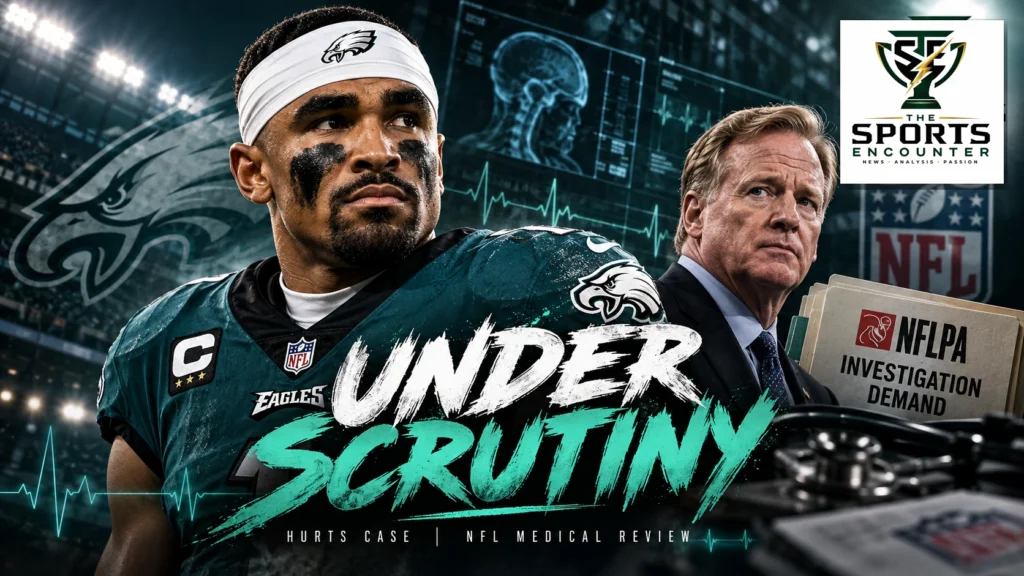
NEW YORK, United States, October 21, 2026: NFL Commissioner Roger Goodell has welcomed the players’ union’s demand for an investigation into the medical treatment of Philadelphia Eagles quarterback Jalen Hurts, whose season is expected to end after doctors discovered deep vein thrombosis and blood clots in both lungs. Hurts played against the Jacksonville Jaguars in London on October 11, one day after specialists diagnosed a superficial blood clot in his left calf. The subsequent complications have raised difficult questions about the decision to clear him for the game, the transatlantic travel surrounding it and the adequacy of the NFL’s medical oversight.
The NFL insists the Eagles followed appropriate medical procedures, while the NFL Players Association argues that a comprehensive investigation is necessary before anyone declares the case properly handled. Philadelphia’s October 19 medical update described Hurts as clinically stable and gave him a very good prognosis, but confirmed that anticoagulant treatment prevents him from playing contact football. The dispute has consequently developed into two connected stories: the health and recovery of one of the NFL’s most prominent quarterbacks, and the broader question of how independently medical decisions are examined when their consequences become serious.
What Happened to Jalen Hurts? The Injury and Blood-Clot Timeline
Understanding the dispute requires separating the original leg injury, the diagnosis made in London and the more serious findings that emerged afterward.
The first relevant event occurred October 4, when Hurts was cleated in the left calf during Philadelphia’s loss to the Los Angeles Rams.
According to the Eagles’ official chronology, Hurts practiced fully on October 7 and 8 before seeking treatment after Thursday’s session. He reported the earlier contact to the team’s medical staff.
Hurts received additional treatment October 9 and remained a full participant in practice. He was added to the injury report.
The Eagles traveled to London ahead of their October 11 game against Jacksonville. On October 10, after the team’s arrival and walkthrough, doctors performed an ultrasound as a precaution.
The examination identified a superficial vein thrombosis in Hurts’ left calf.
The Eagles said their medical staff consulted specialists in London and concluded that Hurts could safely participate in the game. Doctors also recommended a follow-up ultrasound within 72 hours of the game and return journey.
Hurts played against Jacksonville on October 11, completing 21 of 40 passes for 220 yards and one touchdown in Philadelphia’s defeat.
He received treatment after the game and practiced again on October 14. That evening, a follow-up ultrasound revealed movement involving the clot, prompting further evaluation.
Jalen Hurts’ Medical Timeline: October 4-21
| Date | Confirmed Development | Medical or Football Significance |
|---|---|---|
| October 4 | Hurts is cleated in left calf against Rams | Initial reported leg injury |
| October 8 | Seeks treatment after full practice | Medical staff begin addressing calf symptoms |
| October 9 | Receives treatment and practices fully | Added to injury report |
| October 10 | Ultrasound in London identifies superficial clot | Specialists assess participation |
| October 11 | Plays against Jacksonville | Participates after medical clearance |
| October 14 | Follow-up ultrasound reveals clot movement | Further assessment required |
| October 15 | Eagles rule Hurts out against Carolina | Team publishes medical chronology |
| October 17 | Placed on injured reserve | Unavailable for at least four games |
| October 19 | DVT and bilateral pulmonary emboli confirmed | Anticoagulant treatment and no contact football |
| October 20 | NFLPA calls for full investigation | Medical oversight becomes a formal union concern |
| October 21 | Goodell welcomes proposed review | League publicly defends protocol compliance |
Sources: Philadelphia Eagles statements published October 15 and 19, together with NFL reporting on the October 17 roster move and October 21 league response. Dates describe when developments occurred or became public, rather than establishing when each clot first formed.
The distinction between a diagnosis date and the biological development of a condition is important. The public medical record does not establish every intermediate stage of Hurts’ clotting.
The Eagles published their original medical chronology on October 15, providing the first detailed team explanation of why he had been allowed to play.
The Sports Encounter covered the initial development in its Week 6 injury report on Hurts and other significant NFL absences. The subsequent findings make the present story materially different from that initial report.
Why Did the Eagles Allow Jalen Hurts to Play With a Blood Clot?
This is the central question behind the controversy.
The Eagles maintain that Hurts received medical clearance following a review involving their team physicians and specialists in London.
At the time, the diagnosis was superficial vein thrombosis rather than the deep vein thrombosis and bilateral pulmonary emboli identified later.
The team’s account says doctors believed activity and mobility were important and determined that participation was safe under the circumstances known to them.
The NFL has supported that assessment.
League chief medical officer Dr. Allen Sills defended the clinical evaluation and rejected suggestions that football personnel direct physicians to make decisions against a player’s health interests.
But the union argues that the process must be examined independently before its adequacy can be established conclusively.
The questions extend to the initial diagnosis, medical advice about playing, follow-up monitoring and the communication between the club’s medical staff, outside specialists and league officials.
No publicly established finding demonstrates that Hurts was forced to play, that the Eagles concealed a diagnosis or that a medical professional knowingly disregarded a confirmed contraindication.
Equally, a player’s subsequent medical deterioration raises legitimate questions about whether earlier decisions were appropriate based on the information available at the time.
Roger Goodell Defends NFL Protocols but Welcomes a Review
Speaking Wednesday during the NFL’s fall league meeting in New York, Goodell addressed the controversy directly.
The commissioner said the league’s chief medical officer had examined the procedures followed in Hurts’ case and that the NFL was comfortable with the available information.
“The protocols were followed,” Goodell said.
He also acknowledged the players’ union’s right to pursue an investigation.
“We welcome that,” Goodell said.
The two statements capture the unusual position facing the NFL.
League officials have defended the medical process and indicated that they have not identified grounds for disciplinary action against Philadelphia. The NFLPA nevertheless wants a fuller examination of the events before accepting the league’s conclusion.
Goodell also emphasized that Hurts’ long-term health remained the overriding concern.
His comments followed an extensive defense of the Eagles’ treatment decisions by Sills and NFL executive vice president Jeff Miller.
The NFL said its officials had communicated with medical personnel involved in the evaluation, including specialists in London.
Miller also disputed an account suggesting Hurts had remained awake for more than 30 hours before the Jacksonville game. According to the league’s understanding, Hurts returned to his hotel and slept approximately seven or eight hours.
That correction matters because an inaccurate chronology can distort the assessment of medical decisions and the conditions under which they were made.
Why Does the NFL Players Association Want an Independent Investigation?
The NFLPA’s concern centers on accountability and the completeness of the review process.
On October 20, the union said it was unaware of an NFL investigation into Hurts’ treatment and had previously been informed that the league did not intend to review the medical care he received.
The union argued that a full investigation was necessary to establish the facts before conclusions were reached.
The difference between the two institutions involves what constitutes an adequate examination.
NFL officials say the medical sequence has already received sufficient scrutiny to support their conclusion that established procedures were followed.
The NFLPA wants a formal inquiry capable of independently establishing what happened, how decisions were made and whether existing protections operated as intended.
What the NFL, Eagles and Players’ Union Have Established
| Party | Public Position | What Remains Unresolved |
|---|---|---|
| Philadelphia Eagles | Doctors reviewed ultrasound findings and cleared Hurts to play | Detailed clinical rationale and complete decision record are not public |
| NFL medical leadership | Appropriate protocols were followed | Whether an independent inquiry will reach the same assessment |
| Roger Goodell | League welcomes a review while defending existing procedures | Scope and timing of any formal investigation |
| NFL Players Association | Demands a full investigation before accepting conclusions | Whether the inquiry will be initiated and what findings it produces |
| Hurts and his representatives | Confirmed diagnosis, treatment and favorable prognosis | Actual medical clearance date for future contact activity |
The table separates public statements from unresolved matters. The existence of a dispute about process does not establish medical negligence or misconduct.
The labor agreement provides mechanisms through which the NFL or NFLPA may initiate reviews relating to health, safety and care provided by club-affiliated personnel.
That mechanism is important because the union’s request is more specific than a general demand for transparency.
Any eventual findings would need to distinguish between the medical circumstances known when Hurts was cleared and information that only became available after additional testing.
The NFL’s October 21 account of Goodell’s remarks records the league’s public position and the union’s challenge.
What Is the Difference Between Superficial Vein Thrombosis, DVT and Pulmonary Embolism?
The medical distinction helps explain why Hurts’ situation became more serious after the original diagnosis.
A superficial vein thrombosis involves clotting in a vein closer to the skin’s surface.
Deep vein thrombosis involves a clot in a deeper vein, commonly in the leg. It can present a significant risk because part of a clot may travel through the bloodstream.
A pulmonary embolism occurs when a clot obstructs blood flow in an artery in the lungs.
The Eagles and Hurts’ agent confirmed bilateral pulmonary emboli, meaning the condition affected blood vessels serving both lungs.
Although these conditions are related, they differ in location, potential consequences and clinical management.
Jalen Hurts’ Reported Diagnoses: What Each Term Means
| Medical Term | General Meaning | Relevance to Hurts |
|---|---|---|
| Superficial vein thrombosis | Clot in a superficial vein | Initial October 10 diagnosis in left calf |
| Deep vein thrombosis | Clot in a deep vein | Confirmed in October 19 medical update |
| Pulmonary emboli | Clots affecting pulmonary arteries | Confirmed in both lungs |
| Anticoagulation | Medication that reduces blood-clotting activity | Confirmed treatment; prohibits contact football during use |
This table explains general medical terminology and the diagnoses publicly disclosed by Hurts’ representatives. It does not independently diagnose the player, establish how the complications developed or prescribe treatment.
The October 19 joint statement said Hurts was clinically stable and had no significant functional limitations.
It also expressed confidence in his eventual recovery and anticipated that he could return to contact football after completing anticoagulant therapy.
The statement did not provide a definitive return date.
That limitation is important. General medical treatment patterns cannot be used to predict when a particular athlete will receive clearance.
Did Playing or Flying to London Cause Jalen Hurts’ Pulmonary Emboli?
No public finding reviewed for this report establishes that participating in the Jacksonville game or traveling by air caused Hurts’ subsequent complications.
The questions are nevertheless legitimate because both activities occurred during the period in which his condition was being evaluated.
Long-distance travel can be relevant to blood-clot risk assessments in some circumstances, particularly when it involves extended immobility. The clinical implications depend on the individual diagnosis and medical history.
Football presents separate physical demands, including contact, exertion and the risk of additional trauma.
The Eagles say their medical staff considered the initial findings, consulted specialists and determined that Hurts could play.
Goodell and the league’s medical leadership have defended those decisions.
Independent examination of the complete medical record would be required to assess whether the original evaluation, clearance, travel guidance and follow-up testing were appropriate.
It would be medically and journalistically unsound to infer negligence merely from the fact that a more serious condition was diagnosed later.
At the same time, the later complications justify a rigorous review of the circumstances surrounding the earlier decisions.
How the Eagles’ Season Changes Without Jalen Hurts
Hurts’ condition has immediate consequences for Philadelphia’s season.
The Eagles entered Week 7 at 2-4, having lost four consecutive games after opening the season with two victories.
They are now expected to continue without their franchise quarterback for the remainder of the campaign.
Hurts had completed 57.8% of his passes for 933 yards, eight touchdowns and three interceptions through five games.
His absence removes an established passer, an important rushing threat and a player whose short-yardage ability influences defensive preparation even when he does not carry the ball.
Jalen Hurts’ 2026 Numbers Before Injured Reserve
| Measure | Through Five Games | TSE Calculation or Context |
|---|---|---|
| Games played | 5 | Before missing Carolina matchup |
| Passing yards | 933 | 186.6 per game |
| Passing touchdowns | 8 | 1.6 per game |
| Interceptions | 3 | 0.6 per game |
| Completion rate | 57.8% | Season figure before injury absence |
| Record in starts | 2-3 | Team’s first five contests |
Source: NFL statistics through Hurts’ fifth appearance. Per-game calculations divide the respective counting statistics by five and do not project his eventual season totals.
Tanner McKee replaced Hurts against Carolina in Week 6, with Philadelphia losing 25-14.
McKee offers a different quarterback profile, particularly because he does not reproduce Hurts’ mobility or designed rushing threat.
That changes the decisions facing coach Nick Sirianni.
The Eagles may need to place greater emphasis on conventional passing concepts, pocket protection and ways to create opportunities for their receivers without relying on Hurts’ ability to extend plays.
Saquon Barkley remains an important part of the offensive equation. A conventional handoff-based running game becomes particularly valuable when the quarterback no longer represents the same rushing threat.
The Sports Encounter previously examined Hurts’ three-touchdown performance against Washington in Week 1, illustrating how the quarterback’s passing and rushing capabilities contributed to Philadelphia’s early success.
Our Week 2 analysis of Philadelphia’s victory over Tennessee provided another example of his value in late-game situations.
What Does Hurts’ Absence Mean for Tanner McKee and Nick Sirianni?
McKee now faces an opportunity that carries considerable responsibility.
As Philadelphia’s backup quarterback, he had prepared to play when required. The prospect of directing the offense for an extended period presents a different challenge.
His performance against Carolina provided one early indication of the adjustment ahead, but one game is insufficient to establish how effectively the offense will function over the remainder of the season.
The Eagles have also added Joe Milton to their quarterback group, increasing the depth available while Hurts remains sidelined.
Sirianni must stabilize an offense already dealing with questions about efficiency, personnel and consistency.
Those challenges were evident even before the medical developments.
The Sports Encounter’s analysis of coaching pressure surrounding Sirianni documented the team’s earlier struggles and the scrutiny facing its decision-making.
Hurts’ absence adds another significant test, but evaluating Sirianni fairly requires considering the severity of the quarterback disruption alongside the team’s performance.
Philadelphia’s Remaining Schedule Makes the Quarterback Decision Urgent
The Eagles host the Dallas Cowboys on Monday, October 26, before traveling to Washington on November 1 and facing the New York Giants on November 8.
These divisional games matter because the NFC East remains closely contested despite Philadelphia’s disappointing opening six weeks.
With Hurts expected to miss the season, the coaching staff must prepare a sustainable offensive plan rather than wait for an imminent return.
Eagles’ Next Three Games Without Hurts
| Date | Opponent | Location | Key Football Question |
|---|---|---|---|
| October 26 | Dallas Cowboys | Home | Can McKee protect the ball in a pivotal divisional game? |
| November 1 | Washington Commanders | Away | Will Philadelphia establish a consistent offensive rhythm? |
| November 8 | New York Giants | Home | Can the Eagles remain competitive in the NFC East? |
Source: NFL schedule available October 21, 2026. Fixtures are prospective and subject to official league changes. The final column identifies editorial questions rather than predicted outcomes.
Philadelphia’s performance against Washington earlier in the season provides useful context. Its Week 1 win relied on several decisive offensive plays and a late defensive stand.
Another division matchup without Hurts will test the adaptability of the coaching staff and the depth of a roster that entered the season with championship expectations.
Why the Hurts Controversy Matters Beyond Philadelphia
Professional football places players, clubs and league officials in situations where medical decisions can have substantial sporting consequences.
The challenge is ensuring those decisions remain grounded in medical judgment regardless of competitive pressure.
In Hurts’ case, the public dispute concerns how that principle operated in practice.
One side maintains that the established medical process worked appropriately based on the information available at the time.
The other argues that a formal, independent investigation is necessary to establish whether the process was sufficient.
The union’s position does not require assuming that doctors acted improperly. It reflects the principle that significant medical events should be examined using a process capable of producing credible, independently reviewable findings.
That principle has implications across professional football, particularly when teams compete internationally and players receive medical care from combinations of team personnel and outside specialists.
The NFL’s expanding overseas schedule makes the issue more relevant. The Sports Encounter’s investigation into the league’s international growth plans explains how additional overseas games are becoming central to the competition’s strategy.
Those international commitments also make effective medical coordination, communication and follow-up care important operational requirements.
The present controversy does not establish a systemic failure. It does provide a legitimate opportunity to evaluate whether existing safeguards are sufficiently transparent and accountable.
What Happens Next in the NFLPA’s Jalen Hurts Investigation Demand?
Three developments will determine how the controversy progresses.
First, the NFLPA may seek to initiate a formal review under the procedures available through the collective bargaining agreement.
Second, the scope of any investigation must establish which clinical decisions, communications and follow-up procedures will be examined.
Third, the resulting findings will need to distinguish established facts from professional medical judgments and unresolved uncertainty.
There is currently no basis for predicting that an investigation will produce sanctions, exonerate every participant or establish a change in league policy.
Such outcomes depend on the findings of the relevant process.
Meanwhile, Hurts remains focused on recovery under the treatment plan confirmed by his representatives.
The Eagles have indicated that he will continue conditioning and remain engaged with the team where medically appropriate.
His return to contact football will depend on future medical evaluation and the completion of anticoagulant treatment, rather than an externally imposed sporting timetable.
The club’s October 19 medical update provides the authoritative statement of his current diagnosis and prognosis.
The Sports Encounter Analysis: Medical Accountability Must Follow the Evidence
The most difficult part of the Jalen Hurts story is separating the seriousness of the eventual diagnosis from the correctness of decisions made before doctors had the same information.
That distinction is fundamental to a fair examination.
The Eagles say they sought specialist opinions and cleared Hurts after identifying a superficial clot. The NFL says established medical procedures were followed. The NFLPA wants an investigation to establish whether those procedures were applied appropriately and whether existing oversight is adequate.
All three positions require examination through medical records, contemporaneous communication and expert assessment.
The mere fact that Hurts played before receiving a more serious diagnosis cannot prove that the decision was improper. Nor should confidence expressed by league officials substitute for independently establishing the facts.
The strongest outcome would be a process that explains what was known, why particular decisions were made, how the player’s condition was monitored and whether any procedural improvements are warranted.
Hurts’ long-term health remains the most consequential concern. Philadelphia’s season and the league’s reputation matter, but both depend on maintaining the confidence of players and supporters that medical decisions can withstand meaningful scrutiny.
For the Eagles, the football challenge begins immediately against Dallas. For the NFL, the more enduring question is whether the review process can provide answers that remain credible regardless of which institution initially defended its decisions.
Frequently Asked Questions About Jalen Hurts’ Blood Clots
What Happened to Jalen Hurts?
Hurts was initially diagnosed with superficial vein thrombosis in his left calf. Subsequent testing identified deep vein thrombosis and bilateral pulmonary emboli, leading to anticoagulant treatment and an expected absence for the remainder of the 2026 season.
Did Jalen Hurts Play After Doctors Found a Blood Clot?
Yes. Doctors identified a superficial clot on October 10, and Hurts played against Jacksonville in London on October 11 after receiving medical clearance.
Why Is the NFLPA Calling for an Investigation?
The NFLPA wants an independent examination of the medical treatment, clearance and follow-up process before conclusions are reached about whether Hurts’ care was handled appropriately.
What Did Roger Goodell Say About the Hurts Case?
Goodell said on October 21 that the NFL welcomes the union’s request for a review while maintaining that medical protocols were followed.
Does Jalen Hurts Have Blood Clots in His Lungs?
Yes. The Eagles and his agent confirmed bilateral pulmonary emboli in their October 19 medical statement.
Will Jalen Hurts Play Again This Season?
Hurts is expected to miss the remainder of the 2026 season. His representatives have expressed optimism about his eventual recovery, but no confirmed return-to-play date has been announced.
What Is the Difference Between DVT and a Pulmonary Embolism?
Deep vein thrombosis involves a clot in a deep vein, usually in the leg. A pulmonary embolism occurs when a clot obstructs blood flow within the lungs.
Did the Eagles Violate NFL Medical Rules?
No violation has been established in the public record reviewed for this article. NFL officials say protocols were followed, while the NFLPA is calling for a formal investigation.
Who Will Start at Quarterback for the Eagles?
Tanner McKee started in Hurts’ absence against Carolina, while Joe Milton has been added to the quarterback group. Future starting assignments remain subject to team decisions.
When Do the Eagles Play Next?
Philadelphia is scheduled to host the Dallas Cowboys on Monday, October 26, 2026.