


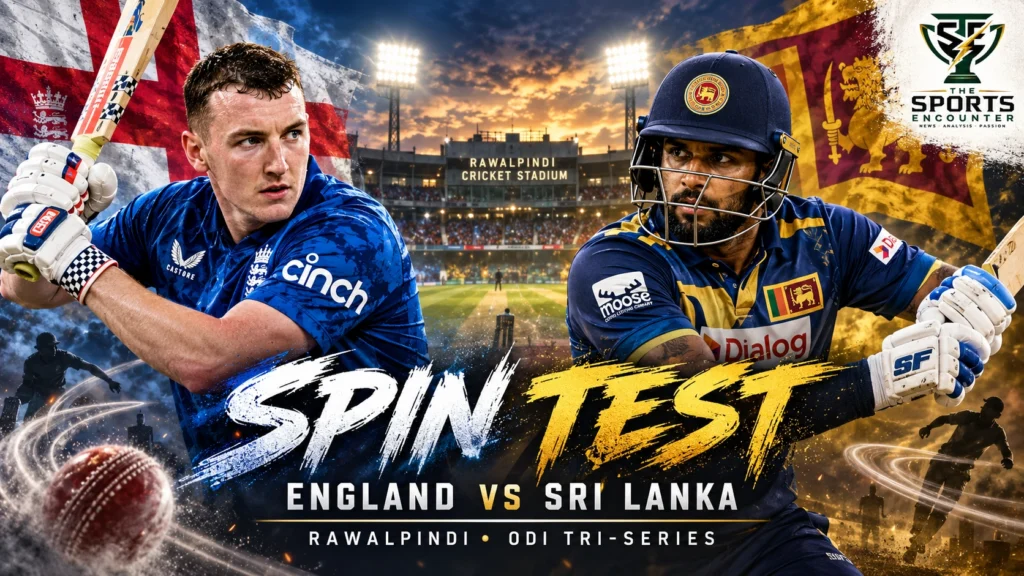
KARACHI, Pakistan, October 21, 2026: England and Sri Lanka will meet at Rawalpindi Cricket Stadium on Thursday, October 22, with both teams searching for their first points in the Pakistan ODI Tri-Series after defeats to the hosts. England arrive following an 87-run collapse against Arafat Minhas, while Sri Lanka have had four days to examine how a chase that reached 210/4 ended in a 37-run defeat. With the tournament moving to Lahore after Thursday’s encounter, the contest offers both sides their first opportunity to move ahead in the race for the October 31 final.
The match presents an especially intriguing tactical question for England. Just two days after Minhas took 6/40 with his left-arm spin, Harry Brook’s side could face Dunith Wellalage, whose 3/49 helped Sri Lanka beat England at Headingley last month. Sri Lanka must decide whether to strengthen their spin attack at the expense of batting depth, while England need to determine whether their response to spin requires greater aggression, better shot selection or a change in the way their middle order manages pressure.
England vs Sri Lanka: Match Details and Live Stakes
| Detail | Information |
|---|---|
| Competition | Pakistan ODI Tri-Series 2026 |
| Match | Third ODI, England vs Sri Lanka |
| Date | Thursday, October 22, 2026 |
| Venue | Rawalpindi Cricket Stadium, Rawalpindi, Pakistan |
| Scheduled start | 1:00 p.m. Pakistan Standard Time |
| England captain | Harry Brook |
| Sri Lanka captain | Kusal Mendis |
| England’s opening result | Lost to Pakistan by 87 runs |
| Sri Lanka’s opening result | Lost to Pakistan by 37 runs |
| Previous bilateral ODI series | England beat Sri Lanka 2-1 in September 2026 |
| Next tournament venue | Gaddafi Stadium, Lahore |
| Tri-Series final | October 31, 2026, Lahore |
Neither team faces immediate elimination in a competition featuring two matches against each opponent. However, losing again would mean entering the Lahore leg without a victory, while Pakistan already have four points from two wins.
The ICC’s official England-Sri Lanka match center confirms the fixture, while the ICC tournament schedule establishes the remaining matches and October 31 final.
Two Defeats, One Common Problem: Why England and Sri Lanka Are Under Pressure
The opening two matches have produced a revealing contrast.
Sri Lanka were 91/4 chasing Pakistan’s 305 on October 18 before Pavan Rathnayake and Janith Liyanage added 119 for the fifth wicket. At 210/4, the chase was back within reach, but the partnership ended and Sri Lanka were dismissed for 268.
England’s defeat on October 20 unfolded differently. Brook’s team reached 91 without loss chasing 303, with Tom Banton and Ben Duckett providing the platform. England subsequently reached 120/1, needing another 183 runs with 190 balls available, before losing wickets in clusters and being dismissed for 215.
| Measure | Sri Lanka vs Pakistan | England vs Pakistan |
|---|---|---|
| Pakistan total | 305 all out | 302/9 |
| Chasing team’s total | 268 all out | 215 all out |
| Defeat margin | 37 runs | 87 runs |
| Promising position | 210/4 | 120/1 |
| Runs needed at that stage | 96 | 183 |
| Runs subsequently added | 58 | 95 |
| Wickets subsequently lost | 6 | 9 |
| Primary problem | Middle-order recovery was not converted | Strong opening platform disappeared against spin |
The numbers do not mean Sri Lanka are automatically better equipped to win Thursday’s match. They show that both teams failed to sustain partnerships during the decisive portion of a chase.
In The Sports Encounter’s report on Pakistan’s victory over Sri Lanka, the 119-run partnership between Rathnayake and Liyanage emerged as the principal threat to Pakistan’s 305.
Two days later, Arafat Minhas’ extraordinary all-round performance against England exposed a different weakness: England’s inability to rebuild once their top order lost momentum.
The team that handles that phase more intelligently on Thursday may have the clearest advantage.
Can England Correct Their Approach Against Left-Arm Spin?
Minhas’ 6/40 is the most immediate reference point for England.
The 21-year-old left-arm spinner dismissed Banton, Brook, Jordan Cox, Jamie Overton, Will Jacks and Adil Rashid, dismantling a batting lineup that had initially looked comfortable pursuing 303.
Brook acknowledged afterward that England were too cautious against Pakistan’s spinners and believed his batters could have applied greater pressure.
That assessment is useful but incomplete. England’s first-wicket partnership was productive, and the chase did not require uncontrolled aggression when the innings reached 120/1.
With nine wickets in hand and 190 deliveries left, the required rate was approximately 5.78 runs per over. England had enough time to manage the chase through sustained partnerships and calculated scoring.
The deeper problem was the failure to find a reliable balance between attacking deliveries, rotating the strike and preserving wickets once Pakistan introduced sustained spin pressure.
Against Sri Lanka, that distinction matters because Wellalage offers a similar bowling angle to Minhas but brings his own style and tactical methods.
England have already seen how dangerous he can be.
Why Dunith Wellalage Could Be Sri Lanka’s Most Important Selection
Wellalage was among Sri Lanka’s decisive performers in their September ODI victory over England at Headingley.
England had reached 143 without loss chasing 322, but Sri Lanka’s bowlers changed the contest through spin, reverse swing and controlled death bowling.
Wellalage took three wickets for 49 runs, helping defend 321 and secure a 16-run victory.
Our detailed Headingley analysis examined how Sri Lanka overturned England’s dominant opening position.
For Thursday’s encounter, the comparison with Minhas is difficult to ignore.
Both attacks have shown that England can struggle to maintain scoring momentum when a left-arm spinner challenges the middle order. However, the two matches unfolded in different conditions, and the reasons behind each collapse should not be treated as identical.
Wellalage was omitted against Pakistan, with Sri Lanka favoring a lineup that included Sahan Arachchige. The possibility of his return now creates a selection dilemma.
Including Wellalage would strengthen the spin attack and provide an additional left-handed batting option, but Sri Lanka must also consider whether they can afford to alter a middle order that produced their best partnership against Pakistan.
Leg-spinner Sachindu Colombage is another important option. His ability to vary pace and attack from a different angle could make Sri Lanka’s middle overs particularly demanding.
The combination of Wellalage and Colombage could become the defining bowling matchup against Root, Brook, Cox and England’s lower middle order.
Adil Rashid Faces an Important Test of His ODI Form
England’s own specialist leg-spinner is under scrutiny.
Rashid returned against Pakistan after a hand injury kept him out of September’s ODI series against Sri Lanka. His comeback was difficult, with figures of 0/55 from eight overs.
Hasan Nawaz was particularly aggressive against him, striking three sixes in his 79-run innings and collecting 24 runs off Rashid’s bowling.
Rashid has now gone four consecutive ODIs without completing his full ten-over allocation, including three matches against India earlier this year.
At 38, questions about his effectiveness are understandable, particularly with England preparing for the 2027 ODI World Cup.
But an underwhelming return after injury does not, by itself, establish that a bowler’s international career is declining irreversibly.
Thursday provides a useful test of his control, variations and ability to deliver meaningful middle-over pressure.
There is also a captaincy component. Brook must decide whether to give Rashid sustained spells when an opposing batter attacks him or adjust the bowling rotation more frequently.
Against Pakistan, Brook’s use of his bowling resources invited scrutiny, especially when he turned to Joe Root late in the innings.
England’s management will need to distinguish between protecting Rashid from unfavorable matchups and maintaining enough confidence in their specialist spinner to let him influence a full ODI.
Avishka Fernando Has a Second Chance to Justify His Recall
Sri Lanka’s batting selection carries its own uncertainty.
Avishka Fernando returned to ODI cricket against Pakistan after an absence dating to February 2025, but his comeback lasted only nine deliveries.
Naseem Shah dismissed him with a short ball, ending an innings that offered little opportunity to demonstrate the domestic form behind his recall.
With Pathum Nissanka unavailable, Avishka is likely to receive another opportunity at the top of the order.
The injury situation was examined in The Sports Encounter’s report on Nissanka’s absence and Sri Lanka’s opening-batting options.
Avishka’s ability to strike boundaries early could be valuable at Rawalpindi, where the new ball has generally offered batters scoring opportunities before the conditions become less predictable under lights.
But his selection also raises a broader question: can Sri Lanka develop a reliable opening partnership without requiring Kusal Mendis and the middle order to repair repeated early setbacks?
England’s attack offers a different challenge from Pakistan’s. Gus Atkinson, Jamie Overton and Josh Tongue bring pace and bounce, while Sam Curran offers left-arm variation.
Avishka will need a more secure initial response if he is to turn his recall into a sustained international opportunity.
Kusal Mendis Returns to a Familiar Opponent After His Headingley Century
Sri Lanka captain Kusal Mendis has a recent reason to approach England with confidence.
His 121 at Headingley in September helped Sri Lanka overturn England’s strong position and win the second ODI by 16 runs.
The innings demonstrated his ability to construct an ODI century against England while sustaining the scoring rate in a demanding chase-or-defend contest.
Yet that victory remains Sri Lanka’s only success from the three-match September series.
England won the opening ODI by 89 runs and then overwhelmed Sri Lanka by 223 runs in the decider at The Oval.
The September results give Brook’s side an established recent record against these opponents, but the Headingley match provides Sri Lanka with a tactical blueprint.
Mendis also has personal familiarity with Rawalpindi. On October 13, his unbeaten 87 helped Sri Lanka win the final T20I against Pakistan at the same venue.
Our report on that Rawalpindi victory showed how Mendis exploited scoring opportunities while maintaining control of the chase.
England’s priority will be to prevent him from occupying the crease long enough to dictate Sri Lanka’s middle-over tempo.
England vs Sri Lanka: What Happened in Their September ODI Series?
England won the three-match series 2-1, but each contest exposed a different tactical characteristic of the teams.
| Date | Match | Result | Defining Performance |
|---|---|---|---|
| September 22 | First ODI, Chester-le-Street | England won by 89 runs | Will Jacks scored 46 not out and took 5/22 |
| September 24 | Second ODI, Headingley | Sri Lanka won by 16 runs | Kusal Mendis scored 121; Wellalage took 3/49 |
| September 27 | Third ODI, The Oval | England won by 223 runs | Tom Banton scored 126 |
England’s opening victory was built around an outstanding all-round performance from Will Jacks.
After scoring an unbeaten 46 to rescue the lower order, Jacks took five wickets for 22 runs to turn a potentially competitive Sri Lankan chase into a comfortable win.
That performance, documented in TSE’s first ODI report, demonstrates why England value Jacks as more than a middle-order batter.
Sri Lanka then responded at Headingley through Kusal Mendis’ century and a coordinated bowling effort.
England’s 223-run victory in the decider was equally significant. Banton scored his maiden ODI hundred, while Jordan Cox contributed 76 as Sri Lanka were overwhelmed.
Our report on England’s emphatic series-clinching victory explains how that performance strengthened the case for Banton’s continued role at the top of the order.
Thursday’s match therefore combines a recent rivalry with two teams seeking to correct separate failures against Pakistan.
England vs Sri Lanka: Head-to-Head ODI Record
According to the ICC match center, England and Sri Lanka have completed 85 ODIs against each other, with England winning 42 and Sri Lanka 39. One match ended in a tie and three produced no result.
| Head-to-Head Measure | Record |
|---|---|
| Total ODIs | 85 |
| England wins | 42 |
| Sri Lanka wins | 39 |
| Tied | 1 |
| No result | 3 |
| Most recent series | England won 2-1, September 2026 |
The record reinforces how competitive the rivalry has been historically, although England have enjoyed the advantage in the most recent series.
A single result in Rawalpindi will not determine the long-term balance between the teams, but it could materially improve one side’s position in the tri-series.
England’s Probable Playing XI
England have generally favored role continuity under Brook, so retaining most of the team that faced Pakistan appears likely.
There may be pressure to change the fast-bowling combination, with Sonny Baker a possible alternative to Josh Tongue.
| Position | Player | Expected Role |
|---|---|---|
| 1 | Tom Banton | Opening batter |
| 2 | Ben Duckett | Opening batter |
| 3 | Joe Root | Top-order anchor |
| 4 | Harry Brook (c) | Captain and middle-order batter |
| 5 | Jordan Cox (wk) | Wicketkeeper-batter |
| 6 | Sam Curran | Seam-bowling all-rounder |
| 7 | Will Jacks | Batting and off-spin all-rounder |
| 8 | Jamie Overton | Fast-bowling all-rounder |
| 9 | Gus Atkinson | Fast bowler |
| 10 | Adil Rashid | Leg-spinner |
| 11 | Josh Tongue / Sonny Baker | Fast bowler |
These are projected selections, not a confirmed playing XI. The final lineup will be announced at the toss.
Sri Lanka’s Probable Playing XI
Sri Lanka have a more consequential balance decision because of England’s recent struggles against left-arm spin.
Wellalage could replace Sahan Arachchige, while the team management may otherwise retain the structure used against Pakistan.
| Position | Player | Expected Role |
|---|---|---|
| 1 | Avishka Fernando | Opening batter |
| 2 | Kamindu Mendis | Top-order batter and part-time spinner |
| 3 | Kusal Mendis (c, wk) | Captain and wicketkeeper |
| 4 | Pavan Rathnayake | Middle-order batter |
| 5 | Dunith Wellalage / Sahan Arachchige | Spin-bowling all-rounder / middle-order option |
| 6 | Janith Liyanage | Middle-order batter |
| 7 | Dasun Shanaka | Seam-bowling all-rounder |
| 8 | Sachindu Colombage | Leg-spinner |
| 9 | Eshan Malinga | Fast bowler |
| 10 | Asitha Fernando | Fast bowler |
| 11 | Dilshan Madushanka | Left-arm fast bowler |
These are probable selections based on available squad information and recent team combinations.
Rawalpindi Pitch Report: Is 300 the New Benchmark?
The first two tri-series matches both featured Pakistan totals above 300.
Against Sri Lanka, the hosts made 305. Against England, they reached 302/9.
Both visiting teams chose to field after winning the toss, with dew expected to make chasing easier during the evening.
However, the results did not follow that assumption.
Pakistan defended both totals, winning by 37 and 87 runs respectively.
The surface appeared suitable for batting during substantial portions of each match, but variable bounce and spin became increasingly influential as the innings progressed.
That creates a genuine strategic dilemma for Thursday’s captains.
Bowling first may remain attractive because of the anticipated dew. Yet the tournament’s early evidence suggests that reaching 300 can give a side a stronger platform than depending on easier batting conditions under lights.
The key is not simply choosing to bat or bowl. Teams must assess how the surface changes, whether the new ball offers meaningful assistance and how quickly spin becomes a factor.
A side batting first may need to preserve enough wickets to accelerate late. A chasing team may need to avoid treating a manageable required run rate as permission to lose wickets while attempting to establish control.
Why the Toss Could Be Less Important Than Middle-Over Discipline
The most useful lesson from the first two matches is that conditions alone did not decide either result.
Pakistan’s batters rebuilt after early trouble and reached competitive totals. Its bowlers then created sustained pressure after the opposition appeared to have made progress in the chase.
Sri Lanka must avoid relying exclusively on the partnership-building ability of Rathnayake and Liyanage after top-order wickets.
England need a better strategy against spin once their opening batters have established a platform.
That means the battle from overs 15 to 40 could be more significant than the first ten.
England may attempt to use Banton and Duckett to attack the powerplay. Sri Lanka may prefer greater patience at the start, followed by calculated acceleration through Mendis, Rathnayake and Liyanage.
The team that best adapts its scoring pattern to the surface will reduce the risk of another collapse.
Two Individual Milestones Worth Watching
| Player | Current Position | Possible Milestone |
|---|---|---|
| Joe Root | 7,936 ODI runs | 64 runs away from 8,000 |
| Dunith Wellalage | 45 ODI wickets | Five wickets away from 50 |
Root has the opportunity to become the first English batter to reach 8,000 runs in men’s ODI cricket.
That possibility gives another layer of significance to his role against Sri Lanka’s spinners. Root’s ability to rotate the strike and manage risk could be particularly important if England lose an early wicket.
Wellalage, if selected, will be aiming to build on the success he enjoyed against England at Headingley.
His immediate importance, however, is tactical rather than statistical. Sri Lanka do not need him to take five wickets to influence the contest. A disciplined spell that interrupts England’s scoring rhythm could be equally valuable.
Pakistan ODI Tri-Series: Standings Before England vs Sri Lanka
| Team | Played | Won | Lost | Points |
|---|---|---|---|---|
| Pakistan | 2 | 2 | 0 | 4 |
| Sri Lanka | 1 | 0 | 1 | 0 |
| England | 1 | 0 | 1 | 0 |
The competition is not decided by Thursday’s result because England and Sri Lanka will meet again in Lahore on October 29.
Nevertheless, the winner will gain two points and a clearer route to the final. The loser will have to recover during the remaining Lahore fixtures.
Pakistan’s two wins place them in a strong position, but mathematical qualification has not yet been secured.
Remaining Pakistan ODI Tri-Series Schedule
| Date | Match | Venue |
|---|---|---|
| October 22 | Sri Lanka vs England | Rawalpindi |
| October 25 | Pakistan vs England | Lahore |
| October 27 | Pakistan vs Sri Lanka | Lahore |
| October 29 | Sri Lanka vs England | Lahore |
| October 31 | Tri-Series Final | Lahore |
The tournament also serves as preparation for the 2027 ODI World Cup in South Africa, Zimbabwe and Namibia.
For England and Sri Lanka, the value of the series extends beyond immediate results. Both sides are attempting to identify dependable batting combinations, bowling balance and match strategies against spin.
Key Battles That Could Decide England vs Sri Lanka
Tom Banton and Ben Duckett Against Dilshan Madushanka
England’s openers provided a rapid start against Pakistan, but Sri Lanka’s left-arm pace gives them a different challenge.
Madushanka dismissed Duckett during the September ODI series, and his ability to attack with the new ball could determine whether England reach the middle overs with momentum.
Joe Root and Harry Brook Against Dunith Wellalage
If Wellalage returns, his left-arm spin will present a direct test of England’s response to their recent collapse against Minhas.
Root’s experience and Brook’s aggressive instincts offer contrasting approaches. The balance between them could define the chase or set up England’s innings.
Adil Rashid Against Kusal Mendis
Mendis has already demonstrated his ability to construct match-winning innings against England.
Rashid’s control will be crucial in preventing Sri Lanka’s captain from establishing a long partnership with the middle order.
Will Jacks Against Sri Lanka’s Middle Order
Jacks took five wickets against Sri Lanka in September and remains an important option for Brook.
His off-spin could help England create a varied attack alongside Rashid and their seamers.
The battle becomes especially important if Sri Lanka’s middle order begins to rebuild as it did against Pakistan.
England vs Sri Lanka: Frequently Asked Questions
When Is the England vs Sri Lanka ODI Tri-Series Match?
England face Sri Lanka on Thursday, October 22, 2026, at Rawalpindi Cricket Stadium.
What Time Does England vs Sri Lanka Start?
The scheduled start is 1:00 p.m. Pakistan Standard Time.
Which Team Has Won a Match in the Tri-Series So Far?
Pakistan have won both completed matches. England and Sri Lanka are yet to record a victory.
How Did England Perform Against Pakistan?
England lost by 87 runs after Pakistan made 302/9. England were dismissed for 215, with Arafat Minhas taking six wickets for 40 runs.
How Did Sri Lanka Perform Against Pakistan?
Sri Lanka lost by 37 runs after Pakistan scored 305. Sri Lanka were dismissed for 268 despite a 119-run partnership between Pavan Rathnayake and Janith Liyanage.
Who Won the September 2026 England-Sri Lanka ODI Series?
England won the three-match bilateral series 2-1, taking the first and third ODIs while Sri Lanka won the second.
Will Dunith Wellalage Play Against England?
His selection had not been confirmed as of the pre-match assessment. Sri Lanka may bring him into the XI because of England’s recent difficulties against left-arm spin.
How Many ODI Runs Does Joe Root Need to Reach 8,000?
Root needs 64 runs to reach 8,000 in men’s ODI cricket.
Where Will the Pakistan ODI Tri-Series Final Be Played?
The final is scheduled for October 31, 2026, at Gaddafi Stadium in Lahore.
The Sports Encounter’s Assessment: The Team That Learns Faster Will Have the Advantage
England and Sri Lanka know one another well after three ODIs in September, but their defeat against Pakistan has given both teams a different set of concerns.
England must address the collapse of their middle order against spin without abandoning the positive batting approach that has helped the team rebuild its ODI form.
Sri Lanka need to improve their opening platform and convert promising partnerships into complete chases.
Wellalage’s possible inclusion creates an especially intriguing tactical choice, while Rashid’s form gives England’s bowling attack an uncertainty it would prefer to resolve quickly.
On a surface that has already produced two defended totals above 300, the captain who handles bowling changes, partnerships and the timing of attacking strokes most intelligently may find the decisive advantage.
England have the recent bilateral record in their favor. Sri Lanka have already demonstrated that they can defend a substantial total against Brook’s team when their spin and seam bowling operate together.
Thursday’s contest will reveal which team has made the more effective adjustments after losing to Pakistan.
Editorial methodology: The match schedule, venue and tournament structure were checked against the ICC. Recent results and scorelines were verified through The Sports Encounter’s published reports and ICC coverage. Predicted playing XIs remain provisional and are subject to the toss. Tactical assessments and qualification scenarios reflect the position before the October 22 match.