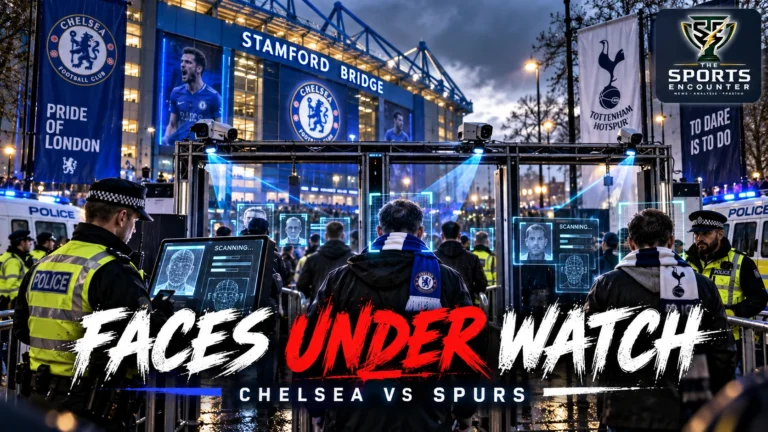
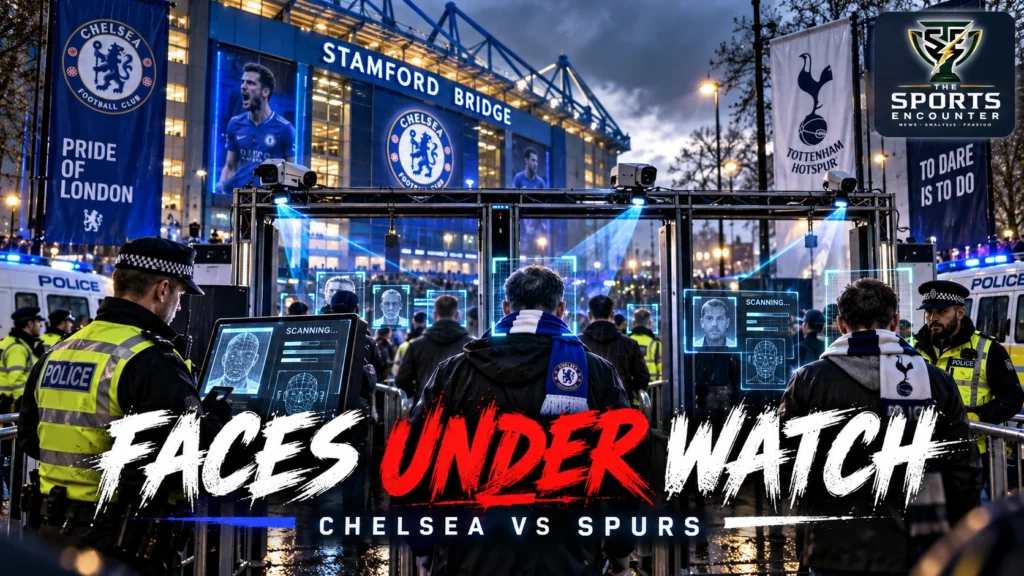
LONDON, United Kingdom, October 22, 2026: Chelsea and Tottenham Hotspur supporters heading to Saturday’s Premier League derby will encounter a security operation involving live facial recognition technology, with London’s Metropolitan Police preparing to deploy two camera-equipped vans near Stamford Bridge. Officers will scan faces in designated areas around Earl’s Court and West Brompton before the October 24 match, comparing images against a police watchlist that includes individuals subject to football banning orders and people wanted for serious offenses. The fixture has been classified as high risk, prompting a policing operation that introduces a growing technological dimension to one of English football’s fiercest rivalries.
The announcement, disclosed by the Chelsea Supporters’ Trust on Wednesday, comes as the Premier League invests up to £10 million in a wider policing partnership that includes facial recognition trials. Police argue the technology can help identify individuals who pose a risk to public safety, while civil liberties campaigners have questioned the proportionality of scanning people in public spaces. For supporters, the most important questions are practical: where will cameras operate, who can be identified, what happens when the system produces an alert, and how effectively are the privacy protections enforced?
Where Will Police Use Facial Recognition Before Chelsea vs Tottenham?
According to the police communication published by the Chelsea Supporters’ Trust, two live facial recognition vans will operate in the Earl’s Court and West Brompton areas during a designated period before kickoff.
Both areas are important routes for people traveling toward Stamford Bridge.
Story at a glance
Where Will Police Use Facial Recognition Before Chelsea vs Tottenham?
According to the police communication published by the Chelsea Supporters’ Trust, two live facial recognition vans will operate in the Earl’s Court and West Brompton areas during a designated period before kickoff.
How Will Live Facial Recognition Work at Stamford Bridge?
Live facial recognition technology processes video images of people passing through a designated camera area.
Who Is on the Police Watchlist for Chelsea vs Tottenham?
The Chelsea Supporters’ Trust disclosed four principal categories of people included in the planned operation.
Why Chelsea vs Tottenham Has Been Classified as a High-Risk Fixture
Chelsea and Tottenham share a long and often fiercely contested London rivalry.
This Is Not the First Time Facial Recognition Has Been Used at Premier League Matches
The Chelsea-Tottenham deployment belongs to a wider program of football-related facial recognition operations.
West Brompton is particularly relevant because supporters can reach the stadium on foot from its transport connections. Earl’s Court is another major interchange used by visitors traveling across west London.
The deployment therefore extends beyond the stadium itself. Police will operate the technology in selected public areas used by people approaching the match.
That distinction matters. The announcement does not establish that every supporter entering Stamford Bridge will undergo a separate facial-recognition check at the turnstiles.
It also does not establish that the system will operate continuously throughout Saturday or across every nearby street.
Chelsea vs Tottenham Facial Recognition: Confirmed Operational Details
| Operational Detail | Confirmed Information |
|---|---|
| Fixture | Chelsea vs Tottenham Hotspur |
| Competition | Premier League |
| Date | Saturday, October 24, 2026 |
| Kickoff | 12:30 p.m. British local time (BST) |
| Stadium | Stamford Bridge, London |
| Police force | Metropolitan Police |
| Technology | Live facial recognition |
| Deployment locations | Earl’s Court and West Brompton |
| Equipment | Two facial-recognition vans |
| Operating period | Designated pre-match period |
| Police risk classification | High-risk fixture |
| Public notification | Signs identifying recognition zones |
Source: Metropolitan Police communication disclosed by the Chelsea Supporters’ Trust on October 21, 2026. Exact operational boundaries and activation times were not independently established in the material reviewed.
The Metropolitan Police have described the use of facial recognition as an established approach for certain high-risk football fixtures.
For Saturday’s derby, the planned deployment should be understood as a targeted operation in specific locations, rather than evidence of continuous biometric identification across the entire stadium district.
How Will Live Facial Recognition Work at Stamford Bridge?
Live facial recognition technology processes video images of people passing through a designated camera area.
Software analyzes facial characteristics and compares them with images held on a predefined police watchlist.
When the system identifies a possible match, it generates an alert for officers to examine.
A police officer then reviews the alert and determines whether further engagement is justified.
This human-review stage is important because algorithmic matches are not infallible.
An alert indicates a possible correspondence with a watchlist image. It is not, by itself, proof that a person has committed an offense or that an arrest is warranted.
How the Technology Works: From Camera to Police Decision
| Stage | Technical Process | Human or Policy Control |
|---|---|---|
| 1. Watchlist preparation | Images of designated persons are selected | Police must apply watchlist inclusion criteria |
| 2. Camera capture | Video captures faces within the designated area | Deployment operates in a defined location |
| 3. Facial comparison | Software compares detected faces with watchlist images | Matching threshold affects alerts |
| 4. Possible match | System generates an alert | Officer reviews the result |
| 5. Engagement | Police may approach the individual | Identity and legal grounds require further assessment |
| 6. Data handling | Biometric data is deleted or retained according to applicable rules | Retention depends on alerts, evidentiary requirements and policy |
Source: Metropolitan Police published live facial recognition operating information. The table summarizes the general process and is not a technical specification of Saturday’s individual deployment.
The Met’s official facial recognition guidance explains the distinction between live recognition, retrospective image analysis and officer-initiated recognition.
For the Chelsea-Tottenham operation, the relevant system is live recognition, in which images are compared with a watchlist during the deployment itself.
Who Is on the Police Watchlist for Chelsea vs Tottenham?
The Chelsea Supporters’ Trust disclosed four principal categories of people included in the planned operation.
They include individuals subject to Football Banning Orders connected with Chelsea or Tottenham.
The list also includes people wanted in connection with serious offenses, missing persons and individuals sought under warrants issued through HM Courts & Tribunals Service.
Those categories are significantly narrower than a database containing every football supporter or everyone who has previously attended a Premier League match.
However, the public announcement does not disclose the complete watchlist, the number of individuals included or the detailed criteria applied to every entry.
Watchlist Categories and Their Purpose
| Category | Reason for Inclusion | Important Distinction |
|---|---|---|
| Football Banning Orders | Identify people subject to relevant legal restrictions | Order conditions and legal status determine what is prohibited |
| Serious-offense suspects | Help locate people wanted by police | Being wanted does not establish guilt |
| Missing persons | Assist efforts to locate individuals | Not necessarily associated with criminal activity |
| Court warrants | Identify people sought under applicable warrants | Officers must establish the warrant’s relevance and status |
The presence of missing persons on the watchlist is particularly important when assessing what the technology is designed to accomplish.
Live facial recognition may serve safeguarding purposes as well as criminal investigations.
But the legal consequences of a possible match differ considerably between a missing person, someone suspected of a serious offense and an individual subject to a football banning order.
Police officers must therefore apply the relevant legal circumstances rather than treat every alert as equivalent.
Why Chelsea vs Tottenham Has Been Classified as a High-Risk Fixture
Chelsea and Tottenham share a long and often fiercely contested London rivalry.
Matches between the clubs have regularly carried substantial competitive significance, particularly during periods when both have challenged for European qualification or major trophies.
The fixture also brings together large groups of supporters traveling through busy transport routes in west London.
Police classify certain matches as higher risk based on operational considerations, including intelligence, crowd movements and the historical context of a rivalry.
That classification does not imply that every supporter is dangerous or that disorder is inevitable.
The October 24 match also arrives at an interesting moment in the 2026-27 Premier League season.
Chelsea have recovered from early inconsistency and entered the fixture fourth in the table with 13 points from seven matches.
Tottenham, meanwhile, have endured a difficult opening under Roberto De Zerbi, taking only six points from their first seven games.
Spurs recorded their first Premier League victory of the campaign against Coventry City on October 19, giving them a measure of relief before visiting Stamford Bridge.
For Chelsea, the game presents an opportunity to maintain momentum after consecutive wins over Bournemouth and Everton.
The Sports Encounter’s Premier League Matchweek 7 analysis examines Chelsea’s 2-0 victory against Everton and the developments surrounding Tottenham’s scheduled meeting with Coventry.
Our earlier Matchweek 6 report documented Tottenham’s dramatic 1-1 draw against Manchester United, when ten-man Spurs recovered through a late Dominic Solanke goal.
Those results establish the sporting stakes behind a fixture now attracting attention for reasons extending well beyond football.
This Is Not the First Time Facial Recognition Has Been Used at Premier League Matches
The Chelsea-Tottenham deployment belongs to a wider program of football-related facial recognition operations.
Earlier deployments in London included the north London derby between Arsenal and Tottenham in September 2023.
Reporting has also identified subsequent operations at corresponding fixtures during the 2025-26 campaign.
The technology has been used in other policing contexts, while British Transport Police began a separate trial at selected railway stations in February 2026.
These developments indicate that live facial recognition is becoming a more established part of certain police operations.
However, the existence of earlier deployments does not demonstrate that every stadium or every match will eventually use the system.
Premier League’s £10 Million Policing Partnership Explains the Wider Strategy
In December 2025, the Premier League announced a partnership with the National Police Chiefs’ Council involving investment of up to £10 million.
The program covers several forms of technology and operational experimentation intended to improve matchday safety.
Alongside facial recognition in London, the announced projects included drone trials in the West Midlands and data-driven crowd-management work in Merseyside.
The distinction matters because the £10 million represents a broader partnership ceiling, not an amount allocated solely to the Chelsea-Tottenham operation or to facial recognition.
Separate reporting has attributed £3.42 million of funding to the Metropolitan Police’s football-related facial recognition trials, but the detailed breakdown and actual spending should not be assumed from those figures alone.
Premier League Security Innovation Program: What the Funding Covers
| Program Area | Reported Focus | Intended Operational Benefit |
|---|---|---|
| London | Live, intelligence-led facial recognition | Identify targeted individuals at major fixtures |
| West Midlands | Drone-based observation pilots | Improve information about crowd activity and public safety |
| Merseyside | Data and AI-supported crowd modeling | Better understand crowd movements and potential risks |
| National partnership | Up to £10 million across multiple projects | Test security approaches that may inform future operations |
Source: Premier League and National Police Chiefs’ Council partnership announcement, December 10, 2025. Program objectives are not independently verified outcomes.
The league’s official partnership announcement states that the pilots are intended to inform future public-event safety practices.
Premier League Chief Policy and Social Impact Officer Clare Sumner described the experience and safety of supporters as a central priority when the agreement was announced.
The partnership raises an important question about governance: how will football authorities evaluate whether the benefits of these technologies justify the costs, operational requirements and potential effects on public trust?
The Sports Encounter has previously explored how financial investment is changing English football’s operating environment in its analysis of record Premier League spending. Security spending represents a different kind of investment, one measured principally through public-safety outcomes and supporter experience rather than player performance.
Does Facial Recognition Put Ordinary Chelsea and Tottenham Supporters on a Police Database?
Not automatically, according to the Metropolitan Police’s published operating framework.
The Met states that biometric data for people who do not generate an alert is automatically deleted immediately.
Its policies also require restrictions on watchlist preparation, retention and access to relevant data.
For alerts, separate rules apply. Data may be retained for a limited period or longer where necessary under applicable legal and evidentiary obligations.
The distinction between biometric data and other recorded video material is important. A claim that unmatched biometric templates are immediately deleted should not be interpreted as a guarantee that no other relevant video footage or information can be retained under any circumstances.
What Happens to Facial Recognition Data?
| Data or Event | Published Met Policy | Editorial Qualification |
|---|---|---|
| Face produces no alert | Biometric data automatically deleted immediately | Separate CCTV policies may apply to other footage |
| Possible watchlist match | Alert assessed by officers | A match is not automatically an arrest |
| Alert-related personal data | Deletion normally within applicable retention period | Legal and investigative exceptions may apply |
| Deployment watchlist | Prepared for the operation and deleted after use under current procedures | Original records may still exist in lawful police systems |
| Public signage | Recognition zones identified through notices | Visibility and effectiveness can be assessed after deployment |
Source: Metropolitan Police published facial recognition guidance and policy documentation. This table summarizes the stated policy, not the independently audited data-handling outcome of Saturday’s operation.
Those safeguards are substantial on paper.
Whether they are sufficient remains a contested question among police authorities, privacy advocates and the public.
Why Civil Liberties Campaigners Remain Concerned About Football Surveillance
Live facial recognition introduces a particular form of surveillance because it attempts to compare people’s biometric characteristics with stored images in real time.
Supporters may pass through a recognition zone while undertaking ordinary activities such as attending a match, visiting nearby businesses or traveling through a transport interchange.
Critics argue that even temporary biometric processing can have implications for privacy and freedom of movement.
They also raise questions about how watchlists are created, whether the technology performs consistently across demographic groups and whether public confidence is affected when cameras become a routine feature of public events.
Supporters of the technology offer a different perspective.
They argue that targeted identification can help locate wanted individuals, identify people subject to legal restrictions and potentially prevent serious incidents before they occur.
The Met has published evidence supporting its position.
In May 2026, the force reported more than 170 arrests during a six-month facial recognition pilot in Croydon.
According to the Met, more than 470,000 people passed its cameras during the trial, with one reported false alert. The force also reported that crime in the selected area fell 10.5% compared with the corresponding earlier period.
Those figures illustrate the operational results claimed by police. They do not, on their own, demonstrate that the technology caused the entire decline in crime, nor do they establish the expected accuracy of every football-specific deployment.
The underlying question is how consistently the technology’s effectiveness can be measured alongside its effects on privacy and public trust.
UK High Court Ruling Adds Legal Context to the Debate
The legal position surrounding the Metropolitan Police’s use of live facial recognition was tested in April 2026.
London’s High Court rejected a challenge brought by campaigners who argued that the Met’s approach infringed rights related to privacy, expression and assembly.
The court concluded that the challenged policy framework was lawful and contained relevant safeguards.
That judgment provides important legal context for Saturday’s planned deployment.
It does not mean that every possible future deployment would automatically satisfy all applicable legal requirements regardless of circumstances.
The proportionality of a particular operation, the composition of its watchlist and the way officers implement the published rules remain relevant considerations.
The distinction matters because legal authorization and operational effectiveness are separate questions.
A system can be lawful under an applicable framework while still requiring scrutiny of whether a particular use is necessary, proportionate and properly supervised.
Chelsea vs Tottenham Offers a Test of Security and Supporter Confidence
Saturday’s derby will be played against an increasingly complicated background for both clubs.
Chelsea entered the season with major squad changes and substantial expectations under Xabi Alonso.
The Sports Encounter’s 2026-27 Premier League preview examined the rebuilding challenges facing both clubs before the opening round.
Our Matchweek 3 analysis documented Chelsea’s defeat against Arsenal and Tottenham’s early scoring difficulties.
The following week, the Matchweek 4 report recorded Chelsea’s frustrating draw against Hull and another goalless Tottenham performance.
By Matchweek 5, the two clubs’ paths remained uncertain. Chelsea suffered a derby defeat against Brentford while Tottenham lost to Aston Villa, developments examined in TSE’s September 19 Premier League roundup.
Those previous meetings and results provide the football background. The policing announcement adds a different dimension to the approaching derby.
For supporters, the practical experience may depend on how clearly the recognition zones are marked, whether officers can resolve alerts efficiently and whether the wider crowd operation remains orderly.
The technology should not be evaluated solely on the number of alerts it generates.
False matches, lawful police interventions, data handling and the experiences of people passing through the area are also relevant to assessing the operation.
What Should Be Measured After the Chelsea-Tottenham Deployment?
The most valuable evidence will come after the match, when the police and relevant stakeholders can assess what actually occurred.
A credible evaluation would distinguish the number of people scanned from the number of possible matches, police engagements, correctly identified subjects and resulting arrests.
Those measures should not be conflated.
An alert is not necessarily a correct match. A correct match does not necessarily lead to an arrest. An arrest does not establish that a person is guilty of an offense.
The published plans also allow for a post-deployment debrief within 72 hours, providing an opportunity for stakeholders to request further information.
Useful questions include whether the operation followed the announced locations and hours, whether signage was visible, how many alerts were reviewed and whether any complaints or data-handling problems arose.
No numbers for the October 24 operation can be reported before it takes place.
The Sports Encounter Analysis: Can Football Security Become More Intelligent Without Becoming More Intrusive?
The Chelsea-Tottenham operation reflects a larger change in the way football authorities approach safety.
Traditional security measures rely heavily on visible officers, stadium stewards, intelligence gathering and crowd management.
Live facial recognition adds the ability to compare people passing through selected public areas with a defined list of individuals police are seeking.
That capability can offer a practical advantage in locating targeted individuals within large crowds.
But its value depends on more than technological capability.
The police must demonstrate that the watchlist is appropriately constructed, that alerts are checked fairly and that biometric data is handled according to published rules.
Equally, the Premier League and football stakeholders should be able to explain how the benefits are being measured.
The existence of a substantial funding program and previous deployments makes this an ongoing governance question rather than an isolated matchday experiment.
Supporters deserve clarity about the distinction between being scanned by a temporary system and being placed on a police watchlist.
They also deserve evidence showing whether the system actually contributes to safer football events.
Saturday’s match will provide another opportunity to evaluate that balance.
The football result will be decided on the pitch at Stamford Bridge. The longer-term significance of the facial recognition operation will depend on what police and independent observers can establish afterward about safety, proportionality and public trust.
Continue the Premier League Story
 Premier LeagueTen Hag Accuses Ronaldo of Letting Manchester United Down, Then Turns on Club’s Broken Promises
 Premier LeagueCoventry Thrash Newcastle 4-1 to Complete 36-Goal Premier League Weekend as Manchester City Pull Clear
 Premier LeagueSoccer Leagues Resume Action: Liverpool Face City, Real Chase Barca, Saudi and Cairo Giants Reactivated
Frequently Asked Questions About Chelsea vs Tottenham Facial Recognition
Will Police Use Facial Recognition at Chelsea vs Tottenham?
Yes. The Metropolitan Police have confirmed plans to use live facial recognition during the pre-match policing operation on Saturday, October 24, 2026.
Where Will Facial Recognition Cameras Be Located?
Two police vans are planned for designated areas around Earl’s Court and West Brompton in west London.
Will Every Chelsea and Tottenham Fan Be Identified?
The technology compares faces captured within designated recognition zones against a police watchlist. The public announcement does not establish that every stadium attendee will pass through those zones or be individually identified.
Who Is on the Facial Recognition Watchlist?
The announced categories include people subject to relevant Football Banning Orders, individuals wanted for serious offenses, missing persons and people sought under court warrants.
Does a Facial Recognition Alert Mean Someone Will Be Arrested?
No. An alert indicates a possible match. Officers must examine the information and decide whether further engagement or action is justified.
What Happens to Images of People Who Are Not on the Watchlist?
The Metropolitan Police’s published policy says biometric data that does not generate an alert is automatically deleted immediately. Other video or alert-related information may be governed by separate retention rules.
Is Facial Recognition Legal at Football Matches in England?
The Metropolitan Police operates the technology under a published legal and policy framework. An April 2026 High Court judgment upheld the challenged policy, but individual deployments must still comply with applicable requirements.
Has Facial Recognition Been Used at Premier League Matches Before?
Yes. Earlier deployments have included north London derbies and other selected high-risk football fixtures.
How Much Is the Premier League Spending on Football Policing Technology?
The Premier League announced an investment of up to £10 million across a wider partnership involving facial recognition, drones and crowd-management technology pilots.
When Is Chelsea vs Tottenham Being Played?
The Premier League match is scheduled for Saturday, October 24, 2026, with kickoff at 12:30 p.m. British local time.