


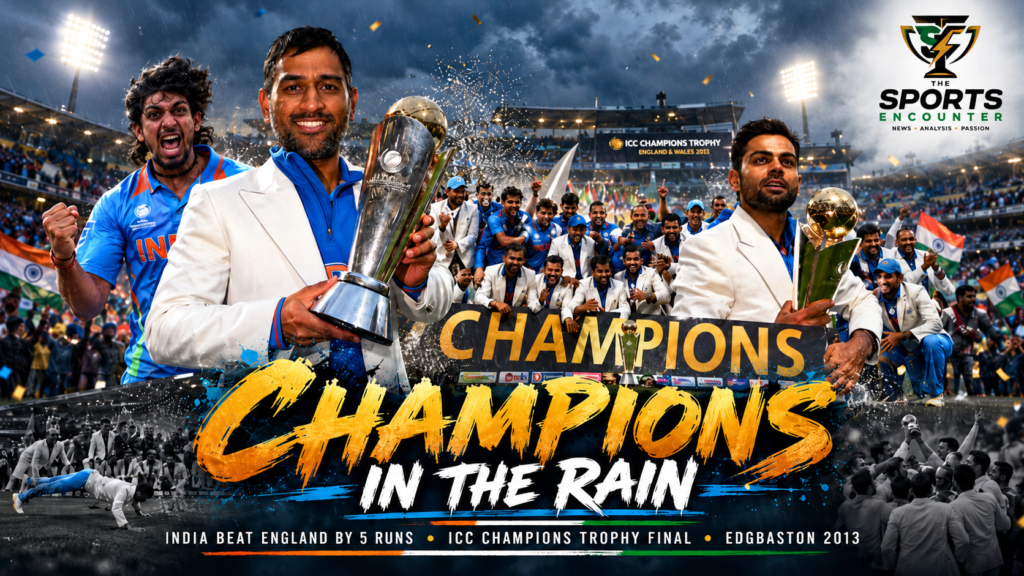
BIRMINGHAM, England, June 23, 2013: England needed only 20 runs from 16 deliveries with six wickets remaining to win the ICC Champions Trophy on home soil. Eoin Morgan and Ravi Bopara had rescued the hosts from 46 for 4, India’s bowlers were running out of deliveries, and the trophy appeared to be slipping from MS Dhoni’s grasp. Then Ishant Sharma claimed two wickets in successive balls, Ravindra Jadeja struck again, and England collapsed to 124 for 8, handing India an extraordinary five-run victory in the rain-shortened final at Edgbaston.
Rain had reduced the championship match to 20 overs per side, and India had struggled to 129 for 7 despite Virat Kohli’s 43 and Jadeja’s unbeaten 33. Ravi Bopara’s three-wicket spell had seemingly given England the advantage, while his subsequent 64-run partnership with Morgan placed the hosts within touching distance of their first Champions Trophy title. But India’s extraordinary recovery transformed the final, made Jadeja the Player of the Match and established Dhoni as the first captain to win all three major ICC men’s white-ball tournaments.
Reader poll question for WordPress
What was the decisive factor in India’s 2013 Champions Trophy victory?Ishant Sharma’s consecutive wicketsRavindra Jadeja’s all-round performanceMS Dhoni’s captaincy and bowling changesEngland’s poor finishing under pressureA combination of these factors
This is a poll-content preview, not a functioning WordPress poll. Connect it to TSE’s verified voting system before publication.
The result belongs among the greatest ODI tournament finals because it combined an unexpected tactical contest, two major reversals of momentum and a dramatic championship consequence.
It is therefore Match 59 in The Sports Encounter’s A Celebration of 5000 ODIs, which revisits 100 matches selected for their tension, individual brilliance, historical importance and enduring place in cricket memory.
India vs England 2013 Champions Trophy Final: Match Summary
| Match detail | Information |
|---|---|
| Tournament | ICC Champions Trophy 2013 |
| Stage | Final |
| Date | June 23, 2013 |
| Venue | Edgbaston, Birmingham |
| Toss | England won and elected to field |
| Overs | 20 per side due to rain |
| India | 129/7 |
| England | 124/8 |
| Result | India won by five runs |
| Player of the Match | Ravindra Jadeja |
| Player of the Tournament | Shikhar Dhawan |
| India’s leading scorer | Virat Kohli, 43 |
| England’s leading scorer | Eoin Morgan, 33 |
| England’s best bowling | Ravi Bopara, 3/20 |
| India’s decisive spell | Ishant Sharma, 2/36 |
| Historical significance | Dhoni completed the three major ICC men’s white-ball titles |
How India and England Reached the Champions Trophy Final
India had entered the tournament with a reshaped batting lineup and a relatively young side under MS Dhoni.
Shikhar Dhawan emerged as the tournament’s outstanding opening batter, while Rohit Sharma’s promotion to the top of the order provided stability.
India won all three group matches, defeating South Africa, West Indies and Pakistan.
In the semifinal against Sri Lanka at Cardiff, the bowlers restricted the opposition to 181 for 8 before India completed a comfortable eight-wicket victory.
The ICC’s account of India’s semifinal victory highlighted the effectiveness of its seam bowling and the team’s unbeaten progress.
England had followed a more demanding route.
The hosts defeated Australia and New Zealand during the group stage, while losing to Sri Lanka. They then overcame South Africa in the semifinal at The Oval.
The final therefore brought together two sides with different strengths.
India had developed into a balanced team with aggressive top-order batting and multiple spin options.
England possessed an experienced seam attack featuring James Anderson and Stuart Broad, complemented by Ravi Bopara’s medium pace and James Tredwell’s off-spin.
Both teams were preparing for a 50-over championship match.
The weather changed everything.
Rain Turns a 50-Over Championship Into a 20-Over Final
Persistent rain delayed the match for several hours.
There were concerns that the final might not be completed.
Eventually, the playing conditions allowed a 20-over contest.
The reduction affected both teams’ strategies.
Batters had considerably less time to establish partnerships, while bowlers could no longer rely on the traditional progression through the three ODI phases.
England captain Alastair Cook won the toss and chose to bowl.
The decision offered his seamers an opportunity to exploit the conditions and place immediate pressure on India’s batters.
It proved successful.
England repeatedly took wickets and prevented India from developing sustained momentum.
However, the rain reduction also created a challenge for the hosts during the chase.
A target of 130 might appear modest in a T20 match, but a major final under difficult conditions can become increasingly demanding when wickets fall.
India would eventually exploit that pressure.
Ravi Bopara’s Three Wickets Leave India Reeling at 66 for 5
England’s most effective bowler was Ravi Bopara.
He produced figures of 3 for 20 from four overs, including one maiden.
Bopara’s wickets were especially damaging because they removed three important Indian batters during the middle overs.
Shikhar Dhawan made 31 from 24 deliveries before falling to Bopara.
Suresh Raina managed only one.
Dhoni was dismissed for a four-ball duck.
India had slipped to 66 for 5 after 13 overs.
At that point, even reaching 120 appeared uncertain.
Bopara’s success was built around controlled medium pace and changes of length.
India’s batters attempted to accelerate against a bowler perceived as less threatening than Anderson or Broad, but Bopara repeatedly interrupted their efforts.
His three wickets denied India a conventional finishing platform.
The hosts had moved into a commanding position.
Yet Bopara’s most productive day with the ball would ultimately end in personal disappointment.
Virat Kohli’s 43 Gives India Something to Defend
Virat Kohli was India’s most important specialist batter in the final.
He scored 43 from 34 deliveries, striking four fours and one six.
Kohli entered following Rohit Sharma’s dismissal, with India still attempting to establish a competitive scoring rate.
As wickets fell around him, his responsibility increased.
He could not attack recklessly because India’s middle order had collapsed.
At the same time, defending excessively would leave the team with a target England could chase comfortably.
Kohli attempted to balance those competing demands.
He found boundaries and rotated the strike while the innings lost momentum.
By the 14th over, India were 66 for 5.
Kohli then combined with Ravindra Jadeja to rescue the innings.
Their sixth-wicket partnership added 47 runs.
That contribution was critical because India eventually won by only five runs.
A total of 129 remained vulnerable, but it was considerably more defensible than the position India had occupied when Dhoni departed.
Kohli was eventually dismissed by Anderson for 43 in the 19th over, leaving India 113 for 6.
He had played the leading batting role, but Jadeja would become the more influential all-round performer.
Ravindra Jadeja’s Unbeaten 33 Changes the Final Before He Takes a Wicket
Ravindra Jadeja produced an innings whose importance became clearer as the match progressed.
He finished unbeaten on 33 from 25 deliveries, including two fours and two sixes.
Jadeja arrived when India’s innings was in serious difficulty.
The top order had failed to establish control, and the captain had been dismissed without scoring.
Jadeja initially needed to preserve his wicket and support Kohli.
He subsequently increased the scoring rate, helping India reach 129 for 7.
His contribution accounted for more than a quarter of India’s runs from the bat after he arrived.
It provided a target that India’s spinners could defend if they found sufficient assistance.
Jadeja’s batting performance was particularly valuable because it gave India a realistic opportunity to apply pressure.
The final would eventually be remembered for wickets during England’s chase.
Yet the victory was also built on runs scored by a lower-middle-order batter when India appeared likely to finish below 110.
Why Jadeja Was Player of the Match
Jadeja subsequently claimed 2 for 24 from four overs.
His wickets included Ian Bell and Jos Buttler.
He also contributed to the late fielding pressure that helped India close out the contest.
His combined figures of 33 not out and two wickets made him a decisive performer in both innings.
The ICC’s retrospective account specifically recognizes Jadeja’s role in the victory.
ICC
England’s Chase Begins Badly Before Morgan and Bopara Take Control
England needed 130 to become Champions Trophy winners.
India needed early wickets because its total provided limited protection against a batting lineup containing Cook, Ian Bell, Jonathan Trott, Joe Root, Morgan and Bopara.
Umesh Yadav delivered the first breakthrough.
He dismissed Cook for two, caught by Ravichandran Ashwin, leaving England 3 for 1 in the second over.
Trott and Bell attempted to rebuild, but India’s spinners soon gained control.
Ashwin removed Trott for 20.
He then dismissed Root for seven.
Jadeja had Bell stumped by Dhoni for 13.
England were 46 for 4 after 8.4 overs.
India had taken four wickets and restricted the scoring rate, making the chase considerably more demanding.
However, the next partnership almost decided the championship in England’s favor.
Eoin Morgan’s 33 Brings England Within Reach of the Trophy
Eoin Morgan scored 33 from 30 deliveries, including three fours and one six.
His innings began with England in serious difficulty at 40 for 3.
When Bell departed at 46 for 4, Morgan was joined by Bopara.
The pair understood that England could not afford another immediate dismissal.
They gradually stabilized the innings, finding gaps in the field and waiting for opportunities to attack.
Morgan was particularly effective at managing the scoring rate without exposing himself unnecessarily.
The partnership grew to 64 runs.
England moved from 46 for 4 to 110 for 4.
With 16 deliveries remaining, the hosts needed only 20 runs.
The required rate was 7.50 runs per over.
Six wickets remained.
At that point, England had recovered from a difficult position to become favorites.
Morgan and Bopara had spent enough time together to understand the bowling conditions, and both were capable of finding boundaries.
India needed an immediate breakthrough.
Dhoni turned to Ishant Sharma.
Ravi Bopara’s 30 Almost Completes an Extraordinary All-Round Performance
Bopara was England’s outstanding all-round contributor.
After taking three Indian wickets, he returned to score 30 from 25 deliveries.
His innings included two sixes.
He helped Morgan transform the chase and brought England within touching distance of victory.
Their 64-run stand was England’s biggest partnership.
That partnership is central to understanding how close India came to losing.
Bopara had already been the principal architect of India’s batting collapse.
He was now helping England recover from its own.
A Champions Trophy final won through three wickets and a crucial batting contribution would have represented an exceptional individual achievement.
But Ishant Sharma changed the outcome in two deliveries.
Ishant Sharma’s Two Consecutive Wickets Turn the Final Upside Down
Ishant’s final bowling figures were 2 for 36 from four overs.
They were India’s most expensive figures of the innings.
Yet his spell contained the two deliveries that fundamentally changed the result.
Morgan Falls With England at 110
Morgan attempted an attacking stroke against Ishant but failed to clear the field.
Ashwin completed the catch.
England were 110 for 5 after 17.3 overs.
The dismissal ended a partnership that had put England within 20 runs of the title.
With Morgan gone, Bopara remained the established batter.
India needed another wicket before England could recover its rhythm.
Bopara Falls From the Very Next Delivery
Ishant then dismissed Bopara for 30.
Ashwin completed another catch.
England were suddenly 110 for 6.
The two established batters were gone in consecutive deliveries.
The required runs had barely changed, but the batting resources available to complete the chase had been sharply reduced.
India had regained control through wickets rather than economical bowling.
That was the decisive reversal.
England had needed 20 from 16 balls with Morgan and Bopara together.
Within two deliveries, both had returned to the pavilion.
Ravindra Jadeja Removes Jos Buttler as England’s Collapse Deepens
The pressure increased when Jadeja bowled Jos Buttler for a first-ball duck.
England were 112 for 7.
Buttler had the power to finish the match quickly, and his dismissal removed another dangerous batting option.
Tim Bresnan then suffered a run-out.
England slipped to 113 for 8 after 18.4 overs.
The collapse had become extraordinary.
In eight deliveries, the hosts had lost four wickets while scoring only three runs.
A chase that had appeared almost complete now depended on Stuart Broad and James Tredwell.
India’s fielders were suddenly operating with the confidence of a team that believed it could defend anything.
England’s batters faced the opposite psychological challenge.
Every delivery carried the possibility that the championship might disappear.
The Decisive Collapse in Numbers
| Stage | England score | Runs added | Wickets lost |
|---|---|---|---|
| Morgan-Bopara partnership established | 46/4 | ||
| Partnership reaches 64 | 110/4 | 64 | 0 |
| Ishant removes Morgan | 110/5 | 0 | 1 |
| Ishant removes Bopara | 110/6 | 0 | 1 |
| Jadeja bowls Buttler | 112/7 | 2 | 1 |
| Bresnan run out | 113/8 | 1 | 1 |
| End of innings | 124/8 | 11 | 0 |
Calculated from the historical scorecard. The defining collapse was four wickets for three runs, from 110/4 to 113/8.
The table illustrates why Ishant’s wickets had such an enormous effect.
England did not immediately lose because the required rate became impossible.
The hosts lost the two batters who had established the chase, followed by two additional wickets that exposed the tail.
Ravichandran Ashwin Defends the Final Over as India Complete a Five-Run Victory
England entered the final over requiring 15 runs.
Broad and Tredwell were at the crease.
Dhoni entrusted the final six deliveries to Ashwin.
The off-spinner had already dismissed Trott and Root during an economical spell.
He now faced the greatest pressure of the match.
England’s lower-order pair attempted to find the boundaries needed to complete the chase.
Broad struck a boundary, but the requirement remained difficult.
England needed six runs from the final delivery.
Tredwell faced Ashwin.
He failed to score.
India finished five runs ahead.
The players rushed together in celebration, with the championship secured after an extraordinary reversal during the final three overs.
Ashwin finished with 2 for 15 from four overs, including a maiden.
His economy rate of 3.75 was the best among India’s bowlers.
He had contributed throughout the chase, taking early wickets and preventing England from completing its recovery.
Ishant supplied the dramatic turning point.
Jadeja removed another dangerous batter.
Ashwin ensured the recovery was completed.
Why MS Dhoni’s Captaincy Became Central to the Victory
Dhoni contributed no runs with the bat.
He had been dismissed for a duck, leaving India 66 for 5.
His greatest contribution came through captaincy and wicketkeeping.
The Indian captain managed his bowling attack carefully despite having only 129 runs to defend.
He used his spinners to restrict England’s scoring rate and create wicket-taking opportunities.
He then returned to Ishant despite the fast bowler having conceded runs earlier.
The decision produced Morgan and Bopara’s dismissals.
Dhoni also completed two stumpings, removing Trott and Bell.
His captaincy demonstrated the importance of retaining wicket-taking options during a low-scoring contest.
India could have attempted to defend the total primarily through economical bowling.
But restricting England’s scoring rate would have been insufficient if Morgan and Bopara had remained together.
Dhoni needed wickets.
The decision to use Ishant produced them at the critical moment.
England vs India: Which Team Controlled Each Phase?
| Phase | India’s performance | England’s performance | Advantage |
|---|---|---|---|
| India’s first 13 overs | 66/5 | Bopara takes three wickets | England |
| India’s final seven overs | Kohli and Jadeja rescue total to 129 | England concede 63 more runs | India recovery |
| England’s first 8.4 overs | Four wickets taken | 46/4 | India |
| Morgan-Bopara partnership | India unable to break stand | 64-run recovery to 110/4 | England |
| Final 16 deliveries | Four wickets for three runs in eight balls | Lower order exposed | India |
| Final over | Ashwin defends 15 | England finish 124/8 | India |
Phase comparison based on the official fall-of-wickets record. The India innings phase includes the 13th-over endpoint at 66/5.
The match’s unusual pattern explains why the final deserves special recognition.
England controlled India’s middle overs.
India recovered sufficiently to post a defendable target.
India then dominated the opening half of England’s chase.
Morgan and Bopara restored the hosts’ advantage.
Finally, India’s bowlers produced the most decisive sequence of the match.
Neither team maintained control long enough to eliminate the opposition’s chances.
Four Turning Points That Decided the 2013 Champions Trophy Final
1. Ravi Bopara Removes Dhawan, Raina and Dhoni
India were reduced to 66 for 5 after 13 overs.
Bopara’s three wickets placed England in an excellent position.
The hosts appeared capable of restricting India to a total below 110.
2. Kohli and Jadeja Add 47 for the Sixth Wicket
The partnership lifted India from 66 for 5 to 113 for 6.
Kohli scored 43 and Jadeja remained unbeaten on 33.
Their contribution created the target India’s bowlers eventually defended.
3. Morgan and Bopara Add 64 to Put England Within Reach
England recovered from 46 for 4 to 110 for 4.
Only 20 runs were required from 16 balls.
The partnership had almost completed a remarkable comeback.
4. Ishant Takes Two in Two Balls Before Jadeja Strikes
Morgan and Bopara fell on consecutive deliveries.
Jadeja subsequently bowled Buttler.
Bresnan was run out.
England lost four wickets for three runs and finished five short.
This final sequence decided the championship.
The Overlooked Statistical Story: England Lost More Than Half Its Wickets in Eight Balls
England’s collapse from 110 for 4 to 113 for 8 deserves particular attention.
The hosts had lost four wickets across their first 104 legal deliveries.
They then lost another four during the next eight.
That represents a dramatic concentration of dismissals in a very short period.
| Measure | Before collapse | Collapse |
|---|---|---|
| Runs scored | 110 | 3 |
| Wickets lost | 4 | 4 |
| Balls | 104 | 8 |
| Runs per over | 6.35 | 2.25 |
| Wickets per six balls | 0.23 | 3.00 |
TSE calculation from the historical innings record. Before the collapse: 110 runs in 17.2 overs (104 balls). Collapse: three runs in eight deliveries, through 18.4 overs.
The wicket rate during that eight-ball collapse was 13 times the rate across the preceding 104 deliveries.
The comparison explains why England’s challenge changed so abruptly.
The required runs remained relatively modest.
But a team that had been batting through two established players was suddenly depending on its lower order under championship pressure.
India’s fielding and bowling converted a manageable chase into a desperate finish.
Why England Lost Despite Needing Only 20 From 16 Balls
England’s failure resulted from several connected factors.
The first was the loss of established batters.
Morgan and Bopara had constructed the chase and understood the pace of the pitch.
Both departed before the target was completed.
The second was the inability of incoming batters to absorb the pressure.
Buttler was dismissed immediately, while Bresnan’s run-out compounded the problem.
The third was India’s effective use of spin.
Ashwin and Jadeja combined for four wickets while conceding only 39 runs from eight overs.
Those figures helped ensure England’s lower order faced a demanding finish.
England’s bowlers had performed effectively, particularly Bopara.
Their batting recovery had also been impressive.
But the late collapse was devastating.
A team with six wickets available required only 20 runs.
Eight deliveries later, four of those wickets had disappeared.
India then completed the defense through Ashwin’s final over.
Why India Deserved the Trophy Despite Its Batting Collapse
India’s innings had been disappointing.
Scoring 129 for 7 in a 20-over final was far below the totals its batting lineup had regularly produced during the tournament.
Dhoni’s dismissal for a duck could have intensified the pressure.
However, Kohli and Jadeja’s partnership prevented a complete collapse.
The bowling attack subsequently produced a disciplined collective performance.
Ashwin took two wickets for 15.
Jadeja claimed two for 24.
Umesh removed Cook early.
Ishant delivered the two wickets that transformed the final.
India also maintained pressure through fielding, including Dhoni’s stumpings and the late run-out.
The victory therefore reflected the strength of a balanced side capable of compensating for weaknesses in one department through excellence in another.
It was a defining characteristic of India’s 2013 Champions Trophy campaign.
Dhoni Completes His Historic Collection of ICC Trophies
The victory had a significance extending beyond the five-run margin.
Dhoni became the first captain to win all three major ICC men’s white-ball trophies.
He had led India to the inaugural ICC World Twenty20 title in 2007.
He then captained the team to the 2011 Cricket World Cup.
The 2013 Champions Trophy completed the set.
| ICC tournament | Year | India’s achievement |
|---|---|---|
| ICC World Twenty20 | 2007 | Champions |
| ICC Cricket World Cup | 2011 | Champions |
| ICC Champions Trophy | 2013 | Champions |
| Dhoni’s historic achievement | 2007–2013 | Captained India to all three titles |
The ICC’s official recognition of Dhoni’s captaincy achievement confirms his unique distinction.
The success also made India a multiple-time Champions Trophy winner, following its shared title with Sri Lanka in 2002.
The 2013 triumph represented India’s first outright Champions Trophy championship.
Shikhar Dhawan’s Tournament Record and Jadeja’s Bowling Complete India’s Success
India’s championship campaign was built on major contributions from several players.
Shikhar Dhawan was named Player of the Tournament.
He scored 363 runs across five matches, including two centuries.
Jadeja finished as the tournament’s leading wicket-taker with 12 dismissals.
Kohli contributed important innings during the competition, while India’s seam bowlers provided wickets with the new ball.
The ICC’s Champions Trophy historical review identifies Dhawan and Jadeja as the leading performers in their respective disciplines.
India finished the competition unbeaten.
The final tested that record more severely than any previous match.
Why Match 59 Belongs in A Celebration of 5000 ODIs
The 2013 Champions Trophy final earns its place among the 100 selected matches because it combined a major championship, a dramatic collapse and one of the most consequential captaincy triumphs in ODI history.
The rain-shortened format created an unusual contest.
England restricted India to 129.
Bopara took three wickets.
Kohli and Jadeja rescued the innings.
India reduced England to 46 for 4.
Morgan and Bopara recovered through a 64-run partnership.
Then England lost four wickets for three runs in eight deliveries.
India won by five.
Few championship finals have changed direction so abruptly during the closing overs.
The contest also provides a fascinating historical comparison with Match 54, the tied 2005 NatWest Series final between England and Australia.
In 2005, England recovered from 33 for 5 to share the trophy after a final-ball tie.
Eight years later, the hosts again recovered from a difficult position, only to surrender their advantage when victory seemed close.
There is another useful connection with Match 58, Virat Kohli’s remarkable unbeaten 133 against Sri Lanka at Hobart in 2012.
At Hobart, Kohli’s batting overwhelmed the opposition.
At Edgbaston, his 43 helped India recover, but its bowlers ultimately determined the result.
Together, those matches illustrate how a successful ODI side must adapt to dramatically different circumstances.
The final also helped establish Dhoni’s place among international cricket’s most accomplished captains.
His team had been outplayed for significant portions of the match, yet he retained the tactical flexibility and composure required to create one final opportunity.
Ishant seized that opportunity.
Jadeja made it count.
Ashwin completed the job.
England had the trophy within reach with 16 balls remaining. India finished those 16 deliveries as Champions Trophy winners.
That extraordinary reversal, and its place in Dhoni’s remarkable captaincy career, makes Edgbaston 2013 an essential chapter in The Sports Encounter’s A Celebration of 5000 ODIs.
4. Complete Match Scorecard
India Innings: 129/7 in 20 Overs
| Batter | Dismissal | R | B | 4s | 6s | SR |
|---|---|---|---|---|---|---|
| Rohit Sharma | b Stuart Broad | 9 | 14 | 1 | 0 | 64.29 |
| Shikhar Dhawan | c Tredwell b Bopara | 31 | 24 | 2 | 1 | 129.17 |
| Virat Kohli | c Bopara b Anderson | 43 | 34 | 4 | 1 | 126.47 |
| Dinesh Karthik | c Morgan b Tredwell | 6 | 11 | 0 | 0 | 54.55 |
| Suresh Raina | c Cook b Bopara | 1 | 6 | 0 | 0 | 16.67 |
| MS Dhoni (c, wk) | c Tredwell b Bopara | 0 | 4 | 0 | 0 | 0.00 |
| Ravindra Jadeja | Not out | 33 | 25 | 2 | 2 | 132.00 |
| Ravichandran Ashwin | Run out (Bell) | 1 | 1 | 0 | 0 | 100.00 |
| Bhuvneshwar Kumar | Not out | 1 | 1 | 0 | 0 | 100.00 |
| Umesh Yadav | Did not bat | |||||
| Ishant Sharma | Did not bat | |||||
| Extras | 4 wides | 4 | ||||
| Total | 7 wickets, 20 overs | 129 |
Fall of wickets: 1-19 (Rohit, 3.5), 2-50 (Dhawan, 8.2), 3-64 (Karthik, 11.1), 4-66 (Raina, 12.2), 5-66 (Dhoni, 13.0), 6-113 (Kohli, 18.3), 7-119 (Ashwin, 19.2).
England Bowling
| Bowler | O | M | R | W | Econ |
|---|---|---|---|---|---|
| James Anderson | 4 | 0 | 24 | 1 | 6.00 |
| Stuart Broad | 4 | 0 | 26 | 1 | 6.50 |
| Tim Bresnan | 4 | 0 | 34 | 0 | 8.50 |
| James Tredwell | 4 | 0 | 25 | 1 | 6.25 |
| Ravi Bopara | 4 | 1 | 20 | 3 | 5.00 |
England Innings: 124/8 in 20 Overs
| Batter | Dismissal | R | B | 4s | 6s | SR |
|---|---|---|---|---|---|---|
| Alastair Cook (c) | c Ashwin b Umesh Yadav | 2 | 9 | 0 | 0 | 22.22 |
| Ian Bell | st Dhoni b Jadeja | 13 | 16 | 1 | 0 | 81.25 |
| Jonathan Trott | st Dhoni b Ashwin | 20 | 17 | 2 | 0 | 117.65 |
| Joe Root | c Ishant b Ashwin | 7 | 9 | 0 | 0 | 77.78 |
| Eoin Morgan | c Ashwin b Ishant | 33 | 30 | 3 | 1 | 110.00 |
| Ravi Bopara | c Ashwin b Ishant | 30 | 25 | 0 | 2 | 120.00 |
| Jos Buttler (wk) | b Jadeja | 0 | 1 | 0 | 0 | 0.00 |
| Tim Bresnan | Run out (Rohit Sharma) | 2 | 4 | 0 | 0 | 50.00 |
| Stuart Broad | Not out | 7 | 5 | 1 | 0 | 140.00 |
| James Tredwell | Not out | 5 | 4 | 0 | 0 | 125.00 |
| James Anderson | Did not bat | |||||
| Extras | 1 lb, 4 wides | 5 | ||||
| Total | 8 wickets, 20 overs | 124 |
Fall of wickets: 1-3 (Cook, 1.5), 2-28 (Trott, 5.1), 3-40 (Root, 7.4), 4-46 (Bell, 8.4), 5-110 (Morgan, 17.3), 6-110 (Bopara, 17.4), 7-112 (Buttler, 18.2), 8-113 (Bresnan, 18.4).
India Bowling
| Bowler | O | M | R | W | Econ |
|---|---|---|---|---|---|
| Bhuvneshwar Kumar | 3 | 0 | 19 | 0 | 6.33 |
| Umesh Yadav | 2 | 0 | 10 | 1 | 5.00 |
| Ravindra Jadeja | 4 | 0 | 24 | 2 | 6.00 |
| Ravichandran Ashwin | 4 | 1 | 15 | 2 | 3.75 |
| Ishant Sharma | 4 | 0 | 36 | 2 | 9.00 |
| Suresh Raina | 3 | 0 | 19 | 0 | 6.33 |
Result: India won by five runs.
Player of the Match: Ravindra Jadeja, 33 not out and 2 for 24.
Player of the Tournament: Shikhar Dhawan, 363 runs.Batting figures, dismissals, extras, fall of wickets and bowling figures checked against the Pakistan Cricket Board’s historical scorecard and corroborated with ICC tournament records.

PCB
+2
5. Frequently Asked Questions
Who Won the 2013 ICC Champions Trophy Final?
India defeated England by five runs at Edgbaston, Birmingham, on June 23, 2013.
Why Was the Final Reduced to 20 Overs?
Persistent rain delayed play for several hours, and the match was shortened to 20 overs per side to allow a result.
Who Was the Player of the Match?
Ravindra Jadeja received the award after scoring an unbeaten 33 and claiming two wickets for 24 runs.
Who Was the Player of the Tournament?
Shikhar Dhawan was named Player of the Tournament after scoring 363 runs.
How Many Runs Did England Need Before Its Late Collapse?
England needed 20 runs from 16 deliveries with six wickets remaining.
Which Bowler Dismissed Morgan and Bopara?
Ishant Sharma dismissed both batters in consecutive deliveries during the 18th over.
What Were Ravichandran Ashwin’s Bowling Figures?
Ashwin finished with 2 for 15 from four overs, including one maiden.
What Was England’s Final Score?
England finished on 124 for 8 after 20 overs, five runs short of India’s 129 for 7.
Which Three Major ICC Titles Did MS Dhoni Win as Captain?
Dhoni captained India to the 2007 ICC World Twenty20, 2011 ICC Cricket World Cup and 2013 ICC Champions Trophy titles.