


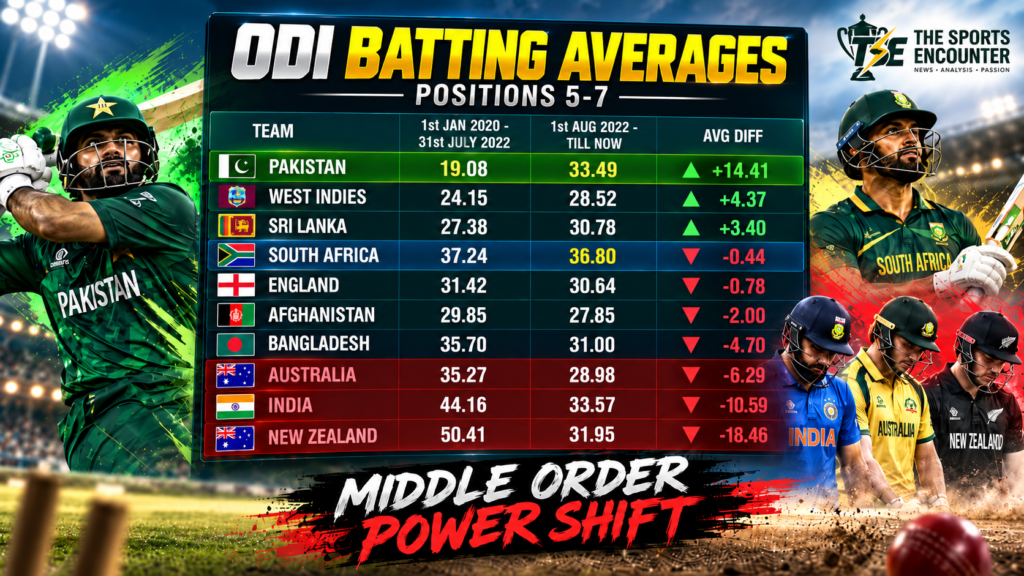
RAWALPINDI, Pakistan, October 20, 2026: Pakistan’s middle-order batting has undergone the most dramatic statistical improvement among ten leading ODI nations since August 2022, according to figures displayed during the Pakistan vs. England ODI tri-series encounter at Rawalpindi Cricket Stadium. The comparison shows Pakistan’s combined batting average at positions five, six, and seven increasing from 19.08 to 33.49, a rise of 75.5%. At the opposite end, New Zealand’s average has fallen by 18.46 runs, while India and Australia have also suffered considerable declines.
The figures reveal a changing balance in ODI batting depth as international teams prepare for the 2027 ICC Cricket World Cup. Pakistan, West Indies, and Sri Lanka have recorded improvements, while South Africa continues to lead the comparison with an average of 36.80 despite a marginal decline. The bigger question is whether these changes reflect stronger batting units, shifting player responsibilities, or the growing difficulty of maintaining consistency beyond the top four.
At a Glance: What the ODI Middle-Order Numbers Reveal
- Pakistan: Largest improvement, rising 14.41 runs per dismissal.
- New Zealand: Sharpest decline, falling 18.46.
- South Africa: Highest recent batting average at 36.80.
- India: Average drops from 44.16 to 33.57.
- Australia: Average falls from 35.27 to 28.98.
- West Indies and Sri Lanka: Both register measurable gains.
Complete ODI Middle-Order Batting Comparison: 2020–2026
The figures cover batters playing at positions five, six, and seven. The percentage-change column has been calculated by The Sports Encounter from the broadcast values.
| Team | Jan 2020–July 2022 | Aug 2022–Oct 2026 | Difference | Change |
|---|---|---|---|---|
| Pakistan | 19.08 | 33.49 | +14.41 | +75.5% |
| West Indies | 24.15 | 28.52 | +4.37 | +18.1% |
| Sri Lanka | 27.38 | 30.78 | +3.40 | +12.4% |
| South Africa | 37.24 | 36.80 | -0.44 | -1.2% |
| England | 31.42 | 30.64 | -0.78 | -2.5% |
| Afghanistan | 29.85 | 27.85 | -2.00 | -6.7% |
| Bangladesh | 35.70 | 31.00 | -4.70 | -13.2% |
| Australia | 35.27 | 28.98 | -6.29 | -17.8% |
| India | 44.16 | 33.57 | -10.59 | -24.0% |
| New Zealand | 50.41 | 31.95 | -18.46 | -36.6% |
Source: Television broadcast graphic during Pakistan vs. England, October 20, 2026. Percentage changes calculated by The Sports Encounter. The second reporting window ends at the broadcast date.
Change in ODI batting average at Nos. 5–7
-20 runs-10 runs0 runs10 runs20 runsPakistanWest IndiesSri LankaSouth AfricaEnglandAfghanistanBangladeshAustraliaIndiaNew Zealand
Runs per dismissal; calculated from the supplied broadcast graphic.
The central finding is compelling: only three of the ten teams improved their batting averages during the comparison periods.
There is also an important statistical distinction. An average measures runs per dismissal, whereas a team’s scoring strength additionally depends on strike rate, wickets remaining, batting conditions, and its ability to accelerate during the closing overs.
Pakistan’s remarkable improvement deserves attention, but so does the fact that South Africa, whose average has declined slightly, still possesses the strongest numerical record in this comparison.
Pakistan’s Middle Order: From a Major Weakness to a Competitive Strength
The most extraordinary figure belongs to Pakistan.
Between January 2020 and July 2022, Pakistan’s batting average across positions five to seven stood at just 19.08, the lowest among the ten teams included in the comparison.
Since August 2022, that number has climbed to 33.49.
Pakistan has consequently moved from tenth place in the earlier comparison to third in the more recent period, behind South Africa and India.
An improvement of 14.41 runs per dismissal is significant in any era of ODI cricket. It suggests Pakistan has become better equipped to recover from setbacks and obtain meaningful contributions from the lower middle order.
Salman Ali Agha: A Key Figure in Pakistan’s Batting Evolution
Salman Ali Agha provides an important example of the value Pakistan can obtain from its middle order.
In Pakistan’s opening match of the 2026 ODI tri-series against Sri Lanka, Agha scored 107 from 90 deliveries, helping his team reach 305 after losing both openers inside six overs.
Pakistan eventually won by 37 runs.
As detailed in The Sports Encounter’s report on Salman Agha’s century against Sri Lanka, his innings demonstrated the importance of a batter capable of repairing the damage caused by early dismissals and then accelerating.
Agha’s contribution is especially relevant because it illustrates a problem Pakistan struggled with during the earlier years covered by the statistical comparison: the absence of sufficiently dependable runs after its established top-order batters.
However, the wider improvement cannot be attributed to one player without reviewing individual batting-position records.
Why Pakistan Still Needs to Be Careful
Pakistan’s improved average is encouraging, but the performance against Sri Lanka also exposed a continuing vulnerability.
The opening partnership contributed little, and Pakistan required Agha’s substantial innings to stabilize its batting.
A dependable middle order should be capable of building on strong starts as well as rescuing troubled innings.
Pakistan’s next challenge is to turn a much healthier batting average into more consistent totals, particularly against top-ranked bowling attacks in major tournaments.
West Indies: Encouraging Progress Beneath Inconsistent Results
West Indies have recorded the second-largest improvement in the comparison.
Their batting average at positions five to seven rose from 24.15 to 28.52, representing an 18.1% increase.
The improvement is substantial relative to their previous record, although their recent average remains the second lowest among the ten teams.
That combination tells an interesting story. West Indies are showing signs of greater batting productivity, but there remains considerable room for improvement.
Amir Jangoo and the Potential of West Indies’ Batting Depth
The West Indies’ recent ODI performances against India demonstrate why their batting resources deserve closer attention.
During the second ODI against India in Guwahati on September 30, 2026, West Indies amassed 405 for seven.
John Campbell scored 101, captain Shai Hope contributed 104, and Amir Jangoo struck 114.
The innings featured three centuries and showed the batting unit’s capacity to sustain an assault beyond its opening partnership.
As examined in The Sports Encounter’s analysis of India’s remarkable 406-run chase, West Indies produced an exceptional batting display but still lost by eight wickets.
Jangoo’s performance was particularly valuable because it highlighted the importance of destructive batting beyond the established top order.
Nevertheless, a spectacular innings does not establish long-term consistency. West Indies must demonstrate that their improved middle-order productivity can withstand difficult surfaces, stronger bowling attacks, and high-pressure chases.
The challenge is to convert occasional outstanding displays into a dependable batting structure.
South Africa: The Standard That Other Teams Are Still Chasing
South Africa presents the most interesting contradiction in the broadcast figures.
Their batting average fell marginally from 37.24 to 36.80, a decline of only 0.44 runs.
Yet their 36.80 average remains the highest in the more recent period.
The Proteas have therefore retained a remarkable degree of batting stability while several established rivals have experienced much larger declines.
David Miller Demonstrates the Value of an Established Finisher
David Miller has long provided South Africa with the ability to transform an innings through aggressive batting under pressure.
One recent example came against Australia in Johannesburg on September 27, 2026.
South Africa were 93 for three before Miller’s career-best 142 from 93 balls, supported by Temba Bavuma’s 103, helped the hosts reach 365 for nine.
South Africa won by 32 runs and secured the ODI series.
The Sports Encounter’s detailed report on Miller’s match-winning 142 illustrated how a substantial middle-order innings could rescue a side from a difficult position and create the platform for a commanding total.
Miller’s performance is a strong example of the role South Africa’s middle order can play, although it cannot, by itself, explain an aggregate covering more than four years.
South Africa’s Strength Extends Beyond Individual Stars
The Proteas have also demonstrated the ability to develop alternative batting options.
In September, a younger South African side completed a 3-0 ODI series victory against Namibia, with contributions from Jordan Hermann, Connor Esterhuizen, and others.
The series-clinching victory against Namibia highlighted the country’s developing batting resources.
That broader talent pool is encouraging for South Africa’s ODI planning, even though success against Namibia must be weighed differently from performances against leading Full Member teams.
As preparations intensify for the 2027 World Cup on African soil, South Africa’s challenge will be to preserve that batting depth against higher-quality opposition and under tournament pressure.
India’s Middle-Order Decline: Why a 24% Drop Cannot Be Ignored
India’s numbers demand careful interpretation.
Between January 2020 and July 2022, India averaged an impressive 44.16 across positions five to seven.
In the subsequent period, that figure declined to 33.57.
The difference of 10.59 runs represents a 24% reduction.
India’s earlier average was the second highest in the comparison. Despite its decline, the more recent average remains second only to South Africa.
Therefore, the figures indicate a considerable reduction in middle-order batting efficiency, rather than suggesting India has suddenly developed one of the weakest middle orders in international cricket.
India’s Dependence on Strong Starts Can Hide Middle-Order Problems
India possesses one of the most formidable top orders in ODI cricket.
Rohit Sharma, Virat Kohli, and Shubman Gill have repeatedly provided the foundation for major totals and successful chases.
Yet a productive top order can sometimes prevent weaknesses elsewhere from becoming obvious.
The problem becomes more apparent when early wickets expose batters who usually enter with a stable scoreboard.
One revealing example came in India’s ODI series defeat against England in July 2026.
In the decisive match at Lord’s, Rohit made 138, Kohli contributed 74, and Gill scored 77.
India still fell 27 runs short of England’s 387.
The Sports Encounter’s report on England’s 2-1 ODI series victory explored the questions surrounding India’s middle-order effectiveness.
India’s Trophy Success Complicates the Picture
Any suggestion that India has experienced a general decline in ODI cricket would ignore its major achievements.
India won the 2025 ICC Champions Trophy by defeating New Zealand in the final.
The official ICC account of India’s Champions Trophy triumph confirms that KL Rahul made decisive contributions in the tournament’s closing stages, including an unbeaten 34 in the final.
India also completed the competition undefeated.
ICC
+1
Those performances underline the danger of judging a batting lineup exclusively through an aggregate average.
India’s statistical decline is real within the broadcast comparison, but its tournament record demonstrates that the team can still produce exceptional middle-order performances when they matter most.
The question for India is whether it can restore the consistency associated with its earlier batting average while retaining the flexibility and match-winning quality of its established players.
Australia: A Declining Middle-Order Average Raises Questions About Batting Balance
Australia’s average has fallen from 35.27 to 28.98, a reduction of 6.29 runs or 17.8%.
That decline becomes more concerning when viewed alongside recent matches in which Australia has failed to capitalize on promising starts.
During Australia’s September 2026 ODI series in South Africa, aggressive opening contributions from Mitchell Marsh and Travis Head were not always followed by equally effective batting through the middle overs.
In the opening ODI, Australia reached 90 without loss but eventually collapsed to 230.
South Africa’s spinners disrupted the innings and turned an encouraging platform into an underwhelming total.
The pattern appeared again during the Johannesburg ODI, where Australia made a promising start while chasing 366 but eventually finished 32 runs short.
However, the third ODI provided a more positive response.
Australia scored 322 for nine at Potchefstroom and won by 45 runs under the DLS method.
Our analysis of Australia’s third ODI victory against South Africa examined how the batting lineup managed to avoid another dramatic collapse after a rapid opening partnership.
What Australia Must Improve Before the World Cup
Australia has traditionally valued batters capable of fulfilling multiple responsibilities: rebuilding, attacking spin, accelerating at the death, and contributing with the ball.
However, aggressive intent can become counterproductive when teams repeatedly lose wickets during transitions between innings phases.
The 2026 series against South Africa suggests Australia needs greater consistency after its initial attacking bursts.
With the ODI World Cup approaching, its middle-order batting combinations require careful examination, particularly against teams capable of maintaining pressure with spin.
The challenge is to protect a strong batting platform without compromising the aggressive approach that has often made Australia successful.
New Zealand: The Most Dramatic Middle-Order Decline
New Zealand’s numbers are the most striking in the entire comparison.
From an outstanding average of 50.41 during January 2020 to July 2022, the Black Caps have fallen to 31.95 in the subsequent period.
That is a decline of 18.46 runs per dismissal, or 36.6%.
No other team in the graphic has experienced such a large reduction.
New Zealand were comfortably the strongest team across positions five to seven in the earlier reporting period.
Their average exceeded India’s by 6.25 runs and South Africa’s by 13.17 runs.
In the more recent period, New Zealand have slipped to fourth place.
What Might Explain New Zealand’s Decline?
Changes in personnel, batting positions, and the composition of New Zealand’s ODI teams are important possibilities.
A shift toward younger or less experienced players can affect aggregate batting averages, especially if those players are required to bat in unfamiliar positions.
Similarly, losing early wickets can force middle-order batters to rebuild rather than accelerate.
However, the broadcast graphic does not establish which factors caused New Zealand’s decline.
A proper examination would require individual player averages, batting positions, dismissals, match counts, and opposition strength.
New Zealand’s Major Tournament Performances Offer a Different Perspective
New Zealand reached the final of the 2025 Champions Trophy, where they were defeated by India.
The Black Caps posted 251 for seven before India completed a four-wicket victory.
The official ICC report on the Champions Trophy final documents a competitive contest in which India’s experience ultimately proved decisive.
ICC
New Zealand have also continued producing important performances through their bowling attack and all-round resources.
In July 2026, for example, they defeated West Indies by six wickets in the third ODI at Providence, taking a 2-1 series lead.
The Sports Encounter’s report on Jayden Lennox’s four-wicket performance illustrates another important aspect of New Zealand’s ODI strength.
The decline in middle-order averages therefore warrants attention, but it should not be confused with a collapse in the team’s overall competitiveness.
Sri Lanka, England, Afghanistan, and Bangladesh Complete the Picture
Four additional teams reveal how uneven the changes in international ODI batting have been.
Sri Lanka improved from 27.38 to 30.78, a gain of 12.4%. The progress is encouraging for a side seeking greater consistency throughout its batting order.
England declined marginally from 31.42 to 30.64. The small change suggests relative stability across the comparison periods, although it conceals the considerable differences between individual performances and matches. England’s recent ODI series successes also demonstrate that batting average alone cannot capture the strength of an attacking lineup.
Afghanistan slipped from 29.85 to 27.85, a 6.7% decline. Its lower average could become an important concern when facing stronger bowling attacks, particularly during major tournaments.
Bangladesh suffered a larger fall, from 35.70 to 31.00, representing a 13.2% reduction. The decline raises questions about the consistency of the batting unit beyond its leading players, although more detailed analysis is needed to determine the underlying causes.
Together, these figures reinforce how differently international teams have developed their middle-order resources since 2022.
Why Batting Positions Five, Six, and Seven Matter More Than Ever
An ODI innings requires several distinct skills.
The opening batters must negotiate the new ball and exploit fielding restrictions.
The No. 3 and No. 4 batters generally carry the responsibility of building partnerships and establishing the innings.
Positions five through seven often determine whether that foundation becomes a match-winning total.
Their responsibilities can change dramatically depending on the match situation.
A No. 5 batter entering at 220 for three in the 38th over faces a completely different challenge from one arriving at 40 for three in the tenth.
The first situation rewards immediate acceleration.
The second demands patience, technical discipline, and partnership building.
That variation makes evaluating middle-order performances particularly complex.
Why Batting Average Alone Does Not Tell the Full Story
Consider two hypothetical middle-order batters.
One averages 40 while scoring at a strike rate of 75.
Another averages 32 while striking at 125.
Which batter contributes more to winning ODI matches?
The answer depends heavily on batting position, overs remaining, match situation, and the composition of the team.
A batter who consistently scores 35 from 25 deliveries during the final ten overs may offer exceptional value even with a lower average.
Similarly, a batter capable of producing 80 from 95 deliveries after a top-order collapse might rescue an otherwise lost innings.
For that reason, international teams must examine several measures alongside batting average:
| Metric | What It Reveals |
|---|---|
| Batting average | Runs scored per dismissal |
| Strike rate | Scoring speed |
| Balls faced per dismissal | Ability to occupy the crease |
| Boundary percentage | Contribution from fours and sixes |
| Dot-ball percentage | Ability to maintain scoring pressure |
| Average against top-ranked teams | Performance against stronger opposition |
| Runs in overs 35–50 | Contribution during the closing stages |
| Average when entering at three wickets down or worse | Effectiveness in difficult match situations |
These measures provide a clearer understanding of the balance between stability and aggression.
A productive middle order should ideally be capable of combining both qualities.
The 2027 ODI World Cup: Which Teams Are Better Positioned?
The 2027 ICC Men’s Cricket World Cup will be hosted by South Africa, Zimbabwe, and Namibia.
The tournament makes middle-order strength especially relevant because batting units must adapt to different surfaces, bowling attacks, and match situations.
South Africa enter this discussion with the highest current average of the ten teams examined.
Pakistan have made the largest improvement.
West Indies and Sri Lanka have also moved in a positive direction.
Meanwhile, India, Australia, and New Zealand have suffered meaningful reductions in their respective batting averages, though all three remain capable of producing major performances in international competitions.
The upcoming tournament will offer an opportunity to assess whether the patterns observed in the broadcast figures translate into performance when conditions and opposition become more demanding.
As the ICC’s coverage of Pakistan’s 2026 ODI tri-series explains, the competition against England and Sri Lanka forms an important part of the teams’ preparations for next year’s World Cup.
Pakistan’s immediate task is particularly interesting.
Its middle-order statistics suggest substantial progress, but the team must now demonstrate that improved averages can deliver reliable performances under pressure.
For South Africa, the challenge is maintaining an already strong record.
India and Australia must examine why their averages have declined.
New Zealand faces the largest statistical gap between its earlier and more recent performances.
West Indies and Sri Lanka will want their improving numbers to become the foundation for more consistent results.
Frequently Asked Questions
1. Which team has improved its ODI middle-order batting average the most since August 2022?
Pakistan leads the comparison, improving from 19.08 to 33.49 across batting positions five through seven, an increase of 75.5%.
2. Which team has the highest recent batting average at positions five to seven?
South Africa leads the ten-team comparison with an average of 36.80.
3. Which team has recorded the biggest decline?
New Zealand has experienced the largest reduction, falling from 50.41 to 31.95, a decline of 36.6%.
4. How much has India’s middle-order batting average declined?
India’s average has fallen from 44.16 to 33.57, representing a reduction of 10.59 runs per dismissal, or approximately 24%.
5. Has Australia’s middle-order batting performance declined?
Yes. According to the broadcast comparison, Australia’s average has fallen from 35.27 to 28.98, a reduction of approximately 17.8%.
6. Have West Indies improved their ODI middle-order batting?
Yes. Their average has risen from 24.15 to 28.52, representing an improvement of approximately 18.1%.
7. Does a higher middle-order batting average mean a team will win more ODI matches?
Not necessarily. Batting average is one measure of performance, but winning also depends on scoring rate, bowling strength, fielding, conditions, opposition quality, and match situations.
8. Why are positions five, six, and seven important in ODI cricket?
These batters frequently determine whether a team can recover after losing early wickets, build partnerships during the middle overs, and accelerate during the final stages of an innings.
The Verdict: Pakistan Has Improved the Most, but South Africa Still Sets the Standard
The broadcast statistics reveal a significant change in ODI batting patterns over the past six years.
Pakistan’s improvement is the most dramatic, with the team’s average rising by 75.5% since August 2022.
West Indies and Sri Lanka have also recorded encouraging gains, while South Africa continues to demonstrate exceptional consistency.
At the opposite end, the declines suffered by New Zealand, India, and Australia suggest that even established international powers cannot take middle-order stability for granted.
However, the rankings come with an important qualification: the figures measure batting averages at three specific positions, rather than the overall quality or success of international teams.
For Pakistan, the numbers offer a reason for optimism ahead of the 2027 World Cup.
For South Africa, they reinforce an existing strength.
For India, Australia, and New Zealand, they identify an area worthy of greater attention.
Ultimately, the value of these improvements and declines will be determined by how consistently each batting unit performs when matches are on the line.