


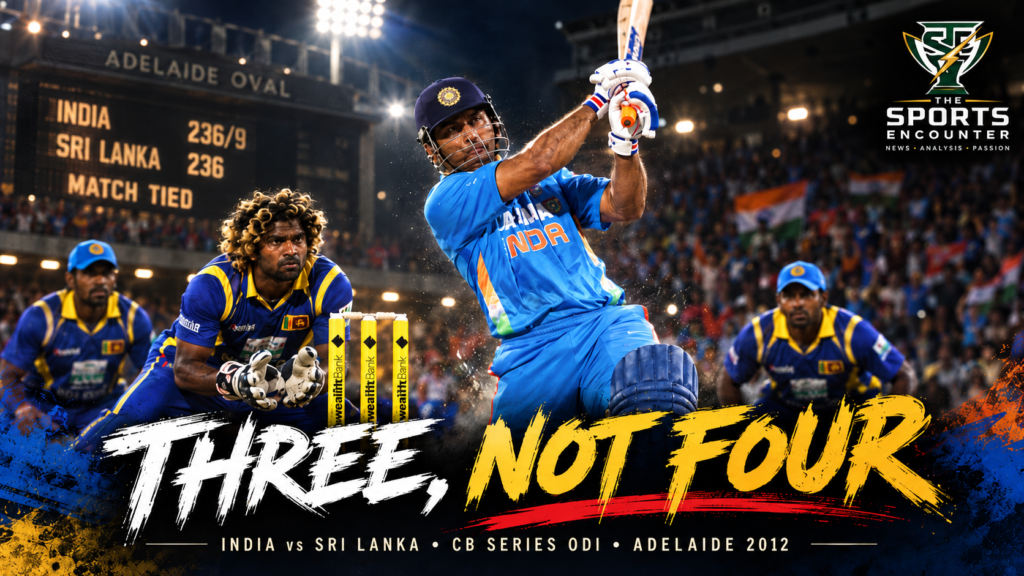
ADELAIDE, Australia, February 14, 2012: MS Dhoni needed one boundary from Lasith Malinga’s final delivery to secure another dramatic victory for India in the Commonwealth Bank Series. The Indian captain struck the ball toward extra cover, but the Sri Lankan fielders prevented it from reaching the rope. Dhoni and Umesh Yadav completed three runs, leaving India on 236 for 9 after 50 overs, exactly matching Sri Lanka’s total at Adelaide Oval. The fifth match of the triangular ODI series ended in a tie.
Sri Lanka had recovered from 79 for 3 through Dinesh Chandimal’s 81 and Mahela Jayawardene’s 43 before India’s bowlers restricted them to 236 for 9. Gautam Gambhir then anchored India’s reply with 91, while Dhoni contributed an unbeaten 58. Yet four Indian run-outs, crucial wickets from Lasith Malinga and Thisara Perera, and disciplined bowling from Rangana Herath ensured the chase remained unsettled until the final delivery. Dhoni was named Player of the Match, but neither captain could claim victory.
The extraordinary finish came just two days after Dhoni had guided India to a last-over victory against Australia at the same venue.
He almost repeated the feat against Sri Lanka.
For much of India’s innings, however, another batter had appeared capable of finishing the job.
Gambhir played a commanding innings while wickets fell at the other end. His dismissal for 91 forced Dhoni to manage the lower order, and successive run-outs placed India under increasingly severe pressure.
By the final over, the difference between victory and defeat had narrowed to a handful of deliveries.
The match earns its place as Episode 57 in The Sports Encounter’s A Celebration of 5000 ODIs, a collection examining the remarkable recoveries, individual performances and unexpected finishes that have defined the format.
The game also provided a fascinating contrast between two established cricketing rivals: Sri Lanka possessed enough discipline to prevent India from winning, while India showed enough resilience to avoid defeat.
India vs Sri Lanka 2012 Commonwealth Bank Series: Match Summary
| Match detail | Information |
|---|---|
| Tournament | Commonwealth Bank Series 2011–12 |
| Match | Fifth match, round-robin stage |
| Date | February 14, 2012 |
| Venue | Adelaide Oval, Adelaide, Australia |
| Toss | Sri Lanka won and elected to bat |
| Sri Lanka | 236/9 in 50 overs |
| India | 236/9 in 50 overs |
| Result | Match tied |
| Points | Two points each |
| Player of the Match | MS Dhoni |
| Sri Lanka’s leading scorer | Dinesh Chandimal, 81 |
| India’s leading scorer | Gautam Gambhir, 91 |
| Dhoni’s contribution | 58 not out |
| India’s best bowling | Vinay Kumar, 3/46 |
| Sri Lanka’s best bowling | Lasith Malinga, 2/53 |
| Final delivery | Three runs from Malinga’s bowling |
| Decisive outcome | Neither team scored the winning run |
Dinesh Chandimal’s 81 Rescues Sri Lanka From Early Trouble
Dinesh Chandimal produced the most important batting contribution in Sri Lanka’s innings.
The young right-hander scored 81 from 91 deliveries, striking six fours and one six.
His innings came after India’s opening bowlers had immediately disrupted Sri Lanka’s plans.
Upul Tharanga departed without scoring, caught behind by Dhoni off Vinay Kumar from the second delivery.
Tillakaratne Dilshan then scored 16 before Irfan Pathan removed him.
Sri Lanka were 28 for 2 in the eighth over.
Kumar Sangakkara and Chandimal began rebuilding, adding 51 runs for the third wicket.
Sangakkara’s 31 from 56 balls provided stability, but his dismissal to Ravichandran Ashwin left Sri Lanka 79 for 3.
Chandimal now faced the responsibility of carrying the innings.
He responded by establishing a substantial partnership with captain Mahela Jayawardene.
The pair added 94 runs for the fourth wicket, moving Sri Lanka from 79 for 3 to 173 for 4.
That recovery was essential because Sri Lanka’s top order had failed to establish a meaningful foundation.
Chandimal’s scoring rate was particularly valuable.
His strike rate of 89.01 allowed Sri Lanka to maintain momentum while Jayawardene provided support.
However, the partnership ended at a critical stage.
Jayawardene was trapped lbw by Vinay Kumar for 43.
Chandimal followed shortly afterward, run out for 81.
Sri Lanka had reached 178 for 5, but their two established batters were gone.
The dismissals prevented the visitors from building toward a total substantially higher than 236.
Chandimal nevertheless deserved recognition for transforming an early crisis into a competitive innings.
Mahela Jayawardene’s 43 Establishes Sri Lanka’s Best Partnership
Mahela Jayawardene played an important supporting role.
The Sri Lankan captain scored 43 from 49 deliveries, striking two boundaries.
His partnership with Chandimal was the most productive of the innings.
The pair combined patience with effective strike rotation, ensuring Sri Lanka did not lose further wickets immediately after Sangakkara’s dismissal.
Jayawardene’s contribution was especially valuable because Sri Lanka had already lost three wickets for 79.
Another dismissal could have exposed the lower middle order far too early.
Instead, the captain helped Chandimal establish control.
Sri Lanka reached 173 before the partnership was broken.
Jayawardene’s dismissal came when India needed wickets to prevent a major acceleration during the final 15 overs.
Vinay Kumar trapped him lbw.
The wicket changed the innings because Chandimal was also dismissed soon afterward.
Sri Lanka suddenly needed new batters to rebuild rather than attack freely.
This interruption became one of the decisive reasons the visitors finished with 236 rather than a total approaching 270.
Vinay Kumar’s 3 for 46 Prevents Sri Lanka From Finishing Stronger
Vinay Kumar was India’s most successful bowler.
He returned 3 for 46 from ten overs, including one maiden.
His spell produced important breakthroughs at different stages.
He removed Tharanga for a duck, preventing Sri Lanka from establishing an opening partnership.
He later trapped Jayawardene lbw for 43, ending the major fourth-wicket recovery.
Vinay also dismissed Nuwan Kulasekara for 12 during the closing overs.
That final wicket was valuable because Sri Lanka’s lower order was attempting to add runs to a competitive but modest total.
Vinay’s economy rate of 4.60 reflected a controlled performance.
On a pitch where disciplined bowling made scoring difficult, his ability to combine wickets with reasonable economy helped India restrict Sri Lanka.
He also benefited from support from the spin attack.
Ashwin’s outstanding spell was another major reason Sri Lanka could not fully exploit Chandimal’s innings.
Ravichandran Ashwin’s 2 for 30 Keeps Sri Lanka Under Pressure
Ravichandran Ashwin produced India’s most economical substantial spell.
He completed ten overs with one maiden, conceding only 30 runs and taking two wickets.
His economy rate was exactly three runs per over.
Ashwin dismissed Sangakkara for 31, breaking the 51-run third-wicket partnership.
He later removed Thisara Perera for five, with Virat Kohli taking the catch.
Those breakthroughs arrived at important moments.
Sangakkara’s dismissal brought Jayawardene into the middle with Sri Lanka still rebuilding.
Perera’s departure denied the visitors a potentially dangerous late-innings hitter.
Ashwin’s spell demonstrates why economy can be as influential as wickets in a relatively low-scoring ODI.
He conceded only 30 runs from 60 legal deliveries.
That restricted Sri Lanka’s ability to increase its scoring rate while Chandimal and Jayawardene were attempting to establish control.
The contrast with Ravindra Jadeja’s spell was significant.
Jadeja conceded 58 runs without taking a wicket, while Ashwin maintained far tighter control.
India therefore relied heavily on Ashwin to limit the damage during the middle overs.
Sachithra Senanayake’s Late 22 Gives Sri Lanka Something to Defend
Sri Lanka’s lower order struggled after the dismissals of Jayawardene and Chandimal.
Angelo Mathews scored 17 from 30 deliveries.
Perera managed five.
Kulasekara contributed 12 from 25 balls.
The lack of sustained acceleration threatened to leave Sri Lanka with an inadequate total.
Sachithra Senanayake then produced an important late contribution.
He scored an unbeaten 22 from only 14 deliveries, including three boundaries.
His strike rate of 157.14 was the highest among Sri Lanka’s batters who faced more than one ball.
The innings was brief but valuable.
Sri Lanka had slipped to 210 for 7 before Senanayake’s late intervention helped lift the total.
He remained unbeaten alongside Rangana Herath as the visitors completed their 50 overs on 236 for 9.
At the time, India’s batting lineup appeared capable of chasing the target.
However, Sri Lanka’s bowlers subsequently demonstrated that the runs were sufficient to create a contest lasting until the final delivery.
Gautam Gambhir’s 91 Gives India Control of the Chase
Gautam Gambhir produced India’s highest individual score.
The left-handed opener made 91 from 106 deliveries, including six boundaries.
His innings was built around patience and careful scoring.
India’s pursuit had begun with a relatively modest target of 237.
However, early wickets threatened to interrupt the chase.
Sachin Tendulkar scored 15 before Kulasekara dismissed him, leaving India 24 for 1.
Virat Kohli contributed another 15 before falling lbw to Perera.
India were 61 for 2.
Rohit Sharma then added 15, but his run-out reduced the score to 94 for 3.
Suresh Raina made only eight before Malinga dismissed him.
India had slipped to 118 for 4.
Gambhir remained the central figure.
He continued accumulating runs while partners failed to establish substantial contributions.
His method was appropriate for the target.
India did not need spectacular boundary hitting.
It needed wickets in hand and enough scoring momentum to avoid a demanding final-over equation.
Gambhir therefore concentrated on occupying the crease, rotating the strike and punishing loose deliveries.
His innings appeared to be guiding India toward a controlled victory.
Gambhir’s 60-Run Partnership With Dhoni Restores India’s Advantage
MS Dhoni joined Gambhir with India struggling at 118 for 4.
The pair added 60 runs for the fifth wicket.
Their partnership moved India to 178 for 5.
India now needed only 59 runs to win.
With Gambhir and Dhoni at the crease, the chase appeared firmly under control.
However, the partnership ended through a costly run-out.
Gambhir departed for 91.
His dismissal exposed India’s lower order and left Dhoni responsible for completing the chase.
It became one of the most important turning points.
Gambhir had already done enough to place India in a favorable position.
But his failure to remain until the finish allowed Sri Lanka to regain control.
MS Dhoni’s Unbeaten 58 Almost Produces Another Last-Over Victory
MS Dhoni was once again required to finish a difficult ODI chase.
The Indian captain scored an unbeaten 58 from 69 deliveries, striking three fours and one six.
He entered when India were 118 for 4 and initially focused on rebuilding alongside Gambhir.
After Gambhir’s dismissal, the responsibility changed.
Dhoni needed to manage the remaining batters, protect his own wicket and keep India within reach of the target.
Ravindra Jadeja contributed only three before falling to Perera.
Ashwin scored 14 from 13 deliveries, helping Dhoni reduce the requirement.
Irfan Pathan then struck eight from five balls, including a six.
However, India continued losing wickets.
Ashwin was caught off Malinga.
Pathan was run out.
Vinay Kumar was also run out, leaving India 233 for 9.
The final wicket could not afford to fall.
Dhoni remained at the crease, with Umesh Yadav at the other end.
Why Dhoni’s 58 Deserved the Player of the Match Award
Dhoni’s innings was significant because it kept India in contention despite the loss of five wickets after his arrival.
He managed the lower order carefully enough to bring India within one boundary of victory.
He also contributed two catches during Sri Lanka’s innings.
His performance followed another successful chase against Australia at Adelaide on February 12, when he had scored an unbeaten 44.
That recent result added context to the final delivery against Sri Lanka.
Dhoni had demonstrated his ability to finish a match under pressure.
At Adelaide two days later, he came extraordinarily close to repeating the achievement.
He ultimately secured a tie rather than a win.
The ICC named him Player of the Match for his unbeaten half-century and wicketkeeping contribution.
Lasith Malinga’s Final Over Denies India the Winning Run
Lasith Malinga was Sri Lanka’s principal fast-bowling threat.
He completed ten overs with one maiden, conceding 53 runs and claiming two wickets.
His dismissals included Raina and Ashwin.
Both were important because they prevented India from establishing stability during the middle and closing overs.
However, Malinga’s greatest responsibility came in the final over.
India needed enough runs to complete a chase that had already experienced several reversals.
Dhoni remained unbeaten, but the lower order had been severely depleted.
Malinga’s task was to prevent the Indian captain from finding the boundary that would settle the match.
The pressure intensified with India losing Vinay Kumar, its ninth wicket, at 233.
Dhoni faced the final delivery with India requiring four runs for victory.
A boundary would win the contest.
Three runs would produce a tie.
Malinga delivered.
Dhoni struck the ball high toward extra cover.
The ball threatened to reach the boundary, but Sri Lanka’s fielders stopped it.
Dhoni and Umesh Yadav ran three.
India finished at 236 for 9.
Sri Lanka had scored 236 for 9.
The result was a tie.
Malinga had prevented the winning boundary, but India had survived without losing its final wicket.
That balance made the finish extraordinary.
Thisara Perera’s Two Wickets Repeatedly Interrupt India’s Chase
Thisara Perera played a valuable supporting role.
He claimed 2 for 45 from nine overs.
His wickets included Kohli and Jadeja.
Kohli had contributed 15 before Perera trapped him lbw, reducing India to 61 for 2.
Jadeja later departed for three after Gambhir’s dismissal.
That wicket was particularly valuable because India had reached 178 for 5 and needed only 59 runs.
Removing Jadeja reduced the number of batters capable of supporting Dhoni during the closing overs.
Perera’s performance demonstrated that Sri Lanka’s defense depended on more than Malinga’s pace.
Kulasekara’s disciplined 1 for 39 from ten overs was equally valuable.
Rangana Herath conceded only 33 from ten overs, including one maiden.
Sri Lanka’s combination of controlled bowling and timely wickets prevented India’s chase from becoming comfortable.
The pressure also contributed to the run-out opportunities that eventually transformed the match.
Four Indian Run-Outs Become Sri Lanka’s Hidden Advantage
Perhaps the most revealing statistic from the Indian innings is the number of run-outs.
Four Indian batters were dismissed through run-outs:
Rohit Sharma, Gambhir, Pathan and Vinay Kumar.
Those dismissals accounted for almost half of India’s lost wickets.
They were particularly damaging because Sri Lanka’s bowlers were defending a relatively modest total.
Every additional wicket forced India to reconsider its approach.
Gambhir’s dismissal was the most consequential because he had scored 91 and appeared capable of finishing the chase alongside Dhoni.
The later run-outs of Pathan and Vinay exposed India’s final batting resources.
The contrast with Sri Lanka’s innings is interesting.
Sri Lanka also lost three batters through run-outs, including Chandimal.
Both teams therefore suffered from mistakes or pressure while running between the wickets.
Across the two innings, seven batters were run out.
That is a striking figure for a match that ended with both teams scoring exactly the same total.
It also explains why the contest remained so unpredictable.
The bowling attacks produced important dismissals, but fielding and running decisions repeatedly altered the balance.
Four Turning Points That Decided the Adelaide Tie
1. Chandimal and Jayawardene Rescue Sri Lanka From 79 for 3
Sri Lanka lost three wickets before reaching 80.
Chandimal and Jayawardene then added 94 runs for the fourth wicket.
The partnership ensured the visitors would establish a competitive total.
However, both departed within five runs of one another, preventing a more substantial score.
2. Ashwin’s Economical Spell Restricts Sri Lanka to 236
Ashwin took two wickets while conceding only 30 runs from ten overs.
His spell restricted Sri Lanka’s scoring rate during the middle overs.
Alongside Vinay Kumar’s three wickets, the performance helped India prevent Chandimal’s innings from producing a target above 250.
3. Gambhir’s Run-Out at 178 Reopens India’s Chase
Gambhir’s 91 had established India’s advantage.
When he departed, India still needed 59 runs but had only five wickets remaining.
Sri Lanka then dismissed Jadeja, Ashwin, Pathan and Vinay.
The lower-order collapse forced Dhoni to assume responsibility for the final runs.
4. Dhoni Scores Three From Malinga’s Final Delivery
India needed four from the final ball.
Dhoni hit toward extra cover, but the boundary was prevented.
The batters completed three runs.
The scores finished level, producing a tie after 100 overs of cricket.
Why India Failed to Win Despite Restricting Sri Lanka to 236
India’s bowling had established a favorable position.
Sri Lanka scored only 236 from its 50 overs.
Vinay and Ashwin took five wickets between them, while Pathan’s early dismissal of Dilshan kept the opposition under pressure.
Gambhir then provided an innings of exceptional stability.
India reached 178 for 4, leaving 59 runs to win with six wickets available.
The main problem was the inability to preserve batting resources during the closing stages.
Gambhir’s run-out removed the principal established batter.
Jadeja managed three.
Ashwin briefly supported Dhoni but was dismissed for 14.
Pathan’s aggressive cameo ended in another run-out.
Vinay’s dismissal then left India nine wickets down.
The hosts had repeatedly allowed Sri Lanka to regain momentum through wickets.
Dhoni’s unbeaten 58 prevented defeat, but India had lost too many partners for the chase to remain straightforward.
The analysis reveals that India’s biggest weakness was running between the wickets under pressure.
Four run-outs in an innings requiring only 237 significantly increased the difficulty of completing the chase.
Why Sri Lanka Could Not Win Despite India’s Late Collapse
Sri Lanka also had opportunities to secure victory.
Chandimal’s 81 and Jayawardene’s 43 had given the team a substantial recovery.
However, losing both established batters in quick succession reduced the possibility of a larger total.
The visitors eventually finished with 236.
That was competitive but left little margin for bowling errors.
Sri Lanka’s bowlers responded admirably.
Malinga took two wickets.
Perera claimed two.
Kulasekara and Herath maintained controlled economy rates.
The team’s fielding also contributed through four Indian run-outs.
Nevertheless, Dhoni remained unbeaten.
Sri Lanka were unable to dismiss the one batter capable of managing the lower order and completing the chase.
India reached the final delivery still able to win with a boundary.
Malinga prevented that boundary, but Sri Lanka could not stop the batters from completing three runs.
The result accurately reflected a contest in which both teams repeatedly gained and surrendered advantages.
How the Tie Changed the Commonwealth Bank Series Standings
The Adelaide encounter formed part of the triangular Commonwealth Bank Series involving India, Sri Lanka and Australia.
India had entered the match following a victory against Australia at Adelaide two days earlier.
That result had strengthened its position in the standings.
The tie against Sri Lanka earned both teams two points.
India moved to the top of the table at that stage, while Sri Lanka continued searching for its first victory in the tournament.
The outcome was particularly frustrating for Sri Lanka because its bowlers had forced India into a difficult final-over position.
For India, the tie represented a missed opportunity to consolidate its position with another victory.
The tournament’s subsequent matches would determine which two teams advanced to the best-of-three finals.
Australia and Sri Lanka ultimately reached the championship series, with Australia winning it 2-1.
India failed to qualify.
The Adelaide tie therefore became part of a broader campaign in which India repeatedly experienced difficult matches and failed to secure sufficient victories.
Why Match 57 Belongs in A Celebration of 5000 ODIs
The 2012 Commonwealth Bank Series encounter deserves inclusion because of its unusual combination of individual performances, fielding errors and a last-ball finish.
Chandimal rescued Sri Lanka with 81.
Jayawardene contributed 43 during a crucial partnership.
Ashwin and Vinay restricted the total to 236.
Gambhir responded with 91, placing India in a favorable position.
Dhoni then scored an unbeaten 58 after the middle order lost wickets.
Seven batters were run out across both innings.
The final delivery produced three runs when India required four to win.
The result was a tie.
The contest also provides an intriguing comparison with Match 54, when England and Australia finished level at 196 in the 2005 NatWest Series final.
In that match, England managed two leg-byes from the final delivery to tie Australia’s total.
Seven years later, India completed three runs from Malinga’s final ball to reach the same outcome against Sri Lanka.
Both contests demonstrated how a single boundary prevented in the field could determine whether a team won or shared the result.
Match 57 also connects naturally with the previous episode covering Virat Kohli’s 183 against Pakistan in the 2012 Asia Cup.
Those matches produced contrasting images of India’s ODI batting during the same year.
Against Sri Lanka at Adelaide, the team struggled to complete a chase of 237.
Against Pakistan at Mirpur, Kohli subsequently led India to 330 for 4, completing a remarkable pursuit with 13 deliveries remaining.
The comparison underlines the unpredictable nature of ODI cricket.
A formidable batting lineup can struggle against a modest target when wickets and running errors accumulate. The same lineup can chase more than 300 when major partnerships develop and the scoring rate remains under control.
For Sri Lanka, Adelaide remains an example of disciplined bowling and fielding rescuing a relatively modest total.
For India, it is remembered for Dhoni’s composure and the winning run that remained tantalizingly out of reach.
After 100 overs, the teams had scored precisely the same number of runs.
That remarkable equality makes the match a deserving entry in The Sports Encounter’s A Celebration of 5000 ODIs.
5. Complete Match Scorecard
Sri Lanka Innings: 236/9 in 50 Overs
| Batter | Dismissal | R | B | 4s | 6s | SR |
|---|---|---|---|---|---|---|
| Upul Tharanga | c Dhoni b Vinay Kumar | 0 | 2 | 0 | 0 | 0.00 |
| Tillakaratne Dilshan | c Dhoni b Irfan Pathan | 16 | 23 | 1 | 1 | 69.57 |
| Kumar Sangakkara (wk) | c Gambhir b Ashwin | 31 | 56 | 2 | 0 | 55.36 |
| Dinesh Chandimal | Run out (Rohit Sharma/Dhoni) | 81 | 91 | 6 | 1 | 89.01 |
| Mahela Jayawardene (c) | lbw b Vinay Kumar | 43 | 49 | 2 | 0 | 87.76 |
| Angelo Mathews | Run out (Dhoni) | 17 | 30 | 1 | 0 | 56.67 |
| Thisara Perera | c Kohli b Ashwin | 5 | 9 | 0 | 0 | 55.56 |
| Nuwan Kulasekara | c Gambhir b Vinay Kumar | 12 | 25 | 0 | 0 | 48.00 |
| Sachithra Senanayake | Not out | 22 | 14 | 3 | 0 | 157.14 |
| Lasith Malinga | Run out (Raina/Dhoni) | 0 | 0 | 0 | 0 | N/A |
| Rangana Herath | Not out | 1 | 1 | 0 | 0 | 100.00 |
| Extras | 3 leg-byes, 5 wides | 8 | ||||
| Total | 9 wickets, 50 overs | 236 |
Fall of wickets: 0/1 (Tharanga), 28/2 (Dilshan), 79/3 (Sangakkara), 173/4 (Jayawardene), 178/5 (Chandimal), 184/6 (Perera), 210/7 (Mathews), 232/8 (Kulasekara), 235/9 (Malinga).
India Bowling
| Bowler | O | M | R | W | Econ |
|---|---|---|---|---|---|
| Vinay Kumar | 10 | 1 | 46 | 3 | 4.60 |
| Irfan Pathan | 9 | 0 | 38 | 1 | 4.22 |
| Umesh Yadav | 9 | 0 | 51 | 0 | 5.67 |
| Ravichandran Ashwin | 10 | 1 | 30 | 2 | 3.00 |
| Ravindra Jadeja | 10 | 0 | 58 | 0 | 5.80 |
| Rohit Sharma | 2 | 0 | 10 | 0 | 5.00 |
India Innings: 236/9 in 50 Overs
| Batter | Dismissal | R | B | 4s | 6s | SR |
|---|---|---|---|---|---|---|
| Gautam Gambhir | Run out (Kulasekara) | 91 | 106 | 6 | 0 | 85.85 |
| Sachin Tendulkar | c Sangakkara b Kulasekara | 15 | 24 | 2 | 0 | 62.50 |
| Virat Kohli | lbw b Perera | 15 | 25 | 1 | 0 | 60.00 |
| Rohit Sharma | Run out (Jayawardene) | 15 | 27 | 2 | 0 | 55.56 |
| Suresh Raina | c Sangakkara b Malinga | 8 | 19 | 0 | 0 | 42.11 |
| MS Dhoni (c, wk) | Not out | 58 | 69 | 3 | 1 | 84.06 |
| Ravindra Jadeja | c Jayawardene b Perera | 3 | 10 | 0 | 0 | 30.00 |
| Ravichandran Ashwin | c Senanayake b Malinga | 14 | 13 | 1 | 0 | 107.69 |
| Irfan Pathan | Run out (Mathews) | 8 | 5 | 0 | 1 | 160.00 |
| Vinay Kumar | Run out (Mathews) | 1 | 2 | 0 | 0 | 50.00 |
| Umesh Yadav | Not out | 0 | 0 | 0 | 0 | N/A |
| Extras | 1 lb, 6 wides, 1 no-ball | 8 | ||||
| Total | 9 wickets, 50 overs | 236 |
Fall of wickets: 24/1 (Tendulkar), 61/2 (Kohli), 94/3 (Rohit Sharma), 118/4 (Raina), 178/5 (Gambhir), 184/6 (Jadeja), 212/7 (Ashwin), 223/8 (Pathan), 233/9 (Vinay Kumar).
Sri Lanka Bowling
| Bowler | O | M | R | W | Econ |
|---|---|---|---|---|---|
| Lasith Malinga | 10 | 1 | 53 | 2 | 5.30 |
| Nuwan Kulasekara | 10 | 0 | 39 | 1 | 3.90 |
| Angelo Mathews | 5 | 0 | 35 | 0 | 7.00 |
| Thisara Perera | 9 | 0 | 45 | 2 | 5.00 |
| Rangana Herath | 10 | 1 | 33 | 0 | 3.30 |
| Sachithra Senanayake | 6 | 0 | 30 | 0 | 5.00 |
Final Delivery: Four Required, Three Scored
| Situation | Detail |
|---|---|
| India before final ball | 233/9 |
| Required for victory | 4 runs |
| Bowler | Lasith Malinga |
| Striker | MS Dhoni |
| Non-striker | Umesh Yadav |
| Shot | Toward extra cover |
| Runs completed | 3 |
| India after final ball | 236/9 |
| Sri Lanka total | 236/9 |
| Result | Tie |
Player of the Match: MS Dhoni, 58 not out from 69 deliveries and two wicketkeeping catches.
Result: India and Sri Lanka tied, both scoring 236 for 9 from 50 overs.Scorecard figures cross-checked against historical innings records. The ICC’s contemporary account independently confirms the last-ball three, the match result and Dhoni’s Player of the Match award.
cricketweb.net
+1
6. Frequently Asked Questions
Who won the India vs Sri Lanka ODI at Adelaide in 2012?
Neither team won. The Commonwealth Bank Series match on February 14, 2012, ended in a tie after both India and Sri Lanka scored 236 for 9 from 50 overs.
How many runs did MS Dhoni score?
Dhoni scored an unbeaten 58 from 69 deliveries, including three fours and one six.
Who was Player of the Match?
MS Dhoni received the award for his unbeaten 58 and two wicketkeeping catches.
What happened on the final ball?
India needed four runs to win. Dhoni struck Lasith Malinga toward extra cover, but the ball was stopped before reaching the boundary. The batters completed three runs, tying the scores.
Who was India’s highest scorer?
Gautam Gambhir scored 91 from 106 deliveries, including six boundaries.
Who scored the most runs for Sri Lanka?
Dinesh Chandimal scored 81 from 91 deliveries, including six fours and one six.
Who took the most wickets for India?
Vinay Kumar claimed three wickets for 46 runs from ten overs.
How many batters were run out?
Seven across both innings: three Sri Lankan batters and four Indian batters.
Did the match go to a Super Over?
No. The match was recorded as a tie, with both teams receiving two competition points.
Who won the 2012 Commonwealth Bank Series?
Australia defeated Sri Lanka 2-1 in the best-of-three finals. India did not qualify for the final stage.