


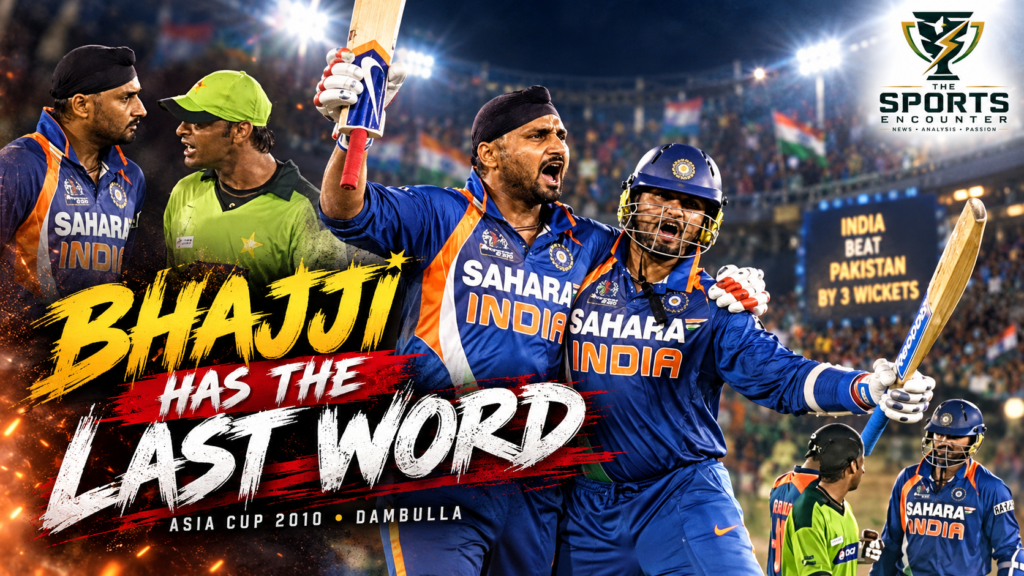
DAMBULLA, Sri Lanka, June 19, 2010: Harbhajan Singh had already exchanged heated words with Shoaib Akhtar when India’s chase of 268 against Pakistan reached its final over in the Asia Cup. Seven runs were still required, only three wickets remained, and Mohammad Amir had the ball. Harbhajan, batting at No. 8, settled the argument with his bat, launching Amir for six over midwicket with one delivery remaining to complete a dramatic three-wicket victory at Rangiri Dambulla International Stadium.
The winning shot capped a contest shaped by Gautam Gambhir’s 83, MS Dhoni’s 56, Suresh Raina’s attacking 34 and Pakistan spinner Saeed Ajmal’s three wickets. Salman Butt had earlier scored 74 and Kamran Akmal 51 to carry Pakistan to 267, but India’s bowlers prevented them from batting out the full 50 overs. The result strengthened India’s path toward the Asia Cup final and produced one of the rivalry’s most memorable conclusions, with a bowler better known for taking wickets supplying the decisive boundary.
The scorecard records a three-wicket win.
It cannot fully convey the frustration, confrontation and changing momentum that preceded Harbhajan’s final shot.
Pakistan had opportunities to seize control during both innings. India, meanwhile, repeatedly recovered through partnerships before losing wickets at moments when victory appeared increasingly comfortable.
By the final over, the contest had become a battle of nerves.
That combination makes the Dambulla encounter Match 55 in The Sports Encounter’s A Celebration of 5000 ODIs.
The match earns its place because the decisive moment belonged to an unlikely finisher, and because the rivalry’s emotional intensity had a direct connection to the closing stages.
India vs Pakistan, 2010 Asia Cup: Match Summary
| Match detail | Information |
|---|---|
| Competition | 2010 Asia Cup |
| Match | India vs Pakistan, fourth tournament match |
| Date | June 19, 2010 |
| Venue | Rangiri Dambulla International Stadium |
| Location | Dambulla, Sri Lanka |
| Toss | Pakistan won and elected to bat |
| Pakistan | 267 all out, 49.3 overs |
| India | 271/7, 49.5 overs |
| Result | India won by three wickets |
| Balls remaining | 1 |
| Player of the Match | Gautam Gambhir |
| India’s leading scorer | Gautam Gambhir, 83 |
| Pakistan’s leading scorer | Salman Butt, 74 |
| Best bowling figures | Saeed Ajmal, 3/56 |
| India’s best bowling | Praveen Kumar, 3/53 |
| Decisive shot | Harbhajan Singh’s six off Mohammad Amir |
Salman Butt’s 74 Gives Pakistan the Start They Needed
Pakistan elected to bat and initially built its innings around the controlled strokeplay of Salman Butt.
Butt scored 74 from 85 deliveries, striking nine boundaries.
His ability to rotate the strike and capitalize on loose deliveries ensured Pakistan made progress without taking excessive risks.
Opening partner Imran Farhat contributed 25 from 46 balls.
The pair added 71 runs before Harbhajan dismissed Farhat in the 17th over.
Pakistan had established a platform but needed one of the incoming batters to convert it into a substantial total.
Shoaib Malik provided that support.
He scored 39 from 46 balls, helping Butt establish another productive partnership.
Together, they added 73 runs for the second wicket.
Pakistan reached 144 for 2 after 29 overs, with enough wickets available to attack the final 20 overs.
However, the innings began to change rapidly.
Zaheer Khan bowled Malik, and Butt was run out shortly afterward.
Pakistan had lost two important batters within six deliveries.
The score was 146 for 3.
The dismissals disrupted a position from which Pakistan might have anticipated a total approaching 300.
Butt’s innings had established the foundation, but the middle order now needed to preserve it.
Shoaib Malik’s 39 Helps Pakistan Build, but the Double Blow Changes the Innings
Shoaib Malik’s 39 was valuable because it enabled Pakistan to maintain a controlled scoring rate during the middle overs.
He supported Butt without attempting to dominate the innings.
Their partnership appeared to be establishing Pakistan’s authority.
However, Malik was bowled by Zaheer on the final ball of the 29th over.
Butt followed in the next over, run out for 74.
Those dismissals changed India’s bowling strategy.
The Indian bowlers could attack new batters rather than continue operating against a settled partnership.
Harbhajan subsequently removed Umar Amin for five, while Ravindra Jadeja dismissed Umar Akmal for 21.
Pakistan were 196 for 5 in the 38th over.
The team had established a platform but failed to convert it into a dominant position.
That failure would later prove significant when India’s chase reached the final over.
Shahid Afridi’s 32 Injects Urgency Into Pakistan’s Innings
Pakistan captain Shahid Afridi attempted to restore momentum after the middle-order dismissals.
Afridi scored 32 from 25 balls, including two fours and a six.
His strike rate of 128 reflected the need for acceleration.
He was particularly important because Pakistan’s run rate had been constrained by India’s bowlers during the middle overs.
Afridi’s aggressive approach allowed the innings to regain momentum.
He was eventually trapped lbw by Praveen Kumar in the 44th over.
Pakistan had reached 219 for 6.
With more than six overs remaining, the team still had an opportunity to score substantially beyond 260.
That task fell largely to Kamran Akmal.
Kamran Akmal’s 51 Gives Pakistan a Competitive Total
Kamran Akmal produced Pakistan’s most aggressive substantial innings.
The wicketkeeper scored 51 from 41 deliveries, striking two boundaries and three sixes.
His innings was particularly important because Pakistan had lost both established batters and several middle-order wickets during the previous overs.
Kamran’s attacking strokes prevented India from completely controlling the closing stages.
He took advantage of scoring opportunities and helped Pakistan move beyond 250.
However, the support around him disappeared.
Abdul Razzaq managed three, while Mohammad Amir was run out for three.
Praveen Kumar eventually dismissed Kamran for 51 in the 49th over.
Pakistan were 265 for 9.
Saeed Ajmal became the final wicket when Zaheer had him caught by Ashish Nehra.
Pakistan finished on 267 after 49.3 overs.
Kamran’s innings ensured India would face a demanding target on a surface where run-scoring required patience.
Nevertheless, Pakistan had failed to bat out its allocation.
The final three deliveries went unused.
Those deliveries cannot be directly equated with the eventual one-ball margin, since the two innings followed different scoring patterns. They nevertheless illustrate Pakistan’s inability to make full use of the resources available during the final overs.
Praveen Kumar’s Three Wickets Prevent Pakistan From Finishing Stronger
Praveen Kumar was India’s leading wicket-taker.
He finished with 3 for 53 from ten overs, including one maiden.
His dismissals were particularly valuable during the closing phase.
Praveen removed Afridi for 32, Razzaq for three and Kamran for 51.
All three wickets interrupted Pakistan’s attempts to accelerate.
The dismissals of Afridi and Kamran were especially important because both had demonstrated the ability to clear the boundary.
Praveen’s contribution was less about dominating the innings from the opening overs and more about preventing Pakistan from maximizing its strong positions.
His wickets restricted the scope for a final assault.
That intervention became significant when India completed the chase with only one delivery remaining.
Harbhajan Singh’s Two Wickets Set Up His Later Batting Heroics
Harbhajan contributed throughout the match.
With the ball, he finished with 2 for 47 from eight overs.
He dismissed Farhat, breaking Pakistan’s opening partnership, before removing Umar Amin for five.
Neither wicket represented the most dramatic moment of the innings, but both helped India interrupt Pakistan’s progress.
Harbhajan also conceded fewer than six runs per over.
His eventual batting contribution would attract far greater attention, yet his bowling had already influenced the target India needed to chase.
Zaheer added 2 for 41 from 9.3 overs, while Jadeja took 1 for 43.
India’s bowlers combined to dismiss Pakistan before the completion of its 50 overs.
That collective performance ensured the target remained 268 rather than something substantially larger.
Gautam Gambhir’s 83 Turns India’s Difficult Chase Into a Winnable Contest
India’s pursuit began cautiously.
Virender Sehwag struggled to establish momentum, scoring ten from 32 balls.
Abdul Razzaq dismissed him in the 11th over, leaving India 47 for 1.
Virat Kohli then made 18 before Ajmal bowled him.
India were 82 for 2 after 17.4 overs.
The required run rate remained manageable, but the chase depended on a substantial partnership.
Gautam Gambhir and captain MS Dhoni supplied it.
Gambhir produced India’s leading innings, scoring 83 from 97 deliveries.
His contribution included six fours and one six.
Unlike the spectacular finish that eventually decided the match, Gambhir’s innings was based on controlled accumulation.
He defended when necessary, rotated the strike and punished scoring opportunities without exposing India to unnecessary risks.
His experience became especially valuable against Pakistan’s varied bowling attack.
Shoaib Akhtar offered pace, Mohammad Amir provided left-arm seam, while Afridi and Ajmal presented different spin challenges.
Gambhir’s judgment helped India maintain a competitive position.
His 83 formed the foundation of the chase and earned him the Player of the Match award.
But his innings also included one of the most heated confrontations of the afternoon.
Gambhir and Kamran Akmal’s Argument Adds Heat to the Rivalry
Gambhir and Pakistan wicketkeeper Kamran Akmal became involved in a heated exchange during India’s chase.
The confrontation reflected the emotional intensity of the fixture.
Both teams were already operating under considerable pressure, and the contest became increasingly confrontational.
The incident did not directly determine the result.
However, it demonstrated how difficult it was for both teams to maintain composure as the match tightened.
Pakistan needed wickets.
India needed stability.
Gambhir’s subsequent dismissal would bring Pakistan back into contention.
MS Dhoni’s 56 Provides the Partnership India Desperately Needs
MS Dhoni joined Gambhir with India at 82 for 2.
The captain played a controlled innings of 56 from 71 deliveries, including two fours and one six.
His approach complemented Gambhir’s accumulation.
Together, they added 98 runs for the third wicket.
The partnership carried India to 180 for 3 in the 36th over.
At that stage, India needed 88 runs from more than 14 overs.
The required rate was comfortable, and the partnership had positioned India strongly.
However, Ajmal bowled Gambhir for 83.
The dismissal reopened the contest.
Rohit Sharma then contributed 22 from 24 deliveries, briefly maintaining India’s momentum.
Afridi eventually trapped Rohit lbw.
Dhoni followed shortly afterward, bowled by Malik for 56.
India had slipped from 180 for 3 to 210 for 5.
The chase was becoming significantly more difficult.
Although India’s required run rate remained achievable, the loss of established batters meant the remaining players would have to operate under considerable pressure.
Pakistan had regained an opportunity to win.
Suresh Raina’s 34 Brings India Within Striking Distance
Suresh Raina’s contribution proved almost as important as the more substantial innings from Gambhir and Dhoni.
Raina scored 34 from 27 balls, including two fours and two sixes.
His strike rate of 125.93 was particularly valuable as the chase approached its conclusion.
After India lost Dhoni at 210 for 5, the batting lineup needed somebody willing to maintain the required scoring rate.
Raina provided that aggression.
He found boundaries while India continued losing wickets at the other end.
Ravindra Jadeja was bowled by Ajmal for six, leaving India 219 for 6 in the 46th over.
Harbhajan then joined Raina.
With the match approaching its final overs, the two batters had very different responsibilities.
Raina was the established batter capable of accelerating.
Harbhajan needed to preserve his wicket and contribute whenever an opportunity appeared.
Their partnership added 43 runs and carried India to 262.
However, Raina was run out on the second delivery of the final over.
Pakistan had removed the batter most likely to complete the chase.
India still needed runs, and the pressure shifted almost entirely to Harbhajan.
Saeed Ajmal’s Three Wickets Nearly Steal the Match for Pakistan
Saeed Ajmal was Pakistan’s most successful bowler.
The off-spinner finished with 3 for 56 from ten overs.
His wickets included Kohli, Gambhir and Jadeja.
The dismissal of Gambhir was particularly significant because it ended India’s most productive batting partnership.
Gambhir and Dhoni had added 98, placing India in a strong position.
Ajmal’s breakthrough reopened the possibility of a Pakistan victory.
He later bowled Jadeja, exposing India’s lower order with more than four overs remaining.
Ajmal demonstrated the value of a spinner capable of taking wickets even when the opposition maintained a steady scoring rate.
His figures were not exceptionally economical, but his dismissals occurred at important stages.
Shahid Afridi also contributed effectively with the ball.
The Pakistan captain returned 1 for 41 from ten overs, including the wicket of Rohit.
Shoaib Malik took 1 for 28 from five overs, dismissing Dhoni.
Pakistan’s spinners claimed five of India’s seven wickets.
The figures illustrate why India struggled to convert a comfortable middle-over position into an early victory.
Shoaib Akhtar’s Confrontation With Harbhajan Singh Gives the Finish Added Bite
Shoaib Akhtar remained one of the most intimidating figures in Pakistan’s bowling attack.
Although he finished wicketless, conceding 57 from ten overs, his pace and aggression contributed to the match’s emotional intensity.
The confrontation with Harbhajan became one of the contest’s defining images.
As India’s chase moved toward the final over, the two exchanged heated words and gestures.
Akhtar’s aggressive approach was intended to challenge the lower-order batter, but Harbhajan refused to retreat from the exchange.
The confrontation has remained part of the rivalry’s folklore.
It is tempting to describe the subsequent winning six as Harbhajan taking personal revenge.
That would be too simplistic as an explanation of the result.
The decisive shot was played against Mohammad Amir, not Akhtar.
Nevertheless, the confrontation added an emotional dimension to an already tense chase.
Harbhajan had the opportunity to respond through his batting.
He eventually did so in the most decisive manner possible.
Harbhajan Singh’s Unbeaten 15 Settles the Match With One Ball Remaining
Harbhajan’s innings lasted only 11 deliveries.
He scored 15 not out, striking two sixes.
The second decided the match.
India entered the final over requiring seven runs.
Amir was entrusted with defending Pakistan’s total.
Raina was run out on the second delivery, leaving India 262 for 7.
The run-out threatened to turn the match toward Pakistan once again.
Praveen Kumar joined Harbhajan and helped ensure the strike could return to the more established lower-order batter.
By the time Harbhajan faced the fifth delivery, India needed only three runs to win.
Amir delivered, and Harbhajan struck a powerful six over midwicket.
India reached 271 for 7 after 49.5 overs.
The three-wicket victory was complete.
Harbhajan celebrated emphatically, and India’s players recognized the significance of another dramatic victory over Pakistan.
The winning blow was particularly memorable because it came from a player whose principal contribution to Indian cricket was off-spin bowling.
He had already taken two wickets.
Now he had finished one of India’s most tense ODI chases.
His 15 runs represented only a small fraction of India’s total.
Their timing made them indispensable.
Four Turning Points That Decided the 2010 Asia Cup Clash
1. Pakistan Lose Malik and Butt in Consecutive Overs
Pakistan had reached 144 for 1 through Salman Butt and Shoaib Malik.
The two wickets that followed disrupted the innings.
Malik was bowled by Zaheer, and Butt was run out in the next over.
The dismissals interrupted Pakistan’s platform and prevented a settled partnership from controlling the final 20 overs.
2. Gambhir and Dhoni Add 98 to Put India in Control
India were 82 for 2 when Gambhir and Dhoni joined forces.
Their partnership lifted the score to 180 for 3.
Both batters demonstrated patience against Pakistan’s attack, allowing India to maintain a manageable required rate.
The partnership established the foundation for victory.
3. Pakistan Remove Gambhir, Rohit and Dhoni
Ajmal dismissed Gambhir for 83.
Afridi removed Rohit for 22.
Malik then bowled Dhoni for 56.
India slipped to 210 for 5, exposing its lower order with 58 runs still required.
Pakistan had regained a genuine opportunity.
4. Raina’s Run-Out Gives Harbhajan the Final Responsibility
Raina’s 34 had brought India close to the target.
His run-out during the final over threatened another reversal.
Harbhajan remained composed and struck the winning six from the penultimate delivery.
The final shot ended a chase that had shifted repeatedly between the two teams.
Why Pakistan Lost Despite Creating Several Opportunities
Pakistan’s defeat was difficult because it had multiple opportunities to establish a decisive advantage.
Its opening batting partnership provided a strong foundation.
However, the dismissal of Butt and Malik in quick succession disrupted the innings.
Pakistan subsequently lost wickets regularly, limiting its finishing acceleration.
Kamran Akmal’s half-century helped repair the damage, but the final total remained 267.
The second problem emerged during India’s chase.
Gambhir and Dhoni were allowed to establish a 98-run partnership.
That stand reduced India’s required rate and made the chase increasingly manageable.
Ajmal and the other Pakistan spinners then restored pressure by dismissing established batters.
But the final overs presented another challenge.
Raina scored rapidly, and Harbhajan managed to survive long enough to exploit the remaining deliveries.
Shoaib Akhtar and Mohammad Amir both completed their spells without taking a wicket.
That was significant in a match decided with only one ball remaining.
Pakistan’s bowling attack produced important breakthroughs, but it could not dismiss India’s final recognized batting resources.
Why India’s Victory Required More Than Gambhir’s 83
Gambhir was deservedly named Player of the Match.
His 83 provided the largest individual contribution to India’s chase.
However, the result depended on several distinct performances.
Dhoni’s 56 supplied the partnership that established control.
Raina’s 34 prevented the required rate from becoming overwhelming after India lost wickets.
Harbhajan’s unbeaten 15 finished the chase.
India’s bowlers also contributed by keeping Pakistan below 270.
Praveen took three wickets, while Zaheer and Harbhajan claimed two each.
The combined performance mattered because no single Indian batter completed the chase from start to finish.
Gambhir departed with 88 runs remaining.
Dhoni was dismissed with 58 still required.
Raina fell before the final boundary.
Harbhajan ultimately supplied the winning blow.
The victory demonstrated the value of contributions distributed across the batting lineup, particularly in a match where wickets repeatedly changed the balance.
How India’s Win Changed the 2010 Asia Cup
India’s victory strengthened its position in the tournament and helped secure progress toward the final.
Pakistan subsequently failed to qualify for the championship match.
India went on to defeat Sri Lanka by 81 runs in the final on June 24, claiming the Asia Cup title.
That outcome provides an important context for the Dambulla encounter.
The three-wicket victory over Pakistan was part of India’s successful tournament campaign.
It also demonstrated the composure of a side capable of winning through different batting approaches.
Gambhir and Dhoni had relied on controlled accumulation.
Raina had attacked during the closing overs.
Harbhajan provided the final flourish.
For Pakistan, the result was another narrow defeat in a high-profile regional tournament.
The team had sufficient bowling talent to challenge India but failed to convert its opportunities.
Why Match 55 Belongs in A Celebration of 5000 ODIs
India’s 2010 Asia Cup victory over Pakistan deserves inclusion because the match combined intense rivalry, changing momentum and an unlikely match-winner.
Pakistan had built a competitive total through Butt, Malik and Kamran.
India’s bowlers prevented a stronger finish.
Gambhir and Dhoni then established a substantial partnership during the chase.
Pakistan’s spinners responded with wickets, reopening the contest.
Raina’s attacking innings took India close.
His final-over run-out created another opportunity for Pakistan.
Harbhajan settled the result with a six.
The finish also supplied one of the most memorable personal exchanges in the history of India-Pakistan ODI cricket.
Harbhajan and Akhtar had confronted each other during the tense final overs.
The Indian off-spinner ultimately delivered the decisive blow against Amir.
The contest belongs alongside Pakistan’s tense victory over India in the 2004 ICC Champions Trophy, another match in which a modest chase remained unresolved until the final over.
The comparison is instructive.
In 2004, Mohammad Yousuf’s patience carried Pakistan through a demanding pursuit.
In 2010, India’s recovery depended on Gambhir’s control, Dhoni’s support and contributions from the lower order.
The match also offers an interesting contrast with the tied 2005 NatWest final between England and Australia.
Both contests carried the tension into the final over.
At Lord’s, neither team managed to score the winning run.
At Dambulla, Harbhajan ensured the final delivery would never be needed.
That combination of rivalry, confrontation, batting recovery and an extraordinary finish makes Match 55 an important entry in The Sports Encounter’s collection of 100 memorable ODIs.
5. Complete Match Scorecard
Historical scorecard verified against the Pakistan Cricket Board’s official match record. R = Runs, B = Balls, SR = Strike Rate, O = Overs, M = Maidens, Econ = Economy Rate.
Pakistan Innings: 267 All Out in 49.3 Overs
| Batter | Dismissal | R | B | 4s | 6s | SR |
|---|---|---|---|---|---|---|
| Salman Butt | Run out (Jadeja/Dhoni) | 74 | 85 | 9 | 0 | 87.06 |
| Imran Farhat | c Sehwag b Harbhajan | 25 | 46 | 3 | 0 | 54.35 |
| Shoaib Malik | b Zaheer Khan | 39 | 46 | 3 | 0 | 84.78 |
| Umar Akmal | c Dhoni b Jadeja | 21 | 26 | 1 | 0 | 80.77 |
| Umar Amin | c Kohli b Harbhajan | 5 | 9 | 0 | 0 | 55.56 |
| Shahid Afridi (c) | lbw b Praveen Kumar | 32 | 25 | 2 | 1 | 128.00 |
| Kamran Akmal (wk) | c Raina b Praveen Kumar | 51 | 41 | 2 | 3 | 124.39 |
| Abdul Razzaq | c Dhoni b Praveen Kumar | 3 | 5 | 0 | 0 | 60.00 |
| Mohammad Amir | Run out (Rohit Sharma) | 3 | 7 | 0 | 0 | 42.86 |
| Shoaib Akhtar | Not out | 3 | 5 | 0 | 0 | 60.00 |
| Saeed Ajmal | c Nehra b Zaheer Khan | 0 | 3 | 0 | 0 | 0.00 |
| Extras | 1 b, 5 lb, 4 w, 1 nb | 11 | ||||
| Total | All out, 49.3 overs | 267 |
Fall of wickets: 1-71 (Farhat, 16.3), 2-144 (Malik, 29.0), 3-146 (Butt, 29.5), 4-159 (Umar Amin, 32.4), 5-196 (Umar Akmal, 37.3), 6-219 (Afridi, 43.4), 7-227 (Razzaq, 45.1), 8-247 (Amir, 47.2), 9-265 (Kamran Akmal, 48.3), 10-267 (Ajmal, 49.3).
India Bowling
| Bowler | O | M | R | W | Econ |
|---|---|---|---|---|---|
| Praveen Kumar | 10 | 1 | 53 | 3 | 5.30 |
| Ashish Nehra | 9 | 0 | 58 | 0 | 6.44 |
| Zaheer Khan | 9.3 | 0 | 41 | 2 | 4.32 |
| Harbhajan Singh | 8 | 0 | 47 | 2 | 5.88 |
| Virender Sehwag | 3 | 0 | 19 | 0 | 6.33 |
| Ravindra Jadeja | 10 | 0 | 43 | 1 | 4.30 |
India Innings: 271/7 in 49.5 Overs
| Batter | Dismissal | R | B | 4s | 6s | SR |
|---|---|---|---|---|---|---|
| Gautam Gambhir | b Saeed Ajmal | 83 | 97 | 6 | 1 | 85.57 |
| Virender Sehwag | c Kamran Akmal b Razzaq | 10 | 32 | 1 | 0 | 31.25 |
| Virat Kohli | b Saeed Ajmal | 18 | 27 | 1 | 0 | 66.67 |
| MS Dhoni (c, wk) | b Shoaib Malik | 56 | 71 | 2 | 1 | 78.87 |
| Rohit Sharma | lbw b Afridi | 22 | 24 | 2 | 0 | 91.67 |
| Suresh Raina | Run out (Kamran Akmal) | 34 | 27 | 2 | 2 | 125.93 |
| Ravindra Jadeja | b Saeed Ajmal | 6 | 9 | 0 | 0 | 66.67 |
| Harbhajan Singh | Not out | 15 | 11 | 0 | 2 | 136.36 |
| Praveen Kumar | Not out | 3 | 2 | 0 | 0 | 150.00 |
| Zaheer Khan | Did not bat | |||||
| Ashish Nehra | Did not bat | |||||
| Extras | 15 lb, 8 w, 1 nb | 24 | ||||
| Total | 7 wickets, 49.5 overs | 271 |
Fall of wickets: 1-47 (Sehwag, 10.2), 2-82 (Kohli, 17.4), 3-180 (Gambhir, 35.4), 4-208 (Rohit, 41.2), 5-210 (Dhoni, 42.2), 6-219 (Jadeja, 45.1), 7-262 (Raina, 49.2).
Pakistan Bowling
| Bowler | O | M | R | W | Econ |
|---|---|---|---|---|---|
| Shoaib Akhtar | 10 | 0 | 57 | 0 | 5.70 |
| Mohammad Amir | 9.5 | 0 | 56 | 0 | 5.69 |
| Abdul Razzaq | 5 | 0 | 18 | 1 | 3.60 |
| Saeed Ajmal | 10 | 0 | 56 | 3 | 5.60 |
| Shahid Afridi | 10 | 0 | 41 | 1 | 4.10 |
| Shoaib Malik | 5 | 0 | 28 | 1 | 5.60 |
Result: India won by three wickets with one ball remaining.
Player of the Match: Gautam Gambhir, 83 from 97 balls.The complete batting figures, bowling figures and fall of wickets were checked against the Pakistan Cricket Board’s historical scorecard.

PCB
6. Frequently Asked Questions
Who won India vs Pakistan in the 2010 Asia Cup?
India defeated Pakistan by three wickets at Dambulla on June 19, 2010, successfully chasing 268 with one ball remaining.
Who hit the winning six?
Harbhajan Singh hit Mohammad Amir for six over midwicket on the fifth delivery of the final over.
Who was Player of the Match?
Gautam Gambhir received the award after scoring 83 from 97 balls.
What happened between Harbhajan Singh and Shoaib Akhtar?
The two became involved in a heated verbal exchange during the closing stages of India’s chase. Harbhajan subsequently hit the winning six off Amir, making the confrontation part of the match’s enduring memory.
How many runs did MS Dhoni score?
Dhoni scored 56 from 71 balls and shared a 98-run third-wicket partnership with Gambhir.
Who took the most wickets for Pakistan?
Saeed Ajmal claimed 3 for 56 from ten overs, dismissing Kohli, Gambhir and Jadeja.
Who was Pakistan’s highest scorer?
Salman Butt scored 74 from 85 balls, including nine boundaries.
How many runs did India need from the final over?
India required seven runs from six deliveries and completed the chase with one ball remaining.
Did India win the 2010 Asia Cup?
Yes. India went on to defeat Sri Lanka by 81 runs in the final on June 24, 2010.