


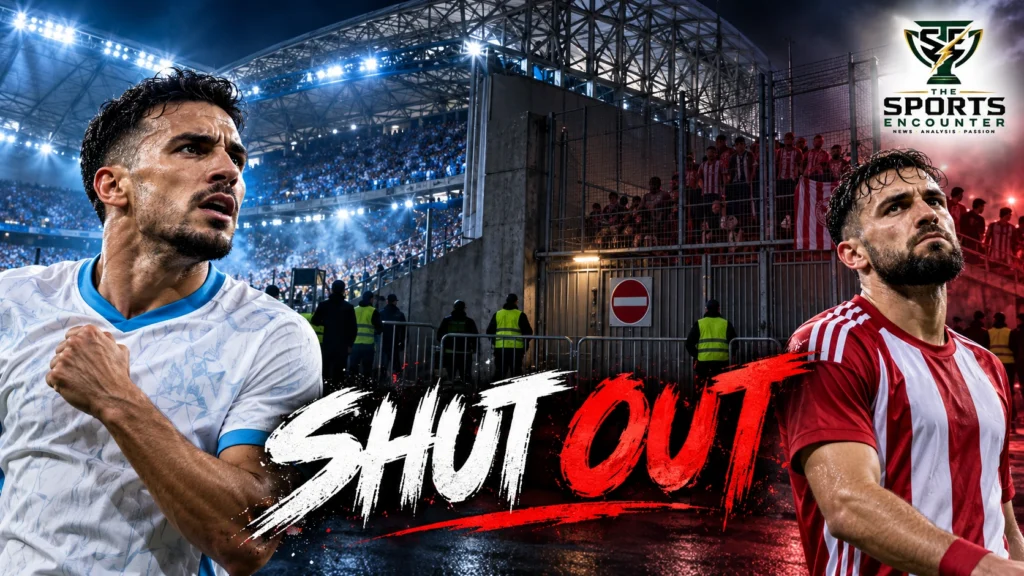
MARSEILLE, France, October 14, 2026: Olympiacos supporters will not be admitted to Thursday’s UEFA Europa League match against Marseille despite French authorities withdrawing restrictions that had threatened their attendance. UEFA welcomed the reversal on Wednesday, but a subsequent Olympiacos announcement confirmed that supporters’ tickets had been canceled and the away section at the CEPAC Vélodrome would remain closed. The conflicting decisions have left Greek fans facing disrupted travel, financial losses and an extraordinary situation in which official permission to attend was restored too late to prevent their exclusion.
The dispute escalated less than 48 hours before the October 15 fixture. Olympiacos had accused French authorities of imposing and then reversing restrictions without adequate warning, saying thousands of supporters had canceled flights, accommodation and other travel arrangements. UEFA welcomed the authorities’ decision to withdraw the restrictions, while Marseille police maintained that no formal nationwide travel ban had been issued. Yet following another security meeting, Olympiacos told ticket holders they would not be admitted. The controversy has now become a test of how European football protects traveling supporters when safety decisions change at the last minute.
Why Olympiacos Fans Cannot Attend Despite UEFA’s Clearance
The most important distinction concerns the difference between official permission to attend and the practical arrangements needed to enter a stadium.
UEFA confirmed Wednesday that the relevant French restrictions had been withdrawn, allowing visiting supporters to attend in principle.
The European governing body welcomed the reversal and expressed regret over the disruption experienced by Olympiacos and its supporters.
However, the situation changed again later that evening.
Following an additional security meeting, Olympiacos announced that all tickets purchased by its supporters in the affected allocations had been canceled.
The club also confirmed that the designated away section at the CEPAC Vélodrome would remain closed.
Supporters already in Marseille were told not to approach the stadium because they would not be admitted.
That later announcement is the operative information for holders of the canceled tickets as of Wednesday night.
It also explains why the original news that French authorities had lifted their restrictions does not fully describe the final outcome.
Olympiacos vs. Marseille: How the Fan Dispute Unfolded
The confusion developed over several weeks, with the decisive reversals arriving during the final days before kickoff.
| Date | Development | Consequence |
|---|---|---|
| September 22 | Olympiacos published travel and security arrangements agreed with French authorities. | Supporters prepared to travel through an organized meeting point and stadium-access procedure. |
| September 30 | The club announced ticket arrangements for the Marseille fixture. | Eligible supporters could purchase tickets and finalize their plans. |
| October 13 | French authorities issued restrictive local security measures affecting Olympiacos supporters. | The Greek club advised supporters against traveling and began arranging ticket cancellations. |
| October 13, later | French authorities reversed the restrictions after approximately ten hours, according to Olympiacos. | Confusion increased because some fans had already canceled travel. |
| October 14 | UEFA welcomed the withdrawal of restrictions and confirmed that visiting-fan access had been restored in principle. | Official permission appeared to reopen the possibility of attendance. |
| October 14, evening | Olympiacos confirmed cancellation of the affected tickets and closure of the away section. | Ticket holders were told not to approach the stadium. |
| October 15 | Marseille vs. Olympiacos, Europa League Matchday 2. | The fixture remains scheduled, with the visiting supporters’ section closed under the latest announced arrangements. |
Timeline compiled by The Sports Encounter from Olympiacos communications, UEFA’s reported response and October 14 reporting. The chronology distinguishes the lifting of government restrictions from the later cancellation of stadium tickets.
What Did French Authorities Originally Restrict?
The initial security decision was broader than an ordinary restriction on stadium seating, according to the documents and account published by Olympiacos.
The Greek club released details of an administrative order affecting supporters identifying with Olympiacos and Red Star Belgrade.
The published extracts described restrictions covering entry to the Vélodrome and movement or presence on public roads in six districts of Marseille.
Those areas included the first, second, sixth, seventh, eighth and ninth arrondissements.
The measures were stated to apply from the morning of October 14 until the early hours of October 16.
French authorities cited concerns about public order and potential confrontations among rival groups of supporters.
Olympiacos strongly challenged both the timing and the handling of the decision.
In its official October 13 statement, the club criticized the reversal after supporters had already altered their plans.
The club argued that the late changes had created additional uncertainty for traveling fans and undermined confidence in the security arrangements.
Why French Police Said There Was No Formal Travel Ban
The Marseille police prefecture offered a different explanation of the administrative measures.
Police told Reuters that no formal nationwide prohibition on supporters traveling to Marseille had been imposed.
A spokesperson explained that the power to issue a formal travel ban rests with France’s Interior Ministry.
The prefecture maintained that the relevant local measures concerned supporters’ presence and display of club colors or merchandise in specified areas rather than a nationwide prohibition on travel.
That explanation does not eliminate the confusion.
A restriction preventing supporters from entering a stadium or moving freely through areas needed to reach it can make attendance impractical even when travel to the city itself remains legally possible.
The published administrative extracts and the police account describe different aspects of the restrictions.
Their competing interpretations help explain how supporters received messages that appeared inconsistent.
For those who had booked transportation and accommodation, the practical question was whether they could safely and reliably attend the match.
That question remained unsettled until the final club announcement closed the away section.
How Planned Security Arrangements Fell Apart Before Kickoff
The last-minute controversy is especially striking because security planning had already been underway for weeks.
On September 22, Olympiacos issued guidance to supporters preparing to travel to Marseille.
That guidance identified Place de la Joliette as an official meeting point.
Supporters were expected to gather there between 2 p.m. and 5 p.m. on matchday for ticket checks and the coordinated arrangements required for reaching the stadium.
The club also offered guidance about accommodation and movement within the city, based on discussions with French police.
These were operational arrangements rather than an informal invitation for fans to make their own way to the away turnstiles.
The existence of those plans makes the October reversal particularly consequential.
Supporters had organized travel around an announced process involving a designated meeting point, security coordination and ticket verification.
When restrictions were introduced and then withdrawn shortly before the match, the original plan became difficult to restore.
The sequence raises questions about how early potential security problems were identified, when the affected parties were informed and why the final arrangements changed so close to kickoff.
The available information establishes the conflicting decisions and their consequences. It does not independently establish that any single authority acted unlawfully.
How Much Money Could Olympiacos Supporters Have Lost?
The immediate financial consequences extend beyond the price of a match ticket.
Olympiacos said thousands of supporters had canceled flights, hotel reservations and other travel plans after the initial restrictions.
It also said hundreds of fans who were already in Marseille had returned to Greece, while others abandoned their intended journeys.
Those are the club’s reported estimates and accounts. A verified final count of affected supporters has not been made public in the material reviewed.
The club’s ticket arrangements involved two affected price categories.
| Expense or Ticket Category | Verified Information | Outstanding Question |
|---|---|---|
| Away-section match tickets | €15 tickets canceled | When all refunds will be completed |
| Other allocated match tickets | €49 tickets canceled | When all refunds will be completed |
| Flights | Supporters canceled bookings, according to Olympiacos | How much was nonrefundable |
| Hotels | Accommodation bookings were disrupted | Whether cancellation charges were recoverable |
| Other travel expenses | Additional costs and disrupted arrangements were reported | Total verified losses and possible compensation |
Olympiacos said it would arrange refunds of the affected match tickets and indicated that it would support collective legal action by supporters seeking compensation.
The distinction between ticket refunds and broader travel compensation is important.
Refunding a €15 or €49 match ticket does not automatically reimburse an airline cancellation charge, nonrefundable hotel booking or other travel expense.
Likewise, the club’s commitment to support potential claims does not mean compensation has already been awarded or that every expense will be recoverable.
No independently verified total financial loss was available as of October 14.
Why UEFA’s Response Carries Wider Significance for Away Supporters
The Olympiacos controversy arrives only weeks after UEFA and other European football organizations publicly endorsed a more restrictive approach to blanket bans on traveling supporters.
On September 3, UEFA, European Football Clubs, Football Supporters Europe and European Leagues jointly supported a Council of Europe recommendation addressing collective restrictions on away fans.
The official UEFA statement on collective supporter bans emphasized proportionality, individual accountability, consultation and timely communication.
Its central principles called for broad restrictions to be reserved for exceptional circumstances supported by clear evidence that less restrictive arrangements would not adequately address serious safety risks.
The guidance also emphasized the importance of giving clubs and supporters sufficient notice to make informed decisions.
That final principle is particularly relevant to Marseille.
Was the Marseille Decision Consistent With UEFA’s New Approach?
The available evidence raises legitimate questions about the handling of the restrictions.
Olympiacos had already sold tickets and communicated organized travel arrangements.
The initial restrictions arrived shortly before kickoff, were reversed and were followed by confirmation that the away section would remain closed.
That sequence illustrates the operational consequences UEFA had recently warned could arise from collective restrictions.
However, the September statement expresses a shared European football policy position and recommendation. It does not, by itself, establish that French authorities violated a binding UEFA regulation.
Determining any legal breach would require examination of the applicable French administrative decisions, the relevant legal authority and any subsequent proceedings.
The immediate editorial conclusion is narrower and better supported: the process left supporters unable to rely on previously announced arrangements.
What UEFA Means by Sporting Integrity in This Dispute
UEFA’s reported response referred to maintaining visiting supporters’ access in the interests of sporting integrity.
That principle recognizes that traveling supporters are part of the competitive environment of European football.
Away fans contribute to the atmosphere, maintain a visible connection between teams and their communities, and support clubs during matches played in unfamiliar environments.
Removing an entire visiting section changes that environment.
It does not establish that the sporting result will be affected, and it does not automatically give either team a competitive advantage.
However, it eliminates the organized visiting support that would otherwise have been present at the stadium.
For Olympiacos, the effect is particularly visible because the fixture comes during the early stages of a competitive Europa League campaign.
Both teams are attempting to accumulate points that could determine their qualification route in January.
Why Marseille vs. Olympiacos Matters Beyond the Fan Controversy
Thursday’s match remains significant for both teams’ European ambitions.
Marseille opened their league-phase campaign with a damaging 4-1 defeat away to Beşiktaş on September 17.
They recovered from an early setback to reach halftime level at 1-1, but conceded twice within three second-half minutes before allowing a fourth goal.
The Sports Encounter’s tactical analysis of the Beşiktaş defeat explained how Junior Olaitan and Orkun Kökçü exploited Marseille’s defensive organization after halftime.
The loss left Marseille without a point and with a minus-three goal difference after Matchday 1.
Olympiacos began the competition differently.
The Greek side defeated Jagiellonia Białystok 2-1 after recovering from a deficit.
That comeback was among the notable results examined in TSE’s Europa League opening-night report.
| Club | Opening Match | Result | Points | Goal Difference |
|---|---|---|---|---|
| Marseille | Away vs. Beşiktaş | Lost 1-4 | 0 | -3 |
| Olympiacos | Home vs. Jagiellonia | Won 2-1 | 3 | +1 |
Matchday 1 figures from confirmed UEFA Europa League results. Both clubs have seven league-phase matches remaining before the October 15 fixture.
Marseille therefore have a strong reason to seek three points at home.
Olympiacos have an opportunity to build on their winning start.
The Vélodrome Has Already Been a Difficult Place for Marseille
Marseille’s problems this season have extended into domestic competition.
Paris Saint-Germain defeated them 2-1 at the Vélodrome in September, a match that exposed defensive fragility and growing frustration around the club.
TSE’s Ligue 1 report on Marseille’s defeat to PSG documented the team’s difficulties and the criticism directed toward its ownership.
The result highlighted how quickly Marseille could lose control after recovering from an unfavorable position.
Against Olympiacos, another failure to turn promising passages of play into a positive result would increase the pressure surrounding the French club’s European campaign.
The departure of experienced goalkeeper Gerónimo Rulli to Manchester City also formed part of Marseille’s summer rebuilding.
TSE’s coverage of Rulli’s return to Manchester City examined that change in Marseille’s goalkeeping resources.
The team must now manage its existing performance concerns alongside an unusually contentious matchday atmosphere.
What the Europa League Format Means for Both Clubs
The 2026-27 Europa League features 36 clubs competing in one league table.
Each side faces eight different opponents, with four matches at home and four away.
The top eight teams advance directly to the round of 16.
Clubs finishing ninth through 24th enter the knockout-phase playoffs, while those ranked 25th or lower are eliminated.
The Sports Encounter previously examined the consequences of that format in its guide to UEFA’s 36-team league-phase competitions.
The system gives goal difference and individual match results added importance across a short eight-game schedule.
Marseille’s opening 4-1 defeat has already created a deficit that the club must address.
Olympiacos enter their second match with three points and a positive goal difference.
The contrasting starts create a sporting contest with consequences for both teams, even before the supporter dispute is considered.
Other Greek clubs have also shown their competitiveness in this season’s Europa League.
OFI Crete defeated Hoffenheim 2-0 despite facing 18 shots and conceding substantial possession, as examined in TSE’s analysis of the Greek club’s victory.
Olympiacos now have an opportunity to produce another significant result for Greek football, although they will do so without the organized visiting support originally expected in Marseille.
What Happens Next for Olympiacos Fans and the Club?
Three immediate questions remain unresolved.
The first concerns the final accounting of the disruption.
Olympiacos has described widespread cancellations and substantial financial losses, but a verified total for affected supporters and unrecovered expenses has not been established.
The second concerns potential legal proceedings.
The club has indicated that it will support collective action aimed at recovering losses. Whether such claims proceed and what compensation, if any, becomes available remains uncertain.
The third concerns responsibility for future supporter-access arrangements.
Olympiacos, Marseille, UEFA and the relevant French authorities all have roles in coordinating safe matchday operations, although their specific powers and responsibilities are different.
The controversy demonstrates why communication between those parties must produce arrangements supporters can reasonably rely upon before committing money and time to an international trip.
For the immediate fixture, the latest announced position remains that Olympiacos supporters’ affected tickets are canceled and the away section will be closed.
The next sporting question will be decided on the field.
The broader question of how the disruption occurred may take considerably longer to resolve.
Frequently Asked Questions About the Olympiacos-Marseille Fan Ban
Are Olympiacos fans allowed to attend the Marseille match?
French authorities withdrew their restrictions, and UEFA welcomed the restoration of visiting-fan access in principle. However, Olympiacos subsequently announced that its supporters’ tickets had been canceled and the designated away section would remain closed.
Why were Olympiacos supporters initially restricted?
French authorities cited public-order and safety concerns. The initial local administrative measures affected stadium access and supporters’ presence in specified areas of Marseille.
Did France officially ban Olympiacos fans from traveling?
Marseille police said no formal nationwide travel ban had been issued by the Interior Ministry. Olympiacos nevertheless reported that the local restrictions made attendance impossible under the original arrangements.
What did UEFA say about the decision?
UEFA welcomed the withdrawal of the restrictions and regretted the uncertainty and inconvenience experienced by Olympiacos and its supporters. Its reported statement emphasized the importance of maintaining access for visiting fans.
Were Olympiacos tickets for the match canceled?
Yes. Olympiacos announced on October 14 that affected €15 and €49 tickets had been canceled and the visiting supporters’ section at the CEPAC Vélodrome would remain closed.
Will Olympiacos fans receive refunds or compensation?
The club said it would arrange refunds for affected match tickets and support possible collective legal action for wider losses. No complete compensation outcome had been established as of October 14.
When is Marseille vs. Olympiacos in the Europa League?
The match is scheduled for Thursday, October 15, 2026, at 9 p.m. local time in Marseille, which is 10 p.m. in Greece. It is the second league-phase fixture for both clubs.
How did Marseille and Olympiacos perform in their opening Europa League games?
Marseille lost 4-1 away to Beşiktaş, while Olympiacos recovered from a deficit to beat Jagiellonia Białystok 2-1. Marseille entered Matchday 2 without points, while Olympiacos had three.
A Decision Reversed Too Late to Restore the Matchday
The central contradiction surrounding Marseille’s Europa League fixture is now clear.
Authorities withdrew the restrictions that had threatened visiting supporters’ access, and UEFA welcomed the decision.
But the reversal arrived after fans had already changed their plans and the original security arrangements had broken down.
Olympiacos ultimately canceled the affected tickets and confirmed that its away section would remain closed.
For supporters who had spent money on travel, the distinction between a withdrawn government restriction and a canceled stadium ticket offers little immediate consolation.
The episode raises serious questions about consultation, timing and responsibility in European football’s treatment of away supporters.
Those questions are especially relevant given UEFA’s recent endorsement of policies intended to make collective restrictions exceptional, proportionate and clearly communicated.
Marseille and Olympiacos will still compete for three important Europa League points on Thursday.
The supporters who expected to follow the Greek champions to the Vélodrome have already experienced a very different outcome from the one they planned for.
Follow The Sports Encounter’s European soccer coverage for further developments involving UEFA competitions, club performances and the issues affecting traveling supporters.