


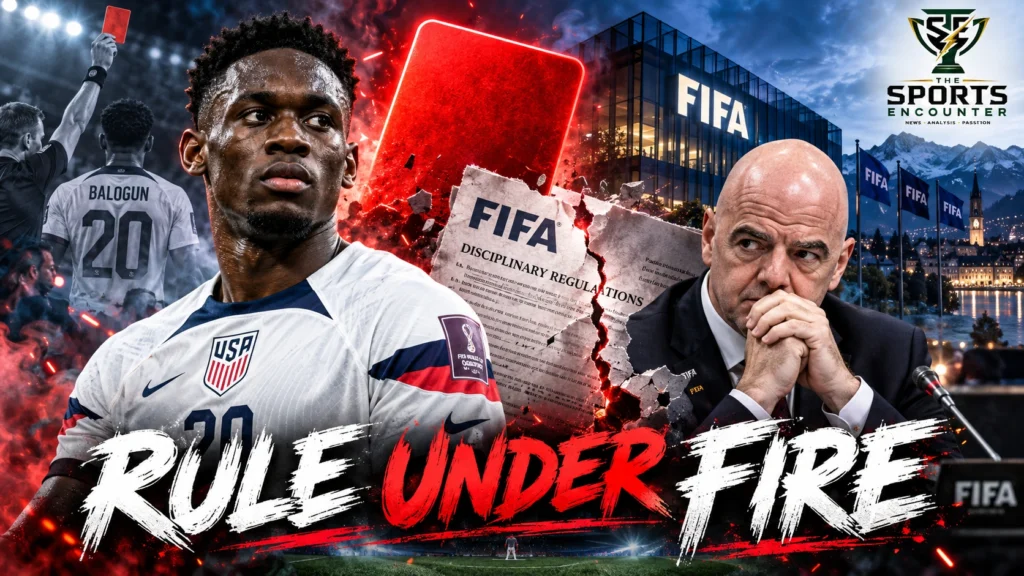
ZURICH, Switzerland, October 14, 2026: FIFA is reportedly preparing to amend the disciplinary rule that allowed United States striker Folarin Balogun to escape an automatic World Cup suspension after his red card against Bosnia and Herzegovina, bringing one of the 2026 tournament’s most controversial decisions back before soccer’s governing authorities. The proposed change is expected to feature in discussions surrounding Thursday’s FIFA Council meeting in Zurich, where President Gianni Infantino already faces mounting questions about institutional independence and decision-making.
The controversy began on July 1 when Balogun was sent off during the Americans’ 2-0 Round of 32 victory over Bosnia. FIFA subsequently suspended enforcement of his one-match ban, allowing him to face Belgium in the Round of 16. The decision followed a request for intervention from U.S. President Donald Trump, although FIFA maintained that its Disciplinary Committee acted independently. Three months later, the prospect of rewriting the provision used to justify that exceptional decision has revived a fundamental question: how should FIFA reconcile automatic punishments with the discretion granted to its disciplinary authorities?
What FIFA Is Proposing After the Balogun Red-Card Controversy
According to reporting published October 14, FIFA is moving toward an amendment intended to prevent another controversy involving the discretionary suspension of an automatic one-match ban.
The proposed change concerns Article 27 of the FIFA Disciplinary Code, the provision FIFA relied upon when it allowed Balogun to remain eligible for the United States’ World Cup knockout match against Belgium.
The broad intention reported ahead of the Council meeting is to establish clearer limits on how mandatory red-card suspensions can be deferred.
That could be a consequential adjustment because Article 27 gives FIFA’s judicial bodies discretion to suspend the implementation of disciplinary measures.
However, the precise proposed wording, any exceptions, its application across competitions, and the intended effective date have not yet been publicly established through a final adopted text.
It would therefore be premature to describe the amendment as an existing rule or claim that every red-card appeal will become impossible.
FIFA has confirmed that its Council meeting is scheduled for October 15. The governing body’s official Council meeting announcement provides the meeting date and published agenda information.
How Folarin Balogun’s Red Card Became a World Cup Governance Crisis
The original incident was a football decision made during a knockout match.
Balogun had scored the United States’ opening goal against Bosnia and Herzegovina and was already one of Mauricio Pochettino’s most important attacking players.
In the 64th minute, he was dismissed after a challenge on Bosnia defender Tarik Muharemović. Referee Raphael Claus issued the red card following a video review.
Balogun’s dismissal left the Americans playing with 10 men, but Malik Tillman subsequently added a second goal to secure a 2-0 victory.
The Sports Encounter’s original USA vs Bosnia match report reconstructed the sending-off, the goals, and the challenge that initially appeared to rule Balogun out of the next round.
Under the World Cup’s disciplinary framework, a direct red card normally produces an automatic suspension for the following match.
That would have made Balogun unavailable against Belgium on July 6.
Instead, the FIFA Disciplinary Committee issued a decision on July 5 suspending the implementation of his automatic one-match ban for a one-year probationary period.
The governing body’s official announcement confirming Balogun’s availability specifically cited Article 27.
The result was extraordinary: a player dismissed in one World Cup knockout match could participate in the next without serving the expected immediate suspension.
FIFA Suspended the Punishment, Not the Referee’s Decision
That distinction is essential to understanding the current debate.
FIFA did not establish that Raphael Claus had incorrectly identified the player or formally erase the on-field red card.
The Disciplinary Committee retained the sanction but suspended its implementation.
Under the probation mechanism, a subsequent offense of similar nature and gravity could trigger enforcement of the suspended punishment, subject to the relevant disciplinary decision.
The Sports Encounter examined the original controversy in its July analysis of Trump’s intervention, Balogun’s eligibility, and Belgium’s objections.
FIFA’s choice created an immediate conflict between the expected application of the automatic suspension and its disciplinary body’s authority to delay enforcement.
Both provisions were part of the regulatory framework. Whether the discretionary power had been exercised consistently and appropriately became the central disagreement.
Article 27 vs Article 66.4: Which FIFA Rule Took Precedence?
The dispute arose because FIFA’s disciplinary framework contains provisions serving different purposes.
Article 66.4 establishes the automatic suspension resulting from a sending-off. Article 10.5 of the 2026 World Cup Regulations similarly provides for a suspension from the team’s next match following a red card.
Article 27, however, allows the relevant FIFA judicial body to suspend implementation of a disciplinary measure, wholly or partly, under a probationary arrangement.
In Balogun’s case, FIFA treated the automatic suspension as a disciplinary measure whose enforcement could be deferred.
| Provision | Purpose | Role in Balogun’s Case |
|---|---|---|
| FIFA Disciplinary Code, Article 66.4 | Automatic next-match suspension following a sending-off | Established the immediate disciplinary consequence |
| 2026 World Cup Regulations, Article 10.5 | Competition-specific red-card suspension requirement | Reinforced Balogun’s expected absence against Belgium |
| FIFA Disciplinary Code, Article 27 | Discretion to suspend implementation of a disciplinary measure | Allowed the committee to defer enforcement for one year |
| Reported October 2026 amendment | Clarification or restriction of disciplinary discretion | Could prevent comparable exceptions in future cases |
These provisions explain why the controversy cannot be resolved simply by asking whether Balogun received a red card.
He did.
The disputed question concerns whether the resulting mandatory suspension should have been eligible for deferred implementation immediately before another World Cup knockout match.
Could FIFA Have Applied Both Rules Without a Contradiction?
FIFA argued that its Disciplinary Committee was entitled to use Article 27 and that the automatic suspension provisions did not expressly remove that discretion.
The Royal Belgian Football Association and UEFA challenged the handling of the decision, emphasizing the importance of predictable automatic suspensions in a competition where the same disciplinary standards should apply to every participating country.
Those positions are not necessarily disagreements over what happened on the field.
They concern how the governing body’s rules interact, how discretion should be exercised, and what safeguards should exist when a sanction affects a knockout opponent.
A future amendment could resolve the ambiguity by expressly identifying which sanctions may be deferred and which must be enforced immediately.
Whether FIFA chooses that approach remains dependent on the actual adopted language.
Why Donald Trump’s Call Made the Balogun Decision Harder to Defend
Political attention transformed the controversy from a disciplinary ruling into an international governance dispute.
Donald Trump acknowledged contacting FIFA President Gianni Infantino to seek reconsideration of Balogun’s red card.
The FIFA decision allowing the American striker to face Belgium followed that intervention.
The chronology created serious questions about whether political access could influence the treatment of national teams competing under the same regulations.
However, the sequence alone does not establish that Infantino directed the committee’s decision.
FIFA denied improper executive involvement. Infantino maintained that he did not personally make the disciplinary ruling, while FIFA officials defended the committee’s independence and its authority under the existing code.
Those denials must be considered alongside the concerns raised by Belgium, UEFA, and other officials seeking a fuller account of how the ruling was reached.
The Sports Encounter’s analysis of Trump’s subsequent support for Infantino examined the increasingly visible political relationship between the two leaders during FIFA’s broader governance difficulties.
The unresolved issue is evidentiary. Public confidence would depend on whether the relevant documents, reasoning, communications, and decision-making safeguards can demonstrate that the committee acted without improper influence.
What Belgium Objected To Before the USA Match
Belgium’s central concern was competitive equality.
Its coaching staff had prepared for a World Cup knockout match under regulations providing for an automatic suspension after a red card.
Balogun’s unexpected availability changed the United States’ attacking options immediately before the game.
His pace, movement behind defenders, and ability to operate centrally gave Mauricio Pochettino another attacking resource.
Belgium nevertheless defeated the United States 4-1, with Charles De Ketelaere scoring twice and Hans Vanaken and Romelu Lukaku also finding the net.
Readers can revisit TSE’s detailed report on Belgium eliminating the United States to understand how the match unfolded.
The result removes any basis for arguing that Balogun’s reinstatement caused Belgium’s elimination. Belgium advanced comfortably despite the disputed eligibility decision.
Its objections to FIFA’s process remained relevant independently of the result.
A governing body’s regulatory consistency is tested by how it treats all participants, including when the immediate competitive beneficiary ultimately loses.
Would the Proposed Amendment Change VAR or Red-Card Appeals?
The reported proposal concerns FIFA’s disciplinary procedures after a match. It should not be confused with changes to the authority of video assistant referees during games.
VAR operates under the Laws of the Game and the procedures established by the International Football Association Board.
The official IFAB VAR protocol explains the categories of incidents that can be reviewed and the on-field referee’s final decision-making authority.
Balogun’s case involved two separate stages:
- The match referee’s decision to send off Balogun after a VAR review.
- The subsequent FIFA disciplinary decision suspending the implementation of the automatic match ban.
The second stage produced the controversy now driving discussion of Article 27.
A rule restricting discretionary suspension of mandatory bans would not, by itself, remove VAR’s ability to review a red-card incident. Nor would it necessarily eliminate other established disciplinary appeals in domestic competitions.
Those procedures operate under distinct regulations and legal authorities.
TSE explored the wider issue of referee credibility in its report on the growing scrutiny of World Cup match officials.
Our later feature, How VAR Became a WAR at the FIFA World Cup 2026, examined how disputed decisions and post-match controversies created questions that extended well beyond the technology itself.
What Would a Stricter Suspension Rule Mean for Players and National Teams?
The practical implications depend on the scope of the final amendment, but several consequences are already identifiable.
1. Automatic Suspensions Could Become More Predictable
If mandatory one-match bans become expressly ineligible for discretionary suspension, national teams would know that a dismissed player must miss the next match unless a separately defined exception applies.
That could reduce uncertainty during tournament preparation and limit late changes to opponent availability.
2. FIFA’s Judicial Bodies Could Have Less Discretion
Article 27 currently provides a mechanism for accommodating particular disciplinary circumstances.
Restricting it would reduce the range of outcomes available to the committee in comparable cases.
That could strengthen consistency, although a rigid rule may also make it harder to accommodate exceptional circumstances unless the amended regulations define appropriate safeguards.
3. Appeals Would Need Clearer Boundaries
The amendment would need to distinguish between a genuinely mistaken dismissal, a challenge to the disciplinary sanction, and a request to defer an otherwise valid punishment.
These are different legal and sporting questions.
Without clear definitions, a revised code could exchange one ambiguity for another.
4. Knockout Tournament Planning Could Become More Stable
For national-team coaches, player eligibility influences selection, match preparation, substitutions, pressing assignments, and attacking combinations.
A late disciplinary reversal can force an opposing coach to reconsider plans immediately before kickoff.
Predictable suspension rules would make those preparations more stable, particularly when tournament matches are separated by only a few days.
Why FIFA’s October 15 Council Meeting Has Become a Test of Governance
The Balogun proposal reaches FIFA’s Council at an especially sensitive moment.
Infantino is already facing criticism over FIFA Forward Enterprise, the abandoned proposal involving a potential private-investment stake in commercial operations connected to the World Cup.
That dispute produced demands for stronger consultation, independent oversight, and greater transparency from important regional football organizations.
TSE documented how UEFA, the Asian Football Confederation, and CONCACAF challenged Infantino’s handling of the commercial proposal.
The Balogun affair raises a different regulatory issue, but the two controversies share questions about institutional independence and the concentration of authority.
FIFA has defended its disciplinary committee’s independence. Critics have continued pressing for evidence sufficient to substantiate that independence in a case involving politically prominent figures.
The October 15 meeting is also expected to address the governance review that Infantino proposed following the commercial-rights backlash.
Our analysis of the proposed independent FIFA governance review explains why the identity of reviewers, access to records, publication of findings, and implementation mechanisms are central to assessing whether meaningful reform is occurring.
The disciplinary-rule discussion adds another test.
Changing a provision may clarify FIFA’s procedures for future tournaments. It would not automatically establish whether the earlier decision was free from improper influence.
What FIFA Must Clarify Before Any Rule Change Can Be Judged
The precise amendment text remains the starting point.
Four questions will determine whether the proposal resolves the underlying regulatory problem.
| Unresolved Question | Why It Matters |
|---|---|
| Which suspensions would become ineligible for deferral? | Determines whether the restriction is narrow or affects disciplinary discretion more broadly. |
| Would a proven refereeing error remain appealable? | Separates wrongful dismissal procedures from deferred punishment. |
| When would the amendment take effect? | Establishes whether the change affects future competitions and when teams must adjust. |
| Will FIFA publish the reasoning behind the Balogun decision? | Addresses the original transparency dispute independently of the proposed new wording. |
A fifth question concerns institutional responsibility: which FIFA body will formally approve the amendment and oversee its implementation?
That question requires confirmation through FIFA’s published decisions rather than assumptions based on pre-meeting reporting.
Can FIFA Restore Trust by Changing Article 27?
The reported amendment could solve a practical problem in international soccer by establishing clearer limits on when automatic red-card suspensions may be deferred.
That would provide more predictable guidance to players, coaches, referees, national associations, and opposing teams.
FIFA’s challenge, however, extends beyond the wording of Article 27.
The governing body must explain why its current disciplinary framework produced an exceptional outcome involving the World Cup’s host nation, what evidence justified that outcome, and how the independence of the decision-making process was protected.
Belgium won the match. The United States exited the tournament. Balogun’s availability no longer affects the 2026 World Cup standings.
But the precedent remains relevant because the same regulatory framework could apply to another player, another country, and another knockout match.
The strongest outcome from the October 15 discussions would be a clearly defined disciplinary system whose rules can be understood before controversy strikes and whose decisions can withstand independent scrutiny afterward.
Until FIFA publishes the amendment and explains how it will operate, its reported plans remain a proposal rather than proof that the underlying governance dispute has been resolved.
Frequently Asked Questions About FIFA’s Balogun Rule Change
What rule is FIFA planning to change after the Folarin Balogun controversy?
Reports indicate that FIFA is considering an amendment affecting Article 27 of its Disciplinary Code, which allows judicial bodies to suspend implementation of disciplinary sanctions. The change is intended to address the discretion exercised when Balogun’s automatic World Cup match ban was suspended. The final amendment text has not been confirmed.
Why was Folarin Balogun given a red card at the 2026 World Cup?
Balogun received a direct red card in the 64th minute of the United States’ July 1 Round of 32 victory over Bosnia and Herzegovina. Referee Raphael Claus dismissed him following a VAR review of a challenge on Tarik Muharemović.
Why did FIFA allow Balogun to play against Belgium?
The FIFA Disciplinary Committee used Article 27 to suspend implementation of Balogun’s automatic one-match ban for a one-year probationary period. The decision made him eligible for the United States’ July 6 Round of 16 match against Belgium.
Did FIFA overturn Balogun’s red card?
No. FIFA’s disciplinary decision concerned enforcement of the automatic suspension. The original on-field red card was not formally cancelled. The resulting sanction was suspended under a probationary arrangement.
What is the difference between FIFA Articles 27 and 66.4?
Article 66.4 provides for an automatic suspension following a sending-off. Article 27 allows FIFA’s judicial bodies to suspend implementation of disciplinary measures. The interaction of these provisions was central to Balogun’s eligibility controversy.
Did Donald Trump influence the Balogun suspension decision?
Trump acknowledged contacting FIFA President Gianni Infantino to request reconsideration. FIFA maintained that its independent Disciplinary Committee made the decision. The publicly established chronology raises questions about potential influence but does not independently prove that Trump or Infantino directed the ruling.
What was the result of USA vs Belgium at the 2026 World Cup?
Belgium defeated the United States 4-1 in the Round of 16 on July 6, 2026, eliminating the final remaining co-host nation. Charles De Ketelaere scored twice for Belgium.
Will FIFA’s proposed change prevent teams from appealing red cards?
That has not been established. The reported proposal concerns the discretion to suspend implementation of automatic match bans. The precise treatment of appeals, exceptions, and disciplinary procedures will depend on the final adopted regulations.
When is FIFA discussing the Balogun rule controversy?
The FIFA Council is scheduled to meet in Zurich on October 15, 2026. Reports indicate that the proposed disciplinary amendment is expected to be considered in connection with that meeting. Any formal decision and effective date require confirmation from FIFA.