


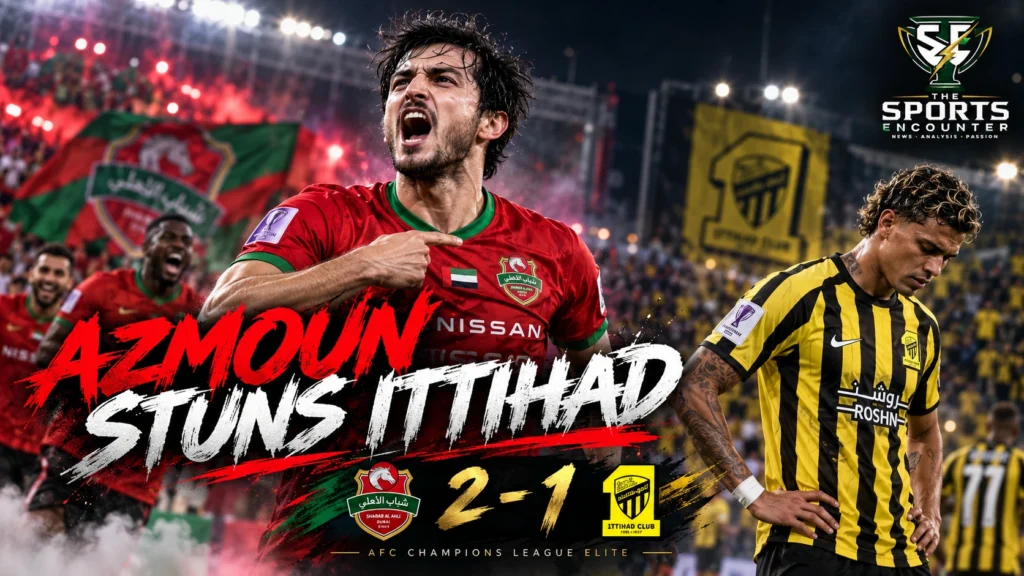
JEDDAH, Saudi Arabia, October 14, 2026: Al-Ittihad had the ball, the territory and almost three times as many shots. Sardar Azmoun needed just 16 minutes to make most of it count for nothing. The Iranian striker scored twice in the opening stages as Shabab Al Ahli defeated the Saudi giants 2-1 at Alinma Stadium on Tuesday, leaving the hosts to wonder how 21 shots, seven attempts on target and 65% possession had produced their first defeat of the AFC Champions League Elite campaign.
Azmoun opened the scoring in the seventh minute after Guilherme Bala created the opportunity with a surging run and a pass across goal. Nine minutes later, the striker broke through again and beat goalkeeper Predrag Rajković to double the visitors’ advantage. Richard Ríos finally gave Al-Ittihad hope with a 66th-minute goal, but the Saudi side could not complete its comeback despite controlling possession and forcing Shabab Al Ahli to defend for much of the contest. The result lifted the Dubai club to six points from two matches while leaving Al-Ittihad with just one, an uncomfortable start for a team expected to challenge Asia’s strongest clubs.
The victory also exposed a problem that has been developing across Al-Ittihad’s recent matches. Their attacking resources remain considerable, but defensive mistakes are becoming costly, and possession has not consistently translated into sufficiently effective finishing. Shabab Al Ahli offered the opposite example in Jeddah: an early attacking advantage, disciplined management of the lead and enough resilience to withstand sustained pressure away from home.
Al-Ittihad 1-2 Shabab Al Ahli: Final Score and Match Statistics
The AFC Champions League Elite 2026/27 fixture took place on October 13 at Alinma Stadium, part of King Abdullah Sports City in Jeddah.
It was the second match of the West region’s eight-game league stage for both clubs.
| Match Detail | Information |
|---|---|
| Competition | AFC Champions League Elite 2026/27 |
| Stage | West Region, League Phase, Matchday 2 |
| Venue | Alinma Stadium, Jeddah, Saudi Arabia |
| Home Team | Al-Ittihad, Saudi Arabia |
| Away Team | Shabab Al Ahli, United Arab Emirates |
| Halftime | Al-Ittihad 0-2 Shabab Al Ahli |
| Full-time | Al-Ittihad 1-2 Shabab Al Ahli |
| Shabab Al Ahli Scorer | Sardar Azmoun, 7′, 16′ |
| Al-Ittihad Scorer | Richard Ríos, 66′ |
| Shabab Al Ahli Points | 6 from 2 matches |
| Al-Ittihad Points | 1 from 2 matches |
Al-Ittihad Dominated the Numbers but Lost the Result
| Statistic | Al-Ittihad | Shabab Al Ahli |
|---|---|---|
| Goals | 1 | 2 |
| Possession | 65% | 35% |
| Total Shots | 21 | 8 |
| Shots on Target | 7 | 3 |
| Shots off Target or Blocked | 14 | 5 |
| Corners | 5 | 0 |
| Fouls | 9 | 8 |
| Yellow Cards | 1 | 0 |
| Red Cards | 0 | 0 |
| Offsides | 0 | 2 |
Al-Ittihad recorded 13 more shots than Shabab Al Ahli and enjoyed a 30-percentage-point possession advantage.
They also won five corners to none.
Those figures establish the home team’s territorial dominance, but they do not establish that Al-Ittihad created the better scoring opportunities.
That distinction matters because the quality of a chance is not measured simply by the number of attempts.
Al-Ittihad converted one of seven shots on target, approximately 14.3%. Shabab Al Ahli converted two of three, approximately 66.7%.
Those conversion figures are descriptive rather than predictive. A single match represents too small a sample to establish the finishing quality of either team’s entire season.
Nevertheless, they illustrate why the away side won despite spending considerably less time in possession.
Sardar Azmoun Strikes Twice Before Al-Ittihad Can Settle
Shabab Al Ahli had arrived in Jeddah knowing that an early advantage could change the match.
Al-Ittihad possessed enough attacking quality to dominate long passages of play, particularly at home.
Allowing the Saudi side to settle into sustained possession without applying attacking pressure would have created a difficult defensive assignment.
Instead, Shabab Al Ahli struck first.
Seventh Minute: Guilherme Bala Creates Azmoun’s Opening Goal
The first breakthrough came after only seven minutes.
Guilherme Bala advanced through Al-Ittihad’s defense, evading opponents before delivering the ball across goal.
Azmoun arrived in position to finish, giving the visitors a 1-0 advantage.
The attacking move was significant because it exposed problems in Al-Ittihad’s defensive organization before the home team had established control.
Bala’s ability to progress through several defenders created the decisive opening.
Azmoun then supplied the finishing touch.
Contemporary reporting also identified a disputed incident immediately before the goal.
Al-Ittihad players appealed for a penalty relating to an earlier challenge, but the decision was not overturned after video review.
The incident was described in Goal.com’s report on the first-goal VAR controversy.
The account establishes that the hosts protested the sequence. It does not establish that the officials made an incorrect decision.
What mattered on the scoreboard was that Shabab Al Ahli had taken an early lead.
Sixteenth Minute: Azmoun Doubles the Lead After Beating Rajković
Al-Ittihad needed an immediate response.
Instead, they conceded again.
Nine minutes after his opening goal, Azmoun broke through the Saudi defense and advanced toward goalkeeper Predrag Rajković.
The Iranian forward moved past the Serbian goalkeeper and completed the finish.
Reza Ghandipour was credited with the assist in contemporary live-match reporting.
The second goal made it 2-0 after only 16 minutes and placed Al-Ittihad in a difficult tactical position.
They now needed at least two goals simply to recover a point.
For Shabab Al Ahli, the early advantage created a different opportunity.
The visitors could defend a substantial lead, protect central areas and look for additional opportunities when Al-Ittihad committed players forward.
Azmoun’s two finishes were decisive, but the broader lesson lay in how the goals developed.
Both exposed the home team’s inability to prevent dangerous attackers from reaching favorable positions.
That defensive vulnerability would remain one of the central questions surrounding Al-Ittihad after the final whistle.
Richard Ríos Gives Al-Ittihad Hope, but the Comeback Falls Short
Al-Ittihad’s response was not passive.
The home side controlled possession, increased attacking pressure and spent much of the remaining match attempting to break Shabab Al Ahli’s defensive organization.
But the visitors had a significant advantage.
They could remain patient without needing to chase another goal immediately.
Al-Ittihad had to turn possession into clear scoring opportunities while protecting themselves against further counterattacks.
Sixty-Sixth Minute: Ríos Makes It 2-1
Richard Ríos finally provided the breakthrough in the 66th minute.
His goal reduced the deficit to 2-1 and gave Al-Ittihad a route back into the contest.
There were still 24 minutes of regulation time remaining.
One more goal would have rescued a draw.
The timing made the final stages particularly important because Shabab Al Ahli could no longer rely on their original two-goal cushion.
But the visitors held firm.
Al-Ittihad’s 21 attempts and seven shots on target ultimately produced only one goal.
The Saudi side maintained the pressure but could not find an equalizer.
Shabab Al Ahli therefore collected all three points and completed one of the most consequential early away victories of the West league phase.
Why Al-Ittihad’s Late Pressure Was Not Enough
There is an important difference between forcing an opponent to defend and creating opportunities that are likely to become goals.
Al-Ittihad achieved the first objective.
The match statistics show that they accumulated possession, shots and corners.
However, only seven of their 21 attempts reached the target.
That means two-thirds of their shots either missed the target or were blocked.
Without a fully verified shot-location map, the quality of each attempt cannot be assessed conclusively.
But the available evidence supports a narrower finding: Al-Ittihad produced considerable attacking volume without producing enough successful finishes.
That problem is particularly costly when a team begins the contest by conceding twice.
The longer it takes to score, the more comfortable an organized opponent can become protecting its lead.
How Shabab Al Ahli Won With Just 35% Possession
Shabab Al Ahli’s victory illustrates why possession is not a direct measurement of superiority.
A team can control the ball for most of the contest while struggling to break down a compact defense.
Another team can spend less time in possession but create decisive situations through effective movement and transitions.
That is what the result suggests happened in Jeddah.
Azmoun Supplied the Finishing That Al-Ittihad Could Not Match
Azmoun converted the two chances that determined the result.
His first goal rewarded Bala’s attacking movement.
His second demonstrated his ability to attack space behind the defense and remain composed when approaching the goalkeeper.
For a forward, those are different technical demands.
The first requires timing, positioning and a quick finish.
The second requires movement into space, control under pressure and the ability to make the correct decision against the goalkeeper.
Azmoun delivered both within nine minutes.
That efficiency meant Shabab Al Ahli did not need to dominate possession to establish control over the score.
André Jardine’s Balanced Approach Survives a Difficult Away Test
Before the match, Shabab Al Ahli coach André Jardine emphasized the importance of respecting Al-Ittihad while pursuing a result in Saudi Arabia.
“We are aiming for a positive result,” Jardine said in his pre-match comments.
He also highlighted the need for balance and physical readiness.
The remarks were published in Shabab Al Ahli’s official October 12 statement.
Tuesday’s result was consistent with that approach.
The visitors took their chances early and then withstood sustained attacking pressure.
They did not need to win the possession battle.
They needed to protect the scoreboard advantage their early finishing had created.
It is not possible to reconstruct every defensive adjustment from the aggregate statistics alone.
However, keeping Al-Ittihad to one goal despite 21 attempts represents an important achievement against opponents with considerable attacking resources.
Al-Ittihad’s Defensive Problems Are Becoming a Repeated Concern
The defeat is particularly worrying because Al-Ittihad’s early defensive vulnerability was not an isolated problem.
Before facing Shabab Al Ahli, the Saudi club had gone five consecutive matches without a clean sheet.
Contemporary reporting identified August 29, when Al-Ittihad drew 0-0 with Al-Fateh, as their most recent match without conceding.
The subsequent sequence included Saudi Pro League fixtures and the AFC Champions League Elite opener.
Shabab Al Ahli extended that run by scoring twice in the first 16 minutes.
Six Matches Without a Clean Sheet Reveal More Than One Bad Night
One poorly defended match can happen to any team.
Conceding across six consecutive competitive fixtures raises a broader question about defensive reliability.
Al-Ittihad have shown considerable attacking ability this season.
But successful title challenges require a team to win matches when its forwards do not produce several goals.
That becomes more difficult when opponents can regularly create scoring opportunities against the defense.
The early goals conceded to Shabab Al Ahli were particularly damaging because they required the hosts to abandon any possibility of controlling the match through a narrow advantage.
From the 16th minute onward, Al-Ittihad were chasing a two-goal deficit.
That changed their tactical priorities for most of the evening.
Al-Ittihad’s Attack Has Already Demonstrated Its Quality
The defeat should not obscure the strength of the team’s attacking resources.
George Ilenikhena scored twice when Al-Ittihad defeated defending Saudi Pro League champions Al-Nassr 2-1 on September 5.
That result ended Al-Nassr’s perfect start and demonstrated the ability of the Jeddah club to produce decisive attacking performances against strong domestic opponents.
The achievement was examined in The Sports Encounter’s analysis of Al-Ittihad’s victory over Al-Nassr.
Three days later, Ilenikhena scored again against Al-Fayha, while Youssef En-Nesyri converted a penalty in another 2-1 victory.
That performance was documented in our report on Al-Ittihad’s narrow win against Al-Fayha.
Those results demonstrate that the squad possesses players capable of deciding close matches.
The concern is whether Al-Ittihad can combine that attacking potential with sufficient defensive stability and more reliable finishing across different competitions.
Another Defeat After Losing to Al-Hilal
The Shabab Al Ahli result also followed Al-Ittihad’s 3-2 Saudi Pro League defeat against Al-Hilal on October 10.
That means the team conceded five goals across two defeats in four calendar days.
Such a sequence does not establish a permanent decline.
But it creates additional pressure ahead of the next domestic and continental assignments.
Al-Ittihad cannot assume that territorial control will compensate for early defensive mistakes against strong opponents.
The first two AFC Champions League Elite matches have now produced just one point.
That is a difficult return for a club with ambitions extending well beyond the league stage.
Shabab Al Ahli Have Taken Six Points From Two Very Different Victories
The Dubai club’s perfect continental start has been built through contrasting performances.
On September 14, Shabab Al Ahli opened their AFC Champions League Elite campaign with a 1-0 home victory over Iran’s Tractor FC.
Yuri César scored in the 22nd minute, and the UAE side protected the advantage to collect three points.
The result was included in TSE’s complete Matchday 1 analysis of all 32 AFC Champions League Elite clubs.
In Jeddah, Shabab Al Ahli followed a different route.
Azmoun scored twice, but the team conceded in the second half and had to protect a narrower lead.
Both matches ended in victories.
| Match | Result | Scorer(s) | Points Earned |
|---|---|---|---|
| September 14, vs Tractor | 1-0 win | Yuri César | 3 |
| October 13, at Al-Ittihad | 2-1 win | Sardar Azmoun (2) | 3 |
| Total | 2 wins | 3 goals scored, 1 conceded | 6 |
Six points from two matches place Shabab Al Ahli in a strong early position in the West region.
They have scored three goals and conceded one, giving them a goal difference of plus two.
It is too early to guarantee qualification, particularly in an eight-match league phase.
However, winning both opening fixtures gives the club a valuable advantage over opponents who have already dropped points.
Azmoun Adds Another Dimension to Shabab Al Ahli’s Attack
Azmoun has established himself as an important attacking player for the UAE club.
The Iranian international brings considerable experience from European football, including spells in Russia, Germany and Italy.
He joined Shabab Al Ahli from Bayer Leverkusen in 2024 after spending part of the preceding season on loan at Roma.
His role has extended beyond isolated moments of individual brilliance.
Shabab Al Ahli have developed several attacking options around him, including Yuri César and Guilherme Bala.
That range of threats was visible earlier in the UAE Pro League season.
Against Khorfakkan in August, Shabab Al Ahli overturned a halftime deficit by scoring five second-half goals.
Azmoun was among the scorers, alongside César, Saeid Ezatolahi and Rikelme.
The performance was examined in TSE’s analysis of the early UAE Pro League title race and Shabab Al Ahli’s attacking strength.
The Jeddah victory provides another example of that attacking depth.
Bala created the opening goal.
Azmoun converted the opportunities.
Other players then helped preserve the advantage.
Why Shabab Al Ahli’s Asian Form Matters After Domestic Setbacks
The visitors have not enjoyed a flawless domestic campaign.
Shabab Al Ahli suffered a 3-1 defeat against Al-Jazira in September, surrendering ground in the early UAE title race.
That result was among the important developments covered in TSE’s review of Al-Jazira taking control of the UAE Pro League.
They subsequently drew 1-1 against Dubai United.
Ezatolahi converted a second-half penalty to rescue a point after United had taken the lead.
That match was examined in our analysis of Shabab Al Ahli’s draw and Ezatolahi’s growing influence.
Those domestic results demonstrated that Shabab Al Ahli could be frustrated by well-organized opponents.
They also made the team’s response in continental competition more important.
Winning at Al-Ittihad suggests the squad can adjust to a different tactical challenge and remain effective away from home.
The performance should not be treated as proof that every domestic weakness has disappeared.
It does demonstrate that the team has the quality to defeat established continental opponents when its attacking execution and defensive organization work together.
Al-Ittihad’s First Two Asian Matches Reveal a Difficult Pattern
Al-Ittihad’s continental campaign began with a 1-1 draw against Qatar’s Al-Shamal on September 14.
Baghdad Bounedjah scored for the Qatari club in the 63rd minute.
Georginio Wijnaldum eventually equalized deep into stoppage time, rescuing a point for the Saudi visitors.
That late recovery prevented an opening defeat, but it also raised questions about why Al-Ittihad had struggled against opponents making their first appearance in the expanded competition.
The Sports Encounter documented the draw in its Matchday 1 report.
The problem became more serious against Shabab Al Ahli.
Al-Ittihad again needed a comeback.
This time, the deficit was two goals, and Richard Ríos could only reduce it to one.
| Match | Result | Al-Ittihad Goals | Points |
|---|---|---|---|
| September 14, at Al-Shamal | 1-1 draw | Georginio Wijnaldum | 1 |
| October 13, vs Shabab Al Ahli | 1-2 defeat | Richard Ríos | 0 |
| Total | 1 draw, 1 defeat | 2 scored, 3 conceded | 1 |
Two matches are not enough to determine whether Al-Ittihad will qualify.
But the Saudi side have already lost five of the first six points available.
They have conceded in both matches, fallen behind in both and depended on second-half responses to remain competitive.
Those are warning signs for a club seeking to make a deep continental run.
What Does the Result Mean for the AFC Champions League Elite West Region?
The 2026/27 AFC Champions League Elite has expanded to 32 clubs, divided into 16-team West and East regional league phases.
Each club plays eight league-stage matches against eight different opponents from its own region.
The top eight teams in each regional table advance to the Round of 16.
The expanded competition was examined in TSE’s analysis of the AFC Champions League Elite draw and the new 32-team structure.
For Shabab Al Ahli, six points provide an excellent early foundation.
The team has already secured victories against opponents from Iran and Saudi Arabia.
For Al-Ittihad, one point creates pressure to recover during the remaining six fixtures.
But it would be premature to declare either club qualified or eliminated.
The league phase is still developing, and other West-region matches will influence the standings and eventual qualification thresholds.
Why This Result Matters for Saudi and UAE Football
The victory also carries wider regional significance.
Saudi Arabian clubs have invested heavily in international talent and are among the leading financial powers in Asian football.
UAE clubs generally operate in a different financial environment but have continued producing competitive continental performances.
Shabab Al Ahli’s victory demonstrates that financial resources and squad reputation cannot substitute for finishing, defensive organization and execution during decisive moments.
The wider competitive landscape was already visible during the opening AFC Champions League Elite matchday.
Al-Ain defeated Al-Nassr 4-0, while Shabab Al Ahli overcame Tractor and Al-Ittihad needed a late equalizer against Al-Shamal.
Those results, examined in TSE’s opening-round analysis, demonstrated that established Saudi clubs would face demanding challenges throughout the competition.
Monday’s subsequent results reinforced that picture.
Defending champions Al-Ahli defeated Al-Wasl 3-1, while Al-Qadsiah were held to a 1-1 draw by Pakhtakor.
The latest developments were examined in TSE’s opening Matchday 2 roundup.
Shabab Al Ahli have now added another significant result to the UAE clubs’ continental record.
Can Al-Ittihad Fix the Problems That Shabab Al Ahli Exposed?
The answer depends on whether Al-Ittihad can identify the difference between problems caused by isolated incidents and those appearing repeatedly across matches.
1. Prevent Opponents From Attacking Open Defensive Spaces
Azmoun’s second goal exposed the danger of allowing an opponent to break through toward goal.
Al-Ittihad must examine the positioning of their defenders, midfield support and response when possession is lost.
A team that dominates the ball can still become vulnerable during transitions if too many players advance ahead of it.
That is a tactical risk to manage rather than an argument against attacking football.
2. Improve the Quality of Chances Rather Than Simply Increasing Shots
Twenty-one attempts indicate sustained attacking activity.
They do not guarantee that the opposition goalkeeper faced 21 serious scoring opportunities.
Al-Ittihad need to evaluate where their shots originated, how many were taken under pressure and whether different passing choices could have produced better opportunities.
The seven efforts on target offer a starting point for that analysis, but a complete shot map would provide a stronger assessment.
3. Avoid Making Every Match a Comeback Mission
Al-Ittihad needed a stoppage-time equalizer against Al-Shamal.
They then conceded twice inside 16 minutes against Shabab Al Ahli.
Repeatedly falling behind changes how a team must play.
Opponents can defend deeper, slow the tempo and force the trailing team into increasingly difficult decisions.
Preventing early concessions would allow Al-Ittihad to use their attacking quality without the added urgency of recovering from a major deficit.
4. Restore Defensive Reliability Before the Next Continental Fixture
The run of matches without a clean sheet creates a measurable target for improvement.
Al-Ittihad need to reduce the number of dangerous situations opponents create, particularly during the opening stages.
That improvement should be assessed through the types and locations of chances conceded, not clean sheets alone.
A goalkeeper’s saves and an opponent’s finishing can influence the final score even when the broader defensive performance is similar.
The objective is to make the team harder to break down while maintaining its attacking strengths.
Al-Ittihad vs. Shabab Al Ahli: Frequently Asked Questions
Who won Al-Ittihad vs. Shabab Al Ahli on October 13, 2026?
Shabab Al Ahli defeated Al-Ittihad 2-1 in Jeddah during Matchday 2 of the AFC Champions League Elite West league phase.
Who scored the goals?
Sardar Azmoun scored for Shabab Al Ahli in the seventh and 16th minutes. Richard Ríos scored Al-Ittihad’s goal in the 66th minute.
How many shots did Al-Ittihad have?
Al-Ittihad recorded 21 shots, including seven on target, according to the supplied full-time statistics. Shabab Al Ahli recorded eight shots, with three on target.
How much possession did Al-Ittihad have?
Al-Ittihad had 65% possession, compared with Shabab Al Ahli’s 35%.
Why did Al-Ittihad lose despite dominating possession?
Shabab Al Ahli converted two early scoring opportunities and protected their lead. Al-Ittihad produced substantial attacking volume but managed only one goal from seven attempts on target.
How many AFC Champions League Elite points do both teams have?
After two matches, Shabab Al Ahli have six points from two victories. Al-Ittihad have one point from a draw and a defeat.
How many teams advance from the West league phase?
The top eight teams from the 16-club West league phase advance to the Round of 16. Each team plays eight league-stage matches.
The Sports Encounter Verdict: Al-Ittihad Had the Numbers, but Azmoun Had the Answers
Al-Ittihad can point to 65% possession, 21 shots and five corners.
Those figures establish that the Saudi side spent substantial periods of the match trying to impose itself on the contest.
They cannot explain away the result.
Shabab Al Ahli arrived in Jeddah with a plan to compete against one of Saudi Arabia’s biggest clubs.
Azmoun converted twice before Al-Ittihad had settled.
Bala supplied the attacking movement that created the first goal.
The visitors then protected their advantage despite facing sustained pressure.
Richard Ríos gave Al-Ittihad a route back, but the hosts could not complete the recovery.
The biggest problem for Al-Ittihad was not a lack of attacking activity.
It was the failure to match that activity with enough effective finishing while preventing costly defensive mistakes.
That combination has now left the club with just one point from two continental fixtures.
For Shabab Al Ahli, the message is much more encouraging.
Six points from two matches, including an away victory in Jeddah, provide a strong start to an increasingly demanding West-region competition.
The UAE side have demonstrated that they can protect a narrow advantage and finish decisively when opportunities emerge.
Al-Ittihad must now demonstrate that their attacking quality can produce results even when opponents defend effectively.
Because in Jeddah, the home team controlled most of the ball.
Sardar Azmoun controlled the outcome.