


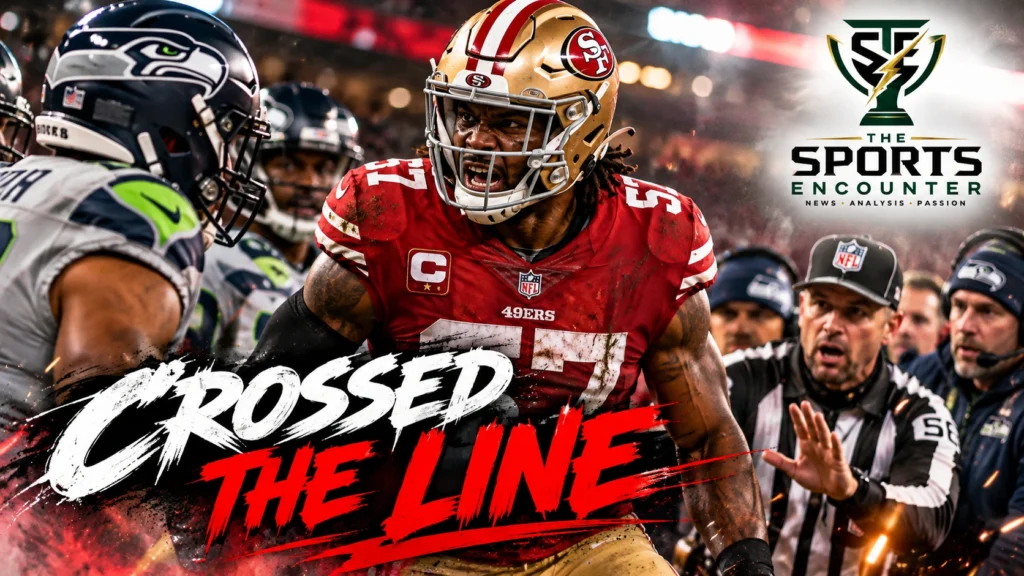
SAN FRANCISCO, United States, October 13, 2026: The San Francisco 49ers have won five consecutive games to begin the NFL season, but linebacker Dre Greenlaw has given the unbeaten franchise an entirely avoidable problem. One headbutt during Sunday’s 32-29 victory over the Seattle Seahawks has resulted in a one-game suspension, potentially depriving San Francisco of an important defensive contributor against the Washington Commanders.
The NFL announced the punishment Monday after Greenlaw headbutted Seattle linebacker Ernest Jones IV during a sideline confrontation in the second quarter.
Jones was not wearing a helmet. The collision left him bleeding, and Greenlaw was ejected from the game.
The confrontation developed after Greenlaw delivered a late hit on Seahawks quarterback Sam Darnold, who had already moved out of bounds. Seattle players confronted the 49ers defender, and the situation escalated when Greenlaw struck Jones with his helmet.
The incident has now become more than a moment of indiscipline in a fiercely contested NFC West rivalry.
Greenlaw’s punishment threatens San Francisco’s defensive continuity at a time when the 49ers have established themselves among the NFL’s strongest teams.
It also adds another episode to the linebacker’s disciplinary history, raising questions about whether his aggressive approach can be maintained without repeatedly exposing his team to unnecessary consequences.
The issue is not whether Greenlaw should play physical football. That is fundamental to his position.
The question is whether he can consistently separate legitimate defensive aggression from conduct that damages his team’s interests.
Why Was Dre Greenlaw Suspended?
The NFL imposed a one-game suspension without pay for unsportsmanlike conduct during San Francisco’s Week 5 victory in Seattle.
According to the league, Greenlaw violated Rule 12, Section 3, Article 1, which prohibits acts contrary to generally understood principles of sportsmanship.
The punishment relates specifically to his helmeted headbutt against Jones during the confrontation.
The sequence began when Darnold scrambled toward the sideline during the second quarter.
Greenlaw contacted the quarterback late, after Darnold had moved out of bounds. Officials assessed a personal foul.
Seattle defenders then confronted Greenlaw near their sideline. During the exchange, Greenlaw headbutted Jones, who was not wearing his helmet.
The officials ejected Greenlaw after reviewing the incident.
The league’s subsequent disciplinary announcement confirmed that the conduct warranted a suspension.
The NFL’s official account of Greenlaw’s suspension establishes the punishment, the circumstances of the headbutt and his right to appeal.
Dre Greenlaw Suspension: Key Facts
| Detail | Confirmed Information |
|---|---|
| Player | Dre Greenlaw |
| Team | San Francisco 49ers |
| Opponent | Seattle Seahawks |
| Game date | October 11, 2026 |
| Final score | 49ers 32, Seahawks 29 |
| Incident | Headbutt on Ernest Jones IV |
| On-field punishment | Ejection |
| League punishment | One-game suspension without pay |
| Applicable rule | Rule 12, Section 3, Article 1 |
| Scheduled game affected | 49ers vs. Washington Commanders, October 19 |
| Potential return | October 20, if the suspension is upheld |
| Appeal eligibility | Yes |
Greenlaw has the right to challenge the punishment under the collective bargaining agreement.
Therefore, while the NFL has formally imposed the suspension, his absence against Washington remains subject to the outcome of any appeal.
What Happened During the Greenlaw-Ernest Jones IV Confrontation?
The incident occurred during a heated divisional contest between two teams with substantial recent competitive history.
Seattle entered the season as the defending Super Bowl champion. San Francisco arrived unbeaten and attempting to strengthen its position in the NFC West.
The atmosphere was already intense because the result carried important divisional consequences.
When Darnold scrambled out of bounds and Greenlaw made late contact, the immediate confrontation was predictable.
Quarterbacks receive specific protections under NFL rules, and defenders are expected to recognize when the ball carrier has left the field of play.
The initial penalty was therefore a football issue involving the timing and legality of contact.
The subsequent headbutt was different.
Greenlaw was no longer attempting to tackle an active ball carrier or defend a live play. He was participating in a confrontation after the whistle.
That distinction is central to understanding the league’s punishment.
Physical contact during football plays is governed by rules intended to permit legitimate tackles and blocks while reducing unnecessary danger.
Striking another player during an altercation falls outside that competitive purpose.
Why Jones Not Wearing a Helmet Made the Incident More Serious
The difference in protective equipment is a critical detail.
Greenlaw was wearing his helmet when he struck Jones, whose head was unprotected.
The confrontation therefore involved unequal protection at the point of contact.
Jones was left bleeding, making the immediate physical consequence visible.
That does not establish a specific medical diagnosis beyond what has been publicly reported, but it reinforces why the action required disciplinary scrutiny.
The NFL is responsible for permitting forceful competition while preventing conduct that creates unnecessary risks outside the play.
In this case, the headbutt did not contribute to stopping a runner, preventing a completion or defending the goal line.
It created a disciplinary problem that could have been avoided entirely.
The NFL’s official video of Greenlaw’s ejection provides additional visual context for the confrontation.
The 49ers Won the Game but Created a Problem for Week 6
San Francisco’s 32-29 victory improved its record to 5-0.
That continuation of its unbeaten start should have been the dominant sporting story following the contest.
Instead, Greenlaw’s conduct introduced an additional concern before the team’s October 19 meeting with Washington.
The 49ers are not merely losing the services of a rotational defender if the suspension stands.
They face the potential absence of a veteran linebacker who has recorded 37 tackles through the opening five games.
Greenlaw returned to San Francisco for the 2026 campaign after spending the previous season with Denver.
His familiarity with the organization and defensive expectations gives him value beyond his individual tackle production.
Linebackers must interpret offensive formations, recognize developing runs, communicate coverage responsibilities and react quickly when a quarterback changes the play.
Those assignments demand knowledge of the system and coordination with teammates.
Removing an experienced player can therefore change the responsibilities of several defenders.
San Francisco has already demonstrated its ability to compensate for setbacks.
The Sports Encounter’s Week 5 NFL power rankings placed the 49ers first after four games, reflecting their outstanding balance between results, offensive execution and defensive performance.
The victory over Seattle strengthened that assessment.
Greenlaw’s suspension now presents a new test of the roster depth supporting those results.
Why Greenlaw Matters to San Francisco’s Defensive Structure
Greenlaw has recorded 37 tackles in five games during the current season.
That is an average of 7.4 tackles per appearance.
The total demonstrates his involvement in San Francisco’s defensive activity, although tackle counts alone cannot establish the quality of every assignment.
Linebacker performance must also be evaluated through positioning, missed tackles, coverage responsibilities and the ability to help teammates maintain defensive structure.
Greenlaw’s return to the 49ers provided another experienced option alongside a defense that has already been asked to manage several personnel challenges.
San Francisco began the season with questions surrounding the availability of important veterans, including Nick Bosa and George Kittle.
The Sports Encounter examined those concerns in its analysis of Bosa and Kittle’s return preparations before the historic Melbourne opener.
The opening weeks subsequently demonstrated San Francisco’s ability to perform despite demanding travel and injury concerns.
But the nature of Greenlaw’s potential absence is different.
An injury is generally outside a player’s immediate control once it occurs. A suspension resulting from an altercation is a disciplinary consequence.
Both create roster-management problems, but they should not be treated as identical circumstances.
What Changes Without Greenlaw?
The 49ers may need to redistribute linebacker responsibilities if the suspension is upheld.
That could affect how the defense approaches running plays, short passing routes, blitz assignments and communication between the defensive front and secondary.
Opponents frequently test replacement players early, particularly when an established starter or prominent rotational defender becomes unavailable.
Washington could attempt to identify situations in which a replacement linebacker is responsible for coverage against a running back or tight end.
It might also try to create difficult run fits through motion and formation changes.
Those are tactical possibilities rather than confirmed plans.
San Francisco’s coaching staff must prepare for them by ensuring that its available linebackers understand their assignments and communicate consistently.
The 49ers’ broader defensive depth will determine how much flexibility remains available.
San Francisco’s Perfect Start Makes Discipline More Important
The 49ers have opened 2026 with five consecutive victories.
Their success began with a 27-7 defeat of the Los Angeles Rams in Melbourne, the NFL’s first regular-season game in Australia.
The Sports Encounter’s report on San Francisco’s Melbourne victory examined how Brock Purdy and a decisive goal-line stand turned that opener into a convincing divisional win.
The 49ers then defeated Miami, Arizona, Denver and Seattle.
The variety of those victories suggests that San Francisco has multiple ways to win.
Against Miami, the offense produced touchdowns on its first five possessions.
The Sports Encounter’s Week 2 review documented how Purdy’s efficient passing and Christian McCaffrey’s contributions helped the 49ers defeat the Dolphins 35-13.
That offensive consistency reduces the burden on the defense.
However, San Francisco cannot assume its offense will perform at that level every week.
There will be games in which defensive stops, field position and controlling the running game determine the outcome.
Those are precisely the situations in which experienced linebackers can be particularly valuable.
When a team is competing for a strong playoff position, even one unnecessary absence can become important.
A single defeat does not necessarily transform a season, but losses can influence divisional standings, playoff seeding and potential postseason home-field advantages.
San Francisco’s immediate objective should be to prevent the Greenlaw incident from affecting the team’s performance against Washington.
Dre Greenlaw’s Previous Suspensions and Sideline Controversies
The latest incident is not Greenlaw’s first disciplinary controversy.
In October 2025, while playing for the Denver Broncos, he received a one-game suspension after an incident involving an official following a victory over the New York Giants.
The league said Greenlaw chased referee Brad Allen and verbally threatened him as the official was leaving the field.
That incident differs substantially from the confrontation with Jones.
One involved alleged threats toward an official. The other involved physical contact with an opposing player during an altercation.
Both resulted in disciplinary action, but each must be considered according to its own circumstances.
The 2023 Eagles Sideline Incident
Greenlaw was also involved in a notable sideline confrontation against Philadelphia during the 2023 season.
The incident involved Eagles head of security Dom DiSandro, who physically intervened as Greenlaw and other players were involved in an altercation near the sideline.
Both men were instructed to leave the field.
The NFL subsequently reminded teams that nonplaying personnel must not involve themselves physically in on-field confrontations.
The league’s response acknowledged responsibilities extending beyond the players involved.
That historical episode provides context for Greenlaw’s disciplinary record, but it would be inaccurate to describe every confrontation as entirely his responsibility without considering the actions of others.
Earlier in his career, Greenlaw was also ejected for an illegal hit on Chargers quarterback Justin Herbert in 2022.
Those incidents should not be combined into one unsupported claim about his intentions or personality.
They do, however, establish a history of occasions when the linebacker has crossed disciplinary boundaries.
Does Repeated Discipline Create a Competitive Liability?
Repeated incidents matter because they can influence a player’s availability.
Greenlaw’s role requires controlled aggression.
He must react rapidly, attack running lanes, pursue ball carriers and challenge opponents physically.
San Francisco does not benefit if those qualities disappear.
But the team also gains nothing from an action that removes him from the field after a play has already ended.
The distinction between effective aggression and unnecessary confrontation is therefore not merely philosophical.
It has practical consequences for roster availability and defensive planning.
Greenlaw’s earlier disciplinary history makes the latest incident particularly difficult to dismiss as an entirely isolated event.
Nevertheless, the current punishment should be evaluated according to the specific conduct and the NFL’s applicable rules, not an assumption that previous incidents automatically determine the correct penalty.
Can Dre Greenlaw Appeal His One-Game Suspension?
Yes. The NFL confirmed that Greenlaw may appeal the suspension under the collective bargaining agreement.
The right to appeal matters because a league announcement is not necessarily the final step in the disciplinary process.
Possible outcomes include the suspension being upheld or modified through the applicable process.
There is no basis to claim that Greenlaw has successfully appealed or that the announced punishment has been overturned without confirmation.
As of the October 12 announcement, the scheduled consequence is a one-game absence against Washington on October 19.
If the punishment stands, Greenlaw would become eligible to return to the active roster on October 20.
That timeline is important for San Francisco’s preparation.
The team must plan for the possibility of playing without him while remaining prepared to adjust if the disciplinary outcome changes.
How Does the NFL Approach Player Discipline?
The league uses different rules and procedures to address unsportsmanlike conduct, unnecessary roughness and player-safety violations.
The relevant disciplinary framework depends on the specific offense.
Greenlaw’s latest suspension concerns a headbutt during a confrontation rather than an ordinary tackling action during live play.
That is an important distinction because the NFL and NFL Players Association have also introduced additional emphasis on certain dangerous tackling techniques.
The NFL and NFLPA’s joint explanation of the 2026 player-safety disciplinary changes identifies five emphasized categories, including hip-drop tackles, horse-collar tackles, launching, hits on defenseless players and blindside blocks.
Those changes should not be confused with the specific sportsmanship rule cited in Greenlaw’s headbutting suspension.
The shared objective is accountability, but different violations may involve different standards and procedures.
Why the NFL Must Draw a Clear Line Between Physicality and Misconduct
Football is a contact sport in which defenders are expected to use controlled force.
That expectation makes disciplinary consistency especially important.
Players need to understand which actions are legitimate parts of competition and which conduct falls outside acceptable boundaries.
Late contact on a quarterback who has moved out of bounds is one category of violation.
Headbutting an opposing player after the play has stopped is another.
Greenlaw’s incident involved both within the same sequence.
The league’s response illustrates why the distinction matters.
A defender can be highly effective and still commit a serious disciplinary offense.
A team can respect a player’s competitiveness while acknowledging that specific conduct damaged its interests.
Those conclusions are compatible.
San Francisco should therefore evaluate Greenlaw’s behavior without confusing accountability with a demand that he become less physical during legitimate football plays.
The same distinction applies to the broader league.
Player safety requires clear enforcement, while effective defense requires that lawful tackling remain possible.
Coaches, officials and players all have responsibilities in maintaining that balance.
What Does the Suspension Mean for the NFC West Race?
San Francisco’s unbeaten record places it in an excellent early position.
Seattle remains a dangerous divisional opponent despite Sunday’s defeat.
The Seahawks entered the season defending the Super Bowl title they won earlier in 2026.
The Sports Encounter’s NFL season-opening analysis examined how Seattle’s championship defense and San Francisco’s ambitions could reshape the NFC title race.
The 49ers have now earned a particularly valuable head-to-head result.
But the division will not be settled in October.
Teams must manage injuries, travel demands, changing opponents and personnel availability throughout the remaining schedule.
San Francisco has already faced an unusually demanding opening period after playing its first game in Melbourne.
That international trip placed additional emphasis on preparation and player recovery.
Our early-season NFL injury analysis documented how injuries to players including 49ers receiver De’Zhaun Stribling complicated the opening weeks.
Those setbacks explain why preserving healthy, available contributors is especially important.
Greenlaw’s potential suspension creates a different form of roster shortage, but its competitive effect could still be meaningful.
Against Washington, the 49ers need their available defenders to perform consistently rather than allowing the incident to become a continuing distraction.
San Francisco’s Next Game: What Washington Could Test
The 49ers are scheduled to face the Washington Commanders on Monday, October 19.
If Greenlaw serves his suspension, Washington will encounter a San Francisco defense forced to adjust its linebacker responsibilities.
The Commanders could attempt to exploit coverage matchups through their running backs and tight ends.
They may also test the linebackers’ run fits by changing formations and using movement before the snap.
Those strategies are possibilities, not confirmed elements of Washington’s game plan.
San Francisco’s response should depend on the strengths of its available personnel.
A coaching staff can compensate for a missing linebacker by adjusting assignments, using different defensive packages or redistributing communication responsibilities.
However, every adjustment carries potential trade-offs.
Adding defensive backs can improve coverage in some situations but may reduce the size of the personnel available against the run.
Using additional linebackers may improve certain run responsibilities while creating different passing-game matchups.
The 49ers must select the combinations that best address Washington’s offense without sacrificing their established defensive strengths.
The Sports Encounter’s report on San Francisco’s training-camp depth building demonstrated that the organization had already been working to manage roster uncertainty before the season began.
That earlier move concerned the offensive line, but it illustrates the broader importance of maintaining reliable options across the roster.
Depth becomes particularly valuable when an important player is unavailable unexpectedly.
What Should the 49ers Do About Greenlaw’s Discipline?
San Francisco faces two separate decisions.
The immediate task is preparing its defense for Washington.
The longer-term challenge is ensuring that Greenlaw’s aggressive playing style does not repeatedly create avoidable suspensions or ejections.
Both require practical responses.
Coaches can review the incident, reinforce expectations about post-play conduct and establish clearer boundaries during confrontations.
They can also work with players to recognize situations in which responding to provocation creates a greater competitive cost than walking away.
Such measures would not require Greenlaw to abandon the physical traits that make him effective.
They would instead aim to preserve those qualities within the rules.
San Francisco’s leadership must also communicate consistently that individual frustration cannot take priority over team availability.
When a player is removed from a game, teammates inherit additional responsibility.
When that removal leads to a suspension, the consequences extend into another week of preparation.
Those effects are measurable, even when their ultimate impact on the result remains uncertain.
Frequently Asked Questions
Why Was Dre Greenlaw Suspended by the NFL?
Greenlaw received a one-game suspension for unsportsmanlike conduct after headbutting Seattle Seahawks linebacker Ernest Jones IV during an October 11, 2026 game.
Was Dre Greenlaw Ejected Against Seattle?
Yes. Officials ejected him during the first half after the sideline confrontation.
Who Did Dre Greenlaw Headbutt?
He headbutted Seattle linebacker Ernest Jones IV, who was not wearing a helmet at the time.
What Started the Greenlaw-Seahawks Confrontation?
Greenlaw delivered a late hit on quarterback Sam Darnold after Darnold had moved out of bounds. Seattle players confronted Greenlaw, and the incident escalated.
How Long Is Dre Greenlaw Suspended?
The NFL imposed a one-game suspension without pay, subject to his right to appeal.
Which Game Could Dre Greenlaw Miss?
If the suspension stands, Greenlaw will miss San Francisco’s October 19 meeting with the Washington Commanders.
Can Dre Greenlaw Appeal His Suspension?
Yes. The NFL confirmed that he may appeal under the collective bargaining agreement.
Has Greenlaw Been Suspended Before?
Yes. He received a one-game suspension in October 2025 following an incident involving an official while playing for Denver.
What Is the 49ers’ Record After Beating Seattle?
San Francisco is 5-0 following its 32-29 victory over the Seahawks.
How Many Tackles Has Greenlaw Recorded in 2026?
He has recorded 37 tackles through five games, according to NFL statistics.
Final Analysis: San Francisco Cannot Afford to Turn Strength Into a Weakness
Dre Greenlaw’s aggressive style has been an important part of his NFL identity.
His willingness to tackle decisively, pursue ball carriers and compete physically helps explain his value to San Francisco.
But that value depends on his availability.
The 49ers have won their first five games and demonstrated enough offensive and defensive depth to emerge as one of the leading early contenders.
Greenlaw’s ejection did not prevent them from defeating Seattle.
His possible absence against Washington presents a different test.
The latest incident also follows previous disciplinary controversies, creating a legitimate reason for San Francisco to reinforce expectations about conduct after the whistle.
Greenlaw does not need to become a less aggressive linebacker.
He needs to ensure that his aggression remains directed toward legitimate football responsibilities.
The 49ers have already shown they can overcome physical setbacks and demanding circumstances.
They should not be forced to repeatedly overcome preventable disciplinary problems as well.
For an unbeaten team pursuing a deep postseason run, every available defender matters.
And in Greenlaw’s case, one moment after the play may cost San Francisco more than the play itself.