


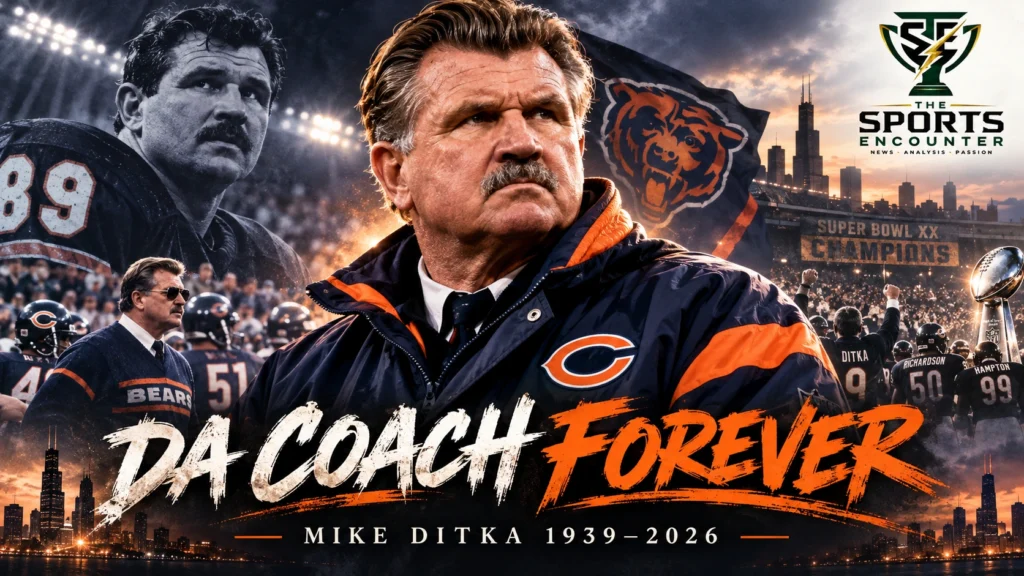
CHICAGO, United States, October 9, 2026: Mike Ditka, the Hall of Fame tight end who helped the Chicago Bears win the 1963 NFL championship and later coached their unforgettable 1985 team to Super Bowl glory, has died at the age of 86. His family announced his death Friday morning, bringing an end to one of the most remarkable lives in American football. Known as “Iron Mike” and “Da Coach,” Ditka transformed the tight end position, won championships as a player and coach, and became so deeply associated with Chicago that his name eventually seemed inseparable from the city’s sporting identity. His family has not disclosed a cause of death.
Ditka’s passing leaves Chicago mourning the man who connected its last two NFL championship teams, two generations separated by 22 years and profoundly different eras of professional football. He played for George Halas, learned coaching under Tom Landry, led Walter Payton and one of history’s greatest defenses, and became a national celebrity whose mustache, sunglasses and sideline fury inspired an enduring television phenomenon. Tributes poured in from former players, coaches, broadcasters and rival franchises on Friday. Yet behind the familiar public image was a more complicated individual: an innovative football mind, a fierce competitor, an occasionally divisive leader and, later in life, an advocate for retired players struggling with the physical and financial consequences of the sport.
Mike Ditka’s Life and Football Career at a Glance
| Milestone | Detail |
|---|---|
| Full name | Michael Keller Ditka |
| Birth name | Michael Keller Dyczko |
| Born | October 18, 1939, Carnegie, Pennsylvania |
| Died | October 9, 2026, aged 86 |
| College | University of Pittsburgh |
| NFL Draft | 1961, fifth overall, Chicago Bears |
| Playing position | Tight end |
| Playing career | 1961-1972 |
| NFL teams | Chicago Bears, Philadelphia Eagles, Dallas Cowboys |
| Career receiving statistics | 427 receptions, 5,812 yards, 43 touchdowns |
| Pro Bowl selections | Five |
| Chicago’s 1963 NFL championship | Won as a Bears player |
| Super Bowl VI | Won as a Dallas Cowboys player |
| Super Bowl XII | Won as a Dallas Cowboys assistant coach |
| Super Bowl XX | Won as Chicago Bears head coach |
| Bears head coaching tenure | 1982-1992 |
| Saints head coaching tenure | 1997-1999 |
| Career regular-season coaching record | 121 wins, 95 losses |
| Pro Football Hall of Fame | Class of 1988 |
| Chicago Bears retired number | No. 89, retired in 2013 |
His death was confirmed by the Chicago Bears in their official remembrance. The organization recognized both his role in bringing championships to the city and his decades-long connection with generations of supporters.
From Dyczko to Ditka: How a Pennsylvania Boy Became the Face of Chicago
Before Chicago knew him as Da Coach, he was Michael Keller Dyczko, the son of a working-class Pennsylvania family with Ukrainian roots.
He was born in Carnegie, outside Pittsburgh, and grew up in nearby Aliquippa, a community shaped by steel mills, industrial labor and the competitive culture of western Pennsylvania football.
The family’s surname was changed from Dyczko to Ditka while Mike was young, creating the name that would eventually become one of the most recognizable in American sports.
It is an extraordinary piece of cultural history. A family name simplified in Pennsylvania would eventually become almost synonymous with Chicago, a city that embraced Ditka’s stubbornness, work ethic and willingness to confront anyone standing in his way.
His upbringing helped shape the image he would later carry into professional football.
He understood physical work. He embraced competition. He respected toughness and expected teammates to do the same.
Those qualities served him well at the University of Pittsburgh, where he emerged as an outstanding football prospect and earned All-American recognition.
When Chicago selected him with the fifth overall pick in the 1961 NFL Draft, the Bears acquired a player whose attitude seemed perfectly suited to the franchise George Halas had built.
They also acquired someone who would change how an entire position was played.
How Mike Ditka Helped Revolutionize the Tight End Position
When Ditka entered the NFL in 1961, tight ends were still widely associated with blocking responsibilities.
The position certainly required receiving ability, but most offenses did not treat the tight end as a primary downfield weapon.
Ditka challenged that conventional approach almost immediately.
As a rookie, he caught 56 passes for 1,076 yards and 12 touchdowns.
Those were extraordinary numbers for his position, particularly in an era when NFL offenses were generally less dependent on high-volume passing than today’s teams.
He became the first tight end in league history to surpass 1,000 receiving yards in a season and received NFL Rookie of the Year honors.
His physical approach made him difficult to tackle after the catch, while his blocking ability prevented defenses from treating him exclusively as a receiver.
That combination gave opposing teams a difficult problem.
If they defended him primarily as a blocker, Ditka could punish them as a receiving threat. If they concentrated on preventing receptions, he remained capable of making an impact in the running game.
In 1964, he caught 75 passes, establishing a single-season tight end record that lasted until 1980.
He earned five consecutive Pro Bowl selections during his first five NFL seasons and became one of the position’s defining early stars.
What Did Ditka’s Playing Career Look Like in Numbers?
Across 12 NFL seasons, Ditka recorded 427 receptions, 5,812 receiving yards and 43 receiving touchdowns.
He played six seasons in Chicago, two with Philadelphia and four with Dallas.
At retirement, he ranked second among NFL tight ends in career receptions.
His numbers require historical perspective.
Modern tight ends routinely operate in passing offenses with far greater volume, different protections and more favorable receiving conditions. Comparing raw totals without recognizing those changes would undervalue the difficulty of Ditka’s achievements.
His contribution lies partly in making the modern receiving tight end possible.
The Pro Football Hall of Fame’s official career record documents the remarkable productivity of his early seasons and his eventual induction into Canton in 1988.
Ditka became the first tight end to receive that honor.
That distinction remains one of his most important contributions to football history.
1963: The First Championship That Connected Ditka to Chicago Forever
Ditka’s first great championship moment arrived during his third NFL season.
The Bears faced the New York Giants in the 1963 NFL Championship Game, played at Wrigley Field in Chicago.
It was an intensely contested game in difficult conditions, with neither offense able to dominate consistently.
Chicago won 14-10, securing its first NFL championship since 1946.
Ditka caught three passes for 38 yards as the Bears completed a season built on defense, disciplined football and the leadership of George Halas.
The victory gave Ditka his first NFL title and established him as part of Chicago’s championship history.
What nobody could have predicted was that he would return more than two decades later to lead the franchise to its next championship.
He became the unique connection between those two teams.
The 1963 title belonged to an NFL that had not yet entered the Super Bowl era. The 1985 championship belonged to a national television spectacle with growing commercial reach and an entirely different cultural significance.
Ditka experienced both.
Dallas Gave Ditka Another Championship and the Coaching Education He Needed
Ditka’s playing career took him from Chicago to Philadelphia in 1967 and then to Dallas in 1969.
His final four seasons came with the Cowboys, where he added another championship to his record.
Dallas defeated the Miami Dolphins 24-3 in Super Bowl VI after the 1971 season.
Ditka caught a touchdown pass in that victory, providing a memorable contribution near the end of his playing career.
He retired following the 1972 season and moved into coaching under Tom Landry.
The Cowboys offered him an education in organization, preparation and the demands of sustaining success across multiple seasons.
Ditka was part of Dallas’ coaching staff when the Cowboys defeated the Denver Broncos in Super Bowl XII following the 1977 season.
He had now won championships as both a player and assistant coach.
Those experiences helped prepare him for the position that would define his public life.
In 1982, the Chicago Bears brought him back as head coach.
Ditka was returning to a city that remembered his playing career but had spent nearly two decades waiting for another NFL championship.
He had an opportunity to change that.
1985 Chicago Bears: The Team That Made Mike Ditka Immortal
Three seasons of rebuilding and growing expectations eventually produced the team that would define Ditka’s coaching career.
The 1985 Chicago Bears became one of the most dominant and recognizable teams in NFL history.
They finished the regular season 15-1.
The defense overwhelmed opponents with relentless pressure, physical tackling and a tactical system that repeatedly disrupted quarterbacks before they could establish a passing rhythm.
Walter Payton remained the emotional and footballing center of the offense. Jim McMahon provided leadership at quarterback. Players such as Mike Singletary, Richard Dent, Dan Hampton, Gary Fencik and William Perry helped create a team that combined exceptional talent with enormous personality.
Ditka presided over all of it.
His demanding approach suited a squad that thrived on competition, confidence and confrontation.
The Bears defeated the New York Giants 21-0 and the Los Angeles Rams 24-0 in the playoffs.
Then came Super Bowl XX.
Super Bowl XX: Chicago 46, New England 10
On January 26, 1986, Chicago met the New England Patriots at the Louisiana Superdome in New Orleans.
The Bears won 46-10.
The score remains the defining number of Ditka’s coaching career.
Chicago’s defense recorded seven sacks, restricted New England to seven rushing yards and scored through both an interception return and a safety.
The offense contributed with rushing touchdowns from Matt Suhey, Jim McMahon and William Perry, along with efficient control of the contest.
The result completed an 18-1 season, including the playoffs.
For Chicago, it was the franchise’s first championship since 1963.
For Ditka, it was another opportunity to celebrate a title with the same organization he had helped lead to victory as a player 22 years earlier.
The achievement made him the only person in the NFL’s modern era to win a league championship as both a player and head coach of the same team.
Buddy Ryan’s Defense Deserves Its Place in the Story
Any serious assessment of the 1985 Bears must also recognize defensive coordinator Buddy Ryan.
Ryan’s aggressive 46 defense was essential to the team’s identity and success.
Its pressure packages, attacking defensive front and ability to overwhelm protection schemes helped produce one of the greatest defensive seasons in football history.
Ditka was the head coach and ultimate leader of the team, but Ryan deserves substantial credit for developing and directing the defense.
The two men did not always enjoy a harmonious working relationship. Their personalities and methods sometimes clashed.
Yet the combination helped produce a championship team whose influence extended far beyond the 1985 season.
This distinction matters when remembering great coaches. Championship football requires talent, collaboration, preparation and outstanding specialists working within a larger organization.
Ditka gave the Bears a forceful public identity and demanded results. Ryan gave their defense a system that made opponents fearful.
Chicago benefited from both.
Walter Payton, the 1985 Bears and the Human Side of a Legendary Team
The 1985 Bears possessed personalities large enough to become famous independently of their football achievements.
Walter Payton, widely regarded as one of the greatest running backs in NFL history, was already an established Chicago icon.
He represented excellence, durability and professionalism throughout a career that extended beyond Ditka’s championship season.
His relationship with the team also provides a reminder that legendary victories can contain complicated individual memories.
Payton did not score a touchdown in Super Bowl XX, even as teammate William Perry received a celebrated goal-line opportunity.
That decision became a lasting part of the discussion surrounding Ditka’s coaching choices.
It does not diminish the championship, but it adds necessary complexity to the familiar images of players carrying Ditka from the field.
Matt Suhey, another essential contributor to the Bears’ success, worked alongside Payton in an effective backfield combination.
The significance of their partnership has survived into the present era.
When Kyle Monangai and D’Andre Swift each rushed for more than 100 yards against Philadelphia in 2025, they became the first Chicago backfield pairing to accomplish that feat since Payton and Suhey in 1985.
That historical connection resurfaced in TSE’s examination of the Bears’ 2026 backfield and Monangai’s injury concerns.
Four decades later, the achievements of Ditka’s players remain reference points for new generations.
Why the 1985 Bears Became Bigger Than Football
The championship made Ditka a Chicago hero. Television and popular culture subsequently made him a national character.
The mustache, sunglasses, sweater vests, cigars and fierce sideline expressions became instantly recognizable.
Ditka frequently argued with officials, challenged players and displayed his emotions in ways that made him impossible to ignore.
His personality became part of the entertainment surrounding the NFL.
Then came Saturday Night Live.
The show’s famous Chicago Superfans sketches transformed the city’s football obsession into a recurring comedy phenomenon.
The characters’ exaggerated accents, devotion to Ditka and unwavering predictions of Bears success helped popularize the phrase “Da Bears” nationwide.
Ditka eventually appeared in the sketches himself, demonstrating that he could participate in the humor surrounding his own public image.
His influence extended beyond television.
Restaurants carrying his name became part of Chicago’s dining and sports culture. He worked as a football broadcaster and television analyst, appearing on major national networks after his coaching career.
He also appeared in the 2005 comedy film Kicking & Screaming alongside Will Ferrell.
Few professional football coaches have crossed into popular culture so completely.
Ditka became recognizable to people who had never watched him play and had never seen the 1985 Bears.
That recognition was built on a personality that Chicago considered unmistakably its own.
The Difficult Years: Why Mike Ditka’s Legacy Is More Complicated Than the 1985 Championship
The Bears remained competitive for several seasons after their Super Bowl victory, but Ditka never led them to another championship.
He won NFL Coach of the Year honors in both 1985 and 1988, and Chicago reached the playoffs repeatedly during his tenure.
His relationship with the organization eventually deteriorated, however.
Disagreements, clashes over personnel and declining results contributed to his departure after the 1992 season.
His coaching career in Chicago ended with 106 regular-season victories.
Ditka returned to NFL coaching in 1997 with the New Orleans Saints.
The second head coaching chapter was considerably less successful.
New Orleans went 15-33 over three seasons, and his tenure became closely associated with one of the most controversial draft trades in NFL history.
The Ricky Williams Trade That Became a Warning About Roster Building
In 1999, the Saints committed enormous draft capital to acquire the fifth overall selection and choose Texas running back Ricky Williams.
The trade involved the team’s remaining 1999 draft selections and additional premium picks from the following year.
It represented an extraordinary concentration of resources in a single player.
Williams later enjoyed a productive NFL career, but the immediate transaction left New Orleans with fewer opportunities to improve other positions.
The Saints finished the 1999 season 3-13, and Ditka was dismissed.
His New Orleans experience remains an important cautionary chapter in his career.
The same conviction and willingness to act decisively that helped define his Chicago success did not consistently translate into effective roster management.
His sideline anger, outspoken public comments and sometimes abrasive treatment of others also attracted criticism throughout his coaching and broadcasting years.
Remembering Ditka fairly requires acknowledging those shortcomings alongside his achievements.
He was a remarkable football figure whose methods and personality could inspire fierce loyalty while also creating friction.
The Work Mike Ditka Did for Retired NFL Players
Ditka’s contribution to football continued long after he stopped coaching.
One of his most meaningful later roles involved helping retired professional football players who were struggling financially or medically.
In 2008, he became chairman of the Gridiron Greats Assistance Fund, expanding work intended to provide practical assistance to former players facing hardship.
The organization supports retired athletes who may lack sufficient medical coverage, disability benefits or financial resources after careers spent helping build professional football into a major American industry.
Its work includes medical assistance, financial support and help with essential living expenses.
The issue was particularly important for players from earlier generations who competed before modern NFL contracts and benefits reached their current scale.
Ditka understood that many of the men who made the league popular had not shared proportionately in its subsequent financial growth.
His involvement with their welfare adds another dimension to his legacy.
He was remembered for demanding toughness from players, but he also recognized that the consequences of football could remain long after their careers ended.
That human cost remains an important subject in modern football.
During the 2026 Pro Football Hall of Fame ceremony, covered in depth by TSE, Roger Craig’s disclosure of vascular dementia brought renewed attention to the physical and emotional consequences experienced by some former players.
Ditka’s support for struggling NFL veterans belongs within that wider conversation about the responsibilities professional sports organizations have toward those who built their success.
Chicago and the NFL Mourn Mike Ditka: Tributes Pour In
The announcement of Ditka’s death prompted a wave of tributes from across professional football.
Jarrett Payton, the son of Bears legend Walter Payton, shared the family’s announcement and paid tribute to the man who had coached his father.
His message captured the emotional significance of the loss:
“Chicago won’t be the same.”
The Bears issued a statement recognizing Ditka’s decades of contributions as a player, coach and ambassador for the franchise.
The Pro Football Hall of Fame highlighted both his toughness and the technical ability that made him one of the most influential tight ends in NFL history.
NFL Commissioner Roger Goodell also paid tribute to the passion and intensity that characterized Ditka’s involvement with the game.
Current Bears coach Ben Johnson described Ditka as a standard against which Chicago coaches are judged, acknowledging the extraordinary expectations created by his achievements.
Green Bay Packers coach Matt LaFleur offered condolences ahead of Sunday’s meeting between the Packers and Bears, adding a poignant dimension to one of the league’s oldest rivalries.
Detroit Lions coach Dan Campbell shared personal memories of encountering Ditka earlier in his football career.
The New Orleans Saints, Philadelphia Eagles, Dallas Cowboys and other NFL organizations also remembered his contributions.
Former Chicago White Sox manager Ozzie Guillen recalled Ditka’s friendship and the conversations they had shared over the years.
For former colleagues, he was a formidable competitor and influential mentor. For Bears fans, he represented the memory of a championship generation that has remained central to the franchise’s identity for four decades.
The NFL’s official collection of tributes documents the responses from teams, players and coaches following Friday’s announcement.
Chicago’s 2026 Bears Still Live in the Shadow of Ditka’s Championship
The remarkable thing about the 1985 Bears is how often their achievements continue to shape conversations about today’s team.
Chicago has produced talented players and competitive seasons since Ditka’s championship, but the franchise has never won another Super Bowl.
The current team entered 2026 with a different identity under Ben Johnson.
Its opening victory against Carolina was an extraordinary offensive performance. Chicago scored 59 points in a 59-37 win, with Caleb Williams contributing four total touchdowns and the running game overwhelming the Panthers.
Our analysis of Chicago’s 59-point opening statement examined a Bears offense very different from the defense-first team that dominated in 1985.
One week later, Chicago managed only three points in a loss to Minnesota, a reversal covered in TSE’s Week 2 analysis of the Bears’ offensive collapse.
By Week 4, the team’s defensive progress had become a more important part of its identity.
Chicago beat the New York Jets 23-12 and improved to 3-1, with Kyle Monangai delivering an outstanding rushing performance. That victory was examined in TSE’s detailed NFL Week 4 report.
Our NFL Week 5 power rankings subsequently placed Chicago sixth, recognizing defensive progress while identifying areas of uncertainty.
These comparisons do not mean the current Bears should be expected to reproduce 1985.
The NFL has changed dramatically in 40 years. Offensive systems, salary-cap management, player development and defensive rules have transformed how championship teams are assembled.
But the standard created by Ditka’s team remains.
Every Chicago roster capable of becoming a contender eventually encounters the same historical question: can this group finally bring another Lombardi Trophy to the city?
It is a question that has outlived multiple coaches, quarterbacks and generations of supporters.
Mike Ditka Returned to Chicago Because It Was Home
One of the most moving details from Ditka’s final years concerns his decision to return to Chicago.
After spending time in Florida, he moved back to the city in November 2024 with his wife, Diana.
The return followed years in which health problems had affected his life, including previous heart-related difficulties and a stroke.
Speaking to the Chicago Sun-Times after relocating, he expressed his happiness at being back.
“I’m finally home!”
The remark was simple, but it explained something that statistics and championship records cannot fully capture.
Ditka had been born in Pennsylvania. He had played in Philadelphia and Dallas, coached in New Orleans and built a national media career.
Yet Chicago remained the city with which he identified most deeply.
He missed its people, its familiarity and the everyday relationships that had developed during his decades there.
His return brought his story almost full circle.
The young tight end who arrived in 1961 had become a champion, coach, celebrity and national football institution.
More than six decades later, he still wanted to be in Chicago.
The Sports Encounter Tribute: Why Mike Ditka Will Be Remembered Long After His Final Game
In the history of American football, Mike Ditka occupies an unusually complete place.
He was an elite player who helped change the possibilities of his position.
He won championships in different roles, learned under two historically important coaches and eventually led one of the greatest teams the NFL has produced.
His achievements crossed generations of the game.
Ditka also demonstrated how a sports figure can become part of a city’s cultural identity. His name, appearance and personality belonged to Chicago in a way that few coaches ever achieve.
He was admired, criticized, celebrated, imitated and occasionally misunderstood.
He made mistakes. His methods did not always work. His career after Chicago never recovered the success of the 1985 championship.
But he also left an influence that cannot be measured entirely through winning percentages or championship rings.
He helped reshape the tight end position, contributed to the growth of professional football, assisted former players in difficult circumstances and gave generations of Chicago supporters memories they continued celebrating long after the games had ended.
The Sports Encounter’s Tributes to the Heroes series recognizes sporting lives for their achievements and the human stories surrounding them.
That principle also guides our tribute to former NFL lineman Trystan Colon, whose quieter career demonstrated that meaningful contributions to the sport are not reserved for Hall of Fame legends.
Ditka’s story stands at the other extreme of football fame, but it deserves the same attention to the person behind the professional record.
He was a steel-town boy whose family name became part of Chicago’s identity.
He played on the Bears’ 1963 championship team and returned to coach their next champion.
He helped make the 1985 Bears unforgettable.
And in his final years, after all the touchdowns, championships, arguments, applause and television appearances, he returned to the city that had embraced him.
Chicago had made Mike Ditka a legend. Mike Ditka had helped make Chicago a championship city.
That relationship will outlive him.
Mike Ditka: Frequently Asked Questions
When Did Mike Ditka Die?
Mike Ditka died on Friday, October 9, 2026. His family confirmed his passing through an announcement shared publicly that morning.
How Old Was Mike Ditka When He Died?
He was 86. Ditka was born on October 18, 1939, and died nine days before his 87th birthday.
What Was Mike Ditka’s Cause of Death?
His family had not publicly disclosed a cause of death as of October 9, 2026. Ditka had experienced significant health problems in earlier years, but those should not be presented as the confirmed cause.
Which Super Bowl Did Mike Ditka Win as Head Coach?
Ditka coached the Chicago Bears to victory in Super Bowl XX on January 26, 1986. Chicago defeated the New England Patriots 46-10 after the 1985 regular season.
Did Mike Ditka Win an NFL Championship as a Player?
Yes. He played on Chicago’s 1963 NFL championship team and later won Super Bowl VI with the Dallas Cowboys after the 1971 season.
How Many Super Bowls Did Mike Ditka Win?
Ditka won three Super Bowls in different roles: Super Bowl VI as a Dallas Cowboys player, Super Bowl XII as a Cowboys assistant coach, and Super Bowl XX as Chicago Bears head coach. He also won the 1963 NFL championship with Chicago before the Super Bowl era.
What Were Mike Ditka’s Career Receiving Statistics?
According to the Pro Football Hall of Fame, Ditka recorded 427 receptions, 5,812 receiving yards and 43 receiving touchdowns during 12 NFL seasons.
When Was Mike Ditka Inducted Into the Pro Football Hall of Fame?
Ditka entered the Pro Football Hall of Fame in 1988, becoming the first tight end inducted into Canton.
Why Was Mike Ditka Called Da Coach?
Ditka’s powerful public personality and success with the Bears made him synonymous with Chicago football. The nickname became nationally famous through the Saturday Night Live Chicago Superfans sketches.
Why Is Mike Ditka So Important to Chicago Bears History?
Ditka was part of the Bears’ 1963 championship team as a player and coached the franchise to its only Super Bowl victory after the 1985 season. He also helped transform the tight end position and became one of the most recognizable figures in Chicago sports history.