


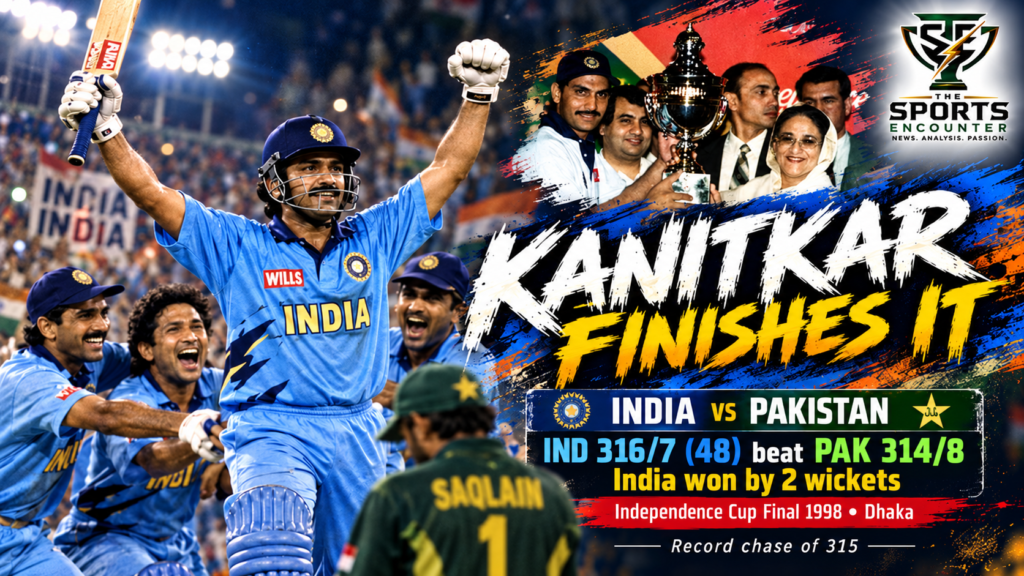
DHAKA, Bangladesh, January 18, 1998: India needed nine runs from the final over of a chase that, by the standards of the time, should never have reached this point.
Sourav Ganguly was gone.
Robin Singh was gone.
Sachin Tendulkar had been gone for almost 40 overs.
Pakistan had recovered from 250/1 to take six wickets for 56 runs, and Saqlain Mushtaq had the ball.
Hrishikesh Kanitkar and Javagal Srinath were left.
The light was fading.
The target was 315.
No team in ODI history had successfully chased that many.
Kanitkar took one.
Srinath scrambled two.
Then two more.
Then a single.
India needed three from two balls.
Saqlain bowled.
Kanitkar swung toward midwicket.
Four.
India 316/7.
Pakistan 314/5.
One ball unused.
The final image belongs to Kanitkar, but India had spent almost 48 overs constructing the possibility he eventually finished.
Ganguly made 124.
Robin Singh, promoted up the order, scored 82.
Tendulkar attacked for 41 from only 26 balls.
Together they took a target that looked enormous in 1998 and made it manageable before another collapse almost gave the trophy back.
That is why India vs Pakistan in Dhaka is Match 47 in A Celebration of 5000 ODIs.
The series roadmap selected it for two reasons: India chased 315 when totals of that size were still exceptional, and Kanitkar struck the championship-winning boundary with one delivery remaining. ICC has also remembered the innings as a then-record chase and the shot that permanently attached Kanitkar’s name to India-Pakistan history. (icc-cricket.com)
TL;DR
- The match was the third and deciding final of the Silver Jubilee Independence Cup.
- India had won the first final by eight wickets.
- Pakistan won the second by six wickets.
- Bad light reduced the deciding game to 48 overs per side.
- India won the toss and chose to field.
- Pakistan scored 314/5.
- Saeed Anwar made 140 from 132 balls.
- Ijaz Ahmed scored 117 from 112.
- Anwar and Ijaz added 230 for the third wicket.
- Harvinder Singh took 3/74.
- India needed 315, which was then beyond any successful ODI chase.
- Sachin Tendulkar attacked for 41 from 26.
- Sourav Ganguly made 124 from 138.
- Robin Singh scored 82 from 83.
- Ganguly and Robin added 179 for the second wicket.
- India reached 250/1 before Pakistan forced a late collapse.
- Saqlain Mushtaq took 3/66.
- India entered the final over needing nine runs.
- With three required from two balls, Hrishikesh Kanitkar hit Saqlain for four.
- India finished 316/7 in 47.5 overs.
- India won by three wickets with one ball remaining.
- Ganguly was Player of the Match.
- Tendulkar was Player of the Series.
- The 315 chase was a world record for the highest successful ODI chase at the time.
India vs Pakistan 1998 Independence Cup Final: Match at a Glance
| Detail | Information |
|---|---|
| Competition | Silver Jubilee Independence Cup 1997-98 |
| Stage | Third and deciding final |
| Date | January 18, 1998 |
| Venue | Bangabandhu National Stadium, Dhaka |
| Match length | 48 overs per side after bad-light reduction |
| Toss | India won and fielded |
| Pakistan | 314/5 in 48 overs |
| India | 316/7 in 47.5 overs |
| Result | India won by three wickets |
| Balls remaining | 1 |
| Player of the Match | Sourav Ganguly |
| Player of the Series | Sachin Tendulkar |
| Pakistan top scorer | Saeed Anwar, 140 |
| India top scorer | Sourav Ganguly, 124 |
| Best Pakistan bowling | Saqlain Mushtaq, 3/66 |
| Best India bowling | Harvinder Singh, 3/74 |
| Record | Highest successful ODI chase at the time |
| Decisive shot | Hrishikesh Kanitkar four off Saqlain Mushtaq |
Why Match 47 Belongs in A Celebration of 5000 ODIs
Modern ODI cricket has altered how 315 feels.
Teams now regularly regard 300 as chaseable.
Scores beyond 350 are no longer freak occurrences.
That was not the ODI landscape of January 1998.
A target of 315 was enormous.
India were attempting something no team had successfully done before.
The difficulty increased because Pakistan had not reached 314 through one isolated innings.
Two batters dominated.
Anwar made 140.
Ijaz made 117.
Their partnership pushed Pakistan from 66/2 to 296/3.
India had dropped chances.
Their bowlers had been punished.
The series itself was level 1-1.
The trophy was at stake.
Then India turned the chase into something that looked almost routine.
At 250/1 after 38.1 overs, the world-record target was suddenly within reach.
Pakistan then made it difficult all over again.
That is the heart of Match 47.
India had to win the same chase twice.
First by making 315 possible.
Then by surviving the collapse that followed.
Saeed Anwar Makes India Pay for Every Chance
Anwar’s innings:
140 runs
132 balls
14 fours
2 sixes
Strike rate: 106.06
For 1998, the combination of volume and tempo was outstanding.
India already knew what Anwar could do.
Less than a year earlier he had scored 194 against them in Chennai, then the highest individual ODI score.
Dhaka produced another major innings.
He controlled the seamers, used the width effectively and ensured Pakistan never allowed India to settle after Shahid Afridi and Aamer Sohail fell relatively early.
The significant detail was not merely Anwar’s scoring.
India gave him opportunities.
Dropped chances allowed Pakistan’s biggest batter to remain.
He punished them.
Ijaz Ahmed Turns 66/2 Into a 230-Run Partnership
Pakistan were not completely secure when Aamer Sohail departed.
Score:
66/2.
India had removed both Afridi and Sohail inside 12 overs.
Ijaz Ahmed then joined Anwar.
What followed nearly decided the final.
Their partnership:
230 runs for the third wicket.
Ijaz made:
117 from 112 balls
8 fours
1 six
Strike rate: 104.46
Like Anwar, he scored above a run a ball in an era when that rate across a century-length innings was exceptional.
The partnership carried Pakistan to 296/2.
Only 14 balls remained when Anwar finally fell.
Pakistan had effectively spent the middle 34 overs of the innings with complete control.
Anwar and Ijaz Produce the Innings Pakistan Needed in a Decider
The partnership worked because their tempo rarely dropped.
India tried seven bowlers.
None found a sustained method for separating them.
Javagal Srinath conceded 61 from 10.
Harvinder Singh took wickets but went for 74.
Robin Singh conceded 47 from eight.
Tendulkar gave away 49 from seven.
Rahul Sanghvi, making his ODI debut, conceded 38 from five.
Pakistan did not need a late explosion because Anwar and Ijaz had already maintained the rate through the middle.
They reached 314 despite losing three wickets near the finish.
In 1998, that looked enough.
Harvinder Singh’s Three Wickets Prevent Pakistan From Going Even Bigger
Harvinder’s final analysis:
10 overs
74 runs
3 wickets
The economy rate reflects how aggressively Pakistan batted.
The wickets still mattered.
He removed Afridi.
Then Sohail.
Later he finally dismissed Anwar.
Pakistan reached 314, but the final few overs could have pushed them closer to 330 had India not removed set batters.
That difference became critical later.
Pakistan Batting Scorecard: 314/5 in 48 Overs
| Batter | Dismissal | R | B | 4s | 6s | SR |
|---|---|---|---|---|---|---|
| Saeed Anwar | c Mohammad Azharuddin b Harvinder Singh | 140 | 132 | 14 | 2 | 106.06 |
| Shahid Afridi | c Robin Singh b Harvinder Singh | 18 | 20 | 1 | 1 | 90.00 |
| Aamer Sohail | c Nayan Mongia b Harvinder Singh | 14 | 17 | 0 | 1 | 82.35 |
| Ijaz Ahmed | c Navjot Sidhu b Javagal Srinath | 117 | 112 | 8 | 1 | 104.46 |
| Azhar Mahmood | c Mohammad Azharuddin b Sachin Tendulkar | 10 | 6 | 1 | 0 | 166.67 |
| Mohammad Hussain | not out | 2 | 2 | 0 | 0 | 100.00 |
Did not bat: Rashid Latif, Inzamam-ul-Haq, Saqlain Mushtaq, Manzoor Akhtar, Aaqib Javed
Extras: 13
Total: 314/5 in 48 overs
Run rate: 6.54
Fall of wickets: 30/1 Shahid Afridi (5.4), 66/2 Aamer Sohail (11.6), 296/3 Saeed Anwar (45.4), 302/4 Ijaz Ahmed (46.4), 314/5 Azhar Mahmood (47.6).
India Bowling
| Bowler | O | M | R | W | Econ |
|---|---|---|---|---|---|
| Javagal Srinath | 10 | 0 | 61 | 1 | 6.10 |
| Harvinder Singh | 10 | 0 | 74 | 3 | 7.40 |
| Robin Singh | 8 | 0 | 47 | 0 | 5.88 |
| Sourav Ganguly | 2 | 0 | 5 | 0 | 2.50 |
| Hrishikesh Kanitkar | 6 | 0 | 34 | 0 | 5.67 |
| Sachin Tendulkar | 7 | 0 | 49 | 1 | 7.00 |
| Rahul Sanghvi | 5 | 0 | 38 | 0 | 7.60 |
Sachin Tendulkar Makes Sure India Do Not Begin the Chase Afraid of 315
India needed aggression immediately.
Tendulkar gave them exactly that.
He made:
41 from 26 balls
7 fours
1 six
Strike rate: 157.69
The innings lasted only 8.2 overs.
Its influence lasted much longer.
India reached 71 before Tendulkar fell.
The required rate had not been allowed to climb.
Ganguly had time to settle.
Pakistan had already been forced to defend rather than attack.
That first partnership changed the emotional character of the chase.
A target of 315 still looked huge.
India did not look intimidated by it.
Player of the Match Sourav Ganguly Builds the Record Chase
Ganguly’s innings was the central performance.
124 runs
138 balls
11 fours
1 six
Strike rate: 89.86
Through a modern lens, the strike rate appears modest for a 315 chase.
Through a 1998 lens, it was highly effective because India were scoring around him.
Tendulkar had attacked early.
Robin Singh accelerated beside him.
Ganguly’s responsibility was continuity.
He remained long enough to turn the target from intimidating to reachable.
ICC has since highlighted this innings as an early example of Ganguly’s ability to chase major ODI totals, noting that his 124 helped India hunt down 315 after centuries from Anwar and Ijaz. (icc-cricket.com)
Robin Singh’s Promotion Becomes India’s Tactical Masterstroke
Robin Singh’s contribution deserves almost as much attention as Ganguly’s.
India promoted him to No. 3.
He responded with:
82 runs
83 balls
4 fours
2 sixes
Strike rate: 98.80
The significance lies in the partnership.
Ganguly and Robin added:
179 runs for the second wicket.
When Tendulkar fell, India were 71/1.
When Robin was dismissed, they were 250/2.
The pair had broken the back of a target that began the innings as a world record.
Robin’s promotion gave India an aggressive left-hander capable of maintaining the rate without forcing Ganguly away from his natural tempo.
It was one of the game’s most important tactical decisions.
India Reach 250/1 and Pakistan Appear Finished
At this stage, the match looked almost decided.
India required 65 more runs.
Almost 10 overs remained.
Nine wickets were in hand.
Ganguly was established.
Robin was established.
The required rate was manageable.
Then Mohammad Hussain removed Robin.
Pakistan finally found a route back.
What followed transformed a historic chase into a thriller.
Saqlain Mushtaq Turns a Comfortable Chase Into Another Crisis
Saqlain had one job.
Take wickets quickly enough that India could no longer rely on established batters.
He did it.
Mohammad Azharuddin made four.
Saqlain removed him.
Navjot Sidhu came in, struck a boundary and was lbw for five.
Ajay Jadeja made eight and was bowled.
Saqlain’s final figures:
9.5 overs
66 runs
3 wickets
His economy rate was not exceptional.
His wickets were.
India had been 250/1.
They became 296/6.
The record chase was suddenly resting on players who had not built it.
Aaqib Javed Removes Ganguly and Gives Pakistan Real Belief
The most important wicket was Ganguly.
India were 274 when Aaqib Javed bowled him for 124.
The batter who had managed the chase for 42 overs was gone.
At that point Pakistan no longer needed to solve India’s best player.
They needed to expose the lower order.
They nearly did.
Nayan Mongia’s Nine Becomes Much More Valuable Than It Looks
Mongia scored only nine.
He faced six balls.
In isolation, that barely registers.
In the match situation, it mattered.
India were losing wickets rapidly.
Kanitkar needed somebody to keep the chase moving.
Mongia hit a boundary.
He ran aggressively.
Then he was run out at the end of the 47th over.
India were:
306/7.
Nine needed.
Six balls left.
Saqlain had the ball.
Pakistan had one final opportunity.
Hrishikesh Kanitkar Arrives in the Match Nobody Expected Him to Finish
Kanitkar’s final score:
11 not out from 12 balls.
One boundary.
That boundary became his career’s most remembered shot.
He had not made Ganguly’s hundred.
He had not made Robin’s 82.
He had not attacked like Tendulkar.
His job was different.
Stay there.
Keep finding singles.
Give India access to the last over.
Then finish if the opportunity came.
It did.
The Final Over: Nine Runs, Two Lower-Order Batters and Saqlain Mushtaq
India needed nine from six balls.
Kanitkar and Srinath were at the crease.
Saqlain, Pakistan’s best wicket-taking bowler in the chase, had the ball.
Ball 1: Kanitkar Takes One
Eight needed from five.
Srinath on strike.
Pakistan would have preferred exactly that.
Ball 2: Srinath Scrambles Two
Six from four.
The ball stayed in play.
India kept running.
Ball 3: Srinath Finds Two More
Four from three.
The pressure changed sides again.
A boundary would almost finish it.
Pakistan needed a dot or wicket.
Ball 4: Srinath Takes One
Three required from two balls.
Kanitkar back on strike.
The match had arrived at the batter India had least expected to become its central figure.
Ball 5: Kanitkar Goes Through Midwicket
Saqlain delivered.
Kanitkar swung.
The ball went through the leg side and reached the boundary.
India had won.
316/7 in 47.5 overs.
One ball remained.
ICC later described Kanitkar as permanently occupying a place in Indian fans’ memories because of that boundary in a then-record chase completed in near darkness. (icc-cricket.com)
India Batting Scorecard: 316/7 in 47.5 Overs
| Batter | Dismissal | R | B | 4s | 6s | SR |
|---|---|---|---|---|---|---|
| Sourav Ganguly | b Aaqib Javed | 124 | 138 | 11 | 1 | 89.86 |
| Sachin Tendulkar | c Azhar Mahmood b Shahid Afridi | 41 | 26 | 7 | 1 | 157.69 |
| Robin Singh | c Aaqib Javed b Mohammad Hussain | 82 | 83 | 4 | 2 | 98.80 |
| Mohammad Azharuddin | c Aamer Sohail b Saqlain Mushtaq | 4 | 11 | 0 | 0 | 36.36 |
| Ajay Jadeja | b Saqlain Mushtaq | 8 | 9 | 1 | 0 | 88.89 |
| Navjot Sidhu | lbw b Saqlain Mushtaq | 5 | 4 | 1 | 0 | 125.00 |
| Hrishikesh Kanitkar | not out | 11 | 12 | 1 | 0 | 91.67 |
| Nayan Mongia | run out (Rashid Latif) | 9 | 6 | 1 | 0 | 150.00 |
| Javagal Srinath | not out | 5 | 3 | 0 | 0 | 166.67 |
Did not bat: Harvinder Singh, Rahul Sanghvi
Extras: 27
Total: 316/7 in 47.5 overs
Run rate: 6.60
Fall of wickets: 71/1 Tendulkar (8.2), 250/2 Robin Singh (38.1), 268/3 Azharuddin (41.2), 274/4 Ganguly (42.4), 281/5 Sidhu (43.2), 296/6 Jadeja (45.4), 306/7 Mongia (46.6).
Pakistan Bowling
| Bowler | O | M | R | W | Econ |
|---|---|---|---|---|---|
| Aaqib Javed | 9.2 | 0 | 63 | 1 | 6.75 |
| Azhar Mahmood | 8 | 0 | 55 | 0 | 6.88 |
| Shahid Afridi | 6.4 | 0 | 56 | 1 | 8.40 |
| Saqlain Mushtaq | 9.5 | 0 | 66 | 3 | 6.71 |
| Mohammad Hussain | 10 | 0 | 40 | 1 | 4.00 |
| Manzoor Akhtar | 4 | 0 | 24 | 0 | 6.00 |
Eight Turning Points That Decided the Independence Cup Final
1. Bad Light Cuts the Match to 48 Overs
Two overs disappeared from each innings.
That increased the value of Pakistan’s sustained scoring and made India’s chase even more demanding.
2. Pakistan Recover From 66/2
India had an opening.
Anwar and Ijaz shut it completely with a 230-run partnership.
3. India Fail to Hold Their Chances
Pakistan’s centurions benefited from fielding errors.
Against batters of that quality, missed chances became expensive.
4. Tendulkar Scores 41 From 26
India could not afford a cautious first 10 overs.
Tendulkar ensured they did not have one.
5. Robin Singh Is Promoted to No. 3
The move produced 82 runs and a 179-run partnership with Ganguly.
It was India’s most important tactical decision.
6. India Reach 250/1
At that moment, a world-record chase looked surprisingly comfortable.
Pakistan needed wickets immediately.
7. Saqlain Leads the Collapse
India lost six wickets for 56 runs.
The final returned to Pakistan.
8. Kanitkar Hits Four With Three Needed From Two
A record chase, a trophy and an India-Pakistan final were settled with one swing through midwicket.
Why Ganguly, Not Kanitkar, Was Player of the Match
The final shot created the memory.
The innings created the victory.
Ganguly batted for 138 deliveries.
He survived the opening phase.
He watched Tendulkar attack.
He built the decisive stand with Robin.
He stayed while India moved through 200 and 250.
Without his 124, Kanitkar never gets the final-over opportunity.
That is why Ganguly was correctly named Player of the Match.
ICC’s retrospective on Ganguly specifically identifies the 124 against Pakistan as a major early example of his big-chase batting. (icc-cricket.com)
Robin Singh Was the Hidden Performer India Could Not Have Won Without
Ganguly receives the main credit.
Kanitkar receives the enduring highlight.
Robin Singh sits between them.
His 82 came at almost a run a ball.
That was essential because Ganguly was scoring at a more measured rate.
Robin prevented the required rate from spiraling.
His dismissal at 250/2 was the moment Pakistan re-entered the match.
That alone tells us how valuable he had been.
Saeed Anwar’s 140 Belongs Among the Great Losing Innings Against India
Anwar did almost everything required to win.
He faced 132 balls.
Scored 140.
Controlled the middle overs.
Shared a 230-run stand.
Pakistan made 314.
In almost any ODI of that period, those numbers should have delivered victory.
That they did not says more about the quality of India’s chase than about any failure in Anwar’s innings.
Pakistan’s Biggest Problem Was Their Inability to Break the Second-Wicket Partnership
Pakistan scored enough.
Their late bowling recovery was good enough.
Saqlain created enough pressure.
The damage came earlier.
Once Tendulkar fell at 71, Pakistan had an opportunity to slow India down.
Instead, Ganguly and Robin added 179.
Pakistan did not take the second wicket until the 39th over.
By then, India had spent too long ahead of the chase.
The late wickets made the finish dramatic.
They could not erase what had happened in the middle.
India Won Because They Never Allowed the Required Rate to Become the Main Opponent
This is the most important tactical point in the chase.
A target of 315 can defeat a team psychologically before the bowlers do.
India avoided that.
Tendulkar’s early scoring meant the rate did not climb.
Robin’s promotion maintained the tempo.
Ganguly occupied the crease.
Even when wickets began falling, India were close enough that the lower order needed nine from six rather than 19 or 25.
The final boundary was possible because India had controlled the arithmetic for most of the innings.
The Best-of-Three Final Format Made the Decider Even Bigger
The tournament used a format rarely seen today.
India and Pakistan contested a best-of-three final series.
India won the first final comfortably by eight wickets.
Pakistan responded in the second, winning by six wickets.
That made January 18 a genuine decider.
There was no tomorrow.
No aggregate result.
No consolation.
The winner of the third final took the trophy.
For an India-Pakistan match, that context amplified every late wicket and every final-over run.
ICC’s broader review of India-Pakistan knockout history specifically notes the three Dhaka finals and Kanitkar’s winning boundary in the deciding record chase. (icc-cricket.com)
The Record Chase Changed What 300 Meant
This match also belongs in the series because it captures ODI cricket at a point of transition.
Three hundred was still a major total.
Chasing 300 was rarer.
Chasing 315 had not been done.
India’s 316/7 therefore expanded the assumptions surrounding what could be pursued.
Later generations would push that boundary much further.
Australia would score 434 and lose.
South Africa would chase 435.
Totals of 350 would become increasingly common.
But records are understood within their own era.
In January 1998, 315 represented the edge of ODI possibility.
India crossed it.