


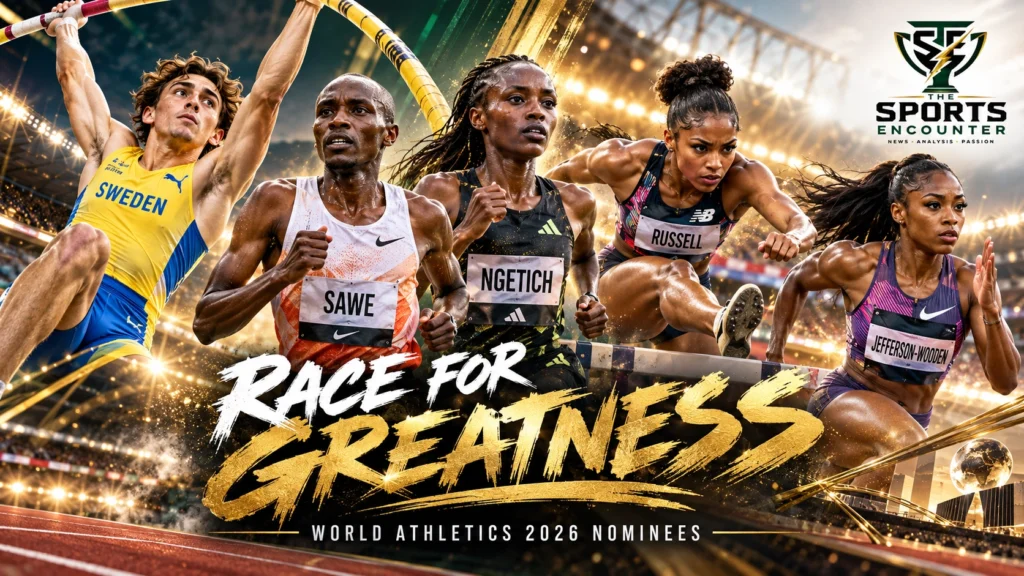
MONACO, Monaco, October 6, 2026: How do you compare the first record-eligible sub-two-hour marathon with a pole vaulter who keeps pushing the world record higher? What carries more weight: an undefeated season built around a world record, a sprint double against the world’s fastest athletes, or a year in which one runner won global titles on both cross-country terrain and the road?
World Athletics has created exactly that argument with its 2026 World Athlete of the Year nominations.
Twenty athletes from 15 countries have been shortlisted for the men’s and women’s honors ahead of the World Athletics Awards in Monaco on November 29. The nominees include Sabastian Sawe, Mondo Duplantis, Alison dos Santos, Kenneth Bednarek and Collen Kebinatshipi on the men’s side, while Agnes Ngetich, Masai Russell, Melissa Jefferson-Wooden, Marileidy Paulino and Audrey Werro headline an exceptionally deep women’s field.
The list contains world-record holders, global champions, Diamond League winners, Asian Games champions, European champions and athletes who pushed their events into territory that either had never been reached or had been untouched for decades.
More importantly, they are all competing directly against one another.
World Athletics has changed the award structure for 2026, removing the separate track, field and out-of-stadium Athlete of the Year honors that existed last season. Ten women and 10 men now enter one ranking process, with three finalists from each group eventually reaching Monaco.
That change makes this year’s argument more difficult, and considerably more interesting.
World Athlete of the Year 2026 Nominees at a Glance
| Women’s Nominee | Country | Defining 2026 Achievement |
|---|---|---|
| Tigst Assefa | Ethiopia | Berlin Marathon 2:11:04; London women-only world record of 2:15:41 |
| Chase Jackson | United States | North American shot put records of 21.02m and 21.14m; world indoor and Diamond League titles |
| Melissa Jefferson-Wooden | United States | Ultimate 100m-200m double; world leads of 10.62 and 21.47 |
| Agnes Ngetich | Kenya | World cross-country champion and world half-marathon champion in a 1:05:15 women-only world record |
| Marileidy Paulino | Dominican Republic | Unbeaten over 400m; Ultimate and Diamond League champion; 48.48 world lead |
| María Pérez | Spain | Inaugural half-marathon race-walk world record of 1:30:06 and European title |
| Camryn Rogers | Canada | 81.13m North American hammer record and five best throws of the season |
| Masai Russell | United States | 12.09 world 100m hurdles record; undefeated season; Ultimate and Diamond League titles |
| Audrey Werro | Switzerland | Ultimate, Diamond League and European 800m titles; 1:53.70 world lead |
| Yan Ziyi | China | 71.74m Asian and world U20 javelin record; Diamond League and Asian Games champion |
| Men’s Nominee | Country | Defining 2026 Achievement |
|---|---|---|
| Kenneth Bednarek | United States | Ultimate 100m-200m double in 9.85 and 19.52; Diamond League 200m champion |
| Kristjan Čeh | Slovenia | European discus champion with 72.51m championship record; Diamond League champion |
| Andy Díaz Hernández | Italy | World indoor, Diamond League and European triple jump champion; 18.15m |
| Alison dos Santos | Brazil | 45.80 world 400m hurdles record; unbeaten season; Ultimate champion |
| Mondo Duplantis | Sweden | Raised pole vault world record to 6.31m; Ultimate, world indoor and European champion |
| Collen Kebinatshipi | Botswana | 43.39 Ultimate 400m title; Diamond League champion; six sub-44 races |
| Josh Kerr | Great Britain & Northern Ireland | 3:42.66 world mile record; Ultimate 1500m and world indoor 3000m champion |
| Rumesh Tharanga Pathirage | Sri Lanka | 92.62m world lead; Ultimate, Diamond League, Asian Games and Commonwealth champion |
| Sabastian Sawe | Kenya | 1:59:30 London Marathon world record and first record-eligible sub-two-hour marathon |
| Ja’Kobe Tharp | United States | 12.75 world 110m hurdles record; Ultimate and Diamond League champion |
The complete shortlist and official performance summaries are available through World Athletics’ official World Athlete of the Year announcement.
Why the 2026 Award Is Harder to Judge Than Previous Years
Until last season, World Athletics separated its leading contenders into track, field and out-of-stadium categories before selecting the overall men’s and women’s World Athletes of the Year.
That structure made comparison easier because a marathoner first competed against other road or race-walking athletes, while a sprinter was primarily measured against track athletes and a pole vaulter against the field-event group.
World Athletics changed that system for 2026.
The organization announced in May that the event-group awards would disappear, leaving one pool of 10 nominees per gender and ultimately one men’s and one women’s World Athlete of the Year.
The official explanation of the revamped World Athletics Awards makes the consequence clear: performances that once occupied different award categories now compete directly for the same three finalist positions.
That means Sawe’s marathon must somehow be weighed against Duplantis’ pole vault season. Russell’s 12.09 must be compared with Ngetich winning across cross country and road running. Jefferson-Wooden’s sprint double sits in the same debate as Yan’s javelin breakthroughs and Pérez’s race-walking record.
There is no perfect mathematical conversion between them.
That is precisely why this year’s vote could become one of the most revealing in the award’s history.
Does Sabastian Sawe Have the Strongest Single Performance of 2026?
There is an obvious starting point in the men’s race.
One hour, 59 minutes and 30 seconds.
Sawe won the London Marathon in 1:59:30, becoming the first man to break two hours in a record-eligible marathon. The qualification matters because Eliud Kipchoge had previously run 1:59:40.2 during the specially arranged INEOS 1:59 Challenge in 2019, but that performance did not meet standard record conditions.
Sawe took the barrier down inside a conventional elite race that could produce an official world record.
World records fall regularly in athletics. Some carry more symbolic weight than others because the number itself has occupied the sport’s imagination for decades.
The two-hour marathon belonged in that category.
If voters place the highest value on the performance that changed the sport’s understanding of what was possible, Sawe has an extraordinary argument.
Why Mondo Duplantis Can Still Beat the Sub-Two Marathon
Duplantis has spent so long operating beyond the rest of men’s pole vault that dominance can begin to feel ordinary.
It is not.
The Swede improved his own world record to 6.31m in 2026 while also winning the World Indoor Championships, European Championships and inaugural World Athletics Ultimate Championship.
Earlier in the summer, TSE examined how Duplantis cleared 6.25m in Zurich while Emmanouil Karalis reached 6.20m, a competition that showed the event moving into heights almost nobody outside the Swede had previously inhabited.
Duplantis then moved the global record again.
He also enters the 2026 race as the defending overall World Athlete of the Year.
After winning in Monaco last November, Duplantis joked that he hoped to keep “irritating everyone who has to vote for me for years to come.”
His World Athletics reflection after the 2025 award now looks almost prophetic.
The voters have him in front of them again.
Alison dos Santos Has the World Record and an Unbeaten Season
Dos Santos provides perhaps the most complete combination of historical performance and sustained superiority.
He ran 45.80 in Zurich to break Karsten Warholm’s 45.94 world record in the 400m hurdles, taking 0.14 seconds from one of the defining marks of the modern track era.
TSE’s full analysis of Dos Santos’ 45.80 showed that the performance did not arrive in isolation. He repeatedly operated in extraordinary territory throughout the season and kept beating Warholm across their meetings.
World Athletics now credits Dos Santos with an 11-race unbeaten hurdles season. He added the Ultimate title in 45.98, the third-fastest performance in history, and also took the Diamond League crown.
That makes the Brazilian difficult to dismiss even in a field containing Sawe and Duplantis.
He has the world record, championship victories and season-long consistency.
Bednarek and Kebinatshipi Make the Men’s Track Case Much Deeper
Kenneth Bednarek’s Ultimate Championship changed his position in the men’s discussion because he left Budapest as the 100m and 200m champion.
His 9.85 won the 100m. His 19.52 personal best in the 200m was the world lead, and he later added the Diamond League 200m title.
The Sports Encounter’s report on Bednarek and Jefferson-Wooden’s $300,000 Ultimate doubles examined why Budapest did more than reward two fast athletes. Both defeated elite championship fields across two events within the same compressed competition.
Kebinatshipi’s argument comes through the 400m.
The Botswana star ran 43.39 to win the Ultimate title, moving to fifth on the world all-time list. He also collected the Diamond League title, broke the series record three times and produced six sub-44-second races, the most ever recorded by one athlete in a single season.
There may be no world record beside his name, but the season has remarkable depth.
Pathirage Has Built One of the Year’s Most Complete Championship Résumés
Rumesh Tharanga Pathirage represents one of the year’s most significant global breakthroughs.
The Sri Lankan javelin thrower produced a national-record world lead of 92.62m and then repeatedly proved that the mark was not an isolated explosion.
In Zurich, Pathirage threw 92.07m to record his second 92-meter competition of 2026. Earlier, he had stunned Neeraj Chopra and other established stars at the Commonwealth Games, while his season ultimately brought titles at the Commonwealth Games, Diamond League Final, Asian Games and Ultimate Championship.
World Athletics says he won 13 of his 14 competitions.
That is an unusually complete season for an athlete whose global standing changed so dramatically within months.
Agnes Ngetich Has a Different Kind of Women’s Athlete of the Year Case
Ngetich has excelled across surfaces rather than inside one event.
She won the World Cross Country Championships by 42 seconds and then dominated the World Half Marathon Championships by 50 seconds, running 1:05:15 in Copenhagen to break the women-only world record.
TSE’s complete Copenhagen report documented how aggressively Ngetich controlled that race. She had already created a 10-second advantage by 5km, extended it to 26 seconds by 10km and reached 15km 53 seconds clear of her nearest challenger.
The distinction around the record matters.
Women have run faster half marathons in mixed races. World Athletics separately recognizes a women-only world record because the race conditions and potential pacing dynamics differ when women compete without male runners in the field.
Ngetich also produced world-leading performances of 8:08.95 for 3000m and 28:58 for 10km.
Few candidates can match that versatility.
Masai Russell May Have the Cleanest Women’s Track Résumé
Russell’s case is brutally simple.
She broke the world record and did not lose.
The American ran 12.09 in Zurich to break Tobi Amusan’s 12.12 world record in the women’s 100m hurdles. The wind reading was 0.0 m/s, removing any suggestion that favorable conditions helped carry the performance into record territory.
TSE’s analysis of Russell’s historic 12.09 also showed how close she had already come earlier in the year, including a 12.14 performance before finally breaking through.
World Athletics credits her with nine of the 10 fastest times of the season.
She then added the Ultimate and Diamond League titles as part of an unbeaten 100m hurdles campaign.
If voters prioritize dominance within one event, Russell is difficult to place anywhere outside the very top group.
Jefferson-Wooden Did Something Even the Fastest Women Rarely Achieve
Jefferson-Wooden’s strongest argument is not one time.
It is the combination.
She won the Ultimate Championship 100m in a world-leading 10.62 and followed it with 21.47 in the 200m. The latter made her the third-fastest woman ever over 200 meters, behind only Florence Griffith Joyner and Shericka Jackson.
Her Budapest double, covered in TSE’s Ultimate Championship sprint analysis, also came against fields containing some of the biggest names in contemporary sprinting.
Running one of the fastest 100m times in history is difficult enough.
Producing one of the fastest 200m performances ever during the same championship turns the achievement into something much rarer.
Audrey Werro Has Turned the Women’s 800m Into a Historical Chase
Werro’s 1:53.70 in Zurich changed the scale of the women’s 800m conversation.
The Swiss runner broke the Diamond League record for the third time during the season and moved to third on the world all-time list.
That run came during a Zurich meeting TSE described as one of the most extraordinary collections of performances of the 2026 athletics season, alongside the Dos Santos and Russell world records and Duplantis’ 6.25m clearance.
Werro then backed her raw speed with championships.
She won the European title, Diamond League Final and Ultimate Championship.
That matters because the best athlete award is not simply a ranking of personal bests. Championship execution under different conditions carries its own weight.
Yan Ziyi’s Nomination Is Remarkable Even Before Her Age Is Considered
Yan opened her season with 71.74m, breaking both the Asian and world U20 records and moving to second on the senior women’s javelin all-time list.
She then demonstrated that her breakthrough belonged inside a genuine championship season.
At the Asian Games, Yan threw 70.46m to win gold by 7.76 meters over Olympic champion Haruka Kitaguchi. TSE’s Aichi-Nagoya report highlighted how the Chinese teenager turned one of the strongest athletics fields of the Games into a remarkably one-sided final.
She also won the Diamond League title.
That combination makes her more than a future prospect appearing early on a senior shortlist.
She is already winning at senior championship level.
Why the Ultimate Championship Has Such a Large Presence on the Shortlist
The inaugural World Athletics Ultimate Championship was designed to put the world’s best athletes into compact, high-pressure competition with major prize money and fewer opportunities to hide behind tactical scheduling.
Its influence on the shortlist is obvious.
Bednarek, Jefferson-Wooden, Dos Santos, Duplantis, Kebinatshipi, Kerr, Pathirage, Tharp, Paulino, Russell and Werro all strengthened their award cases in Budapest.
Before the event, TSE’s complete guide to the Ultimate Championship’s new rules examined World Athletics’ attempt to create a faster and more direct elite championship product.
The first edition has now done something else.
It has become one of the major reference points in the Athlete of the Year debate.
Which Athletes Have the Strongest Cases Right Now?
There is no objective formula that can turn a 1:59:30 marathon, a 6.31m pole vault and a 45.80 hurdles race into the same unit. That makes any ranking analytical rather than definitive.
On the men’s side, Sawe’s historic marathon gives him perhaps the most transformative single achievement. Duplantis combines another world record with three major titles and the weight of sustained dominance. Dos Santos has a world record, an unbeaten season and championship success. Bednarek and Kebinatshipi offer extraordinary track seasons, while Pathirage combines elite distance with an unusually broad collection of titles.
A reasonable first group of men’s finalist contenders therefore begins with Sawe, Duplantis and Dos Santos, but the gap to Bednarek, Kebinatshipi and Pathirage is small enough that the voting structure could materially change that order.
The women’s race may be even harder.
Russell owns a world record and an unbeaten season. Ngetich has global titles across two very different forms of distance running. Jefferson-Wooden produced a championship sprint double with performances of 10.62 and 21.47. Paulino did not lose a 400m race all year and ran 48.48. Werro collected three major titles while moving within sight of one of athletics’ oldest records.
If historical marks receive the greatest weight, Russell and Ngetich have compelling cases. If championship range and elite sprint performance dominate the vote, Jefferson-Wooden becomes equally difficult to leave outside the final three.
That is an assessment of the résumés, not a prediction of the vote.
The New Voting System Could Matter as Much as the Performances
World Athletics will not allow one constituency to control the award.
Four voting groups each account for 25% of the final ranking: fans voting through the World Athletics survey, athletes who competed at World Athletics Series events during 2026, accredited media members, and the wider World Athletics Family of officials, athlete representatives, event organizers, federation leaders, partners and staff.
That balance introduces several different ways to interpret excellence.
Fans may gravitate toward historic and highly visible performances. Athletes may place extra value on competitive difficulty and consistency. Media voters may consider records, narratives and championship context. Administrators and event specialists may evaluate performance across the entire season.
No constituency has more voting power than another.
That makes widespread respect potentially more valuable than overwhelming popularity within one audience.
Twenty Nominees From 15 Countries Show How Broad the 2026 Season Became
The shortlist also says something about the global shape of athletics.
The 20 athletes represent 15 countries across Africa, Europe, Asia, North America, South America and the Caribbean.
Kenya has Sawe and Ngetich. The United States supplies Bednarek, Tharp, Jefferson-Wooden, Jackson and Russell. Sweden has Duplantis, Botswana has Kebinatshipi, Brazil has Dos Santos, Sri Lanka has Pathirage, China has Yan and the Dominican Republic has Paulino.
The range extends just as widely across disciplines.
There are marathoners, sprinters, middle-distance runners, hurdlers, pole vaulters, triple jumpers, shot putters, hammer throwers, discus and javelin throwers, race walkers and athletes whose seasons crossed track, road and cross country.
Under the old format, much of that diversity was separated into different categories.
In 2026 it sits on one ballot.
Duplantis, Sawe and Pérez Enter 2026 With an Unusual Awards History
The revised system also creates an interesting connection with last year’s ceremony.
Duplantis won the overall men’s World Athlete of the Year award in 2025. Sawe won the men’s out-of-stadium honor, while María Pérez won the women’s equivalent.
Those category titles no longer exist.
Sawe and Pérez therefore move from being recognized as the best within one broad branch of athletics to competing directly with every discipline for the overall award.
Duplantis, meanwhile, is attempting to defend the highest honor under a system that asks voters to make an even broader comparison.
When Does Voting Close and When Will the Winners Be Announced?
The opening vote closes at midnight Central European Summer Time on Saturday, October 17.
World Athletics will then reduce each 10-athlete shortlist to three finalists.
The six finalists will be announced across November 10 and 11 and invited to Monaco for the World Athletics Awards on November 29.
The ceremony will also include the men’s and women’s Rising Star awards, Coach of the Year, the President’s Award and the new Moment of the Year honor.
By then, the statistics will already be settled.
The difficult part will be deciding what they mean.
The 2026 Vote Is Really a Debate About What Athletic Greatness Looks Like
Sawe took one of endurance sport’s most famous numerical barriers and moved through it under record-eligible conditions. Duplantis continued a reign that now stretches beyond normal comparisons with other pole vaulters. Dos Santos and Russell rewrote world records in events already operating at extraordinary historical levels.
Ngetich dominated across terrain and distance. Jefferson-Wooden conquered both major sprints in Budapest. Paulino went through an entire season unbeaten. Werro pushed the women’s 800m toward territory untouched for generations. Pathirage transformed Sri Lanka’s position in world javelin. Yan became a teenage thrower capable of beating established senior champions.
There is no weak route into this shortlist.
The harder question is what voters value most when none of the achievements look alike.
For the first time under the revised World Athletics Awards structure, they will have to answer that question directly.
Frequently Asked Questions
Who Are the 2026 World Athlete of the Year Nominees?
World Athletics has nominated 10 women and 10 men. The women’s shortlist is Tigst Assefa, Chase Jackson, Melissa Jefferson-Wooden, Agnes Ngetich, Marileidy Paulino, María Pérez, Camryn Rogers, Masai Russell, Audrey Werro and Yan Ziyi. The men’s nominees are Kenneth Bednarek, Kristjan Čeh, Andy Díaz Hernández, Alison dos Santos, Mondo Duplantis, Collen Kebinatshipi, Josh Kerr, Rumesh Tharanga Pathirage, Sabastian Sawe and Ja’Kobe Tharp.
Who Won World Athlete of the Year in 2025?
Mondo Duplantis won the men’s award and Sydney McLaughlin-Levrone won the women’s World Athlete of the Year honor in 2025.
What Did Sabastian Sawe Run in the London Marathon?
Sawe ran 1:59:30, becoming the first man to break two hours in a record-eligible marathon and setting a world record.
What World Record Did Agnes Ngetich Set?
Ngetich ran 1:05:15 to set the women’s-only half-marathon world record while winning the World Half Marathon Championships in Copenhagen.
What Is Mondo Duplantis’ Current World Record?
World Athletics lists Duplantis’ 2026 pole vault world record at 6.31 meters.
What World Record Did Masai Russell Break?
Russell ran 12.09 in the women’s 100m hurdles, improving Tobi Amusan’s previous world record of 12.12.
What World Record Did Alison dos Santos Set?
Dos Santos ran 45.80 in the men’s 400m hurdles, breaking Karsten Warholm’s 45.94 world record.
How Does World Athlete of the Year Voting Work in 2026?
Fans, World Athletics Series athletes, accredited media and the World Athletics Family each contribute 25% of the vote that determines the final rankings.
When Does World Athlete of the Year Voting Close?
The first voting stage closes at midnight CEST on October 17, 2026.
When Will the 2026 World Athletes of the Year Be Announced?
The winners will be announced at the World Athletics Awards in Monaco on November 29. Three men’s and three women’s finalists will be announced on November 10 and 11.