


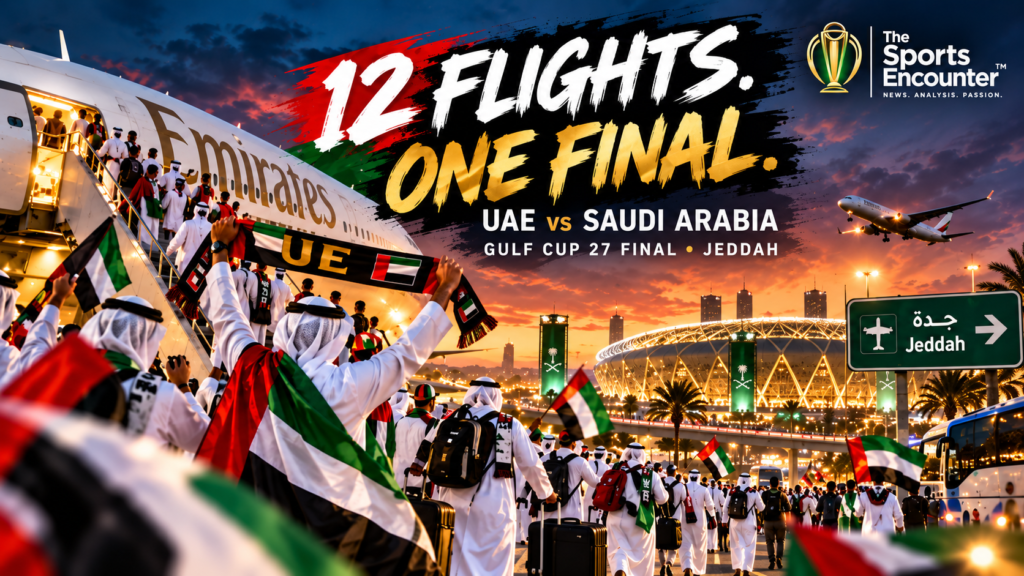
JEDDAH, Saudi Arabia, October 6, 2026: Twelve specially arranged aircraft carrying United Arab Emirates supporters toward Jeddah may tell the story of tonight’s Gulf Cup final before Saudi Arabia and the UAE even walk onto the field.
The UAE Football Association initially arranged six flights to help supporters attend the title match. Demand was so strong that the allocation was doubled to 12.
The response has transformed tonight’s final from a major regional football fixture into something broader: a traveling fan event, a test of the Gulf Cup’s commercial pull and another reminder that national-team football still has the capacity to mobilize supporters across borders in the Gulf.
Saudi Arabia will have home advantage at Alinma Stadium inside King Abdullah Sports City.
The UAE will bring their own noise.
For supporters crossing from the Emirates, this is not simply another away match. The national team has not won the Gulf Cup since 2013 and has not appeared at a FIFA World Cup since 1990.
For Saudi fans, the stakes are equally emotional. The Green Falcons have waited since 2004 for another Gulf Cup crown.
One regional trophy.
Two ambitious football nations.
Thousands of supporters.
And an evening in Jeddah that could say as much about the future value of Gulf football as the result itself.
Why the UAE Doubled Its Fan Flights From Six to 12
The strength of demand surprised even the organizers.
The UAE Football Association originally made six specially arranged aircraft available to supporters heading to Jeddah.
Those seats were rapidly taken.
The association then increased the allocation to 12 flights, explicitly citing the scale of demand from supporters.
That response provides a useful measurement of interest that television ratings cannot yet provide.
Fans are not merely watching.
They are rearranging schedules, registering for flights and crossing an international border to attend.
The exact number of supporters aboard the 12 aircraft has not been officially established, so TSE is not attaching an invented crowd figure to the program.
The signal is clear without one.
Demand was large enough for the federation to double its original transport plan.
Why This Article Is Different From TSE’s Gulf Cup Final Preview
TSE has already examined the football matchup in depth in Saudi Arabia’s 390-Minute Wall Meets UAE’s Goal-Scoring Precision.
That preview explains Saudi Arabia’s defensive record, the UAE’s attacking efficiency, the historical head-to-head, key players and the tactical questions likely to shape the final.
The bigger story developing on matchday is happening beyond the tactical board.
It is happening in airports.
In supporter groups.
Across social platforms.
Inside households throughout the Gulf.
And ultimately inside a stadium with capacity for more than 60,000 spectators.
That fan mobilization gives the final a different kind of importance.
Jeddah Is Becoming a Meeting Point for Gulf Football Culture
This is the first Gulf Cup staged in Jeddah.
That matters beyond geography.
The Gulf Cup Football Federation deliberately tied the tournament’s identity to the city, including visual references to Jeddah’s historic architecture when it launched the Gulf Cup 27 branding.
The result has been a tournament that combines sport, local identity and cross-border tourism.
Supporters from across the Gulf have had reasons to travel.
Tonight provides the clearest example.
A Saudi home crowd will meet a visible traveling UAE contingent for the tournament’s decisive match.
The Gulf Cup Federation itself describes the competition as a platform that brings together football excellence with the social and cultural connections between Gulf states.
Tonight turns that idea into something tangible.
A Final Built for Supporter Rivalry
Saudi Arabia and the UAE do not need artificial marketing to manufacture interest in this fixture.
The sporting relationship already carries history.
Saudi Arabia lead the Gulf Cup head-to-head and denied the UAE the AFC Asian Cup title on home soil in 1996.
The Emirates eliminated Saudi Arabia in the 2007 Gulf Cup semifinal and went on to win their first championship.
Saudi Arabia returned the favor in the 2014 semifinal.
Their broader rivalry, including major qualifying meetings, is detailed in TSE’s complete Gulf Cup final preview.
Supporters remember those moments.
That is part of what creates genuine football rivalry.
A rivalry gains strength through repetition, consequence and memory.
Tonight has all three.
UAE Supporters Have Been Given a Team Worth Traveling For
Fan enthusiasm is easier to generate when the football creates belief.
The UAE have done that throughout Gulf Cup 27.
They began with a 4-0 victory over Yemen as Nicolás Giménez scored twice during a devastating attacking spell.
TSE covered that performance in Giménez Leads 25-Minute Blitz as UAE Open Gulf Cup 27 With 4-0 Rout of Yemen.
Then came a 3-0 win against defending champions Bahrain.
That victory confirmed the Emirates as one of the tournament’s strongest teams and secured early progress alongside Qatar, covered in UAE and Qatar Seal Gulf Cup Semifinal Spots as Defending Champions Bahrain Bow Out.
A 1-1 draw against Qatar secured first place in Group B on goal difference.
TSE explained the group-stage equation in UAE Win Group B on Goal Difference.
Then Ousmane Camara’s goal defeated Oman 1-0 in the semifinal.
The UAE therefore reach Jeddah’s final undefeated.
Nine goals.
Three clean sheets.
One defeat away from none.
Supporters traveling today have genuine sporting reasons to believe.
Saudi Fans Have Their Own 22-Year Wait to End
The hosts enter the final with an equally powerful emotional stake.
Saudi Arabia last won the Gulf Cup in 2004.
Their route through this tournament has been built around defensive control.
They beat Kuwait 1-0.
Oman 3-0.
Iraq 2-0.
The perfect nine-point group campaign is covered in Saudi Arabia Finish Perfect as Oman Catch Iraq in Gulf Cup 27 Group A.
Saudi Arabia then survived 120 goalless semifinal minutes against Qatar before winning on penalties.
That gives the home support its own narrative.
This is a chance to watch Saudi Arabia win a Gulf Cup in Saudi Arabia after more than two decades without the trophy.
A large Emirati presence therefore will not reduce the atmosphere.
It should intensify it.
The Federation Support Matters Because Fans Often Decide Whether Regional Events Feel Major
Football competitions can have strong teams and good matches without creating a major-event atmosphere.
Supporter involvement changes that.
Travel programs, ticket access, fan zones and transport coordination lower the practical barriers that often prevent national-team supporters from traveling.
The UAE’s decision to increase aircraft capacity is therefore more than a gesture.
It helps convert television interest into physical attendance.
That creates fuller stands.
Fuller stands create stronger television pictures.
Those images improve the perception of the tournament.
That can make the event more attractive to sponsors, broadcasters, cities and future commercial partners.
The chain begins with something as basic as helping supporters get to the stadium.
What Do the TV Rights Say About Gulf Cup 27’s Commercial Value?
The broadcast picture is another useful measure of the tournament’s market potential.
Before Gulf Cup 27 began, television and streaming rights had already been acquired by multiple Gulf outlets, while competition officials continued discussions around wider distribution.
That matters because media rights are among the most direct commercial measures of a sports competition’s relevance.
The greater the audience broadcasters believe they can reach, the greater the incentive to acquire rights, build studio programming and send production teams to the host city.
The final between Saudi Arabia and the UAE gives rights holders the strongest possible closing product.
Two sizable consumer markets.
A historical rivalry.
A Saudi home crowd.
Thousands of traveling Emirati supporters.
A trophy at stake.
Those elements are commercially attractive even before a final audience number exists.
What Will the TV Audience Be?
There is an important distinction between expected reach and verified audience.
No authoritative final television audience figure for tonight’s match can exist before the match is played.
TSE therefore will not attach an invented “millions of viewers” figure to the final.
What can be established is that the match sits inside a regional broadcast ecosystem with television and digital-rights buyers, extensive studio programming and substantial media coverage throughout Gulf markets.
The final should be the competition’s strongest television property.
Actual viewership should be assessed once reliable figures become available.
Sponsorship Shows Gulf Football Is Selling More Than 90 Minutes
The Gulf Cup Federation has also been building the competition’s commercial platform through official partnerships.
BYD, for example, became the tournament’s official automotive partner, with its agreement including fan-zone activities and supporter experiences.
The federation described the partnership as part of its effort to expand fan engagement and increase the tournament’s marketing value.
That language is important.
Modern sports value is increasingly created away from the pitch as well as on it.
Sponsors want supporters interacting with brands.
Broadcasters want fans watching before and after matches.
Host cities want visitors spending money on hotels, restaurants and transport.
Football federations want the competition to remain culturally important enough that supporters travel.
The 12 UAE flights fit directly into that ecosystem.
Why the Final Matters Commercially for Jeddah
King Abdullah Sports City is already one of the region’s major football venues.
Hosting Saudi Arabia against the UAE in a regional final strengthens Jeddah’s positioning as an events destination.
A major final generates activity across several sectors:
- airlines and aviation
- hotels and hospitality
- restaurants
- ground transportation
- ticketing
- sports merchandising
- broadcasting
- digital media
- sponsorship
- tourism
- fan-zone activation
Not every economic effect can be quantified before post-event data becomes available.
The visible demand is nevertheless important.
People are traveling because the football is worth traveling for.
For a sports competition, that is one of the strongest forms of consumer validation.
Gulf Football’s Commercial Ecosystem Is Becoming More Connected
The final is also arriving during a broader expansion of cross-border Gulf football.
The 2026-27 Gulf Champions League has expanded to 12 clubs and will create regular Saudi, UAE, Qatari, Iraqi, Omani, Bahraini and Kuwaiti matchups.
That competition begins only days after Gulf Cup 27 ends.
The connection is important.
National-team competition creates emotional attachment.
Club competition can then provide recurring regional inventory throughout the season.
Saudi Arabia’s rapidly developing sports economy adds commercial scale.
The UAE brings strong clubs, substantial corporate activity and an established sports-event market.
Qatar brings another mature regional football ecosystem.
Repeated competitive contact between these markets increases the value of Gulf football as a connected commercial product rather than several isolated domestic competitions.
The Final Can Strengthen Football Passion Beyond Saudi Arabia and the UAE
A packed regional final has effects that are difficult to measure on a spreadsheet.
Children see national-team players performing under pressure.
Supporters form memories around goals, saves and trophies.
Families watch together.
National-team shirts become visible in public spaces.
Rivalries become inherited.
Future matches acquire meaning because previous ones mattered.
This is how football culture deepens.
The Gulf already has enormous interest in European club football.
The long-term opportunity is converting more of that passion into sustained engagement with Gulf national teams, domestic leagues and regional competitions.
A Saudi Arabia-UAE final with genuine traveling support helps that process.
UAE’s Bigger Football Ambition Is a Return to the World Cup
The UAE’s national-team ambition extends beyond the Gulf Cup.
One historical point needs to be clear.
The Emirates have already played at a FIFA World Cup.
Their only appearance came at Italia 1990.
The next breakthrough would therefore be a return to the World Cup after decades away, rather than a maiden qualification.
That context makes nights like this useful.
Tournament finals expose players to pressure.
They create consequences.
They demand game management.
They force teams to perform in hostile environments.
For a UAE program trying to establish itself consistently among Asia’s strongest national teams, those experiences carry value beyond one regional trophy.
Supporter engagement matters here as well.
A national team with a visible following has a stronger football culture around it.
The sight of UAE supporters flying into another country for a regional final creates the sort of attachment federations want to sustain over an entire qualification cycle.
Gulf Cup Success Can Give UAE Supporters Something to Build Around
The Emirates have experienced frustrating tournament cycles since their 2013 Gulf Cup victory.
This campaign has felt different.
They scored four against Yemen.
Three against Bahrain.
They managed the Qatar group decider.
They survived a tight semifinal against Oman.
They are now playing for a trophy.
The relationship between a national team and its supporters is strengthened through moments like these.
Success creates attendance.
Attendance creates atmosphere.
Atmosphere makes matches feel important.
Important matches attract sponsors and broadcasters.
Commercial growth can then help competitions improve their production, promotion and supporter experience.
The cycle is strongest when the football remains credible.
The UAE’s run to the final has supplied that credibility.
Saudi Arabia vs UAE Is Exactly the Kind of Final Gulf Cup 27 Needed
From a tournament perspective, tonight’s matchup offers almost everything organizers could reasonably want.
The host nation is involved.
The visiting side comes from another major Gulf market.
Both teams are unbeaten.
Both have genuine historical stakes.
Supporters are traveling.
There is an established rivalry.
There is a trophy drought on both sides.
The stadium is one of the region’s major venues.
And there is enough commercial and broadcast interest around the competition to take advantage of the occasion.
The football still determines whether the final itself becomes memorable.
Everything around it is already in place.
The 12 Flights May Become the Defining Image Before Kickoff
A cup final will ultimately be remembered through what happens on the field.
Before kickoff, however, the strongest image of the buildup may be much simpler.
Six aircraft were planned.
Supporters wanted more.
The number became 12.
That tells us something about the current relationship between the UAE national team and its fans.
It also tells us something about the Gulf Cup.
In an era when clubs dominate the global football calendar, this regional national-team competition can still persuade people to board aircraft, cross borders, wear national colors and spend an evening believing that one result matters deeply.
That has sporting value.
It has cultural value.
And increasingly, it has commercial value.
Tonight in Jeddah, all three will share the same stadium.
Frequently Asked Questions
Why did the UAE increase its fan flights to Jeddah?
The UAE Football Association doubled the allocation from six specially arranged aircraft to 12 because of strong supporter demand for the Gulf Cup final.
How many UAE supporters will travel?
No authoritative final passenger total has been published, so TSE is not assigning an estimated number. What is verified is that the flight allocation doubled from six aircraft to 12.
Why is Saudi Arabia vs UAE such a major Gulf fixture?
The teams have a long regional history across the Gulf Cup, Asian Cup and World Cup qualifying, including major knockout matches and a strong Saudi advantage in their overall Gulf Cup record.
Has the UAE ever qualified for the FIFA World Cup?
Yes. The UAE played at the 1990 FIFA World Cup in Italy. It remains the country’s only appearance.
Why does the final matter for UAE football beyond the Gulf Cup?
The match gives the UAE another high-pressure tournament experience as the national program tries to establish sustained progress and eventually return to the World Cup stage.
What does the final mean commercially?
The match brings together major Gulf markets, a large home crowd, traveling UAE supporters, television rights, digital distribution, sponsorship, tourism and fan-zone activity.
How many people will watch the final on television?
No verified final audience number is available before kickoff. The competition has been distributed across multiple regional broadcast and digital outlets, but any specific viewership claim should wait for reliable post-event figures.
Why is Jeddah important to this Gulf Cup?
Gulf Cup 27 is the first edition hosted in Jeddah, giving the city another major regional football event at a time when Saudi Arabia is expanding its role as a host of major competitions.
When did Saudi Arabia last win the Gulf Cup?
Saudi Arabia last won the championship in 2004.
When did the UAE last win the Gulf Cup?
The UAE last lifted the trophy in 2013.