


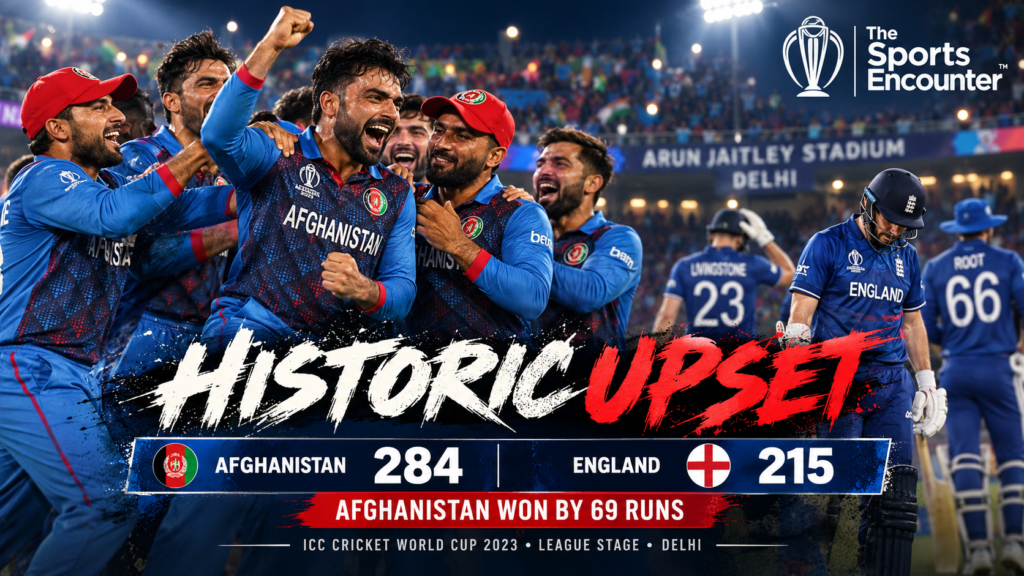
NEW DELHI, India, October 15, 2023: England had watched Afghanistan lose three wickets in 13 deliveries.
Rahmanullah Gurbaz was gone after making 80. The score had fallen from 114/0 to 122/3. Afghanistan’s fastest start of the World Cup was threatening to dissolve into another promising innings that an established team would eventually control.
England had their opening.
Afghanistan refused to give them the match.
Ikram Alikhil rebuilt. Rashid Khan contributed. Mujeeb Ur Rahman arrived at No. 9 and attacked. Afghanistan recovered to 284.
Then they made the defending world champions look far more uncomfortable than the target suggested.
Jonny Bairstow fell for two.
Joe Root was bowled by Mujeeb.
Dawid Malan went at 68.
Jos Buttler was gone at 91.
Liam Livingstone followed at 117.
England’s celebrated batting depth kept disappearing.
Harry Brook fought with 66, but Afghanistan kept taking wickets around him until Mujeeb removed England’s last established batter.
Rashid Khan finished the tail.
England were all out for 215.
Afghanistan had won by 69 runs.
This was only their second victory in men’s Cricket World Cup history, eight years after beating Scotland in 2015. This time the defeated team were the reigning champions. ICC described it as a historic victory and one of the tournament’s major shocks. icc
That is why Afghanistan vs England belongs as Match 44 in A Celebration of 5000 ODIs.
The result announced something larger than an upset.
Afghanistan had spent years coming close against major cricket nations.
In Delhi, they finally learned how to finish one.
TL;DR
- England won the toss and asked Afghanistan to bat.
- Afghanistan made 284 all out in 49.5 overs.
- Rahmanullah Gurbaz smashed 80 from 57 balls.
- Gurbaz and Ibrahim Zadran added 114 for the first wicket.
- Afghanistan then slipped from 114/0 to 122/3.
- Ikram Alikhil rebuilt the innings with 58 from 66 balls.
- Rashid Khan contributed 23 from 22.
- Mujeeb Ur Rahman blasted 28 from 16.
- Adil Rashid took 3/42 for England.
- England were bowled out for 215 in 40.3 overs.
- Harry Brook made 66 from 61 balls.
- Mujeeb Ur Rahman took 3/51.
- Rashid Khan took 3/37.
- Mohammad Nabi took 2/16.
- Afghanistan’s spinners claimed eight of England’s 10 wickets.
- Afghanistan won by 69 runs.
- Mujeeb Ur Rahman was named Player of the Match.
- It was Afghanistan’s second men’s World Cup victory.
- England were left with only two points from their first three matches.
Afghanistan vs England 2023 World Cup: Match at a Glance
| Detail | Information |
|---|---|
| Competition | ICC Men’s Cricket World Cup 2023 |
| Match | 13th Match |
| Date | October 15, 2023 |
| Venue | Arun Jaitley Stadium, Delhi |
| Toss | England won and fielded |
| Afghanistan | 284 all out in 49.5 overs |
| England | 215 all out in 40.3 overs |
| Result | Afghanistan won by 69 runs |
| Player of the Match | Mujeeb Ur Rahman |
| Afghanistan top scorer | Rahmanullah Gurbaz, 80 |
| England top scorer | Harry Brook, 66 |
| Best Afghanistan bowling | Rashid Khan 3/37, Mujeeb 3/51 |
| Best England bowling | Adil Rashid, 3/42 |
| Key batting stand | Gurbaz and Ibrahim Zadran, 114 |
| Tactical theme | Afghanistan spin took eight wickets |
| Tournament impact | England and Afghanistan both moved to two points from three games |
The official ICC match report confirms Afghanistan’s 284, England’s 215 and the 69-run margin. icc
Why Match 44 Belongs in A Celebration of 5000 ODIs
The original A Celebration of 5000 ODIs roadmap was built around matches where the scorecard cannot fully preserve how dramatically expectations changed.
Delhi fits that idea perfectly.
Afghanistan entered after defeats to Bangladesh and India.
England had arrived in India as defending world champions and had just beaten Bangladesh by 137 runs.
The pitch had already produced enormous scores during the tournament.
England’s batting lineup contained Bairstow, Root, Malan, Brook, Buttler, Livingstone, Curran and Woakes.
A chase of 285 looked difficult.
It did not look historic.
Afghanistan changed the assumptions through three distinct phases.
Gurbaz attacked England before the field spread.
Alikhil and the lower order repaired the innings after the collapse.
Then Mujeeb, Nabi and Rashid turned the second innings into a spin examination England never solved.
ICC later identified Afghanistan’s performance as one of the great World Cup upsets. icc
The bigger reason for inclusion, however, is what happened next.
Four years earlier, Afghanistan had come desperately close to major World Cup victories without finishing them.
They pushed India to the final over in Match 34: Shami’s Hat-Trick Saves India After Afghanistan Drag 224 to the Final Over.
A week later, their spinners put Pakistan in serious trouble before Imad Wasim escaped in Match 33: Imad Wasim Drags Pakistan From 156/6 to a Two-Ball Escape Against Afghanistan.
In Delhi, Afghanistan did not merely threaten an established power.
They completed the job with 57 balls unused.
Rahmanullah Gurbaz Turns the Powerplay Into Afghanistan’s Statement
Afghanistan needed aggression early because England had elected to chase.
Gurbaz supplied it.
His innings:
80 runs
57 balls
8 fours
4 sixes
Strike rate: 140.35
Ibrahim Zadran played the quieter role at the other end.
Their partnership reached 114.
Afghanistan were 79/0 after the first 10 overs, their best World Cup powerplay start at the time. icc
That opening stand changed England’s bowling plans.
Chris Woakes went for 41 in four overs.
Sam Curran conceded 46 from four.
England’s two normally reliable seam options had combined for 87 runs from eight overs without a wicket.
Afghanistan were no longer trying to survive the new ball.
England were trying to escape it.
Gurbaz Punishes England’s Short Bowling
England repeatedly offered Gurbaz lengths he could attack.
He pulled.
He cut.
He used pace rather than trying to manufacture it.
Sam Curran’s ninth over became particularly damaging, conceding 20 as Afghanistan’s openers took full control.
Gurbaz reached fifty from 33 balls.
England had expected an opportunity to attack an Afghanistan batting lineup still searching for consistency.
Instead, their seamers were pushed into defensive fields before the powerplay had properly ended.
Adil Rashid Starts England’s Fightback at 114/0
England eventually found control through spin.
Adil Rashid removed Ibrahim Zadran for 28.
Score: 114/1.
Rahmat Shah followed eight runs later.
Then came the moment Afghanistan appeared capable of undoing all their early work.
Hashmatullah Shahidi called Gurbaz through for a risky single.
Gurbaz was run out for 80.
Afghanistan had moved from:
114/0
to
122/3.
Three wickets in 13 balls.
The emotional shift was enormous.
Gurbaz left visibly furious after a dismissal that had little to do with England’s bowling and everything to do with Afghanistan’s own decision-making.
The innings could easily have collapsed from there.
It did not.
England’s Middle-Overs Recovery Exposes Afghanistan’s Old Weakness
For several years, this had been Afghanistan’s recurring problem against major teams.
They could create a competitive position.
The challenge was maintaining it after something went wrong.
Azmatullah Omarzai attacked briefly before Liam Livingstone removed him for 19.
Joe Root bowled Hashmatullah Shahidi for 14.
Mohammad Nabi later fell for nine.
Afghanistan reached 190/6.
The 114-run opening partnership had become a distant memory.
England now had a realistic opportunity to restrict them somewhere around 230 or 240.
Ikram Alikhil stopped that happening.
England Bowling
| Bowler | O | M | R | W | Econ |
|---|---|---|---|---|---|
| Chris Woakes | 4 | 0 | 41 | 0 | 10.25 |
| Reece Topley | 8.5 | 1 | 52 | 1 | 5.88 |
| Sam Curran | 4 | 0 | 46 | 0 | 11.50 |
| Adil Rashid | 10 | 1 | 42 | 3 | 4.20 |
| Mark Wood | 9 | 0 | 50 | 2 | 5.56 |
| Liam Livingstone | 10 | 0 | 33 | 1 | 3.30 |
| Joe Root | 4 | 0 | 19 | 1 | 4.75 |
Afghanistan’s 284 Looked Chaseable Until Farooqi Struck
England had chased and posted far larger totals during the white-ball revolution that made them 2019 champions.
They had also arrived in Delhi without Ben Stokes, who missed England’s opening three matches through injury before returning later in the tournament. ICC subsequently identified his absence as one factor that left Jos Buttler without one of England’s senior pressure players during the opening phase of the campaign. icc
Even without Stokes, England possessed enough batting to chase 285.
They needed a stable start.
They got the opposite.
Fazalhaq Farooqi trapped Bairstow lbw for two.
England were 3/1.
Afghanistan had the early wicket required to make the target feel different.
Afghanistan Bowling
| Bowler | O | M | R | W | Econ |
|---|---|---|---|---|---|
| Mujeeb Ur Rahman | 10 | 1 | 51 | 3 | 5.10 |
| Fazalhaq Farooqi | 7 | 0 | 50 | 1 | 7.14 |
| Naveen-ul-Haq | 6 | 1 | 44 | 1 | 7.33 |
| Mohammad Nabi | 6 | 0 | 16 | 2 | 2.67 |
| Rashid Khan | 9.3 | 1 | 37 | 3 | 3.89 |
| Azmatullah Omarzai | 2 | 0 | 13 | 0 | 6.50 |
Eight Turning Points That Made Afghanistan’s Upset Possible
1. Gurbaz and Ibrahim Race to 114 Without Loss
England lost control of the opening phase and were forced onto defensive fields far earlier than expected.
2. Afghanistan Lose Three Wickets for Eight Runs
England suddenly had the innings back under control.
Gurbaz’s run-out was particularly dangerous because it removed Afghanistan’s dominant batter without England needing to dismiss him.
3. Ikram Alikhil Rebuilds the Innings
His 58 ensured the opening partnership was not wasted.
Afghanistan retained enough wickets to attack late.
4. Mujeeb’s 28 Pushes Afghanistan to 284
England’s requirement moved from manageable to uncomfortable.
Those extra runs gave Afghanistan tactical freedom with the ball.
5. Farooqi Removes Bairstow at 3/1
Afghanistan gained immediate belief and prevented England from settling into the chase.
6. Mujeeb Bowls Root
England lost one of their strongest players of spin before the seventh over ended.
7. Buttler and Livingstone Fall Before England Reach 120
England’s two most explosive middle-order options disappeared before either could change the required rate.
8. Mujeeb Removes Brook at 169/8
England’s last realistic rescue attempt ended.
Afghanistan were no longer chasing an upset.
They were completing one.
What Afghanistan Did Differently From Their 2019 Near-Misses
This is the most important historical layer of Match 44.
Afghanistan had already shown they could pressure top teams.
In 2019 they came within 11 runs of India in Match 34.
They came within two deliveries of Pakistan in Match 33.
Those matches exposed a recurring problem.
Afghanistan could create winning positions.
They struggled to close them.
Delhi showed development in three areas.
First, the lower order repaired the innings rather than allowing the early platform to disappear.
Second, Afghanistan kept attacking even after England’s initial wickets.
Third, their spinners maintained pressure as a group rather than relying on Rashid Khan to manufacture everything.
Those improvements became a theme of Afghanistan’s 2023 World Cup.
They later beat Pakistan and Sri Lanka and came within three wickets of beating Australia before Glenn Maxwell’s 201* produced the miracle revisited in Match 42.
Match 44 was the first clear announcement that Afghanistan had moved beyond moral victories.
Why England’s Attack Failed Before Their Batting Did
Much of the attention naturally falls on England’s 215.
Their bowling had already created problems.
Woakes and Curran combined for:
8 overs
87 runs
0 wickets
Afghanistan exploited England’s new-ball lengths.
Adil Rashid repaired much of that damage with 3/42.
Livingstone and Root also provided control.
But England’s inability to remove Afghanistan’s lower order allowed the total to climb from 190/6 to 284.
That mattered because England’s chase never received room to settle.
A target of 240 would have allowed them to survive a few early wickets.
At 285, every rebuilding phase still needed scoring intent.
Afghanistan understood that pressure.
England never escaped it.
Ben Stokes’ Absence Left England Without a Proven Crisis Batter
Stokes had come out of ODI retirement for the World Cup but missed England’s opening three games through injury. ICC later noted that his absence deprived Buttler of one of the squad’s senior leadership figures during the troubled opening phase. icc
It would be wrong to claim Stokes’ absence caused this defeat.
Afghanistan dismissed the XI England selected.
They deserved full credit.
Still, his absence mattered structurally.
England were 91/4.
Then 117/5.
Those are exactly the situations where Stokes had built his reputation.
Brook fought admirably, but England lacked another batter willing and able to occupy the crease alongside him.
Stokes returned for England’s next match.
By then, their title defense was already under severe pressure.
No significant in-game injury was reported as materially changing the Afghanistan match itself.
England Suffer Another World Cup Shock to a Supposed Underdog
England have a peculiar history of World Cup defeats in matches they were expected to control.
Zimbabwe defended only 134 against them in 1992, a remarkable game revisited in Match 10: Eddo Brandes Defends 134 and Leaves England Stunned.
Sri Lanka defended 232 against the tournament favorites at Headingley in 2019, covered in Match 36: Malinga Turns 232 Into a Trap as England’s World Cup Certainty Suddenly Cracks.
Afghanistan’s 2023 victory belongs in that lineage.
There is one major difference.
Zimbabwe’s 1992 win came against an England team already assured of semifinal qualification.
Sri Lanka’s 2019 upset shook England but did not prevent them from eventually becoming champions.
The Afghanistan defeat came early enough to expose problems that England never properly solved.
The Defending Champions Never Fully Recovered
England left Delhi with one win and two losses.
They had two points from three games.
The schedule ahead included South Africa, India, Australia and Pakistan.
The Afghanistan defeat therefore had consequences larger than one upset.
England’s margin for error had disappeared.
Their next match produced an even heavier defeat against South Africa.
The campaign eventually unraveled into one of the poorest title defenses in modern World Cup history.
The contrast with 2019 was severe.
Four years earlier, England had survived the Sri Lanka upset, recovered and eventually won an unforgettable final against New Zealand, revisited in Match 39: England Win the World Cup on Boundary Count After New Zealand Tie Them Twice.
Delhi in 2023 pointed in the opposite direction.
Instead of recovery beginning after an upset, the problems multiplied.
Afghanistan Finally Convert Pressure Into a Landmark Win
The lasting significance belongs to Afghanistan.
Their rise in ODI cricket had never been difficult to see.
Rashid Khan had become a global star.
Nabi carried immense experience.
Mujeeb brought mystery and control.
Gurbaz added fearless batting.
The missing element was consistency against elite teams across a full 50-over match.
They found it against England.
Gurbaz gave them aggression.
Ikram gave them repair.
Mujeeb supplied lower-order runs.
Farooqi provided the first breakthrough.
Nabi shut down the middle overs.
Rashid finished the tail.
The victory was built by different players at different stages.
That is why it became more important than a single upset.
Afghanistan looked like a proper ODI team capable of winning through several routes.
How Match 44 Fits Afghanistan’s ODI Evolution
For readers following the series, Afghanistan’s progression is unusually clear.
Match 33 against Pakistan in 2019 showed how close their spin attack could take them.
Match 34 against India showed they could push an unbeaten contender into the final over.
Match 44 showed they could finish.
Then came the extraordinary Australia game in Match 42, where Afghanistan reduced the eventual champions to 91/7 before Maxwell produced one of the greatest innings ever played.
The sequence tells a story larger than individual results.
Afghanistan went from threatening the elite to beating them.
Delhi was the breakthrough.
Frequently Asked Questions
Who won Afghanistan vs England at the 2023 Cricket World Cup?
Afghanistan defeated England by 69 runs after scoring 284 and bowling the defending champions out for 215.
Who was Player of the Match?
Mujeeb Ur Rahman was Player of the Match after scoring 28 from 16 balls and taking 3/51.
How many runs did Rahmanullah Gurbaz score?
Gurbaz made 80 from 57 balls with eight fours and four sixes.
Who top-scored for England?
Harry Brook scored 66 from 61 balls.
How many wickets did Afghanistan’s spinners take?
Mujeeb Ur Rahman, Rashid Khan and Mohammad Nabi combined for eight wickets.
What were Rashid Khan’s bowling figures?
Rashid took 3/37 from 9.3 overs.
Was this Afghanistan’s first World Cup victory?
No. It was Afghanistan’s second men’s World Cup victory. Their first came against Scotland in 2015. icc
Why was the victory historically important?
Afghanistan defeated the defending world champions after losing their first two matches of the tournament, confirming that they could convert strong positions against elite opposition into major World Cup victories.
Was Ben Stokes playing?
No. Stokes missed England’s first three World Cup matches through injury and returned afterward. icc
Why is Afghanistan vs England included in A Celebration of 5000 ODIs?
Afghanistan combined a 114-run opening stand, a lower-order recovery and eight spin wickets to defeat the reigning world champions by 69 runs. The match also marked a turning point in Afghanistan’s evolution from dangerous outsiders into a side capable of beating elite ODI teams.