


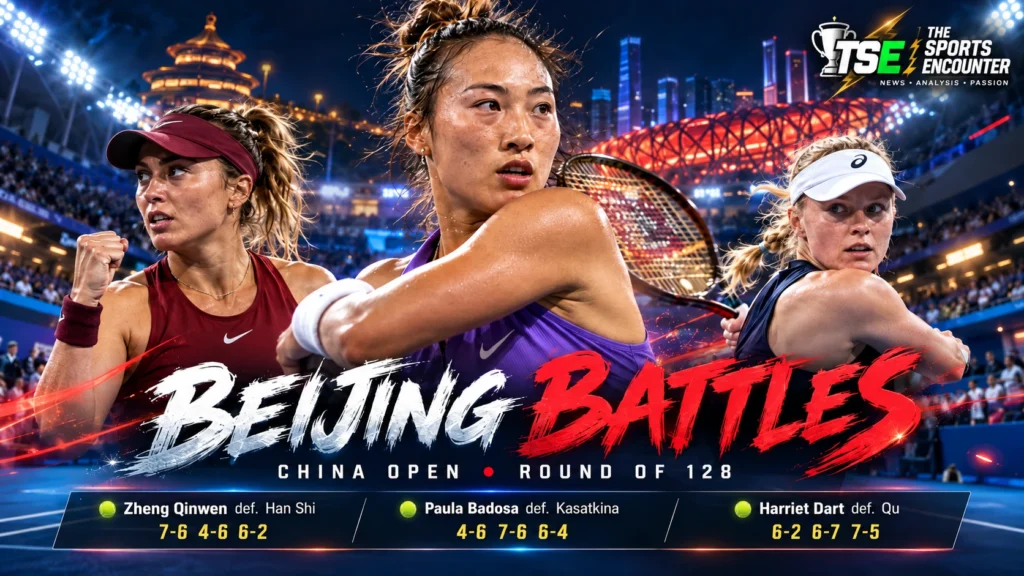
BEIJING, China, October 1, 2026: Zheng Qinwen survived a two-hour, 44-minute test from compatriot Han Shi, Paula Badosa escaped after coming within two points of defeat against Daria Kasatkina, and a group of Chinese teenagers gave Beijing plenty to remember as the China Open women’s Round of 128 reached its conclusion.
The opening round produced 16 completed matches across Thursday’s schedule, but the scoreboard alone does not explain how varied the day became.
Some players moved through with little resistance. Others needed every available game.
Zheng was pushed into a deciding set by a qualifier ranked far below her. Badosa had to recover after Kasatkina moved close to closing their match. Harriet Dart spent more than three hours resisting 17-year-old Yihan Qu. Storm Hunter, Kimberly Birrell, Ashlyn Krueger and Sonay Kartal advanced in straight sets, while several Chinese players ensured the home crowd had more than one reason to stay engaged.
The result is a second-round field already carrying very different levels of physical and emotional mileage.
China Open 2026 Round of 128 Results
| Winner | Opponent | Score |
|---|---|---|
| Gao Xinyu | Panna Udvardy | 6-2, 6-3 |
| Camila Osorio | Lanlana Tararudee | 6-3, 6-3 |
| Anastasia Zakharova | Yushan Shao | 6-0, 6-2 |
| Kamilla Rakhimova | Jessica Bouzas Maneiro | 6-4, 7-6(2) |
| Katerina Siniakova | Magda Linette | 6-4, 6-3 |
| Paula Badosa | Daria Kasatkina | 4-6, 7-6(7), 6-4 |
| Zheng Qinwen | Han Shi | 7-6(6), 4-6, 6-2 |
| Alina Charaeva | Yuliia Starodubtseva | 5-7, 7-5, 6-2 |
| Xinran Sun | Eva Lys | 6-1, 3-0 ret. |
| Lin Zhu | Alycia Parks | 6-4, 6-2 |
| Harriet Dart | Yihan Qu | 6-2, 6-7(5), 7-5 |
| Storm Hunter | Yu Jun Lin | 6-2, 6-1 |
| Kimberly Birrell | Aoi Ito | 6-1, 6-1 |
| Sonay Kartal | Andrea Lazaro Garcia | 6-2, 6-3 |
| Ashlyn Krueger | Sofia Kenin | 6-3, 6-3 |
| Katie Volynets | Robin Montgomery | 7-5, 7-5 |
The China Open is the second-to-last WTA 1000 tournament of the season and carries added importance in the Asian Swing because the WTA Finals race is still developing. The Sports Encounter’s Wuhan Open field and WTA Finals race analysis explains why results in Beijing can reshape the closing weeks of the season.
Zheng Qinwen Survives a Match That Became Far Harder Than Expected
Zheng Qinwen was supposed to be the established player controlling the stage.
Han Shi made sure that never happened comfortably.
Zheng eventually won 7-6(6), 4-6, 6-2, but the match lasted 2 hours and 44 minutes and required the Olympic champion to rethink the way she was constructing points.
The first set alone provided warning.
Zheng needed five set points before finally taking the tiebreak. Shi then responded by winning the second set 6-4, forcing the match into a decider.
That is where Zheng changed the rhythm.
WTA reporting after the match showed that she recognized she had been rushing points too aggressively and needed to return to greater consistency before trying to take over rallies. She broke twice in the deciding set and finally created separation. :chatgpt-content-reference{index=”3″}
That adjustment is more important than the fact she needed three sets.
Zheng’s 2026 season has repeatedly asked her to solve uncomfortable matches after setbacks. TSE’s report on her comeback against Iga Swiatek at the US Open showed the same capacity to remain dangerous after falling into losing positions.
She later pushed world No. 1 Elena Rybakina to three sets in New York, another match examined in TSE’s US Open quarterfinal analysis.
Beijing did not require the same level of comeback.
It did require the same problem-solving instinct.
Han Shi Lost the Match but Strengthened Her Case
Shi entered as a qualifier ranked No. 231 and was trying to record her first WTA 1000 main-draw victory.
Instead of shrinking on the Diamond Court, she forced Zheng through three full sets.
Five aces and repeated pressure on Zheng’s return games helped prevent the favorite from establishing easy control.
There are first-round defeats that disappear quickly from a tournament.
This was not one of them.
Badosa Was Two Points From Defeat Before the Match Turned
Paula Badosa’s 4-6, 7-6(7), 6-4 victory over Daria Kasatkina produced the most dramatic established-name battle of the round.
Kasatkina won the opening set and moved within two points of victory in the second.
Badosa survived.
She took the tiebreak 9-7 and then completed the turnaround in the deciding set.
WTA reporting described the victory as another sign that the Spaniard is beginning to rediscover the version of herself she has been chasing through a difficult 2026 season. Since Wimbledon, Badosa has steadily rebuilt her match volume and confidence after dropping as low as No. 141 in the rankings. :chatgpt-content-reference{index=”4″}
Kasatkina will find the defeat particularly frustrating because the opportunity was real.
She has already experienced another first-round match this summer where control slipped away after winning the opening set. At Cincinnati, Zeynep Sonmez recovered to eliminate her 2-6, 7-6(4), 6-3, a result covered in TSE’s Cincinnati opening-day report.
TSE later identified Kasatkina’s Cincinnati exit among the tournament’s biggest early disappointments in its analysis of the players who failed to convert promising positions.
Beijing brought another painful variation of the same problem.
China’s Young Players Turn the Opening Round Into More Than Zheng’s Story
Zheng was the headline attraction.
She was not the only Chinese player who mattered.
Gao Xinyu defeated Panna Udvardy 6-2, 6-3.
Lin Zhu beat Alycia Parks 6-4, 6-2.
Xinran Sun advanced when Eva Lys retired while trailing 6-1, 3-0.
And although Yihan Qu did not beat Harriet Dart, her three-hour resistance may have been one of the most revealing performances of the day.
Sun and Qu are both teenagers.
WTA coverage highlighted them as part of China’s emerging generation, noting that the 16-year-old Sun had recently won her first junior Grand Slam title at the US Open before receiving a Beijing wild card. She needed only 43 minutes against Lys before the German retired with a foot injury. :chatgpt-content-reference{index=”5″}
Qu’s match could hardly have been more different.
The 17-year-old lost the first set 6-2, forced a second-set tiebreak and won it, then pushed Dart all the way to 7-5 in the deciding set.
She lost.
She also made a three-hour main-draw debut against an experienced qualifier feel competitive until the final games.
Harriet Dart Wins the Longest Battle Among the Key Matches
Dart’s 6-2, 6-7(5), 7-5 victory over Qu lasted 3 hours and 3 minutes.
That made it one of Thursday’s most demanding first-round contests.
Dart won the first set comfortably, but Qu refused to disappear.
The Chinese wild card took the second-set tiebreak and stayed with Dart until the final stages of the third.
The British qualifier eventually broke through, but the physical cost matters because Beijing is only beginning.
Dart now reaches the second round having already played three matches in China Open qualifying plus a three-hour main-draw opener.
That workload is very different from the one carried by players who received first-round byes.
Storm Hunter Turns Qualifying Into a Clean Main-Draw Start
Storm Hunter’s 6-2, 6-1 victory over 16-year-old wild card Yu Jun Lin was one of the cleanest wins of the day.
Hunter converted five of seven break points and did not face the sustained resistance that complicated several other opening-round matches. :chatgpt-content-reference{index=”6″}
The Australian had already fought through qualifying to reach the main draw.
That background gives the result additional value because qualifiers often arrive carrying extra physical mileage.
Hunter had already featured in TSE’s Asian Swing coverage at the Singapore Open, where she pushed Joanna Garland to three sets before losing. The full result appeared in our Singapore Open Day 1 report.
Beijing began far more efficiently.
Krueger Beats Kenin and Reverses Their 2026 Madrid Result
Ashlyn Krueger defeated Sofia Kenin 6-3, 6-3 in an all-American matchup that carried more context than the score suggests.
Kenin had beaten Krueger in straight sets in Madrid earlier this season.
Beijing produced the reverse result.
Krueger served eight aces and won 81 percent of her first-serve points, numbers that limited Kenin’s chances to get involved in enough return games. :chatgpt-content-reference{index=”7″}
Krueger’s recent form also deserves attention because she and Robin Montgomery reached the US Open women’s doubles final only weeks ago.
TSE covered that run in detail through its US Open women’s doubles final report, where Krueger and Montgomery pushed the top seeds before losing in three sets.
They arrived in Beijing on opposite sides of the singles draw.
Krueger advanced.
Montgomery did not.
Volynets Ends Montgomery’s Beijing Run in Two Tight Sets
Katie Volynets beat Robin Montgomery 7-5, 7-5 in a match where neither set offered much separation.
The score tells the story efficiently.
Montgomery stayed close enough to create pressure but could not find the late break she needed in either set.
Her singles exit comes only weeks after she and Krueger became one of the breakthrough stories of the US Open doubles tournament.
The Sports Encounter followed that run from the US Open doubles quarterfinals through the championship match.
Beijing has already separated the American pair.
Siniakova Brings Championship Experience Into the Singles Draw
Katerina Siniakova beat Magda Linette 6-4, 6-3 without needing a deciding set.
Her singles ranking does not fully reflect the competitive experience she carries into major events.
Siniakova arrived in Beijing only weeks removed from another major doubles title.
She and Taylor Townsend completed a career Grand Slam as a partnership at the US Open by defeating Montgomery and Krueger in the final, a run covered in TSE’s New York championship report.
She has also won significant WTA 1000 doubles titles this year, including Toronto alongside Zhang Shuai, covered in our National Bank Open doubles finals report.
Beijing now gives her a chance to turn that championship rhythm into a deeper singles run.
Birrell and Kartal Waste Little Time
Kimberly Birrell and Sonay Kartal produced two of the day’s most efficient victories.
Birrell beat Aoi Ito 6-1, 6-1.
She did not face a break point and won five of nine break opportunities, keeping the match almost entirely on her terms. :chatgpt-content-reference{index=”8″}
Kartal defeated Andrea Lazaro Garcia 6-2, 6-3 in 1 hour and 14 minutes.
The result was particularly meaningful because it was Kartal’s first tour-level win in six months after a back injury had interrupted her season. :chatgpt-content-reference{index=”9″}
These are the types of first-round wins players want at a WTA 1000.
Minimum time.
Minimum damage.
Another round waiting.
Who Else Advanced From the China Open Round of 128?
Camila Osorio beat Lanlana Tararudee 6-3, 6-3.
Anastasia Zakharova overwhelmed Yushan Shao 6-0, 6-2.
Kamilla Rakhimova defeated Jessica Bouzas Maneiro 6-4, 7-6(2).
Alina Charaeva recovered from losing the opening set to beat Yuliia Starodubtseva 5-7, 7-5, 6-2.
Lin Zhu defeated Alycia Parks 6-4, 6-2, giving the home field another straightforward win.
These results will not attract the same immediate attention as Zheng or Badosa.
They matter because the China Open draw becomes significantly more difficult once the seeded players with opening-round byes begin entering in greater numbers.
Why Round 2 Changes the China Open Immediately
The first round is only the entry point.
The Beijing field includes world No. 1 Elena Rybakina, Aryna Sabalenka, Coco Gauff, Mirra Andreeva, Iga Swiatek, Naomi Osaka and several other top players. :chatgpt-content-reference{index=”10″}
That is where the physical differences created in Round 1 begin to matter.
Zheng has already played nearly three hours.
Dart has played more than three hours in the main draw after qualifying.
Badosa survived a three-set escape.
Birrell and Kartal barely allowed their matches to become complicated.
Those workloads do not determine the next results.
They do shape the conditions players carry into them.
The broader Asian Swing also means there is limited recovery time before Wuhan, where the entire WTA Top 10 is expected to compete. TSE’s Wuhan Open preview explains how Beijing fits into the final WTA 1000 stretch of the season.
What Did the China Open Round of 128 Tell Us?
The most important lesson was not that favorites survived.
It was how differently they survived.
Zheng needed tactical adjustment.
Badosa needed nerve.
Dart needed endurance.
Hunter, Birrell, Krueger, Siniakova and Kartal needed efficiency.
China also came away with several encouraging results through Gao, Sun, Zhu and Zheng, while teenagers Sun and Qu gave the home crowd evidence that the country’s Beijing story extends beyond its established stars.
The first round did not decide the China Open.
It did expose which players are already carrying momentum, pressure or fatigue into the next one.
China Open 2026 Round of 128 FAQs
Did Zheng Qinwen Win Her First China Open Match?
Yes. Zheng Qinwen defeated qualifier Han Shi 7-6(6), 4-6, 6-2 in 2 hours and 44 minutes.
Who Did Paula Badosa Beat in Beijing?
Badosa defeated Daria Kasatkina 4-6, 7-6(7), 6-4 after coming within two points of elimination in the second set.
How Long Did Harriet Dart’s Match Last?
Dart’s 6-2, 6-7(5), 7-5 victory over Yihan Qu lasted 3 hours and 3 minutes.
Did Storm Hunter Win Her China Open Opener?
Yes. Hunter defeated Yu Jun Lin 6-2, 6-1 in straight sets.
What Happened to Eva Lys?
Lys retired against 16-year-old Xinran Sun while trailing 6-1, 3-0. WTA reporting cited a foot injury.
Did Sofia Kenin Advance?
No. Ashlyn Krueger defeated Kenin 6-3, 6-3.
Who Beat Robin Montgomery?
Katie Volynets defeated Montgomery 7-5, 7-5.
Did Katerina Siniakova Win?
Yes. Siniakova beat Magda Linette 6-4, 6-3.
Which Chinese Players Advanced?
Among Thursday’s completed Round of 128 matches, Zheng Qinwen, Gao Xinyu, Xinran Sun and Lin Zhu advanced.
When Does the China Open Second Round Begin?
The WTA schedule places second-round singles matches across October 2 and October 3.