


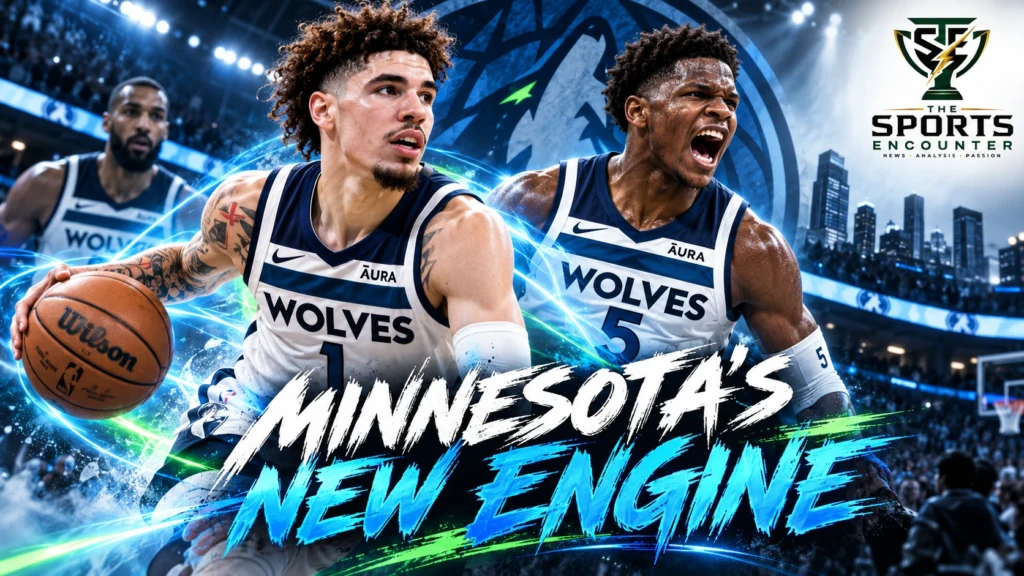
MINNEAPOLIS, United States, September 30, 2026: The Minnesota Timberwolves spent the offseason trying to solve a problem that has followed them deep into the playoffs: how do you make Anthony Edwards’ life easier without taking away what makes him special?
Their answer was LaMelo Ball.
Minnesota acquired Ball from the Charlotte Hornets in one of the biggest transactions of the summer, adding a 25-year-old point guard capable of pushing pace, creating his own shot and, most importantly, organizing an offense around Edwards rather than forcing Edwards to organize everything himself.
The move was far bigger than a simple Ball-for-Naz Reid swap. In the expanded four-team transaction, Minnesota received Ball, Josh Green and additional assets, while Charlotte received Reid along with substantial future draft compensation. Julius Randle also moved to Brooklyn as part of the broader deal.
The full package, confirmed by the NBA’s official trade report, makes Minnesota’s intentions clear.
The Timberwolves did not make a minor adjustment.
They changed the structure of the team around Edwards.
That gamble was already one of the central moves in The Sports Encounter’s analysis of the offseason moves that could reshape the 2027 NBA title race.
Now the real question begins.
Does LaMelo Ball make Minnesota merely more entertaining, or does he make the Timberwolves good enough to reach the NBA Finals?
What Did Minnesota Actually Get in LaMelo Ball?
Ball arrives after averaging 20.1 points, 7.1 assists and 4.8 rebounds across 72 games for Charlotte last season.
He shot 40.7% from the field, 36.8% from three-point range and 89.9% from the free-throw line.
Those numbers, available through Basketball Reference’s LaMelo Ball statistical profile, only explain part of Minnesota’s interest.
Ball gives the Timberwolves something they have lacked at a high level: a natural lead guard who sees passing windows early, throws advanced passes before defenses are set and can control possession without asking Edwards to initiate every action.
That distinction matters.
Edwards is one of the NBA’s best scorers. Last season he averaged 28.8 points while shooting 48.9% from the field and 39.9% from three.
He can create.
He can pass.
He can run pick-and-roll.
But there is a difference between being capable of running an offense and having to spend large portions of every night doing it.
Minnesota now has someone whose primary instinct is to organize other people.
Why the Timberwolves Made Such an Aggressive Trade
The Timberwolves finished 49-33 last season, good for sixth in the Western Conference.
They beat Denver in six games in the first round before losing 4-2 to San Antonio in the Western Conference semifinals.
That defeat was not evidence that Minnesota lacked talent.
It showed how narrow the margins become when playoff defenses take away a team’s preferred actions.
Edwards remained Minnesota’s central threat, but the Wolves could become predictable when opponents loaded multiple defenders toward him and forced somebody else to create advantages consistently.
Julius Randle helped with that problem. He averaged 21.1 points and 5.0 assists last season.
Mike Conley had spent several seasons giving Minnesota traditional point-guard organization.
But the team was changing.
Conley’s role had declined. Randle was moved. Reid was traded. Minnesota’s front office clearly decided that the next version of the roster needed to become quicker, more perimeter-oriented and more naturally organized around Edwards.
That direction had already become visible when Minnesota committed long term to Ayo Dosunmu. TSE examined that shift in its analysis of why Dosunmu’s new deal pointed toward a faster, more guard-driven Timberwolves identity.
Ball takes that idea much further.
The LaMelo Ball-Anthony Edwards Fit Could Change Minnesota’s Entire Offense
The most obvious benefit is workload.
Edwards no longer has to bring the ball up, initiate the first action, beat the initial defender, read the second defender and then still be expected to finish the possession.
Ball can handle the early stages.
That should allow Edwards to attack defenses that are already moving.
There is an enormous difference between asking Edwards to beat a set defense from a standstill and giving him the ball after Ball has already forced two defenders to react.
That is where the partnership becomes interesting.
Ball can push in transition and look for Edwards before the defense organizes.
He can run a high pick-and-roll with Rudy Gobert, force the low defender to step toward the rim and create a kick-out opportunity for Edwards or Jaden McDaniels.
He can attack a switch and force help.
He can also simply give Minnesota another player capable of creating something late in the shot clock when an initial possession breaks down.
For years, Edwards’ greatest strength has also created one of Minnesota’s biggest temptations.
When possessions become difficult, give him the ball and ask him to solve the problem.
That works often enough to become a habit.
It is much harder to win four playoff rounds that way.
Ball Could Make Edwards More Dangerous Without the Ball
One of the most interesting possibilities is not what Ball does with the ball.
It is what Edwards can do without it.
Edwards is such a dangerous isolation scorer that defenses naturally watch him even before he touches the ball.
If Ball is controlling the possession, Minnesota can use Edwards as a cutter, a weak-side shooter, a relocation threat or a receiver coming off screens.
That forces defenders into uncomfortable choices.
Help toward Ball and Edwards may have space.
Stay attached to Edwards and Ball has a clearer lane toward the basket or Gobert.
Switch actions involving both guards and the defense may end up with the wrong defender on one of them.
The challenge is that this will require adjustment from both stars.
Ball has traditionally been a high-usage lead guard.
Edwards has become accustomed to controlling Minnesota’s biggest possessions.
The fit looks promising on paper, but it should not be described as automatically perfect before the pair have played meaningful games together.
Chris Finch now has to build an offense in which both players remain aggressive without taking turns watching the other one operate.
Minnesota Should Become Faster, but Pace Alone Will Not Win a Championship
Ball naturally wants to play quickly.
He advances the ball with passes that many guards would not attempt and often sees transition opportunities before teammates have fully crossed half court.
Minnesota was already ninth in NBA pace last season, so this is not a team transforming from one of the league’s slowest systems into a running team overnight.
The difference should be the quality of its early offense.
Ball can produce easier opportunities before defenses settle.
That matters for Edwards, Jonathan Kuminga and McDaniels, all of whom can attack open space more effectively than they can attack five defenders packed into the half court.
Gobert may benefit most visibly.
Ball has spent his career looking for lob opportunities, early seals and passes over the top of defenses.
Gobert does not need post touches to be useful offensively. He needs defenders to respect the possibility of a pass above the rim.
Ball gives Minnesota more of those possibilities.
But playoff basketball eventually slows down.
Every serious contender needs to execute against set defenses in the final five minutes of games.
The Timberwolves cannot simply run their way through the Western Conference.
The real value of Ball will be whether the same creativity that improves their transition attack also gives them cleaner half-court possessions in May.
Jonathan Kuminga Makes the New Starting Five Even More Interesting
Ball was not Minnesota’s only major addition.
The Timberwolves also signed Jonathan Kuminga, who is expected to join Ball, Edwards, McDaniels and Gobert in the starting rotation.
Minnesota’s official announcement confirmed the Kuminga signing in September.
| Position | Player | Primary Role |
|---|---|---|
| PG | LaMelo Ball | Lead creator, transition passer, perimeter scorer |
| SG | Anthony Edwards | Primary scorer and late-game offensive centerpiece |
| SF | Jaden McDaniels | Two-way wing, floor spacer and elite perimeter defender |
| PF | Jonathan Kuminga | Rim pressure, athleticism and transition scoring |
| C | Rudy Gobert | Rim protection, rebounding, screens and vertical spacing |
That lineup has obvious athletic potential.
Ball can pass ahead.
Edwards can finish through contact.
Kuminga can run directly at retreating defenses.
McDaniels can trail into open threes or attack closeouts.
Gobert can sprint into screens and rim runs.
The concern will be spacing and decision-making when teams force Minnesota into slower possessions.
Kuminga is not replacing Randle’s playmaking one-for-one. Reid’s shooting is also gone.
Minnesota therefore needs Ball to create enough high-quality looks to compensate for some of the offensive versatility that left during the offseason.
Jaden McDaniels Could Be One of the Biggest Beneficiaries
McDaniels averaged 14.8 points last season and shot 41.2% from three.
Those numbers matter because defenders already have to respect him more than they once did.
Ball should create additional catch-and-shoot opportunities.
If a defender leaves McDaniels to stop Ball’s penetration or Gobert’s roll, the pass should arrive quickly.
If defenders stay home, Ball has more space to attack.
This is how one elite playmaker can alter the value of several teammates without necessarily increasing his own scoring average.
Ball does not have to average 25 points for this trade to succeed.
If Minnesota’s other scorers become more efficient because the offense produces cleaner possessions, his influence will be visible beyond his box score.
Ayo Dosunmu Gives Minnesota Another Important Backcourt Option
The Wolves are not relying entirely on Ball and Edwards.
Dosunmu remains one of the most important supporting guards on the roster.
His ability to defend, shoot and handle secondary creation gives Finch several lineup combinations.
He can play next to Ball.
He can play next to Edwards.
He can reduce the amount of time either star has to guard the opponent’s quickest perimeter player.
That depth becomes especially useful because Ball’s availability remains one of the biggest variables surrounding Minnesota’s season.
TSE’s earlier breakdown of Dosunmu’s importance next to Edwards becomes even more relevant now that Ball has been added to the same guard rotation.
The Biggest Risk Is Health
This is where Minnesota’s optimism has to meet reality.
Ball played 72 games last season, which was encouraging after several injury-interrupted years.
But his availability history remains uneven.
He played 75 games in 2021-22 before appearing in only 36 games in 2022-23, 22 in 2023-24 and 47 in 2024-25.
The 72-game season was an important recovery.
It does not erase the previous three years.
Edwards also enters 2026-27 after an unusually interrupted season of his own.
He played 61 regular-season games after appearing in 79 in each of the previous three seasons.
Minnesota cannot reach the ceiling of this roster if its two most important perimeter players spend long stretches unavailable together.
That does not mean injury should define the prediction.
It does mean the Timberwolves’ championship case is heavily dependent on continuity.
Decision-Making Matters More Than Labels About Effort
Ball has sometimes been criticized for loose possessions, ambitious passes and shot selection.
Those are fair basketball questions.
Calling him lazy does not explain the problem.
The more useful issue is discipline.
Can Ball keep the creativity that makes him special while recognizing when a spectacular pass is unnecessary?
Can he manage a fourth-quarter possession differently from a February transition opportunity?
Can he remain engaged defensively when opponents repeatedly target him?
Can he reduce avoidable turnovers without becoming cautious?
Minnesota does not need a less creative LaMelo Ball.
It needs a more selective one.
The playoffs will punish every careless possession.
What Minnesota Lost Matters Too
It would be easy to describe Minnesota’s offseason entirely through Ball’s arrival.
That would miss half the story.
Naz Reid is gone.
Julius Randle is gone.
Mike Conley is gone.
Those players represented scoring, shooting, rebounding, experience and playmaking.
Minnesota is betting that a different collection of skills works better around Edwards.
The Wolves have added Ball, Kuminga, Trey Lyles and Cody Williams while retaining important guards such as Dosunmu and Donte DiVincenzo.
This is why TSE described Minnesota’s summer as one of the NBA’s biggest offseason gambles.
The Timberwolves have not simply added a star to last year’s team.
They have built a different team.
Can LaMelo Ball Help Minnesota Beat the West’s Best?
That is the standard that matters.
Minnesota already knows it can win regular-season games.
It has finished 49-33 in consecutive seasons.
It has played multiple rounds of postseason basketball.
The next step is not making the playoffs.
It is surviving the teams that ended previous runs.
San Antonio eliminated Minnesota last season and eventually reached the NBA Finals, where the Spurs learned how unforgiving elite late-game execution can become. TSE followed that progression through San Antonio’s dramatic Finals collapse against New York and the Knicks’ championship-clinching Game 5 victory.
Those games provide a useful standard for Minnesota.
Championship teams need more than talent.
They need multiple creators.
They need late-game structure.
They need players who can make the correct decision after the defense takes away the first option.
That is exactly where Ball is supposed to help.
Where Do the Timberwolves Fit in the 2026-27 Championship Race?
Minnesota enters a Western Conference filled with teams that have legitimate reasons to believe they can reach the Finals.
San Antonio return from the Finals.
Oklahoma City remain loaded.
Denver still have championship infrastructure.
Other Western contenders have spent the offseason changing their own rosters.
TSE’s earlier look at the opening 2026-27 championship picture showed just how crowded the top of the league already looked before several later offseason moves were completed.
Minnesota now belongs in that conversation.
Not because Ball guarantees anything.
Because the Timberwolves have directly addressed one of the weaknesses that limited them when possessions became difficult.
How the 2026-27 Schedule Will Test the New Backcourt
Minnesota will not have much time to ease Ball into the system.
The NBA calendar places every contender under pressure quickly, and the Timberwolves’ schedule includes a Christmas Day meeting with Oklahoma City.
TSE’s complete guide to the 2026-27 NBA schedule highlights the major dates, national games and early tests that will begin shaping the playoff conversation long before spring.
For Minnesota, those games will reveal more than whether Ball can produce highlights.
They will show who controls late possessions.
They will show whether Edwards is comfortable giving the ball up early and getting it back later.
They will show whether the new starting five can defend elite opponents without sacrificing offense.
They will also show how Finch balances Ball, Edwards, Dosunmu and DiVincenzo when matchups demand more perimeter defense.
What Would Make the LaMelo Ball Trade a Success?
Ball does not need to average career highs in points for the trade to work.
Minnesota should judge the move through a broader set of questions.
| Area | What Minnesota Needs |
|---|---|
| Playmaking | More easy shots created before the defense is fully set |
| Edwards workload | Fewer possessions where Edwards must create everything from the first dribble |
| Transition | Ball using early passes to activate Edwards, Kuminga and McDaniels |
| Gobert fit | More lob opportunities and pressure around the rim |
| Three-point creation | Cleaner catch-and-shoot looks for Minnesota’s wings |
| Decision-making | Creative play without unnecessary turnovers |
| Health | Ball and Edwards available together for most of the season and postseason |
| Playoffs | More than one reliable ball handler when defenses take away Minnesota’s first option |
Ball Makes the Timberwolves More Dangerous, but the Experiment Still Has to Work
There is every reason to expect Minnesota to be entertaining.
That is the easy prediction.
Ball and Edwards can produce spectacular transition basketball. Both can shoot from deep. Both can create shots that few players would attempt. Kuminga adds another explosive athlete. Gobert provides a vertical target. McDaniels gives the lineup two-way balance.
The harder question is whether excitement becomes control.
That is what separates a dangerous playoff team from an NBA champion.
Ball gives Minnesota a genuine point guard in his prime, one capable of changing tempo and seeing opportunities before they develop.
Edwards gives Minnesota one of the league’s most destructive scorers.
Together, they give Chris Finch options he did not have before.
But options still have to become habits.
The stars must learn where each wants the ball.
The defense must survive.
Ball must stay available.
The Wolves must replace the production and versatility that left with Randle and Reid.
And when playoff defenses force Minnesota into its third or fourth option, Ball must give Edwards something the Timberwolves have too often lacked.
An easier answer.
If he does, Minnesota’s ceiling changes significantly.
The Timberwolves have never reached the NBA Finals.
The Ball trade is the clearest indication yet that they believe the Anthony Edwards era should not be judged merely by playoff appearances.
They are trying to win now.
For continuing roster analysis, trades, injuries, playoff coverage and the 2026-27 championship race, follow The Sports Encounter’s NBA Hub and browse the complete TSE NBA archive.
LaMelo Ball and Timberwolves FAQs
Who Did the Timberwolves Trade for LaMelo Ball?
Minnesota’s acquisition of Ball was part of a four-team transaction centered on Naz Reid and significant future draft compensation. The Timberwolves also received Josh Green and additional assets in the expanded deal.
What Did LaMelo Ball Average Last Season?
Ball averaged 20.1 points, 7.1 assists and 4.8 rebounds in 72 games while shooting 36.8% from three-point range.
How Does LaMelo Ball Help Anthony Edwards?
Ball gives Minnesota another primary ball handler who can initiate offense, push transition opportunities and create shots for teammates. That should allow Edwards to spend more possessions attacking after the defense has already been moved rather than having to create every advantage himself.
Will Anthony Edwards Play More Off the Ball?
He should have more opportunities to do so, but Minnesota is unlikely to turn Edwards into a primarily off-ball player. He will remain one of the team’s most important creators, particularly late in games.
What Is the Timberwolves’ Expected Starting Five?
The expected group entering the season is LaMelo Ball, Anthony Edwards, Jaden McDaniels, Jonathan Kuminga and Rudy Gobert.
Why Is LaMelo Ball’s Health a Concern?
Ball played 72 games last season but had several injury-limited seasons before that, including 36 games in 2022-23, 22 in 2023-24 and 47 in 2024-25.
Did Anthony Edwards Have Injury Problems Last Season?
Edwards played 61 regular-season games in 2025-26 after appearing in 79 games in each of the previous three seasons. His availability will be another important factor in Minnesota’s title hopes.
Can the Timberwolves Reach the NBA Finals?
They have the talent to contend, but the Western Conference remains deep. Minnesota’s ceiling will depend on Ball’s health, the Edwards-Ball fit, the new lineup’s defense and whether the Wolves can produce more reliable half-court offense in the playoffs.
When Does the 2026-27 NBA Season Begin?
The regular season begins in October 2026, with Minnesota entering the year as one of the Western Conference teams carrying legitimate championship expectations.