


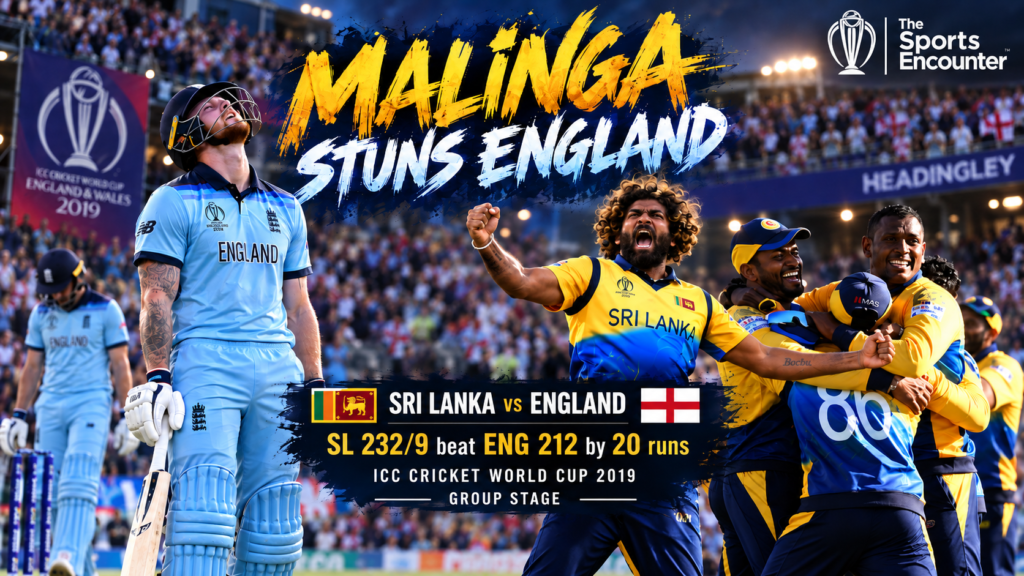
LEEDS, England, June 21, 2019: England needed 233.
For a batting lineup that had spent the previous few years redefining what an ODI total could look like, the equation seemed almost embarrassingly manageable.
Sri Lanka had been 3/2.
They had crawled to 232/9.
England were playing at home, entered as tournament favorites and had made 300-plus totals feel almost routine.
Then Lasith Malinga trapped Jonny Bairstow with his second ball.
James Vince followed.
Joe Root rebuilt.
Malinga came back and removed him too.
When Jos Buttler was pinned lbw, England were 144/5 and a target that had looked modest was suddenly becoming dangerous.
Then Dhananjaya de Silva took three wickets in 14 balls.
England collapsed to 178/8.
Ben Stokes still refused to surrender. He dragged the requirement down, protected Mark Wood from the strike and briefly made Headingley believe a remarkable escape was still possible.
But one ball to Wood was enough.
Nuwan Pradeep found the edge.
England were 212 all out.
Sri Lanka had defended 232 by 20 runs.
That is why this match is No. 36 in A Celebration of 5000 ODIs.
It was not merely an upset.
It was the afternoon when a World Cup that had started to look predictable suddenly became unstable.
TL;DR
- Sri Lanka won the toss and chose to bat.
- They collapsed to 3/2 after 2.2 overs.
- Avishka Fernando counterattacked with 49 from 39 balls.
- Kusal Mendis made 46 from 68.
- Angelo Mathews anchored the innings with an unbeaten 85 from 115.
- Sri Lanka finished on 232/9.
- Jofra Archer and Mark Wood took three wickets each.
- Lasith Malinga dismissed Jonny Bairstow for a golden duck and James Vince early.
- Malinga later removed Joe Root for 57 and Jos Buttler for 10.
- England fell from 127/3 to 178/8.
- Dhananjaya de Silva took 3/32, including three wickets in 14 balls.
- Ben Stokes finished unbeaten on 82 from 89 balls.
- England were bowled out for 212 in 47 overs.
- Sri Lanka won by 20 runs.
- Lasith Malinga was named Player of the Match after taking 4/43.
Sri Lanka vs England 2019 World Cup: Match at a Glance
| Detail | Information |
|---|---|
| Competition | ICC Cricket World Cup 2019 |
| Match | 27th Match |
| Date | June 21, 2019 |
| Venue | Headingley, Leeds |
| Toss | Sri Lanka won the toss and batted |
| Sri Lanka | 232/9 in 50 overs |
| England | 212 all out in 47 overs |
| Result | Sri Lanka won by 20 runs |
| Player of the Match | Lasith Malinga |
| Sri Lanka top scorer | Angelo Mathews, 85* |
| England top scorer | Ben Stokes, 82* |
| Best Sri Lanka bowling | Lasith Malinga, 4/43 |
| Best England bowling | Mark Wood, 3/40 |
| Other major bowling performance | Dhananjaya de Silva, 3/32 |
| Key collapse | England 127/3 to 178/8 |
Why Match 36 Belongs in A Celebration of 5000 ODIs
The original A Celebration of 5000 ODIs roadmap gives the basic reason.
Sri Lanka defended only 232 against the tournament favorites.
Malinga took four wickets.
The result altered the World Cup standings.
All of that is true.
The deeper reason this match belongs here is that it turned England’s greatest strength against them.
England had built their ODI identity around aggression.
Targets around 230 were supposed to be removed quickly.
They had the batters.
They had home conditions.
They had depth extending deep into the order.
Sri Lanka gave them a target that looked too small to fear.
That was the trap.
Once Malinga removed both openers, England could no longer play the chase they had expected.
Root had to rebuild.
Morgan had to stabilize.
Stokes had to survive.
Buttler had to repair.
The deeper England went, the more the pressure shifted from Sri Lanka to them.
A target that looked inadequate at halftime became heavier with every wicket.
That transformation is exactly what this series is designed to capture.
Sri Lanka Are 3/2 Before the Match Has Even Started Properly
England could hardly have begun better.
Jofra Archer removed Dimuth Karunaratne for one.
Chris Woakes dismissed Kusal Perera for two.
After 2.2 overs, Sri Lanka were 3/2.
At that point, 232 would have sounded optimistic.
The question was whether Sri Lanka could survive long enough to create any total worth defending.
Avishka Fernando gave them the first answer.
Avishka Fernando Changes the Tempo
Fernando was playing his first match of the tournament.
He did not bat like someone interested in surviving.
His 49 came from 39 balls.
Six fours.
Two sixes.
Strike rate 125.64.
That innings mattered because Sri Lanka could not afford another cautious rebuild after losing two wickets for three.
Fernando forced England’s fast bowlers to defend.
For the first time in the innings, England had to react rather than simply attack.
He added 59 with Kusal Mendis and moved Sri Lanka from 3/2 to 62/3.
His dismissal one short of fifty returned control to England.
But the innings had been rescued from immediate disaster.
Kusal Mendis and Angelo Mathews Build the Total England Later Underestimate
Mendis and Mathews then changed the style again.
The boundaries disappeared.
Survival became the priority.
They added 71 for the fourth wicket.
Mendis made 46 from 68 balls.
Mathews settled into the innings England least wanted to face later: one that consumed deliveries without gifting another wicket.
The partnership took Sri Lanka to 133/3.
Then Adil Rashid struck twice in two balls.
Mendis was caught.
Jeevan Mendis followed first ball.
Sri Lanka were 133/5.
England had another opening.
Mathews refused to disappear.
Angelo Mathews Makes 85 Look Bigger Than 85
Mathews finished unbeaten on 85 from 115 deliveries.
Five fours.
One six.
Strike rate 73.91.
Those numbers do not look extraordinary in isolation.
The match makes them extraordinary.
He arrived after Sri Lanka had already lost two early wickets.
He saw Fernando counterattack and fall.
He saw Kusal Mendis rebuild and fall.
He watched wickets continue around him.
Yet he remained.
Without Mathews, Sri Lanka probably do not reach 220.
Without 220, Malinga may never have enough runs to make England uncomfortable.
His innings was slow because Sri Lanka’s situation demanded patience.
It became match-winning because England later discovered how difficult the same surface could be.
Dhananjaya de Silva’s 29 Quietly Pushes the Target Beyond 230
Dhananjaya de Silva contributed 29 from 47 balls.
It was not glamorous.
It mattered.
He and Mathews added enough through the middle and late overs to move Sri Lanka toward a defendable total.
The partnership also delayed England’s access to the tail.
When Archer removed Dhananjaya at 190/6, Sri Lanka still had more than six overs remaining.
The lower order added enough scraps to reach 232.
At halftime, it looked insufficient.
By the 41st over of England’s chase, every one of those runs mattered.
England’s Bowlers Do Their Job
England’s defeat should not obscure the quality of their bowling.
Mark Wood took 3/40 from eight overs.
Jofra Archer took 3/52 from 10.
Adil Rashid claimed 2/45.
Chris Woakes conceded only 22 from five overs and took a wicket.
Ben Stokes bowled five overs for only 16.
Moeen Ali went for 40 from 10.
England restricted Sri Lanka to fewer than five runs per over.
Against the batting lineup England possessed, that should have been enough.
Their bowlers had done their job.
The batting failed to finish it.
Lasith Malinga’s Second Ball Changes the Chase Immediately
England’s target was 233.
Malinga gave them no chance to settle into it.
Jonny Bairstow faced his second delivery.
LBW.
Golden duck.
England 1/1.
That dismissal immediately changed the psychology of the chase.
England could no longer begin with two aggressive openers putting Sri Lanka under pressure.
One of them was already gone.
Malinga was not finished.
James Vince Falls and England Lose Their Comfortable Start
James Vince made 14 from 18.
He looked capable of moving the innings forward.
Then Malinga found him too.
Vince edged to Kusal Mendis.
England were 26/2.
Sri Lanka now had something they did not have at the innings break.
Belief.
The target still looked manageable.
The match no longer looked routine.
Joe Root Rebuilds England’s Chase
Joe Root did exactly what the situation required.
He slowed the game down.
He absorbed pressure.
He built partnerships.
Root made 57 from 89 balls.
His stand with Eoin Morgan moved England from 26/2 to 73/2.
After Morgan fell for 21, Root and Stokes continued.
The chase began to stabilize.
At 127/3, England needed another 106 with seven wickets available.
This was the point where the tournament favorites should have taken back control.
Instead, Malinga returned.
Malinga Removes Root and Turns Pressure Into Panic
Root was the batter holding England’s chase together.
Malinga removed him for 57.
Caught behind.
England 127/4.
That wicket changed the match more than the score initially suggested.
Stokes remained.
But England had lost their stabilizer.
Jos Buttler joined him.
Sri Lanka suddenly had the opportunity to attack both pressure and expectation.
Malinga took it.
Jos Buttler’s Wicket Is Malinga’s Masterstroke
Buttler was one of the most dangerous finishers in world cricket.
With Stokes already set, his arrival could have ended Sri Lanka’s resistance.
Malinga produced the delivery Sri Lanka needed.
Full.
Straight.
Buttler trapped lbw for 10.
England 144/5.
Malinga had removed Bairstow, Vince, Root and Buttler.
Four wickets.
Every one belonged to England’s top six.
This was not tail-end cleanup.
He dismantled the part of England’s batting order that was supposed to make 233 routine.
Player of the Match Lasith Malinga Turns Back the Clock
Malinga finished with:
10 overs
1 maiden
43 runs
4 wickets
Economy rate: 4.30
The figures alone justify Player of the Match.
The identity of the wickets makes the spell even stronger.
Bairstow.
Vince.
Root.
Buttler.
Malinga attacked the chase at four different stages.
He struck before England had started.
He removed the second opener.
He returned when Root had rebuilt control.
Then he eliminated Buttler before the middle order could accelerate.
This was the same bowler whose historic four wickets in four balls against South Africa had already earned a place in this series.
Readers can revisit that extraordinary spell in Match 21: Malinga Takes Four in Four, but South Africa Escape the Last Wicket.
Twelve years later, the method was different.
The impact was just as dramatic.
Moeen Ali Gives Sri Lanka a Chance They Cannot Waste
England reached 160/5.
Moeen Ali had Stokes at the other end.
He had made 16.
The game remained winnable.
Then Dhananjaya de Silva entered the match with the ball.
Moeen attacked him.
Isuru Udana took the catch.
England 160/6.
The lower order was exposed.
Dhananjaya sensed the opportunity.
Dhananjaya de Silva Takes Three Wickets in 14 Balls
Chris Woakes lasted four balls.
Caught behind.
Adil Rashid lasted two.
Caught behind.
Dhananjaya had taken three wickets in 14 deliveries.
England went from 160/5 to 178/8.
This was the collapse that turned Malinga’s damage into a winning position.
Dhananjaya finished with 3/32 from eight overs.
His wickets were not as famous as Malinga’s.
They were just as necessary.
England’s batting depth was supposed to save them once the top order failed.
Dhananjaya removed the depth.
Ben Stokes Refuses to Let the Match End
England were 178/8.
Stokes remained.
He had already passed fifty.
Jofra Archer joined him.
England still needed 55.
The logical conclusion was that Sri Lanka had won.
Stokes disagreed.
He attacked when the field allowed it.
He protected the tail.
He kept reducing the target.
Archer survived 11 balls before falling for three.
England were 186/9.
Mark Wood arrived.
Forty-seven still required.
The game should have been over.
Stokes kept going.
Stokes Produces the Innings England Needed From Someone Else Too
Stokes finished unbeaten on 82 from 89 balls.
Seven fours.
Four sixes.
The innings became increasingly aggressive as England ran out of partners.
He turned 47 required into something that briefly felt reachable.
Sri Lanka even dropped him late.
Stokes responded by attacking harder.
The problem was that he had no recognized batter left.
Wood had to survive only a handful of deliveries.
Sri Lanka needed one mistake.
Nuwan Pradeep Needs One Ball at Mark Wood
Stokes manipulated the strike brilliantly.
He tried to keep Wood away from Sri Lanka’s bowlers.
But one ball was enough.
Pradeep found the edge.
Kusal Perera completed the catch.
Wood out for zero.
England 212 all out.
Stokes unbeaten on 82.
Sri Lanka win by 20 runs.
The innings ended with one of the tournament’s best batters stranded because the rest of England had disappeared around him.
Complete Match Scorecard
Sri Lanka Batting: 232/9 in 50 Overs
| Batter | Dismissal | R | B | 4s | 6s | SR |
|---|---|---|---|---|---|---|
| Dimuth Karunaratne (c) | c Buttler b Archer | 1 | 8 | 0 | 0 | 12.50 |
| Kusal Perera (wk) | c Moeen Ali b Woakes | 2 | 6 | 0 | 0 | 33.33 |
| Avishka Fernando | c Rashid b Wood | 49 | 39 | 6 | 2 | 125.64 |
| Kusal Mendis | c Morgan b Rashid | 46 | 68 | 2 | 0 | 67.65 |
| Angelo Mathews | not out | 85 | 115 | 5 | 1 | 73.91 |
| Jeevan Mendis | c & b Rashid | 0 | 1 | 0 | 0 | 0.00 |
| Dhananjaya de Silva | c Root b Archer | 29 | 47 | 1 | 0 | 61.70 |
| Thisara Perera | c Rashid b Archer | 2 | 6 | 0 | 0 | 33.33 |
| Isuru Udana | c Root b Wood | 6 | 4 | 1 | 0 | 150.00 |
| Lasith Malinga | b Wood | 1 | 5 | 0 | 0 | 20.00 |
| Nuwan Pradeep | not out | 1 | 1 | 0 | 0 | 100.00 |
Extras: 10
Total: 232/9 in 50 overs
Run rate: 4.64
Fall of wickets: 3/1 Dimuth Karunaratne, 3/2 Kusal Perera, 62/3 Avishka Fernando, 133/4 Kusal Mendis, 133/5 Jeevan Mendis, 190/6 Dhananjaya de Silva, 200/7 Thisara Perera, 209/8 Isuru Udana, 220/9 Lasith Malinga.
England Bowling
| Bowler | O | M | R | W | Econ |
|---|---|---|---|---|---|
| Chris Woakes | 5 | 0 | 22 | 1 | 4.40 |
| Jofra Archer | 10 | 2 | 52 | 3 | 5.20 |
| Mark Wood | 8 | 0 | 40 | 3 | 5.00 |
| Ben Stokes | 5 | 0 | 16 | 0 | 3.20 |
| Moeen Ali | 10 | 0 | 40 | 0 | 4.00 |
| Adil Rashid | 10 | 0 | 45 | 2 | 4.50 |
| Joe Root | 2 | 0 | 13 | 0 | 6.50 |
England Batting: 212 All Out in 47 Overs
| Batter | Dismissal | R | B | 4s | 6s | SR |
|---|---|---|---|---|---|---|
| James Vince | c Kusal Mendis b Malinga | 14 | 18 | 2 | 0 | 77.78 |
| Jonny Bairstow | lbw b Malinga | 0 | 1 | 0 | 0 | 0.00 |
| Joe Root | c Kusal Perera b Malinga | 57 | 89 | 3 | 0 | 64.04 |
| Eoin Morgan (c) | c & b Udana | 21 | 35 | 2 | 0 | 60.00 |
| Ben Stokes | not out | 82 | 89 | 7 | 4 | 92.13 |
| Jos Buttler (wk) | lbw b Malinga | 10 | 9 | 1 | 0 | 111.11 |
| Moeen Ali | c Udana b Dhananjaya de Silva | 16 | 20 | 0 | 1 | 80.00 |
| Chris Woakes | c Kusal Perera b Dhananjaya de Silva | 2 | 4 | 0 | 0 | 50.00 |
| Adil Rashid | c Kusal Perera b Dhananjaya de Silva | 1 | 2 | 0 | 0 | 50.00 |
| Jofra Archer | c Thisara Perera b Udana | 3 | 11 | 0 | 0 | 27.27 |
| Mark Wood | c Kusal Perera b Pradeep | 0 | 4 | 0 | 0 | 0.00 |
Extras: 6
Total: 212 all out in 47 overs
Run rate: 4.51
Fall of wickets: 1/1 Jonny Bairstow, 26/2 James Vince, 73/3 Eoin Morgan, 127/4 Joe Root, 144/5 Jos Buttler, 160/6 Moeen Ali, 176/7 Chris Woakes, 178/8 Adil Rashid, 186/9 Jofra Archer, 212/10 Mark Wood.
Sri Lanka Bowling
| Bowler | O | M | R | W | Econ |
|---|---|---|---|---|---|
| Lasith Malinga | 10 | 1 | 43 | 4 | 4.30 |
| Nuwan Pradeep | 10 | 1 | 38 | 1 | 3.80 |
| Dhananjaya de Silva | 8 | 0 | 32 | 3 | 4.00 |
| Thisara Perera | 8 | 0 | 34 | 0 | 4.25 |
| Isuru Udana | 8 | 0 | 41 | 2 | 5.13 |
| Jeevan Mendis | 3 | 0 | 23 | 0 | 7.67 |
Eight Turning Points That Decided Sri Lanka vs England
1. Sri Lanka Survive 3/2
If England had taken another wicket immediately, the match may have ended before lunch.
Fernando counterattacked and changed the innings.
2. Fernando Scores 49 From 39
Sri Lanka needed someone to challenge England rather than merely survive.
Fernando did it.
His innings restored energy after the opening collapse.
3. Mathews Refuses to Leave
Sri Lanka kept losing wickets.
Mathews remained unbeaten on 85.
Those runs converted a disastrous start into something defendable.
4. Malinga Removes Bairstow With His Second Ball
England’s chase lost its expected rhythm immediately.
Sri Lanka suddenly believed.
5. Root Falls at 127/4
England had rebuilt.
Malinga broke the partnership that was taking control back.
6. Buttler Falls at 144/5
This was the wicket that exposed England’s lower middle order before the target had become comfortable.
7. Dhananjaya Takes Three Wickets in 14 Balls
England collapsed from 160/5 to 178/8.
The chase became Stokes against an entire team.
8. Pradeep Finds Wood’s Edge
Stokes had kept the impossible alive.
Wood faced one decisive delivery.
Sri Lanka finally finished the job.
Why England Lost a Match They Were Expected to Win
England’s failure was not about the size of the target.
It was about losing control of the chase repeatedly.
Bairstow’s early wicket forced a rebuild.
Vince fell before the rebuild developed.
Morgan fell after Root had steadied things.
Root then fell immediately before England wanted to accelerate.
Buttler disappeared before he could change the rate.
Moeen, Woakes and Rashid followed in rapid succession.
England never produced one partnership long enough to put Sri Lanka back under permanent pressure.
That is unusual for a side with so much batting depth.
Sri Lanka made it happen.
England’s Aggression Becomes Hesitation
England had built their modern ODI identity around attacking cricket.
But a small chase creates its own psychological problem.
The batting side knows it should win.
Every early wicket therefore feels bigger.
At 26/2, England could no longer treat 233 casually.
At 73/3, they had to rebuild again.
At 127/4, the chase remained comfortable mathematically but dangerous emotionally.
That tension slowed the innings.
Sri Lanka exploited it.
The same England team that usually imposed pressure suddenly spent much of the chase trying not to make the next mistake.
Ben Stokes Almost Produces the Escape
Stokes deserves his own place in the story because he nearly overturned everything Sri Lanka had built.
At 178/8, there was no rational reason to expect England to win.
He kept swinging.
At 186/9, the game seemed finished again.
He kept farming the strike.
Stokes reached 82 not out.
The target fell.
The crowd rose.
Sri Lanka began feeling pressure they had largely avoided for several overs.
Then Wood edged Pradeep.
Stokes never got another chance.
Angelo Mathews’ Innings Looks Better After England Bat
Mathews’ 85 initially looked too slow.
Once England began batting, the conditions reframed it.
Root scored at a strike rate of 64.04.
Stokes finished at 92.13 only after late acceleration.
Morgan scored 21 from 35.
The surface was not easy.
Mathews had understood that before England did.
He did not win Player of the Match because Malinga produced the decisive spell.
But Sri Lanka could not have defended 232 without him.
Dhananjaya de Silva Provides the Second Punch
Malinga created the crisis.
Dhananjaya ensured England could not recover from it.
His three wickets came in the section where England expected its depth to matter.
Moeen Ali.
Chris Woakes.
Adil Rashid.
Three wickets.
Fourteen balls.
England’s long batting order had effectively disappeared.
That is why the victory should never be reduced to one Malinga spell.
Malinga supplied the headline.
Dhananjaya supplied the collapse.
Sri Lanka’s Bowling Plan Works Because Everyone Contributes
Malinga took four.
Dhananjaya took three.
Udana took two.
Pradeep took the final wicket.
Thisara Perera went wicketless but conceded only 34 from eight overs.
Pradeep gave away only 38 from 10.
Sri Lanka never allowed England a sustained release.
Whenever one bowler’s spell ended, another presented a different problem.
Slower pace.
Swing.
Yorkers.
Off-spin.
Variation.
England were forced to restart repeatedly.
Why This Win Changed the World Cup
Sri Lanka entered the match as outsiders.
England entered as one of the strongest teams in the tournament.
A comfortable England victory would have reinforced the growing impression that the semifinal race was beginning to settle.
Sri Lanka’s win broke that pattern.
Suddenly the gap behind England narrowed.
Sri Lanka had renewed belief.
England’s route no longer looked automatic.
Other teams chasing semifinal places gained reason to believe the table could still move.
That wider consequence is one of the major reasons Match 36 belongs in this series.
A single low-scoring upset changed the emotional direction of the tournament.
England Had Been Shocked by Small Targets Before
There is a historical echo here.
At the 1992 World Cup, England needed only 135 against Zimbabwe.
They were bowled out for 125.
Eddo Brandes took four wickets and transformed another apparently routine chase into one of the World Cup’s most famous upsets.
TSE revisited that match in Match 10: Eddo Brandes Defends 134 and Leaves England Stunned.
The totals were different.
The psychological structure was similar.
England knew they should chase the runs.
The defending side made certainty disappear before the chase could settle.
Sri Lanka and England Had Their Own World Cup History
This was also not the first time Sri Lanka and England had produced a World Cup match that refused to behave normally.
In 2007, England needed three from the final ball.
Dilhara Fernando bowled Ravi Bopara.
Sri Lanka won by two runs.
That thriller appears in Match 22: Fernando’s Final Ball Breaks England’s Remarkable Recovery.
Twelve years later, Headingley produced a different kind of tension.
The finish was not decided by the final ball.
The uncertainty lasted almost the entire chase.
Malinga’s World Cup Legacy Gets Another Chapter
Malinga had already produced one of the greatest bowling sequences in World Cup history with four wickets in four balls against South Africa in 2007.
That performance appears in Match 21 of this series.
By 2019, he no longer possessed quite the same pace.
He still possessed the skills.
The sling.
The yorker.
The slower ball.
The angle.
The ability to attack a batter’s confidence.
Against England, experience replaced raw speed.
The result was 4/43 and one of Sri Lanka’s most famous World Cup wins.
The Upset Looks Even Stranger Against England’s Larger 2019 Story
England would eventually recover.
They would go on to reach the final.
They would ultimately win their first men’s ODI World Cup in extraordinary circumstances.
That later success makes the Headingley defeat more fascinating rather than less.
World champions are often remembered as if their path was inevitable.
This match proves it was not.
There was a point in the group stage when England looked vulnerable, their semifinal place looked uncertain and a 232-run chase exposed all the pressure that came with being favorites.
That is what makes great tournament history interesting.
The eventual winner is rarely as comfortable as memory later suggests.
Frequently Asked Questions
Who Won Sri Lanka vs England at the 2019 Cricket World Cup?
Sri Lanka won by 20 runs after scoring 232/9 and dismissing England for 212 in 47 overs.
Who Was Player of the Match?
Lasith Malinga was named Player of the Match after taking 4/43 from 10 overs.
Who Did Lasith Malinga Dismiss?
Malinga dismissed Jonny Bairstow, James Vince, Joe Root and Jos Buttler.
How Many Runs Did Angelo Mathews Score?
Mathews made an unbeaten 85 from 115 balls.
How Many Runs Did Ben Stokes Score?
Stokes finished unbeaten on 82 from 89 deliveries.
What Was Dhananjaya de Silva’s Bowling Figure?
Dhananjaya took 3/32 from eight overs.
How Did England Collapse?
England moved from 127/3 to 178/8 as Malinga removed Root and Buttler before Dhananjaya took three quick middle-order wickets.
What Was Sri Lanka’s Score?
Sri Lanka scored 232/9 from 50 overs.
Why Is This Match Included in A Celebration of 5000 ODIs?
Sri Lanka defended a modest 232 against the tournament favorites, Malinga dismantled England’s top order, Dhananjaya destroyed the lower middle order and the result reopened the World Cup semifinal race.
Where Can Readers Follow the Full Series?
Every installment can be followed through the A Celebration of 5000 ODIs series hub and the main 100-match roadmap.