


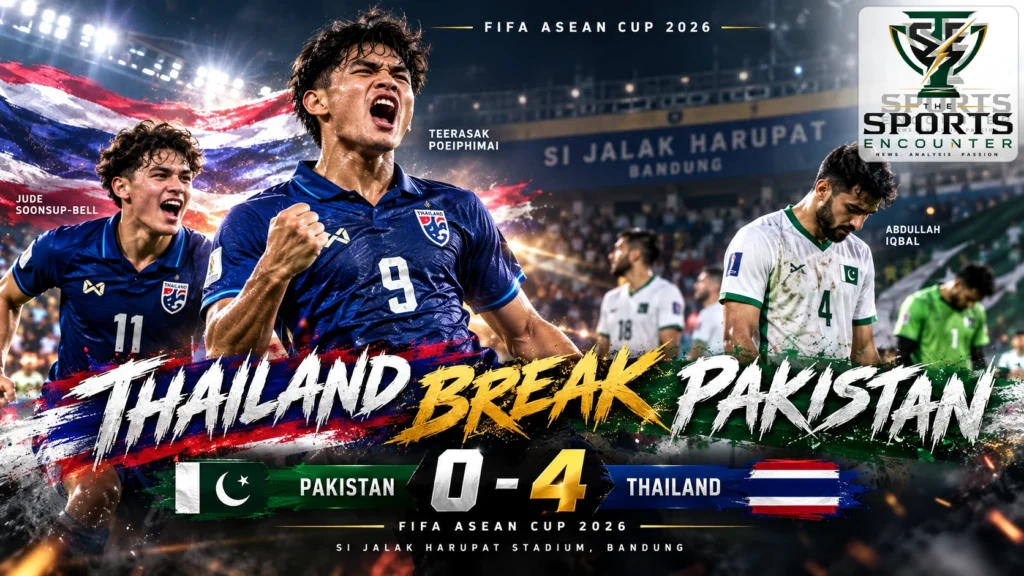
BANDUNG, Indonesia, September 26, 2026: For 31 minutes, Pakistan had done the hardest part.
Thailand controlled the game without turning that superiority into a goal, and the longer the FIFA ASEAN Cup opener remained scoreless, the more Pakistan could believe that discipline might make the enormous difference in international experience manageable.
Then Teerasak Poeiphimai arrived at the far more dangerous part of the contest: the moment when one mistake becomes two.
Teerasak broke Pakistan’s resistance in the 32nd minute, Jude Soonsup-Bell doubled Thailand’s lead 10 minutes later, and the War Elephants eventually completed a 4-0 victory at Si Jalak Harupat Stadium that immediately changed the mathematics of Division 1 Group B.
A deflected Teerasak effort produced Thailand’s third in the 64th minute before the striker scored again in the 84th, completing a performance in which he was directly involved in three of the four goals.
The result gives Thailand three points and a four-goal cushion before Tuesday’s heavyweight meeting with Vietnam. Pakistan, meanwhile, have almost no margin left when they face the Philippines.
That pressure was built into the tournament from the beginning. As The Sports Encounter explained in its complete FIFA ASEAN Cup 2026 preview, only the winner of each Division 1 group advances to the final.
Pakistan vs Thailand 4-0: Match at a Glance
| Detail | Information |
|---|---|
| Competition | FIFA ASEAN Cup 2026, Division 1 Group B |
| Result | Pakistan 0-4 Thailand |
| Venue | Si Jalak Harupat Stadium, Bandung |
| Thailand Goals | Teerasak Poeiphimai 32′, Jude Soonsup-Bell 42′, deflected Teerasak effort/own goal 64′, Teerasak Poeiphimai 84′ |
| Halftime | Pakistan 0-2 Thailand |
| Thailand Next Match | vs Vietnam, September 29 |
| Pakistan Next Match | vs Philippines, September 29 |
How Did Pakistan Keep Thailand Out for the First 30 Minutes?
The final score makes the game look straightforward. The opening half-hour was not.
Thailand entered as the overwhelming favorite, but Anthony Hudson’s team initially played at a measured tempo and struggled to turn territorial control into clear finishing opportunities.
Kritsada Kaman had one of the better early openings but failed to direct his effort accurately enough to trouble Pakistan.
That period mattered because Pakistan’s best realistic route into the contest involved making Thailand impatient.
The longer the favorite remains scoreless against a deep and committed opponent, the more decisions begin to accelerate. Passes are forced. Fullbacks commit earlier. Spaces can appear behind the first attacking wave.
Pakistan reached that point.
They simply could not stay there.
Why Did Teerasak Poeiphimai’s 32nd-Minute Goal Change Everything?
The opening goal exposed how quickly persistent pressure can punish a team once its defensive structure is forced to react twice inside the same attack.
A delivery from Thailand’s right found Soonsup-Bell, whose header was stopped. The danger was not finished.
Teerasak had followed the attack and reacted first to the loose ball, converting the rebound in the 32nd minute.
It was not the most elaborate goal Thailand will score in this tournament. It may have been the most important one on Saturday.
Pakistan had spent more than half an hour defending a scoreless match. The goal immediately changed the assignment from protection to recovery.
That distinction matters against a Thailand team accustomed to controlling matches from in front.
Teerasak has spent much of 2026 demonstrating precisely why he is dangerous in those moments. He scored twice when Thailand beat Singapore 3-1 in the first leg of their ASEAN Championship semifinal, a performance TSE analyzed in Thailand’s semifinal victory at Jalan Besar.
He later entered the ASEAN Championship final among the competition’s most influential attackers and ranked prominently in TSE’s Top 10 players of the tournament.
Bandung supplied another example of the same quality: Teerasak did not need repeated chances to change the match.
Jude Soonsup-Bell Turns Control Into a Two-Goal Problem
Pakistan still had a route back after 1-0.
Ten minutes later, it became much narrower.
Soonsup-Bell converted in the 42nd minute after Thailand again created the decisive opening from a wide attacking position.
The timing was damaging.
A one-goal halftime deficit could have allowed Pakistan to reset without radically changing its approach. At 2-0, the second half required considerably more ambition, which inevitably created more space for Thailand to attack.
Soonsup-Bell’s goal also showed the attacking depth Hudson has available.
Thailand came to the tournament with several established names, including Chanathip Songkrasin, Supachok Sarachat and Supachai Chaided, but did not need all of them to overwhelm Pakistan.
That was one of the more important conclusions from the opening match.
Hudson said before the tournament that Thailand had tried to select its strongest available group because the ASEAN Cup also forms part of preparation for the 2027 Asian Cup.
We want to build the strongest possible team in preparation for the Asian Cup early next year.
The broader squad construction now looks significant because Thailand’s route to the FIFA ASEAN Cup final may depend on managing several matches in a short period rather than relying on the same attacking combination every time.
Teerasak Creates Thailand’s Third Even When He Does Not Get the Goal
Thailand did not need to attack at maximum speed after halftime.
The score had already placed Pakistan in the more uncomfortable tactical position.
Still, the third goal arrived in the 64th minute when Teerasak attacked a difficult ball from a narrow angle and struck a volley that deflected off a Pakistan player before reaching the net.
Available detailed match reporting credited the goal as an own goal rather than Teerasak’s hat trick, so TSE is recording him with two confirmed goals while noting his direct role in the third.
That distinction does not change his influence.
He had now created the first goal through anticipation, remained central to Thailand’s penalty-area movement and forced the intervention that produced the third.
It was exactly the kind of performance that makes Thailand’s attacking depth dangerous over a three-match group stage.
Why Teerasak’s Second Goal Mattered Beyond the Score
The fourth arrived in the 84th minute.
Peeradon Chamratsamee supplied the final pass and Teerasak finished calmly to complete his brace.
At 3-0, the three points were already secure.
The fourth still mattered.
Only one team from Group B reaches the Division 1 final, while the runner-up enters the bronze match. TSE highlighted the brutality of that format when the competition was announced in our analysis of why the FIFA ASEAN Cup leaves almost no room for a slow start.
That makes goal difference potentially important in a group containing Thailand and reigning regional champion Vietnam.
Thailand did not merely collect three points against Pakistan. They built a four-goal margin before facing their strongest direct rival.
What Went Wrong for Pakistan After a Promising Opening Half-Hour?
The biggest problem was not conceding four times.
It was how quickly the match changed after the first goal.
Pakistan reached the 31st minute at 0-0. Eleven minutes later, they were two goals behind.
That 10-minute spell removed most of the value from the defensive work that had come before it.
International soccer punishes concentration losses more severely against teams that combine technical quality with experienced penalty-area movement. Thailand’s first two goals demonstrated that gap.
The opener came after Pakistan survived the first effort but failed to control the second ball.
The second arrived before Pakistan could reach halftime and reorganize.
Those are correctable problems. They are also the kind that Pakistan cannot repeat against the Philippines because the tournament format has already moved them close to elimination territory.
Pakistan’s Tournament Is Not Over, but the Philippines Game Is Now Critical
Pakistan’s next match is against the Philippines on September 29 in Bandung.
After Vietnam defeated the Philippines 1-0 in Saturday’s second Group B match, both Pakistan and the Philippines enter that meeting without a point.
That makes their matchup effectively an elimination game for any realistic ambition of reaching the Division 1 final.
| Team | Played | Points | Goals | Goal Difference |
|---|---|---|---|---|
| Thailand | 1 | 3 | 4-0 | +4 |
| Vietnam | 1 | 3 | 1-0 | +1 |
| Philippines | 1 | 0 | 0-1 | -1 |
| Pakistan | 1 | 0 | 0-4 | -4 |
Pakistan therefore have two immediate objectives against the Philippines.
First, win.
Second, repair some of the goal-difference damage inflicted by Thailand.
A draw would leave Pakistan requiring an extraordinary sequence of results before the final group match against Vietnam.
The Philippines should not be treated as a simple recovery opportunity. They reached the decisive stages of this summer’s regional championship race before Malaysia ended their semifinal hopes with a 1-0 victory, a match covered in TSE’s report on Pavithran Gunalan’s decisive goal.
Thailand vs Vietnam Already Looks Like the Match That Could Decide Group B
Thailand’s next assignment carries completely different stakes.
Vietnam also opened with three points, beating the Philippines 1-0 later on Saturday.
That means Tuesday’s Thailand-Vietnam meeting can establish a clear leader before the final round.
The rivalry hardly needs another layer.
Vietnam beat Thailand in last month’s ASEAN Championship final, drawing the second leg 2-2 in Hanoi to complete a 4-2 aggregate victory. TSE’s final report documented how Thailand threatened a comeback before missed opportunities and two own goals helped Vietnam retain the trophy.
Thailand had reached that final after surviving a difficult semifinal against Singapore. The War Elephants won the first leg 3-1 before losing the return 2-1 and advancing 4-3 on aggregate, as detailed in TSE’s analysis of the Bangkok second leg.
Their regional pedigree is therefore well established.
What Saturday added was margin.
Vietnam have three points and a one-goal advantage.
Thailand have three points and a four-goal advantage.
The group has already begun to look like another direct contest between the region’s two strongest recent teams.
Thailand’s Depth May Be the Bigger Warning Than the 4-0 Score
There is an obvious temptation to judge this match entirely through Pakistan’s limitations.
That would miss part of the story.
Thailand entered the ASEAN Championship earlier this year as the most successful nation in the competition’s history. Its route through the knockout phase reinforced the importance of squad depth, experience and the ability to win different types of matches.
TSE’s historical analysis of the 2026 ASEAN semifinalists showed why Thailand and Vietnam entered that stage with structural advantages over most of the region.
Saturday provided the next piece of evidence.
Thailand did not need a frantic opening, a superstar performance from Chanathip or a full-strength attacking lineup to win comfortably.
They stayed patient, found the first weakness, scored twice before halftime and continued adding goals without turning the match into an uncontrolled chase.
That is a more sustainable tournament signal than simply scoring four.
What Does the Result Tell Us About Pakistan’s First FIFA ASEAN Cup Test?
Pakistan were invited into Division 1 partly because this competition is supposed to expose developing national teams to stronger and less familiar opposition.
Saturday certainly did that.
Thailand are not merely another international opponent. They are one of Southeast Asia’s deepest national teams and recently reached another regional final.
Pakistan now have usable evidence about the level required.
The challenge is turning that evidence into improvement quickly enough to matter against the Philippines.
There is no long qualification campaign here and no second round-robin meeting.
Three group matches decide everything.
The lesson from 4-0 is therefore not complicated: Pakistan cannot afford another 10-minute loss of control.
Thailand, meanwhile, leave the opening night with exactly what they wanted: three points, a clean sheet, four goals and the strongest early goal difference in Group B.
Tuesday against Vietnam will tell us how much of that advantage is real.
Fans can follow the wider tournament through The Sports Encounter’s soccer coverage and revisit how Thailand, Vietnam and the rest of Southeast Asia arrived at this point through our ASEAN Championship top-performers analysis.
Pakistan vs Thailand FIFA ASEAN Cup 2026 FAQs
What Was the Pakistan vs Thailand Score?
Thailand defeated Pakistan 4-0 in their FIFA ASEAN Cup 2026 Division 1 Group B opener in Bandung.
Who Scored for Thailand Against Pakistan?
Teerasak Poeiphimai scored in the 32nd and 84th minutes, while Jude Soonsup-Bell scored in the 42nd minute. Thailand’s third came from a deflected Teerasak effort in the 64th minute that was reported as an own goal.
Who Was Thailand’s Standout Player?
Teerasak Poeiphimai was Thailand’s decisive attacker, scoring twice and being directly involved in the move that produced the third goal.
Where Was Pakistan vs Thailand Played?
The match was played at Si Jalak Harupat Stadium in Bandung, Indonesia.
Who Does Pakistan Play Next?
Pakistan next face the Philippines on September 29 in Bandung.
Who Does Thailand Play Next?
Thailand face Vietnam on September 29 in a match that could have major implications for first place in Group B.
Can Pakistan Still Reach the FIFA ASEAN Cup Final?
Yes, mathematically. However, Pakistan have no points after their opening defeat and only the Group B winner advances to the Division 1 final, making victory over the Philippines extremely important.
How Does the FIFA ASEAN Cup Group Stage Work?
Each team plays the other teams in its group once. The group winner advances to the Division 1 final, while the runner-up qualifies for the bronze match.