


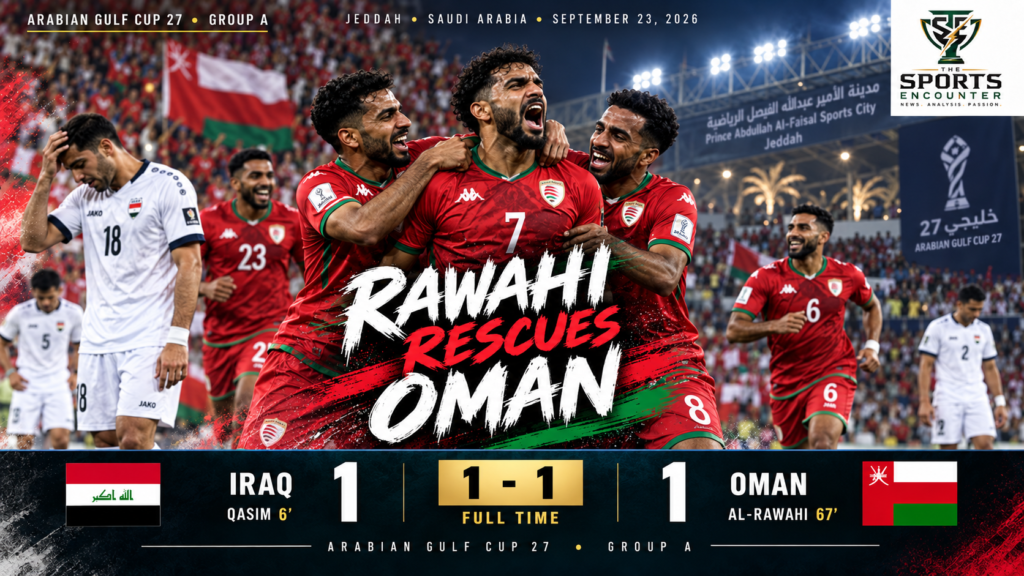
JEDDAH, Saudi Arabia, September 23, 2026: Iraq needed six minutes to seize control of their Arabian Gulf Cup opener. They spent the rest of the evening discovering how difficult it can be to keep it.
Mohammed Qasim collected Aymen Hussein’s pass inside the penalty area, shifted the ball onto his left foot and drove Iraq ahead before Oman had properly settled into the game. The goal survived a VAR review and became the first goal of Gulf Cup 27. Iraq then carried the greater authority through most of the first half and came close to extending their lead.
But 1-0 never became 2-0.
That failure eventually defined the match.
Oman returned from halftime with greater aggression, Iraq gradually lost the control that had made the opening 45 minutes look comfortable, and Nasser Al-Rawahi finally broke through in the 67th minute. His run into space from the left and composed finish gave Oman a 1-1 draw at Prince Abdullah Al-Faisal Sports City Stadium and left both teams with one point from the opening game of a difficult Group A.
For Iraq, the frustration lies in what the game could have been. For Oman, the point matters because they recovered from a poor first half without allowing the early deficit to dictate their tournament.
TL;DR
- Iraq 1-1 Oman
- Mohammed Qasim scored in the 6th minute, assisted by Aymen Hussein.
- The opener was confirmed after a VAR review.
- Iraq were the stronger team through the first half but failed to create the two-goal cushion their advantage merited.
- Oman improved considerably after halftime.
- Qasim and Mustafa Saadoun both went off with injury issues during Iraq’s second-half decline.
- Nasser Al-Rawahi equalized in the 67th minute after Ahmed Al-Kaabi found his run down the left.
- Aymen Hussein threatened again late, but Iraq could not restore the lead.
- Al-Rawahi was subsequently named Player of the Match.
- Both teams move to one point, with two Group A games remaining.
Iraq vs Oman: Match at a Glance
| Detail | Information |
|---|---|
| Competition | 27th Arabian Gulf Cup, Gulf Cup 27 |
| Stage | Group A, Matchday 1 |
| Match | Iraq vs Oman |
| Result | 1-1 |
| Venue | Prince Abdullah Al-Faisal Sports City Stadium, Jeddah |
| Iraq scorer | Mohammed Qasim, 6′ |
| Oman scorer | Nasser Al-Rawahi, 67′ |
| Halftime | Iraq 1-0 Oman |
| Player of the Match | Nasser Al-Rawahi |
| Iraq next match | vs Kuwait, September 26 |
| Oman next match | vs Saudi Arabia, September 26 |
| Group | Iraq, Oman, Saudi Arabia, Kuwait |
| Qualification | Top two advance to semifinals |
The official Gulf Cup federation placed Iraq, Oman, Saudi Arabia and Kuwait together in Group A, with Jeddah hosting the tournament from September 23 through October 6.
Official Gulf Cup 27 group and tournament information
Mohammed Qasim Needed Six Minutes to Change the Match
The opening goal was exactly the kind of start Iraq wanted after arriving in Jeddah with expectations of challenging for a fifth Gulf title.
Aymen Hussein helped create it, finding Qasim inside the penalty area. Qasim produced the decisive part himself, striking powerfully with his left foot into a difficult corner beyond Ibrahim Al-Mukhaini. After video review, the goal stood.
There was a historical wrinkle to the moment as well. GOAL noted that Qasim had previously scored Iraq’s first two goals of Gulf Cup 24 in the 2019 opener against Qatar. Seven years later, he returned to Gulf Cup football and again supplied the tournament’s opening goal.
More important for this match was what happened afterward.
Qasim remained dangerous. A later move from Iraq’s left gave him another sight of goal, but Al-Mukhaini prevented Iraq from stretching the advantage. That save became more valuable as the night unfolded because Iraq never created the scoreboard separation that their first-half superiority suggested was possible.
Iraq Controlled the First Half but Left Oman Alive
Contemporary reports broadly agree on the first-half pattern: Iraq were the better side.
They attacked earlier, played with greater confidence after scoring and defended the middle of the pitch well enough to prevent Oman from building sustained pressure. Oman spent much of the half searching for a clean route through Iraq’s defensive structure.
The problem for Iraq was efficiency.
A one-goal lead changes how a second half can develop. A two-goal lead can change how the opponent is allowed to play.
At 1-0, Oman could remain patient.
Iraq had opportunities to make that patience impossible. They failed to take them.
That is the first major lesson Graham Arnold will take from the match. Iraq’s recent tournament football has already shown how quickly promising phases can disappear. TSE followed that volatility during the World Cup, from Haaland’s Norway beating Iraq 4-1 to France’s 3-0 win over Iraq and the later Senegal-Iraq knockout-stage battle.
Gulf Cup 27 gives Arnold another chance to develop a team capable of turning good periods into complete matches.
The Match Changed After Halftime
Oman did not need to reinvent the game. They needed to play it higher up the field.
Their second-half approach became more assertive, while Iraq’s first-half grip weakened. Reports from the stadium described the contest becoming much more even after the interval, with both teams creating greater danger around the opposing penalty area.
Iraq also suffered two disruptions.
Qasim, the scorer and their most obvious first-half attacking threat, left the game with an injury issue. Mustafa Saadoun also had to come off. Current reporting confirms the substitutions were injury-related, although no reliable source had established the severity of either problem at the time of writing.
That distinction matters.
It would be premature to call either player doubtful for Kuwait without a medical update. What can be said is that Iraq lost two important pieces while the balance of the match was shifting toward Oman.
Nasser Al-Rawahi Punishes Iraq’s Retreat
Oman’s equalizer was the clearest example of why their second half looked different.
Ahmed Al-Kaabi released Al-Rawahi with a long pass toward the left channel. Al-Rawahi attacked the space, reached shooting range and drove the ball into the upper-left area of the Iraqi goal in the 67th minute.
It was an individual action built on a team adjustment.
Oman were now willing to push runners into the spaces Iraq had protected more effectively before halftime. Their equalizer came from exploiting exactly one of those channels.
Al-Rawahi’s contribution earned him the Player of the Match award. Afterward, he described the opening fixture as difficult and emphasized the value of avoiding defeat before Oman’s second match against host nation Saudi Arabia.
That assessment fits the tournament situation. Oman did not win, but they prevented a poor first half from becoming a damaging opening defeat.
Aymen Hussein Almost Gives Iraq the Final Word
Iraq responded after conceding rather than completely surrendering the initiative.
The clearest late opportunity fell to Aymen Hussein, whose 90th-minute header threatened to turn the match back toward Iraq. It did not produce the winning goal.
That moment completed a frustrating night for the Iraqi striker.
Hussein had helped create Qasim’s opener and remained a central reference point in attack, but Iraq could not manufacture the second decisive action needed to win.
For all the discussion about Iraq losing control after halftime, they still finished the game with an opportunity to take all three points.
They simply did not take it.
What Iraq Got Right
Iraq’s opening half showed why they entered the competition with legitimate ambitions.
They started quickly, used Hussein effectively as an attacking focal point and found Qasim early enough to force Oman to play from behind. Their defensive organization also limited Oman’s ability to respond immediately after the goal.
The concern is game management.
Iraq had the lead, the stronger first half and opportunities to extend the score, yet allowed the match to remain within one moment of changing.
That is a recurring problem in short tournaments. Control without a second goal often becomes temporary control.
The broader context matters too. Iraq are trying to rebuild momentum after a turbulent World Cup campaign, something readers can trace through TSE’s wider soccer coverage and international match analysis.
What Oman Got Right
Oman’s strongest achievement was psychological as much as tactical.
Conceding after six minutes in the opening match of a compact group stage can force a team to abandon its plan too early. Oman did not.
Tarik Sektioui’s side absorbed Iraq’s superior first half, remained within one goal, then played with greater ambition after the interval. That patience ultimately created the platform for Al-Rawahi’s equalizer.
Their concern is the opposite of Iraq’s.
Oman cannot afford to spend another opening half reacting. Their next opponent is Saudi Arabia, and allowing the hosts to establish early territorial control could create a much harder recovery assignment.
Still, the point gives Oman something valuable before that game: proof that this team can change the direction of a match after falling behind.
Why the Draw Matters More Than One Point
This is not a group in which either Iraq or Oman can comfortably accept repeated draws.
Saudi Arabia and Kuwait complete Group A, and only the top two teams reach the semifinals. The federation’s official draw placed all four together, creating a group containing Iraq’s four Gulf Cup titles, host nation Saudi Arabia, record champion Kuwait and an Oman side that reached the previous final.
The strength of the regional field also fits a broader trend covered by TSE in its Gulf Champions League 2026-27 draw analysis, where Iraqi, Omani, Saudi and Kuwaiti football are increasingly intersecting across club as well as national-team competition.
Before Saudi Arabia and Kuwait complete their own opening match, Iraq and Oman sit level on one point with identical goal difference.
That makes September 26 significantly more important.
Can Iraq Still Reach the Semifinals?
Absolutely, but the draw changes the shape of Iraq’s path.
Their second game is against Kuwait at Prince Abdullah Al-Faisal Stadium on September 26, followed by the group finale against Saudi Arabia on September 29. The confirmed tournament schedule places the Saudi-Iraq game at 8:30 p.m. local time, simultaneously with Oman-Kuwait.
Official Saudi federation Gulf Cup 27 schedule
A win over Kuwait would move Iraq to four points and put qualification largely back under their own control before facing Saudi Arabia.
Another draw would leave Iraq on two points and make the Saudi game far more dangerous because qualification could then depend on the Oman-Kuwait result.
A defeat to Kuwait would leave Iraq with one point entering their hardest remaining fixture and could make victory over Saudi Arabia essential.
The larger issue is not simply mathematics. Iraq need to show they can protect an advantage for 90 minutes. They cannot assume every group match will offer the same early breakthrough.
Can Oman Reach the Semifinals?
Oman’s route is equally open, but their immediate assignment is arguably more demanding.
They face hosts Saudi Arabia on September 26 before meeting Kuwait in the final round three days later.
A win against Saudi Arabia would move Oman to four points and transform the draw with Iraq into a useful opening result.
Another draw would preserve their unbeaten start but almost certainly increase the importance of beating Kuwait.
A defeat would leave Oman on one point and place heavy pressure on the final group match.
Saudi Arabia’s own recent tournament football has shown both resistance and vulnerability. TSE documented their 1-1 World Cup opener against Uruguay, the subsequent defeat to Spain that damaged their knockout hopes and the tense draw with Cabo Verde.
Oman therefore have reasons for confidence, but their first-half performance against Iraq cannot become the template.
Five Turning Points That Defined Iraq 1-1 Oman
| Minute | Turning point | Why it mattered |
|---|---|---|
| 6′ | Mohammed Qasim scores | Iraq gained immediate control and forced Oman to chase the match |
| First half | Ibrahim Al-Mukhaini prevents another Qasim effort | Oman remained only one goal behind despite Iraq’s superiority |
| Second half | Qasim and Mustafa Saadoun leave with injury issues | Iraq lost continuity while Oman were gaining momentum |
| 67′ | Nasser Al-Rawahi equalizes | Oman converted their second-half improvement into a point |
| 90′ | Aymen Hussein threatens with a late header | Iraq had one final opportunity to recover the victory they had allowed to slip |
The Real Warning for Iraq
The score says Iraq dropped two points.
The performance says something slightly different.
They proved they could overwhelm Oman early, control long periods and create the conditions for a comfortable win. They also showed how quickly that advantage can become fragile when the second goal never arrives.
For Oman, the reverse is true. Their first half exposed problems, but their second half demonstrated resilience, patience and an ability to attack the spaces Iraq began to leave.
That is why the draw probably tells us more about these teams than an opening win for either side would have done.
Iraq showed the higher ceiling.
Oman showed the stronger recovery.
Neither showed enough over 90 minutes to feel comfortable about what comes next.
Frequently Asked Questions
What was the Iraq vs Oman score in Gulf Cup 27?
Iraq and Oman drew 1-1 in their opening Group A match at Prince Abdullah Al-Faisal Sports City Stadium in Jeddah.
Who scored for Iraq?
Mohammed Qasim scored in the sixth minute after receiving the ball from Aymen Hussein. The goal was confirmed following a VAR review.
Who scored Oman’s equalizer?
Nasser Al-Rawahi equalized in the 67th minute after attacking the left channel and finishing beyond the Iraqi goalkeeper.
Who was Player of the Match?
Nasser Al-Rawahi received the Player of the Match award after scoring Oman’s equalizer.
Who does Iraq play next?
Iraq face Kuwait on September 26, before meeting Saudi Arabia in the final Group A round on September 29.
Who does Oman play next?
Oman face Saudi Arabia on September 26 and Kuwait on September 29.
How many teams qualify from Group A?
The top two teams advance to the Arabian Gulf Cup semifinals.