


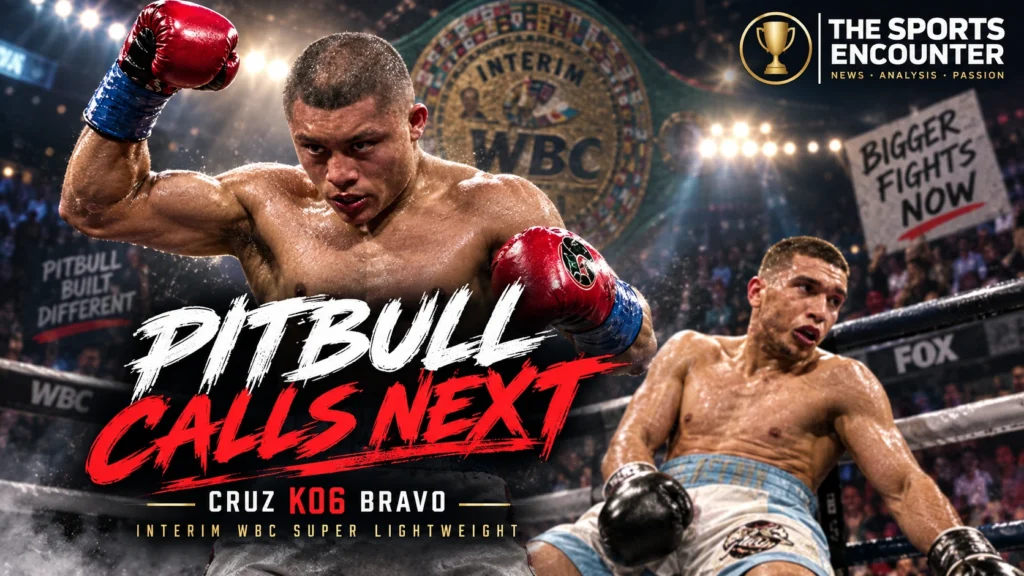
SAN DIEGO, United States, September 19, 2026: Isaac “Pitbull” Cruz spent much of Saturday night trying to fight through clinches, warnings and a significant reach disadvantage. When the opening finally arrived, one left hook ended the argument.
Cruz knocked out Nestor Bravo at 1:30 of Round 6 at Pechanga Arena in San Diego, retaining his interim WBC super lightweight title and improving to 29-3-2 with 19 knockouts.
The Mexican had already dropped Bravo in the opening round and remained the more dangerous fighter throughout a contest repeatedly interrupted by holding and rough exchanges. Bravo was deducted two points before Cruz found the decisive left hook in the sixth, sending the Puerto Rican challenger down for the final time.
The finish also answered the central question raised in The Sports Encounter’s Cruz-Bravo preview. Bravo entered approximately five inches taller and with a seven-inch reach advantage. Cruz had to find a way across that distance without walking into clean counters.
He did more than find Bravo. He broke through twice, finished him inside six rounds and then used the post-fight spotlight to call for Ryan Garcia.
Isaac Cruz vs Nestor Bravo: Fight at a Glance
| Detail | Information |
|---|---|
| Fight | Isaac Cruz vs Nestor Bravo |
| Result | Isaac Cruz won by knockout |
| Round | Round 6 |
| Time | 1:30 |
| Finishing punch | Left hook |
| Venue | Pechanga Arena, San Diego |
| Title | Interim WBC super lightweight championship |
| Cruz record | 29-3-2, 19 KOs |
| Bravo record | 24-2, 17 KOs |
| Major post-fight development | Cruz called out Ryan Garcia |
The official Premier Boxing Champions fight page listed Cruz as the interim WBC champion entering the contest and highlighted the physical disparity that shaped the matchup: Cruz at 5-foot-4 with a 63½-inch reach against Bravo at 5-foot-9 with a 70-inch reach.
Cruz Solves the Reach Problem Immediately
Bravo’s dimensions were supposed to give him the tactical advantage before Cruz could establish his pressure.
That was the theory.
The reality changed in Round 1.
Cruz closed the distance quickly enough to land a left hook that sent Bravo to the canvas and immediately forced the challenger into a different kind of fight.
From that point, Bravo increasingly relied on clinches and physical disruption whenever Cruz reached punching range.
The problem for Bravo was that holding could interrupt Cruz’s combinations, but it could not erase the pressure.
The champion kept walking forward, attacking at close range and looking for the same type of opening that had produced the first knockdown.
That persistence eventually decided the contest.
A Fight Full of Fouls Before the Cleanest Punch of the Night
The bout became increasingly disorderly after the opening round.
Referee Thomas Taylor repeatedly intervened as Bravo held, wrestled and pulled Cruz into awkward exchanges. Two points were eventually deducted from Bravo for infractions during the fight.
Those deductions would have mattered significantly had the contest reached the scorecards.
Cruz made them irrelevant.
Midway through the sixth, he created enough space for his left hook. The shot landed cleanly on Bravo’s jaw and dropped him backward onto the canvas.
Bravo could not beat the count.
For all the wrestling, warnings and interruptions that preceded it, the ending was unusually clear.
Cruz had entered the fight needing to prove that his pressure could overcome a much longer opponent. He ended it with perhaps the most decisive single punch available to a pressure fighter.
The Preview Question Has Its Answer
TSE’s pre-fight analysis identified distance control as the central technical question.
Bravo’s reach meant Cruz could not spend all night following him at the end of a jab. He needed to shorten the ring, move past the first layer of defense and make Bravo fight at a distance that favored the champion.
That is essentially what happened.
Bravo had enough size to complicate Cruz’s entries, but he never established the clean long-range control required to keep the Mexican outside.
The repeated clinching told its own story.
Cruz was getting where Bravo did not want him.
The finish therefore matters beyond another knockout on Cruz’s record. It suggests the 28-year-old can still impose his most recognizable strength against opponents specifically built to make that strength difficult to use.
Cruz’s First Fight With Eddy Reynoso Delivers the Right Kind of Result
Cruz entered this camp after linking with trainer Eddy Reynoso, a change designed to add greater technical discipline to a style already built around aggression.
The immediate result is encouraging.
Cruz did not abandon his identity. He remained the shorter fighter pressing forward and forcing exchanges.
The difference was that the fight did not require uncontrolled aggression from the opening bell until the finish.
He knocked Bravo down early, stayed patient through a messy middle section and found the ending when the opportunity appeared.
That development matters because Cruz has already operated at world-title level. His next step depends less on becoming more aggressive and more on becoming harder to solve against different physical and tactical profiles.
Boxing careers often turn on exactly that kind of adjustment. The Sports Encounter explored a similar theme in its analysis of Tyson Fury’s comeback win over Mariusz Wach, where the result mattered partly because of what it preserved for the fights ahead.
Ryan Garcia Becomes the Name Everyone Will Talk About
Cruz did not leave his next target ambiguous.
After the knockout, he called for Ryan Garcia.
The attraction is obvious.
Cruz has one of the most fan-friendly pressure styles in the lighter weight classes. Garcia brings reach, hand speed, knockout power and a significantly larger commercial profile.
The matchup would also recreate the same type of physical problem Bravo presented, only at a considerably higher level.
Garcia is taller, longer and dangerous when opponents rush toward his left hook. Cruz would again have to cross distance without becoming predictable.
No fight has been formally announced, so the callout should be treated as the beginning of a negotiation rather than a confirmed matchup.
That distinction is worth maintaining in boxing, where public challenges can create enormous attention without automatically producing contracts.
TSE has seen the same issue at heavyweight. Our Fury-Joshua negotiation analysis showed why public statements and actual signed fight terms are two different things.
Cruz Still Has a WBC Championship Route at 140 Pounds
The Ryan Garcia possibility exists alongside a more conventional championship pathway.
Cruz remains the interim WBC super lightweight champion.
Full WBC champion Dalton Smith is scheduled to defend against former champion Alberto Puello on October 24. The World Boxing Council’s official announcement confirms Smith-Puello as the next major championship fight at the top of the division.
That creates two different directions for Cruz.
| Possible Route | What It Offers Cruz |
|---|---|
| Remain at 140 pounds | Pursue the full WBC super lightweight championship pathway |
| Target Ryan Garcia | Larger commercial fight, likely requiring movement toward welterweight |
The sporting route and commercial route do not necessarily point toward the same opponent.
Cruz now has leverage to explore both.
Nestor Bravo’s Size Never Became Control
Bravo entered at 24-1 with 17 knockouts and enough physical advantages to make the assignment legitimate.
He also carried power.
What never developed was sustained control.
The challenger struggled to keep Cruz at the end of straight punches for long enough periods. Once Cruz crossed the outer range, Bravo frequently looked to clinch rather than build combinations.
That made the fight increasingly difficult for him.
Bravo suffered his second professional defeat and the first knockout loss of his career.
For a 32-year-old contender attempting to break into the upper tier at 140 pounds, the result is significant. He now has to rebuild after losing both the fight and the tactical argument behind his biggest opportunity.
Marco Verde Survives Trouble and Keeps His Perfect Record
The San Diego card also produced three stoppages beneath the main event.
Mexican Olympic silver medalist Marco Verde overcame an early scare to stop Guillermo Hernandez at 1:46 of Round 5 and remain unbeaten as a professional.
Hernandez managed to put Verde on the canvas during the fight, but Verde recovered and gradually took control before forcing the stoppage.
Verde’s development remains worth following because elite amateur pedigree creates expectations quickly in professional boxing.
The Sports Encounter has tracked how boxing success can accelerate careers at major multi-sport competitions, including the historic breakthroughs documented in our Glasgow 2026 Day 5 report and the following day’s boxing medal developments.
Verde is now navigating the next stage of that process at professional level.
Eumir Marcial and Daniel Blancas Complete a Night of Stoppages
Filipino Olympic bronze medalist Eumir Marcial stopped Omar Ulises Huerta at 1:08 of Round 3, continuing his unbeaten professional run.
Daniel Blancas also remained undefeated by stopping Sergio Jimenez at 1:38 of Round 7.
The previously scheduled Jesus Ramos Jr. vs Meiirim Nursultanov fight did not take place after being scratched at the weigh-in. Premier Boxing Champions said it would be rescheduled.
The official PBC event page lists the revised San Diego card and confirms the cancellation of Ramos-Nursultanov.
What Comes Next in Boxing?
Cruz-Bravo opened a busy stretch that continues almost immediately.
Liam Davies faces Nathaniel Collins for the European featherweight title on September 26. Takuma Inoue and Tenshin Nasukawa meet in their WBC bantamweight rematch a day later, while Floyd Schofield and Lucas Bahdi fight for the vacant WBA lightweight title on October 10.
All three were part of TSE’s four-fight boxing preview, with the Cruz-Bravo question now answered first.
The remaining dates can also be followed through The Sports Encounter’s Upcoming Sports Encounters calendar.
Boxing is also part of the wider combat-sports story developing around the 2026 Asian Games. TSE’s Aichi-Nagoya 2026 preview explains why boxing and the Games’ new MMA program make combat sports one of the most interesting sections of the event.
The professional schedule operates differently, but the competitive principle is familiar.
One fight can change a career quickly.
For Cruz, six rounds in San Diego preserved his belt, answered a tactical question and opened the door to a considerably larger conversation.
Frequently Asked Questions
Who won Isaac Cruz vs Nestor Bravo?
Isaac Cruz defeated Nestor Bravo by knockout in Round 6 at Pechanga Arena in San Diego.
How did Isaac Cruz knock out Nestor Bravo?
Cruz landed a clean left hook that dropped Bravo in the sixth round. Bravo did not beat the referee’s count.
What time did Cruz vs Bravo end?
The knockout was officially recorded at 1:30 of Round 6.
Did Isaac Cruz retain his title?
Yes. Cruz retained the interim WBC super lightweight championship.
Was Nestor Bravo knocked down earlier in the fight?
Yes. Cruz dropped Bravo in the opening round before finishing him in the sixth.
Why did Nestor Bravo lose points?
Bravo was deducted two points during a foul-heavy fight after repeated infractions and referee interventions.
What is Isaac Cruz’s record after beating Nestor Bravo?
Cruz improved to 29 wins, three losses and two draws, with 19 knockouts.
Who did Isaac Cruz call out after the fight?
Cruz called out Ryan Garcia after retaining his interim WBC title.
Who is the WBC super lightweight champion?
Dalton Smith holds the full WBC super lightweight title and is scheduled to defend against Alberto Puello on October 24, 2026.
Who won on the Cruz-Bravo undercard?
Daniel Blancas stopped Sergio Jimenez in Round 7, Marco Verde stopped Guillermo Hernandez in Round 5, and Eumir Marcial stopped Omar Ulises Huerta in Round 3.