


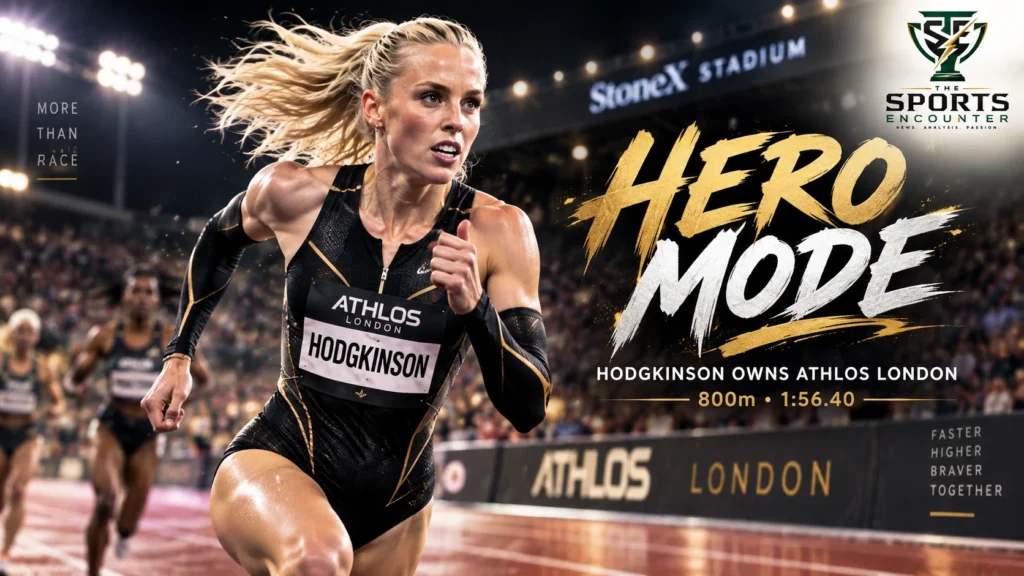
LONDON, England, September 19, 2026: Keely Hodgkinson ended one of the most physically difficult seasons of her career with a commanding 800m victory at ATHLOS London, pulling away over the final 200 meters to win in 1:56.40 at StoneX Stadium.
The Olympic champion finished more than two seconds ahead of Switzerland’s Valentina Rosamilia, turning her final race of 2026 into a reminder of the speed and control that remain available even after months shaped by hamstring trouble, interrupted racing and repeated battles with Audrey Werro.
Hodgkinson also became the visual center of ATHLOS’ first event outside the United States, racing in a striking black hooded speedsuit and dark glasses as the all-women’s professional track league combined elite competition with athlete walkouts, music, fashion, prize money and a deliberately entertainment-led presentation.
The performance was confirmed by World Athletics’ official ATHLOS London report, which recorded Hodgkinson’s 1:56.40 as a meeting record. The official ATHLOS event page also details the league’s format, prize structure and athlete-ownership model.
Keely Hodgkinson at ATHLOS London: Key Facts
| Detail | Information |
|---|---|
| Event | ATHLOS London 2026 |
| Race | Women’s 800m |
| Winner | Keely Hodgkinson |
| Winning Time | 1:56.40 |
| Runner-up | Valentina Rosamilia |
| Runner-up Time | 1:58.75 |
| Winning Margin | 2.35 seconds |
| Venue | StoneX Stadium, London |
| Date | September 18, 2026 |
| First Lap | 57.53 |
| First-Place Prize | $65,000 |
Hodgkinson Waits, Then Breaks the Race Open
The time alone does not explain how comfortable Hodgkinson looked.
Raevyn Rogers took the field through the opening lap in 57.53, with Hodgkinson positioned close enough to respond without having to force the pace herself.
That decision mattered.
Hodgkinson has spent much of 2026 racing against athletes capable of turning the 800m into a sustained test from the gun. Audrey Werro, in particular, has repeatedly forced the British star into faster and more aggressive tactical decisions.
London offered a different race.
Hodgkinson stayed controlled through the first 600 meters, then separated decisively over the final bend and home straight. Rosamilia could not follow the change of pace and crossed in 1:58.75.
The 2.35-second winning margin was considerably larger than the gaps Hodgkinson has faced against the strongest 800m runners this summer.
That does not mean the hierarchy has suddenly changed again. Werro and Femke Broeders-Bol were not in the London field, and those absences matter when interpreting the performance.
What the race did show is that Hodgkinson’s underlying level remains high after an unusually difficult run of physical problems.
Six Days Earlier, Audrey Werro Had Beaten Hodgkinson Again
The London victory came only six days after Hodgkinson finished second to Werro at the inaugural World Athletics Ultimate Championship in Budapest.
Werro won that final in 1:55.88. Hodgkinson followed in 1:56.26, with Broeders-Bol third in 1:56.74.
The Sports Encounter’s coverage has followed the changing balance of the women’s 800m throughout the season. The rivalry took a major turn at the European Championships when Werro beat Hodgkinson to European gold in a championship-record 1:54.81.
That defeat was especially significant because it came in Birmingham, where Hodgkinson carried home support and Olympic champion status into one of the most anticipated races of the championships.
Hodgkinson subsequently withdrew from the Zurich Diamond League, a decision The Sports Encounter examined in our analysis of why Hodgkinson chose recovery instead of another immediate Werro rematch.
Werro continued racing and won again, including a dramatic Diamond League Final in Brussels. Our Brussels analysis showed how Werro and Broeders-Bol had turned the event into one of track and field’s strongest late-season rivalries.
Budapest then reinforced that competitive shift.
Against that background, Hodgkinson’s London victory works best as evidence of resilience rather than a verdict on who ends 2026 as the world’s leading 800m runner.
1:56.40 Shows How Much Speed Hodgkinson Still Had Left
There is another useful way to read the performance.
Hodgkinson ran 1:56.26 against Werro in Budapest six days earlier. Her ATHLOS time was only 0.14 seconds slower.
That is notable after a season in which her training and racing rhythm had repeatedly been interrupted.
The World Athletics Ultimate Championship had already forced athletes into a compressed, high-pressure format. The Sports Encounter examined the competition’s experimental structure in our guide to the radical new rules introduced for Budapest 2026.
Hodgkinson moved from that environment directly into another unconventional meeting in London.
The circumstances were different, but the performance level barely moved.
That consistency may be the most encouraging part of Friday’s result for Hodgkinson and her team.
The Black Speedsuit Became Part of the Story
Hodgkinson’s race was visually unusual before the gun even fired.
She arrived in an all-black hooded speedsuit with dark glasses, a design developed through a long-running project with Nike.
The look inevitably evoked Cathy Freeman’s famous full-body racing suit from the Sydney 2000 Olympics, although Hodgkinson’s version carried a distinctly modern, fashion-led presentation suited to the ATHLOS concept.
Hodgkinson described the project enthusiastically after the race, saying: “It’s a project I’ve been working on with Nike for a long time.”
The clothing would have been a secondary detail at a traditional championship.
ATHLOS is deliberately built so that it is not.
Individual entrances, visual identity, music, athlete storytelling and presentation are part of the product alongside the competition itself.
Hodgkinson’s suit therefore became a useful representation of what the league is trying to create: elite athletics in an environment where the athletes are presented as personalities rather than competitors appearing briefly between races.
ATHLOS London Was About More Than One 800m
Friday was the first ATHLOS meeting staged outside the United States after the project began with two events in New York.
The London program contained only seven senior events, each designed as a straight final rather than part of a conventional championship structure.
That compressed format produced a little over two hours of competition featuring several Olympic and global champions.
| Event | Winner | Performance |
|---|---|---|
| 100m Hurdles | Alaysha Johnson | 12.50 |
| Long Jump | Alyssa Jones | 6.66m |
| 100m | Sha’Carri Richardson | 10.80 |
| Mile | Klaudia Kazimierska | 4:19.43 |
| 400m | Marileidy Paulino | 48.73 |
| 800m | Keely Hodgkinson | 1:56.40 |
| 200m | Gabby Thomas | 22.13 |
Richardson’s 10.80 gave ATHLOS another major headline, while Thomas closed the night by winning the 200m in 22.13.
Paulino produced one of the strongest performances of the meeting in the 400m. She ran 48.73, narrowly beating Norway’s Henriette Jæger, who clocked 48.78.
Kazimierska’s mile produced one of the closest finishes. She came through late to beat Britain’s Georgia Hunter Bell 4:19.43 to 4:19.54.
Johnson also edged Tobi Amusan by only one hundredth in the 100m hurdles, winning 12.50 to 12.51.
Richardson and Thomas Bring Another Layer to ATHLOS
ATHLOS is not relying on one athlete or one event to establish its identity.
Richardson and Thomas are especially important because both sit at the intersection of performance, commercial visibility and the league’s ownership model.
Eligible participating athletes can receive equity in ATHLOS, while Thomas, Richardson and Tara Davis-Woodhall are among the athlete stakeholders and advisers helping shape the competition.
That structure is substantially different from a conventional track meet where athletes receive appearance fees and prize money but have no direct ownership relationship with the event.
The Sports Encounter has already examined how athlete presentation is changing elsewhere in the sport. The World Athletics Ultimate Championship used innovations in broadcasting, competition design and presentation, while our report on Melissa Jefferson-Wooden and Kenny Bednarek’s $300,000 sprint doubles in Budapest showed how significantly prize structures are also changing at the elite level.
ATHLOS is attacking the same problem from another direction.
Rather than asking only how athletics can make individual meetings more valuable, it is asking whether athletes can become financially connected to the growth of the competition itself.
Why the $65,000 Winner’s Prize Matters
Each London event winner earned $65,000.
Second place paid $35,000, third $20,000, fourth $15,000, fifth $10,000 and sixth $6,000.
ATHLOS says more than $2.1 million in cash prize money will be distributed across its London and New York meetings in 2026. The overall champion in each discipline can also earn a further $25,000 championship bonus.
The full framework is explained in ATHLOS’ official 2026 league announcement.
Prize money alone will not determine whether the league succeeds, but it helps explain why the project has attracted elite athletes at the very end of a demanding international season.
Traditional athletics calendars often ask stars to compete deep into the year without creating a particularly strong financial or entertainment reason for doing so.
ATHLOS is trying to change that equation.
The Meeting Also Fits a Bigger London Athletics Story
StoneX Stadium is very different from the London Stadium used for major championships and Diamond League events, but ATHLOS’ international debut arrives during an important period for the city’s athletics ambitions.
London had been campaigning to host the 2029 World Athletics Championships, with The Sports Encounter examining the proposed £400 million legacy case behind that bid.
World Athletics ultimately awarded the 2029 championships to Nairobi, creating the first senior World Athletics Championships to be staged in Africa. Our report on Nairobi’s historic selection explored what that decision means for the sport’s global geography.
London nevertheless remains one of athletics’ strongest commercial markets.
ATHLOS choosing the city for its first international meeting reinforces that position, even though its model looks very different from a conventional global championship.
Tara Davis-Woodhall’s Absence Also Shows the Demands of the Calendar
ATHLOS was designed around many of the sport’s biggest female personalities, including Tara Davis-Woodhall.
Her season, however, was disrupted after a car accident before the Ultimate Championship in Budapest.
The Sports Encounter examined the consequences when Davis-Woodhall’s accident put her Budapest participation in doubt.
That episode is relevant to ATHLOS because the league sits at the very end of an already packed athletics season.
Attracting stars requires more than money and presentation. Athlete health, travel and accumulated fatigue remain unavoidable constraints.
Hodgkinson’s own year makes that clear.
What Hodgkinson’s Win Does and Does Not Tell Us About the 800m
Friday’s result should be interpreted carefully.
Hodgkinson was dominant.
She ran 1:56.40, improved the meeting record and beat the next athlete by more than two seconds.
Yet neither Werro nor Broeders-Bol was in the field.
Werro’s 2026 season includes European gold, a 1:53.70 Swiss record, the Diamond League title and the inaugural Ultimate Championship title.
She has beaten Hodgkinson repeatedly in the races that directly shaped this season’s 800m hierarchy.
That context makes the London result more interesting, not less.
Hodgkinson did not need ATHLOS to prove she remains an elite 800m runner. Her Olympic title already establishes that.
What she needed was evidence that a season disrupted by physical problems could finish with her running freely, controlling a race and leaving the track without another setback.
She got exactly that.
ATHLOS Now Heads Back to New York
Hodgkinson’s own 2026 racing season is finished, but the ATHLOS season is not.
The league returns to New York on October 2 at Icahn Stadium for its championship meeting.
Under the 2026 format, athletes collect points across London and New York, with overall titles decided at the second stop.
The larger question extends beyond who wins those titles.
ATHLOS is testing whether elite track and field can build a recurring professional product around athletes rather than relying almost entirely on the Olympics, World Championships and Diamond League for mainstream attention.
World Athletics is experimenting with its own future through the Ultimate Championship. ATHLOS is trying another model based on ownership, entertainment, short sessions, strong prize money and recognizable personalities.
Both projects are asking essentially the same question: how can track and field make its biggest athletes matter to audiences for more than a few weeks every four years?
Hodgkinson’s black speedsuit drew plenty of attention in London, but the more important image came once the race started.
After everything that interrupted her season, she still had enough left to run 1:56.40 and leave the field behind.
Keely Hodgkinson ATHLOS London FAQs
Who won the women’s 800m at ATHLOS London 2026?
Keely Hodgkinson won the women’s 800m at StoneX Stadium in London.
What time did Keely Hodgkinson run?
Hodgkinson won in 1:56.40, improving the ATHLOS meeting record.
Who finished second behind Hodgkinson?
Switzerland’s Valentina Rosamilia finished second in 1:58.75.
How large was Hodgkinson’s winning margin?
Hodgkinson won by 2.35 seconds.
Why was Keely Hodgkinson wearing a black hooded suit?
Hodgkinson wore a specially developed black hooded Nike speedsuit that formed part of a long-running design project and matched ATHLOS’ fashion-led presentation style.
How much did the ATHLOS London 800m winner earn?
First place at ATHLOS London paid $65,000.
Who won the ATHLOS London 100m?
Sha’Carri Richardson won the women’s 100m in 10.80 seconds.
Who won the 200m at ATHLOS London?
Gabby Thomas won the 200m in 22.13 seconds.
Who won the 400m?
Olympic champion Marileidy Paulino won the 400m in 48.73, narrowly beating Henriette Jæger’s 48.78.
When is the next ATHLOS event?
ATHLOS returns to Icahn Stadium in New York on October 2, 2026, for the championship meeting of its two-city season.