


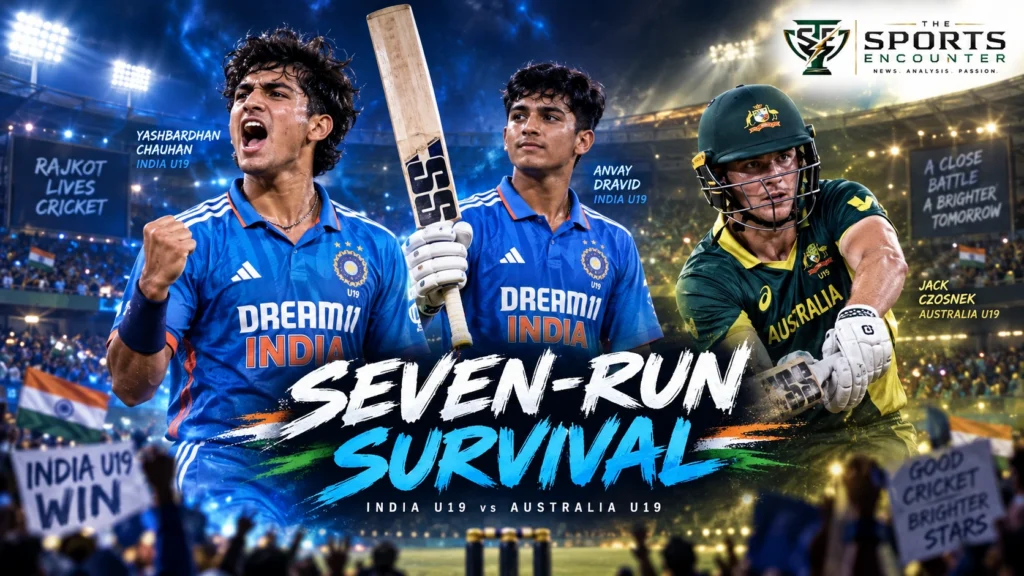
RAJKOT, India, September 18, 2026: India Under-19s survived a fierce late assault from Australia captain Jack Czosnek to win the opening Youth ODI by seven runs at Niranjan Shah Stadium and take a 1-0 lead in the three-match series.
The scheduled one-day contest was reduced to 20 overs per side, turning the series opener into a compressed examination of power, nerve and decision-making.
India recovered from 88 for four to reach 182 for six, driven by Yashbardhan Chauhan’s 54 from 34 balls and Anvay Dravid’s explosive 38 from 18.
Australia responded aggressively. Hayden Barbulovic made 40 from 24, Neel Patel scored 45 from 31, and captain Jack Czosnek threatened to steal the match with 55 from just 27 deliveries.
Yet India found wickets at exactly the moments they needed them.
Australia reached 149 for two in the 17th over and appeared well placed to complete the chase. They then lost five wickets for 26 runs, finishing on 175 for seven as India closed out the final over under pressure.
Readers can follow continuing international and youth cricket coverage through The Sports Encounter’s Cricket Hub.
India U19 vs Australia U19: First Youth ODI Scorecard
| Match Detail | Information |
|---|---|
| Competition | Australia Under-19s tour of India 2026 |
| Match | 1st Youth ODI |
| Date | September 18, 2026 |
| Venue | Niranjan Shah Stadium, Rajkot |
| Format on the day | 20 overs per side |
| Toss | Australia U19 won the toss and fielded |
| India U19 | 182/6 in 20 overs |
| Australia U19 | 175/7 in 20 overs |
| Result | India U19 won by 7 runs |
| Series | India lead 1-0 |
| Top India batter | Yashbardhan Chauhan, 54 off 34 |
| Top Australia batter | Jack Czosnek, 55 off 27 |
India Recover From 88 for Four
India’s innings did not initially look like one that would finish beyond 180.
Aaryavir Sehwag gave the hosts an energetic start with 28 from 26 balls, hitting five fours before Spencer Green removed him at 45 for one.
Captain Lakshya Raichandani made 15 from 15, while Kushagra Ojha struck 16 from 14. Both fell in quick succession, leaving India at 65 for three after 9.1 overs.
Arjun Rajput attempted to counterattack with 15 from eight balls, including a four and a six, but Green trapped him lbw at 88 for four.
India had used almost 12 overs and had lost four of their top five.
The innings needed someone to change its speed immediately.
Yashbardhan Chauhan Gives India an Innings to Defend
Yashbardhan Chauhan supplied the stability India required without allowing the scoring rate to collapse.
He struck five fours and two sixes in his 54 from 34 deliveries, scoring at 158.82 while wickets fell around him.
His innings became more valuable because he resisted the temptation to treat every delivery as a boundary opportunity after Rajput’s dismissal.
India needed a partnership.
Chauhan found one in Anvay Dravid.
The Chauhan-Dravid Partnership Changes the Match
India moved from 88 for four to 157 for four as Chauhan and Dravid added 69 runs in 34 balls.
Dravid supplied the acceleration.
The wicketkeeper-batter smashed 38 from only 18 deliveries at a strike rate of 211.11. His innings included two fours and three sixes, allowing Chauhan to continue controlling the other end.
Dravid’s recent emergence has already made him one of India’s most closely watched youth players. The son of former India captain Rahul Dravid had scored 87 from 67 balls against Sri Lanka Under-19 earlier in the year before earning another place in the Indian one-day squad.
Youth cricket has increasingly become an important part of the wider development story across the sport. The Sports Encounter recently examined another high-pressure U19 contest when England Under-19s edged Pakistan by two runs at Wormsley.
Dravid eventually fell to Eli Brain at 157 for five, but by then India had transformed the innings.
Chauhan Keeps Going Until the Final Over
Chauhan reached his half-century before Thomas Vaseo removed him for 54 with two balls remaining in the innings.
India finished on 182 for six, meaning they had scored 94 runs from their final 49 deliveries after slipping to 88 for four.
That recovery proved decisive.
India Under-19 Batting Scorecard
| Batter | Runs | Balls | 4s | 6s | Strike Rate |
|---|---|---|---|---|---|
| Aaryavir Sehwag | 28 | 26 | 5 | 0 | 107.69 |
| Lakshya Raichandani (c) | 15 | 15 | 2 | 0 | 100.00 |
| Kushagra Ojha | 16 | 14 | 1 | 1 | 114.28 |
| Yashbardhan Chauhan | 54 | 34 | 5 | 2 | 158.82 |
| Arjun Rajput | 15 | 8 | 1 | 1 | 187.50 |
| Anvay Dravid (wk) | 38 | 18 | 2 | 3 | 211.11 |
| Yashveer Goud | 7* | 7 | 0 | 0 | 100.00 |
| Manal Chauhan | 1* | 1 | 0 | 0 | 100.00 |
| Extras | 8 | ||||
| Total | 182/6 in 20 overs | ||||
Australia Under-19 Bowling
| Bowler | Overs | Runs | Wickets | Economy |
|---|---|---|---|---|
| Kasey Barton | 4 | 37 | 0 | 9.25 |
| Will Byrom | 4 | 37 | 1 | 9.25 |
| Thomas Vaseo | 4 | 35 | 1 | 8.75 |
| Spencer Green | 4 | 43 | 2 | 10.75 |
| Eli Brain | 4 | 29 | 2 | 7.25 |
Australia Start the Chase Like a Team With a Plan
A target of 183 required Australia to score at 9.15 runs per over.
They did not allow that requirement to dictate the opening phase.
Hayden Barbulovic and Neel Patel attacked from the beginning, putting on 58 for the first wicket in 6.4 overs.
Barbulovic made 40 from 24 balls, striking three fours and three sixes at 166.66.
Patel was slightly more measured but equally important. His 45 from 31 contained four fours and two sixes.
Australia were ahead of the required tempo without taking reckless risks.
India needed someone to break the partnership.
Chauhan, already their highest scorer, intervened with the ball.
Yashbardhan Chauhan Becomes India’s Two-Way Match-Winner
Chauhan stumped Barbulovic through Anvay Dravid at 58 for one and later dismissed Patel for 45.
His four overs cost only 28 runs and brought two wickets.
That made his overall contribution particularly significant:
- 54 runs from 34 balls
- 2 wickets for 28 runs
- India’s highest individual score
- Both Australian openers dismissed
India’s senior cricket history is filled with players who have altered matches through multiple disciplines, a tradition explored in The Sports Encounter’s tribute to Kapil Dev’s influence on Indian cricket.
Chauhan remains at the beginning of his development, but this match offered a small example of how valuable multi-dimensional cricketers become in shortened games.
Jack Czosnek Almost Steals It for Australia
Australia were 93 for two when captain Jack Czosnek took control.
Zed Hollick struggled for rhythm during his 24 from 27 balls, but Czosnek compensated through immediate aggression.
He struck six fours and three sixes in a brilliant 55 from 27 balls, scoring at 203.70.
Czosnek and Hollick added 56 runs for the third wicket and carried Australia to 149 before Arjun Rajput dismissed Hollick.
At that stage, Australia needed only 34 runs from 19 balls.
With Czosnek established, the chase was alive.
Australia Reach 149 for Two, Then Lose Control
The final 19 deliveries changed the match completely.
Hollick fell at 149.
Eli Brain was run out two balls later.
Czosnek continued attacking and moved Australia to 171, leaving his team needing 12 runs from seven deliveries.
Chigurupati Venkata then produced the wicket India had been searching for.
Czosnek was caught by Manal Chauhan for 55.
Australia had lost the one batter capable of finishing the chase in a single over.
India Concede Only Four Runs From the Final Seven Balls
The closing sequence belonged to India.
After Czosnek departed at 171 for five, Australia managed only four further runs.
Charlie Henderson was run out for three, Blake Cattle fell to Mohit Ulva from the final delivery, and Australia finished seven runs short.
From 149 for two, they had lost five wickets for 26 runs.
That collapse was smaller than the kind seen in a conventional 50-over innings, yet in a 20-over chase it was decisive.
Mohit Ulva’s Four Overs Quietly Decide the Chase
Czosnek supplied the most spectacular batting of Australia’s innings, but Mohit Ulva’s spell gave India the control needed to survive it.
Ulva conceded only 19 runs from four overs.
His economy rate of 4.75 was comfortably the best among India’s bowlers.
In a match where both teams scored close to nine runs per over, conceding fewer than five became the equivalent of creating several extra wickets.
He also dismissed Cattle with the final ball, closing the game personally.
Manal Chauhan provided another important holding spell, conceding only 24 from four overs, while Yashbardhan’s two wickets removed Australia’s opening pair.
The balance between containment and wicket-taking ultimately separated the teams.
Australia Under-19 Batting Scorecard
| Batter | Runs | Balls | 4s | 6s | Strike Rate |
|---|---|---|---|---|---|
| Neel Patel | 45 | 31 | 4 | 2 | 145.16 |
| Hayden Barbulovic | 40 | 24 | 3 | 3 | 166.66 |
| Zed Hollick | 24 | 27 | 1 | 1 | 88.88 |
| Jack Czosnek (c) | 55 | 27 | 6 | 3 | 203.70 |
| Eli Brain | 2 | 2 | 0 | 0 | 100.00 |
| Blake Cattle (wk) | 2 | 4 | 0 | 0 | 50.00 |
| Charlie Henderson | 3 | 5 | 0 | 0 | 60.00 |
| Kasey Barton | 0* | 0 | 0 | 0 | – |
| Extras | 4 | ||||
| Total | 175/7 in 20 overs | ||||
India Under-19 Bowling
| Bowler | Overs | Runs | Wickets | Economy |
|---|---|---|---|---|
| Mohit Ulva | 4 | 19 | 1 | 4.75 |
| Chigurupati Venkata | 3 | 39 | 1 | 13.00 |
| Shavin Vinodh | 3 | 42 | 0 | 14.00 |
| Manal Chauhan | 4 | 24 | 0 | 6.00 |
| Yashbardhan Chauhan | 4 | 28 | 2 | 7.00 |
| Yashveer Goud | 1 | 12 | 0 | 12.00 |
| Arjun Rajput | 1 | 11 | 1 | 11.00 |
Aaryavir Sehwag and Anvay Dravid Bring Familiar Names Into a New Generation
Two names in India’s lineup naturally attract additional attention.
Aaryavir Sehwag is the son of former India opener Virender Sehwag, while wicketkeeper Anvay Dravid is the younger son of Rahul Dravid.
Aaryavir’s 28 did not become a defining innings, but his five boundaries helped India reach 45 before the first wicket fell.
Anvay’s contribution was more substantial. His 38 from 18 transformed India’s middle overs and gave Chauhan the freedom to bat deeper into the innings.
Their presence is part of a wider youth movement in Indian cricket. The Sports Encounter has also followed Vaibhav Sooryavanshi’s extraordinary rise through Indian age-group and senior cricket, another reminder of how quickly promising teenagers are now entering higher levels of competition.
Australia’s Youth Tour Has Bigger Meaning Than One Result
Cricket Australia selected a largely fresh Under-19 squad for this tour.
According to Cricket Australia’s official squad announcement, Will Byrom and Kasey Barton were the only members of this touring group who had played in Australia’s Under-19 World Cup campaign earlier in 2026.
The trip therefore offers Australia another opportunity to expose emerging players to Indian conditions before they approach senior domestic and international cricket.
The Sports Encounter recently examined the wider succession challenge confronting Australian cricket in our analysis of Australia’s ageing core and emerging generation.
Czosnek, Barbulovic, Patel, Brain and others are several steps away from that senior discussion, but tours like this are where those pathways begin.
Australia’s senior side is already navigating its own transition. Matt Renshaw, Cooper Connolly and other emerging players have recently taken larger roles, including during Australia’s ODI victory over Zimbabwe led by Renshaw and Nathan Ellis.
India-Australia Cricket Finds Another Close Finish
India and Australia have produced countless tight senior contests, and their youth teams added another one in Rajkot.
The seven-run margin naturally invites comparison with some of the rivalry’s famous narrow finishes.
The Sports Encounter’s retrospective on Australia’s one-run World Cup victory over India in Chennai in 1987 revisits one of the most dramatic examples.
The stakes in Rajkot were far smaller, but the underlying lesson was familiar.
India did not win because Australia failed to compete.
They won because the hosts handled the final pressure better.
What the Result Means for the Series
The victory gives India a 1-0 lead in the three-match Youth ODI series.
The BCCI’s official series schedule confirms that the second one-day match will also be played in Rajkot on September 21, followed by the third on September 23.
The teams then move into the longer format, with the first multi-day match scheduled in Rajkot from September 27 and the second in Ahmedabad from October 5.
Cricket Australia’s official series page also lists the three-match one-day leg running from September 18 to September 23.
That schedule means Australia have little time to dwell on the opening defeat.
They found enough batting to chase 183. Their problem was finishing the job.
India showed the opposite quality. They survived losing early wickets, recovered through Chauhan and Dravid, and then found a way to defend seven runs when Australia’s captain threatened to take the game away.
For a youth series designed to test players before the next stage of their careers, that final pressure may prove as valuable as the result itself.
Frequently Asked Questions
Who won India U19 vs Australia U19 first Youth ODI?
India Under-19s beat Australia Under-19s by seven runs in Rajkot on September 18, 2026. India scored 182 for six before restricting Australia to 175 for seven.
Why was the India U19 vs Australia U19 Youth ODI only 20 overs?
The official match remained classified as the first Youth ODI of the series, but the contest was played with a maximum of 20 overs per side. The available scorecard confirms the reduced innings length but does not specify the reason for the reduction.
Who was India’s top scorer against Australia U19?
Yashbardhan Chauhan top-scored for India with 54 from 34 balls, including five fours and two sixes.
How many runs did Anvay Dravid score?
Anvay Dravid scored 38 from 18 balls at a strike rate of 211.11. He hit two fours and three sixes and shared a 69-run partnership with Yashbardhan Chauhan.
Is Anvay Dravid related to Rahul Dravid?
Yes. Anvay Dravid is the younger son of former India captain and head coach Rahul Dravid. He is a wicketkeeper-batter and has represented India at Under-19 level in 2026.
Who is Aaryavir Sehwag?
Aaryavir Sehwag is the son of former India opener Virender Sehwag. He opened the batting for India Under-19s in the first Youth ODI against Australia and scored 28 from 26 balls.
Who was Australia’s top scorer in the first Youth ODI?
Captain Jack Czosnek scored 55 from 27 balls, hitting six fours and three sixes. His dismissal with Australia on 171 proved to be the decisive late breakthrough.
What were Yashbardhan Chauhan’s bowling figures?
Chauhan followed his 54 with figures of two wickets for 28 runs from four overs. He dismissed both Australian openers, Hayden Barbulovic and Neel Patel.
When is the second India U19 vs Australia U19 Youth ODI?
The second Youth ODI is scheduled for September 21, 2026, at Niranjan Shah Stadium in Rajkot.
How many matches are Australia U19 playing in India?
The tour contains three one-day matches followed by two multi-day fixtures. The one-day matches are in Rajkot, while the multi-day leg is split between Rajkot and Ahmedabad.