


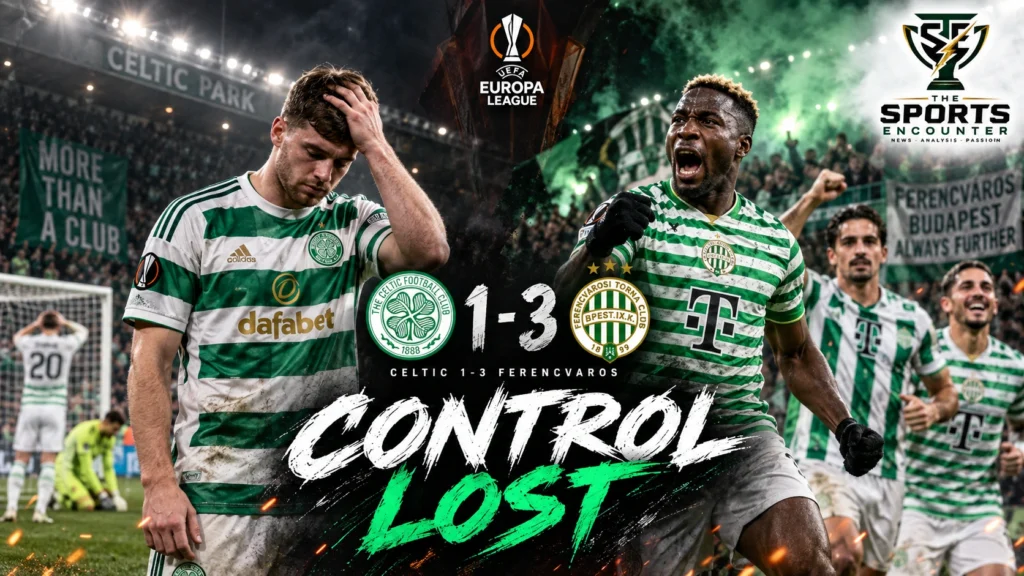
GLASGOW, Scotland, September 17, 2026: Celtic controlled 63% of possession, attempted more shots, won 11 corners and spent long stretches pushing Ferencváros toward their own penalty area. The Hungarian champions still left Celtic Park with the only statistic that truly mattered: a 3-1 victory.
The result exposed a painful contrast in Martin O’Neill’s side. Celtic had enough of the ball to shape the match, but Ferencváros controlled the moments that changed it. Bamidele Yusuf repeatedly attacked the spaces Celtic left open, Kristoffer Zachariassen restored the visitors’ lead almost immediately after Mika Baur’s equalizer, and former Celtic winger Daniel Arzani struck only two minutes into the second half.
For Celtic, this was another European night in which territorial control failed to become scoreboard control. For Ferencváros, it was a continuation of the ruthless efficiency that carried them through the Europa League play-offs and into the league phase.
Readers can follow every developing storyline through The Sports Encounter’s UEFA Europa League hub and our wider soccer coverage.
Celtic vs Ferencváros: Match Summary
| Match Detail | Information |
|---|---|
| Competition | UEFA Europa League 2026-27, League Phase |
| Date | September 17, 2026 |
| Venue | Celtic Park, Glasgow |
| Result | Celtic 1-3 Ferencváros |
| Celtic Scorer | Mika Baur 44′ |
| Ferencváros Goals | Yusuf/Scales deflection 20′, Kristoffer Zachariassen 45+1′, Daniel Arzani 47′ |
| Possession | Celtic 63% – 37% Ferencváros |
| Shots | Celtic 16 – 14 Ferencváros |
| Shots on Target | Celtic 4 – 6 Ferencváros |
| Corners | Celtic 11 – 3 Ferencváros |
UEFA’s official Europa League schedule confirms the Matchday 1 fixture and sends Celtic to Benfica on October 15, while Ferencváros host Viktoria Plzeň on the same night.
Celtic Had the Ball, Ferencváros Had the Better Attacks
The possession numbers make Celtic’s defeat look strange until the attacking sequences are examined more closely.
O’Neill’s team completed more passes, entered the final third more often and generated 11 corners. Their territorial advantage was obvious. Yet only four of Celtic’s 16 attempts reached the target, while Ferencváros tested Viljami Sinisalo six times from 14 shots.
That difference explains the game better than possession.
Ferencváros did not need to dominate the ball because their transitions repeatedly arrived in cleaner attacking situations. Celtic often had numbers forward when possession broke down, leaving Yusuf and Arzani space to attack before the home defense could reset.
Yusuf Finds the Weakness Down Celtic’s Left
The opening goal in the 20th minute began with Ferencváros exploiting the area around Kieran Tierney.
A cross was not properly dealt with, Yusuf attacked the loose ball and his effort took a decisive touch off Liam Scales before beating Sinisalo.
Whether the final attribution sits with Yusuf or the deflection is less important than the sequence that produced it. Celtic had enough defenders in the area. They did not deal cleanly with the first ball, the second movement or the shot.
That became the recurring issue throughout the night.
Celtic’s Defensive Shape Was Being Broken by Moments, Not Sustained Pressure
Ferencváros were not pinning Celtic inside their penalty area for long periods.
They did something more damaging. They waited for a mistake in positioning, a loose clearance or a turnover, then attacked immediately.
This was particularly effective because Celtic were committing Tierney and other players forward to maintain width. When possession changed hands, the spaces behind those advanced positions became available.
Yusuf recognized them faster than Celtic could close them.
Mika Baur Gives Celtic the Equalizer They Needed
Celtic responded well enough to spend much of the remainder of the first half pushing Ferencváros backward.
The reward finally arrived in the 44th minute.
Tierney delivered from the left and Mika Baur finished to make it 1-1, giving Celtic Park the release it had been waiting for and seemingly restoring the match to the position O’Neill wanted before halftime.
The equalizer also appeared to reward Celtic’s territorial control. They had kept the ball, continued creating wide overloads and finally converted one of their deliveries into a goal.
Then the match changed again almost immediately.
Zachariassen Turns Celtic’s Best Moment Into Their Worst
Ferencváros restored their lead in first-half stoppage time.
Yusuf again carried the danger, beating Celtic defenders before finding captain Kristoffer Zachariassen, who finished from close range.
The timing made the goal especially damaging.
Celtic had spent much of the half chasing the equalizer and finally found it with halftime approaching. Instead of entering the dressing room level and with momentum, they were suddenly behind again.
The emotional swing was enormous.
That is the kind of sequence experienced European teams exploit. Ferencváros did not allow Celtic time to enjoy the equalizer or reorganize around it.
Daniel Arzani Needed Two Second-Half Minutes to Break Celtic’s Momentum
Any halftime plan Celtic had built around another comeback lasted less than two minutes.
Arzani collected possession after another Celtic error and drove a powerful finish into the top corner in the 47th minute.
The identity of the scorer added another layer to the moment. Arzani previously spent time at Celtic earlier in his career but struggled to establish himself during an injury-disrupted spell.
His return to Celtic Park as an opponent produced one of the biggest goals of the night.
At 3-1, Ferencváros no longer needed to chase transitions with the same urgency. They could protect central areas, deal with Celtic’s crosses and force the hosts to find two goals against a compact defense.
Celtic’s Late Pressure Produced Territory, Not a Comeback
O’Neill introduced fresh attacking options and Celtic continued pushing forward.
Sebastian Tounekti forced a save, Benjamin Nygren went close from distance and Celtic kept winning corners. The volume increased, but the quality of the final action never reached the level required for a two-goal recovery.
Ferencváros defended their penalty area with discipline, repeatedly clearing deliveries before Celtic could attack second balls.
| Key Statistic | Celtic | Ferencváros |
|---|---|---|
| Possession | 63% | 37% |
| Total Shots | 16 | 14 |
| Shots on Target | 4 | 6 |
| Corners | 11 | 3 |
| Opposition Box Touches | 37 | 16 |
| Clearances | 16 | 39 |
The numbers describe a familiar European problem. Celtic reached dangerous territory more often, but Ferencváros defended the final action and made their own opportunities count.
Bamidele Yusuf Was the Player Celtic Never Solved
Yusuf influenced all three Ferencváros goals.
His shot created the opener, he supplied Zachariassen for the second and he helped release Arzani for the third. Every contribution came from recognizing space quickly and attacking before Celtic recovered their shape.
This was not a performance built around dominating possession.
It was built around understanding where the next dangerous action could happen.
Ferencváros had already demonstrated that kind of ruthless transition play during qualifying. In The Sports Encounter’s Europa League play-off review, the Hungarian champions were one of the standout teams after beating Trabzonspor 5-0 on aggregate.
Their 4-0 second-leg victory showed how dangerous they become once opponents are forced to chase a game.
Celtic experienced exactly that problem.
Celtic’s European Warning Signs Were Already There Against LASK
The defeat becomes more concerning when viewed alongside Celtic’s Champions League qualifying exit.
A month ago, Celtic beat LASK 3-0 at Celtic Park and appeared to have one foot in the Champions League league phase. Our analysis of that first leg noted that LASK had still created enough dangerous moments to warn Celtic against becoming passive in the return.
The warning became reality in Austria.
Celtic eventually lost the tie 5-4 on aggregate after holding a four-goal aggregate advantage, one of the most extraordinary collapses of the entire qualifying round. TSE’s Champions League play-off wrap documented how LASK scored five unanswered goals to eliminate the Scottish champions.
The Ferencváros defeat carries some of the same fingerprints.
Celtic had long spells where the football looked controlled.
Then individual moments completely changed the match.
The Problem Is Becoming Repetition
One poor defensive night can be dismissed as variance.
A recurring pattern deserves more attention.
Celtic’s issue is not that they cannot dominate possession or create territory. They have repeatedly shown that they can.
The concern is what happens when that structure breaks.
Opponents are finding ways to reach Celtic’s penalty area with fewer passes and fewer total possessions, then producing cleaner chances than the hosts create from much larger volumes of attacking play.
Control Without Protection Is Becoming Expensive
O’Neill wants Celtic to attack, particularly at Celtic Park.
That ambition is understandable.
But attacking structure also needs protection behind the ball. Fullbacks cannot both advance without midfield cover. Central defenders cannot repeatedly be left defending large spaces after turnovers.
Ferencváros exposed those weaknesses with remarkable efficiency.
Ferencváros Are Building a Serious European Identity
The result should not be framed only as Celtic failing.
Ferencváros earned this victory.
They arrived in Glasgow having already dismantled Trabzonspor in qualifying, and their official club coverage had openly expressed belief that the team could create a surprise at Celtic Park.
The club’s official football section shows a side entering Europe with confidence after strong domestic and qualifying performances.
Their approach in Glasgow was disciplined rather than conservative.
They accepted that Celtic would have more of the ball, defended their penalty area aggressively and trusted Yusuf, Zachariassen and Arzani to hurt the hosts when transitions opened.
That plan worked almost perfectly.
Ferencváros Continue the Form That Destroyed Trabzonspor
Their road to the league phase already contained one major statement.
Ferencváros beat Trabzonspor 1-0 away and then 4-0 in Budapest, advancing 5-0 on aggregate.
That qualifying performance was one of the strongest in TSE’s complete Europa League play-off package.
The victory at Celtic Park now shows that the qualifying run was not simply a favorable matchup.
Ferencváros have developed a clear way of hurting teams that commit players forward.
Celtic’s Champions League Failure Has Made Europa League Points More Important
Celtic did not expect to begin September in this competition.
After winning the first leg against LASK 3-0, Champions League qualification appeared close. The collapse in Austria pushed them into the Europa League instead.
The Sports Encounter explained the wider consequences of UEFA’s league-phase system in our guide to the 108 clubs entering Europe’s three league phases.
Every Europa League team now plays eight different opponents in one 36-club table.
The top eight qualify directly for the round of 16. Teams finishing ninth through 24th enter the knockout-phase play-offs. Those below 24th are eliminated.
Losing a home game immediately increases the pressure on away fixtures.
Benfica Away Is Now a Much Bigger Match
Celtic travel to Benfica on October 15.
That fixture was always going to be difficult.
It now carries greater importance because Celtic start the league phase without a point.
Benfica themselves opened with an impressive 2-0 victory at AC Milan, part of TSE’s Europa League opening-night report.
Celtic therefore move from losing at home to Ferencváros into an away match against a team that has already won at San Siro.
The margin for another defensive collapse is small.
Ferencváros Can Build From a Rarely Available Away Platform
Ferencváros host Viktoria Plzeň on Matchday 2.
Opening with three away points gives them a completely different strategic position.
They no longer need to chase the home match desperately. They can approach it knowing their first difficult trip has already produced maximum reward.
Other Thursday results have shown how valuable early league-phase points can be. OFI Crete beat Hoffenheim 2-0 despite surrendering much of the statistical control, while Salzburg edged Levski Sofia through Haris Tabakovic’s decisive goal.
The opening round has already demonstrated how quickly unexpected results can reshape the table.
What Celtic 1-3 Ferencváros Really Told Us
Celtic can point to 63% possession.
They can point to 16 shots, 11 corners and 37 touches inside the Ferencváros penalty area.
Those numbers confirm that O’Neill’s side spent plenty of time in attacking territory.
They do not explain why Ferencváros scored three times.
The answer lies in the quality of the decisive moments.
Celtic needed repeated attacks to create one goal.
Ferencváros needed mistakes, space and a few seconds of transition.
Yusuf recognized those moments. Zachariassen finished one. Arzani finished another.
That is why the defeat feels more serious than an ordinary bad result.
Celtic did many of the things teams usually associate with control.
Ferencváros showed them where control actually ends.
Frequently Asked Questions
Who won Celtic vs Ferencváros?
Ferencváros defeated Celtic 3-1 at Celtic Park in their opening UEFA Europa League league-phase match.
Who scored for Celtic against Ferencváros?
Mika Baur scored Celtic’s goal in the 44th minute after a cross from Kieran Tierney.
Who scored for Ferencváros against Celtic?
Ferencváros went ahead after Bamidele Yusuf’s shot deflected off Liam Scales, before Kristoffer Zachariassen and Daniel Arzani scored the second and third goals.
When did Daniel Arzani score against Celtic?
Arzani scored in the 47th minute, only two minutes into the second half.
How much possession did Celtic have?
Celtic controlled approximately 63% of possession.
How many shots did Celtic have?
Celtic attempted 16 shots but put only four on target. Ferencváros recorded six shots on target from 14 attempts.
How many corners did Celtic win?
Celtic won 11 corners compared with three for Ferencváros.
Who do Celtic play next in the Europa League?
Celtic travel to Benfica on October 15 for their second league-phase match.
Who do Ferencváros play next in the Europa League?
Ferencváros host Viktoria Plzeň on October 15.
Why are Celtic playing in the Europa League instead of the Champions League?
Celtic dropped into the Europa League after losing their Champions League play-off against LASK 5-4 on aggregate despite winning the first leg 3-0.