


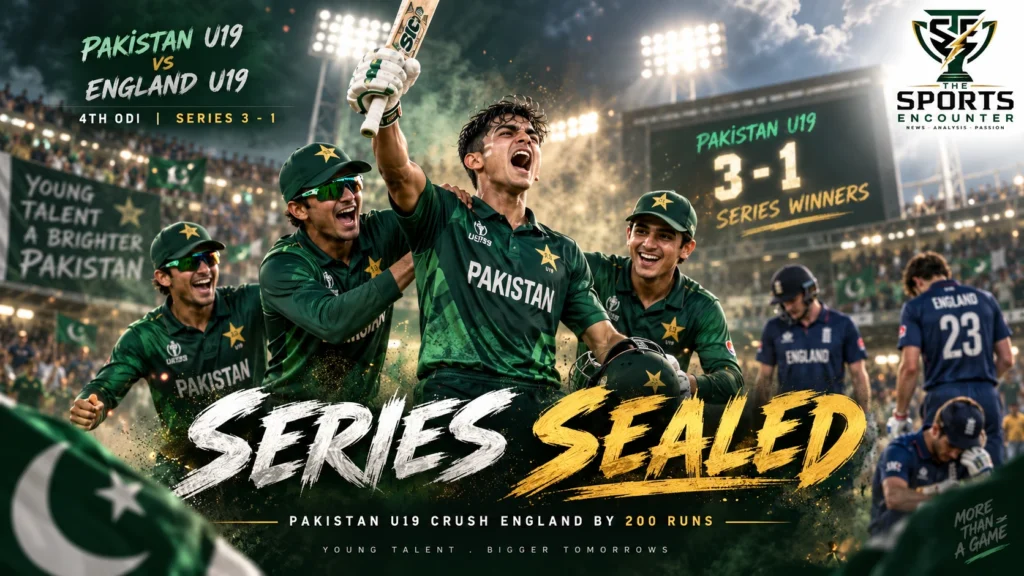
WORMSLEY, England, September 16, 2026: Pakistan Under-19s saved their most complete one-day performance for the final match of the tour, piling up 350 for four before dismissing England Under-19s for 150 in only 20.4 overs to win by 200 runs and close the four-match Youth ODI series 3-1.
The scale of the victory matched the breadth of Pakistan’s performance. Usman Khan and Youth ODI debutant Jahangir Bilal both made 79, captain Farhan Yousaf finished unbeaten on 80 from 54 balls, Ahmed Hussain struck 63 from 53 before taking three wickets, and Jahangir completed a remarkable debut with two wickets for only two runs.
England briefly threatened to turn a target of 351 into an extraordinary chase when Ralphie Albert and Isaac Mohammed attacked from the start, but Pakistan broke the opening stand at 59 and never allowed the innings to stabilize again. The hosts lost their final six wickets for 42 runs as five Pakistan bowlers shared the wickets.
The result completed a dominant white-ball response from Pakistan after England had won the preceding four-day Youth Test by 10 runs. Across the one-day series, Pakistan won three matches by a combined 499 runs, with England’s only success coming by two runs in the third match.
Pakistan U19 vs England U19 4th Youth ODI: Score at a Glance
| Match detail | Information |
|---|---|
| Match | England U19 vs Pakistan U19, 4th Youth ODI |
| Date | September 16, 2026 |
| Venue | Sir Paul Getty’s Ground, Wormsley |
| Toss | Pakistan U19 won the toss and elected to bat |
| Pakistan U19 | 350/4 in 50 overs |
| England U19 | 150 all out in 20.4 overs |
| Result | Pakistan U19 won by 200 runs |
| Series result | Pakistan U19 won 3-1 |
| Pakistan top scorer | Farhan Yousaf, 80 not out from 54 balls |
| England top scorer | Ralphie Albert, 46 from 24 balls |
| Best bowling | Ahmed Hussain, 3/16 |
The full fourth Youth ODI scorecard records a match Pakistan controlled for long stretches after choosing to bat first. The PCB’s official tour hub confirms the match completed Pakistan’s four-game one-day series in England, while the ECB’s Young Lions schedule listed Wormsley as the venue for the final two Youth ODIs.
Usman Khan and Jahangir Bilal Build the Platform
Pakistan did not need an early rescue this time.
Usman and Jahangir gave the innings a controlled start, reaching 45 without loss after the first 10 overs before steadily increasing the tempo. Their opening partnership reached 100 from 111 balls and eventually grew to 148 before Jahangir was trapped lbw by George Harris in the 25th over.
Jahangir’s 79 came from 81 balls and included 13 fours. For a player making his Youth ODI debut, it was a remarkably composed first innings at this level. He absorbed the early movement, scored fluently once settled and allowed Usman to build from the other end.
Usman followed for 79 from 93 balls, with nine fours and a six. His latest contribution continued an excellent one-day series after his 151 in Pakistan’s 177-run victory in the opening Youth ODI.
That first match had shown how dangerous Pakistan could become once their top order established a platform. The final at Wormsley followed the same principle, although the personnel and pace of the innings changed as the afternoon developed.
England Find a Window at 197 for Three
Subhaan Ali removed Usman and then Abdul Qadir for 22, leaving Pakistan at 197 for three after 33.2 overs.
That was England’s best opportunity to slow the innings.
Qadir had been the defining batter in the second Youth ODI, blasting 146 from 100 balls in Pakistan’s 122-run win at Guildford. This time he struck two sixes but could not turn his start into another major innings.
Instead, Ahmed Hussain joined Farhan and changed the shape of the final 17 overs.
Farhan Yousaf and Ahmed Hussain Turn 197 for Three Into 350
The fourth-wicket partnership became the decisive phase of Pakistan’s innings.
Ahmed and Farhan added 144 runs between 197 for three and 341 for four. Ahmed made 63 from 53 balls with eight fours and a six, while Farhan accelerated more aggressively as the innings approached its finish.
The captain reached his half-century from 42 balls and then scored another 30 runs from his final 12 deliveries. His unbeaten 80 contained eight fours and three sixes and came at a strike rate of 148.14.
Pakistan scored 106 runs in the final 10 overs while losing only Ahmed. Hamza Zahoor then struck a six from one of his two deliveries to help take the total to exactly 350.
England’s bowlers struggled to contain the acceleration. Subhaan was their most successful wicket-taker with two for 55, while Harris and Ralphie Albert took one wicket each. Albert conceded 80 from his 10 overs as Pakistan repeatedly found boundaries during the closing stages.
Pakistan’s Batting Numbers Across the Series Tell Their Own Story
Pakistan’s three victories came after first-innings totals of 332, 308 and 350. That is an average of exactly 330 runs in the three matches they won.
| Match | Pakistan score | England score | Result |
|---|---|---|---|
| 1st Youth ODI, Arundel | 332/9 | 155 | Pakistan won by 177 runs |
| 2nd Youth ODI, Guildford | 308 | 186 | Pakistan won by 122 runs |
| 3rd Youth ODI, Wormsley | 300/9 chasing 303 | 302/6 | England won by 2 runs |
| 4th Youth ODI, Wormsley | 350/4 | 150 | Pakistan won by 200 runs |
Another pattern stands out: the team batting first won all four matches. Pakistan controlled three games by putting substantial totals on the board, while England’s only win came after posting 302 in the third match and surviving Pakistan’s chase by two runs.
The third Youth ODI had shown that England could withstand late pressure. Pakistan answered two days later by making the chase almost impossible before the second innings had even begun.
England Start at Nearly 10 an Over
A target of 351 demanded aggression, and England initially embraced the equation.
Isaac Mohammed and captain Ralphie Albert raced to 50 from only 30 balls. Mohammed struck six fours in his 32 from 20 deliveries, while Albert attacked even harder, making 46 from 24 balls with six fours and two sixes.
At 59 without loss after five overs, England were scoring at the rate required.
Niqab Shafiq changed the direction of the innings.
He trapped Mohammed lbw at the end of the sixth over and then had Albert caught by Ahmed Hussain at 81 for two. England had lost both openers within 11 balls.
Mohammad Sayyam then removed Theo Lamey for a four-ball duck and later dismissed Joe Moores for 15. England still reached 93 for three after the opening powerplay, but wickets had begun to replace boundaries.
Ahmed Hussain Completes His All-Round Match
Ahmed’s impact did not end with his 63.
He bowled Jack Nelson for 21, removed Charlie Taylor first ball and returned to dismiss Tom Edwards for the final wicket. His figures of three for 16 from 2.4 overs were the best of the innings.
Rizwanullah bowled Robbie Bowman for 21, while Jahangir was handed the ball late and completed the perfect debut story.
The debutant conceded only two runs in his solitary over and took two wickets. George Harris was bowled for six before Hamza Zahoor stumped Subhaan Ali for a duck.
England collapsed from 108 for four to 150 all out, losing their final six wickets for 42 runs. Their last five wickets produced only 18 runs after the score had reached 132 for five.
Pakistan therefore needed only 20.4 overs to take all 10 wickets.
Pakistan Found a Different Match-Winner Almost Every Time
The defining feature of Pakistan’s 3-1 series win was the number of players who influenced different matches.
Usman made 151 in the opener. Farhan scored 115 in the same match. Abdul Qadir produced 146 in the second. Hamza Zahoor and Hasnain Abbas Dar almost rescued the third from 124 for five before England escaped by two runs. In the finale, Jahangir announced himself with 79 and two wickets, Farhan finished unbeaten on 80, and Ahmed contributed 63 and three for 16.
Pakistan’s bowling also remained distributed. Mohammad Sayyam was central throughout the series, while Rizwanullah, Niqab, Ahmed and others repeatedly provided wickets around him.
That variety matters more at Under-19 level than simply having one dominant player. Youth tours are partly about results, but they also reveal which players can adapt to new roles, unfamiliar conditions and different match situations.
A Very Different England Tour From Pakistan’s Senior Side
The Under-19 series also provided a striking contrast with Pakistan’s senior men, who recently endured a difficult Test tour of England.
The senior side was beaten 3-0, a result examined in The Sports Encounter’s full review of England’s Test-series whitewash. Pakistan did eventually show more resistance at Edgbaston, where Razaullah’s 81 helped turn the third Test into a fourth-day contest, but the series had already exposed significant problems at senior level.
The Under-19 results should not be treated as a direct answer to those problems. They do, however, offer encouraging evidence of batting depth and competitive white-ball talent below the senior team.
Pakistan arrived in England as reigning Asian Under-19 champions and left the one-day portion of the tour having produced three emphatic wins, several major individual innings and a final performance in which batting, bowling and leadership all aligned.
Pakistan Leave Wormsley With the Series and the Final Word
England’s two-run win in the third Youth ODI had prevented Pakistan from completing a sweep and given the hosts a chance to finish the series level.
The response was decisive.
Pakistan added 350 for four, their highest total of the series, then removed England inside 21 overs. The 200-run margin was also their largest victory of the four-match contest.
For Jahangir, the day delivered 79 runs, two wickets and a winning international debut. For Farhan, it completed a series in which his batting and captaincy repeatedly shaped Pakistan’s strongest performances. For Ahmed, 63 and three for 16 provided the most complete all-round contribution of the finale.
Most importantly, Pakistan turned a 2-1 lead into a convincing 3-1 series result rather than allowing England’s narrow win two days earlier to change the direction of the tour.
Follow The Sports Encounter’s Cricket coverage for international cricket, emerging players, match reports, tactical analysis and the major stories shaping the game.