


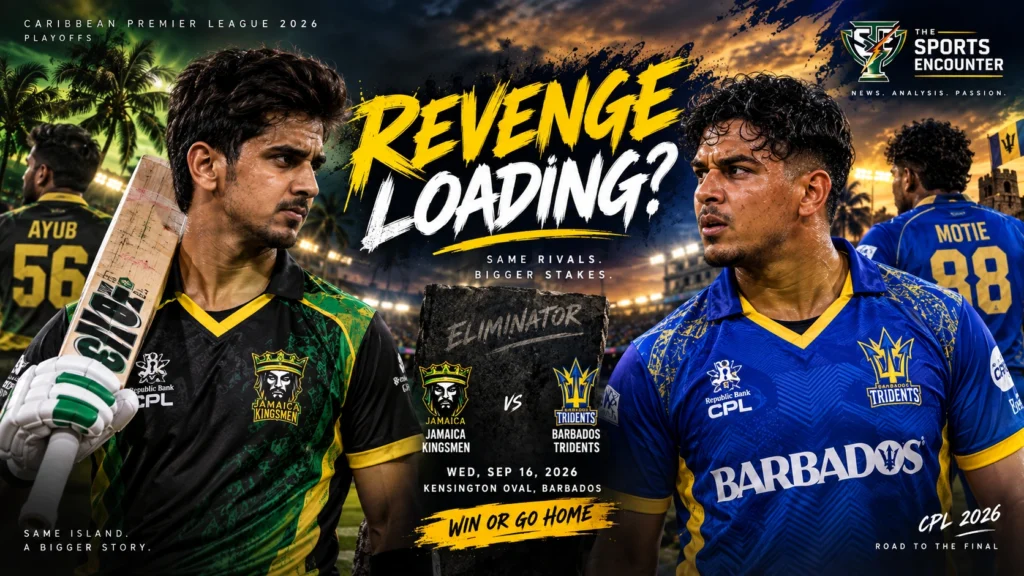
BRIDGETOWN, Barbados, September 13, 2026: Jamaica Kingsmen were one delivery away from beating Barbados Tridents at Kensington Oval. Four days later, the same two teams will return to the same ground with their seasons on the line, and Jamaica could arrive with the one batter capable of changing the structure of the contest before it reaches another frantic final over.
Saim Ayub is expected to rejoin the Kingsmen for the CPL 2026 playoff phase after his international commitments with Pakistan, giving Jamaica a major reinforcement ahead of Wednesday’s Eliminator against Barbados.
The timing could hardly be more significant.
Barbados defeated Jamaica by two wickets from the final ball on Saturday night after chasing 151, with Gudakesh Motie turning a requirement of 17 from the final over into one of the wildest finishes of the tournament. Shadrack Descarte had earlier held the innings together with 56 from 42 balls before Motie completed the escape with an unbeaten 17 from eight.
Jamaica still reached the playoffs because their net run rate kept them ahead of St Lucia Kings, but qualification only preserved their season. It did not solve the problem exposed at Kensington Oval.
The Kingsmen scored 150/9 despite Maaz Sadaqat making 47 from 34. Their middle order never fully controlled the innings, and when Barbados eventually created one final opening, Jamaica could not defend 17 from the last six balls.
Ayub gives them another way to win.
Barbados Tridents vs Jamaica Kingsmen: CPL 2026 Eliminator
| Match | CPL 2026 Eliminator |
|---|---|
| Teams | Barbados Tridents vs Jamaica Kingsmen |
| Date | September 16, 2026 |
| Venue | Kensington Oval, Bridgetown, Barbados |
| Qualification | Barbados 3rd, Jamaica 4th |
| What is at stake? | Winner advances to Qualifier 2; loser is eliminated |
| Qualifier 2 | Winner of Eliminator vs loser of Qualifier 1 |
| Final | September 20 at Kensington Oval |
The official CPL knockout schedule places the third- and fourth-ranked teams in the Eliminator. The winner survives to face the loser of the first-versus-second Qualifier in Friday’s Qualifier 2.
That makes Wednesday very simple for both teams. There is no net run rate calculation, no dependence on another result and no second chance.
Win, and the season continues.
Lose, and it ends.
Saim Ayub Changes More Than Jamaica’s Top Order
Ayub’s value cannot be reduced to the possibility of another century.
His presence changes where Jamaica can take risks.
Against St Kitts and Nevis Patriots earlier in the tournament, Jamaica were 63/4 when Ayub transformed an innings that appeared headed toward another rescue operation. He made 102 from 58 balls, striking six fours and eight sixes, and carried the Kingsmen to 182/7.
The Sports Encounter’s full report on Saim Ayub’s maiden T20 century showed why the innings mattered beyond its size. He did not merely attack from the start. Ayub absorbed Jamaica’s early damage, rebuilt with Rovman Powell and then accelerated once the innings had stabilized.
He also returned 1/20 from four overs, dismissing Andre Fletcher as Jamaica won by 11 runs.
The official CPL report on that performance described Ayub as the central figure in an all-round Jamaica victory.
That skill set addresses the problem Barbados exposed on Saturday.
Jamaica Scored 150, but Too Much of the Innings Drifted
Maaz Sadaqat’s 47 gave Jamaica their strongest contribution in Match 34, but the innings repeatedly lost momentum around him.
Rovman Powell made eight from 12 balls. Keemo Paul scored five from 12. Andre Russell threatened briefly with 10 from four, while Hassan Khan and Keacy Carty supplied late runs.
The Kingsmen finished at 150/9.
That total nearly survived, but the sequence matters when evaluating what Ayub could add.
Jamaica have spent significant portions of CPL 2026 recovering from top-order damage. The pattern was already visible when Keemo Paul rescued them with 65 from 36 after they slipped to 54/4 against the Patriots.
It appeared again when Guyana reduced Jamaica to 87/6 before Hassan Khan repaired the innings.
Jamaica possess several players capable of rescue innings. Ayub offers something different: the possibility of controlling the match before a rescue becomes necessary.
What Does Saim Ayub’s Return Change Tactically?
1. Jamaica gain another Powerplay aggressor
Barbados were able to attack Jamaica’s batting lineup on Saturday knowing that wickets would expose a middle order that has sometimes taken time to rebuild.
Ayub can disrupt that plan.
His ability to score quickly without relying exclusively on slogging forces Chris Green to make earlier decisions about Motie, Daniel Sams and AM Ghazanfar. Saving every preferred matchup for the middle overs becomes harder if Jamaica score efficiently during the Powerplay.
2. Maaz Sadaqat no longer carries the same burden
Sadaqat made 47 from 34 in the league meeting and was Jamaica’s most substantial batter.
With Ayub available, Sadaqat does not necessarily have to perform the dual role of survival and acceleration. Jamaica can distribute responsibility more naturally through Ayub, Sadaqat, Powell, Russell and Paul.
3. Barbados must account for another spin option
Ayub’s bowling has quietly become part of his value.
His 1/20 against the Patriots showed that Jamaica can use him for meaningful overs rather than treating him as a part-time option. Against a Barbados batting order containing several right-handers, that creates another tactical variable for Powell.
4. Jamaica become less dependent on Russell producing something extraordinary
The first meeting between these teams already demonstrated the danger of that dependence.
In August, Barbados posted 206/3 before Andre Russell almost stole the chase with 68 from 38 balls. Jamaica finished five runs short despite smashing 20 sixes.
Our report on Daniel Sams surviving Russell’s extraordinary assault at Sabina Park showed how close Jamaica came despite losing too many wickets before Russell’s intervention.
The pattern is familiar.
Ayub provides the Kingsmen with another batter capable of determining the match before Russell is forced into emergency mode.
Barbados Already Know How to Beat Jamaica
Revenge narratives can create the impression that the losing team possesses all the motivation.
Barbados have something more useful: evidence.
They have beaten Jamaica twice this season.
The first victory came at Sabina Park when Sams’ four wickets helped them survive Russell’s late attack. The second arrived Saturday night at Kensington Oval, when Descarte and Motie completed an entirely different kind of win.
That variety should encourage Barbados.
They have shown they can beat Jamaica in a high-scoring match and in a low-scoring pressure chase.
The Tridents’ late-season recovery has also been broader than this matchup. Their eight-wicket victory over St Lucia Kings restored control of their playoff campaign after a difficult middle stretch.
Earlier defeats had exposed vulnerabilities, including Sunil Narine’s dominant all-round performance against Barbados and another TKR victory that kept the defending champions alive late in the qualification race.
Barbados responded by finding different contributors.
That matters in knockout cricket because the Eliminator is unlikely to be won by one pre-selected hero.
Gudakesh Motie Is Becoming Barbados’ Pressure Player
Motie’s final-over batting will dominate memories of Saturday night, but his complete match was even better.
He took 2/7 from three overs, delivering 12 dot balls and dismissing Jamaica’s two highest-impact top-order contributors, Sadaqat and Usman Khan.
Later, with Barbados almost out of the chase, he made 17 not out from eight balls at a strike rate above 200.
That combination gives the Eliminator one of its most compelling individual contests.
Ayub can attack spin.
Motie can control the middle overs.
If Jamaica use Ayub near the top, Barbados may have to decide whether to challenge him with Motie immediately or preserve their best spin option for Powell, Russell and Paul.
How Chris Green answers that question could shape the game before the final five overs arrive.
Descarte’s 56 Exposed a Different Jamaica Problem
Jamaica will also have to decide how much Saturday’s bowling performance should be changed after coming within one ball of victory.
Hunain Shah was excellent for much of the chase, taking 2/25. Andre Russell conceded only 28 from four overs. Vitel Lawes gave away 26 from four.
For long periods, Jamaica executed well.
The problem was that Descarte survived long enough to keep Barbados within theoretical range.
His 56 from 42 was not explosive by modern T20 standards, but it prevented Jamaica from converting early wickets into a collapse.
When Descarte fell, Barbados still needed significant work. Green struggled for rhythm, Sams made only five, and Jamaica appeared to have regained complete control.
Then Motie arrived.
The lesson for Jamaica is uncomfortable because it is not solved simply by replacing one bowler or changing the final-over option. They had chances to kill the chase earlier and did not take them.
Odean Smith’s Final Over Cannot Be Ignored
Seventeen runs should have been enough.
Instead, Smith opened with a boundary ball, followed it with consecutive wides and then presented Motie with a hittable delivery that disappeared for six.
By the time Jamaica regained control of their lengths, Barbados needed only five from four.
The scores were eventually level with one delivery left.
Motie completed the chase.
Powell therefore faces a genuine tactical decision before the Eliminator. Does he trust Smith again at the death, believing execution rather than selection caused the failure, or redistribute the closing overs toward Russell, Paul and Hunain?
Jamaica’s earlier wins offer alternatives. Paul has already produced an outstanding all-round match, while Hunain’s pace has repeatedly provided wickets and control.
Knockout cricket magnifies those decisions.
The Eliminator Is Also a Test of Memory
There is a psychological dimension to facing the same opponent four days after losing from the final ball.
Jamaica do not need to forget Saturday.
They need to separate what worked from what failed.
For 19 overs of the chase, their bowlers had created enough pressure to win. Their attack removed eight wickets. Hunain repeatedly found his lengths. Paul dismissed Sams. Russell removed Descarte.
The final over cannot erase that.
Barbados face the opposite challenge.
They cannot assume that surviving once means the same approach will work again, particularly if Ayub returns and Jamaica’s batting ceiling rises.
The late-season CPL qualification race already showed how rapidly the standings changed as Barbados recovered from seventh and Jamaica survived on net run rate.
Now there are no standings left to manage.
Why Saim Ayub Could Be the Difference
The strongest argument for Ayub is not that Jamaica suddenly become favorites because one player returns.
It is that the Kingsmen become harder to predict.
Without him, Saturday’s innings leaned heavily on Sadaqat before the middle order supplied scattered contributions.
With Ayub, Jamaica gain another aggressive top-order option, another player capable of rebuilding after early wickets and another bowler Powell can use through the middle overs.
His century against the Patriots was especially revealing because it came after Jamaica fell to 63/4. Ayub proved he could absorb pressure before creating it.
That is precisely the quality required in an Eliminator.
TSE Verdict: Jamaica Get Their Rematch, but Barbados Own the Recent Evidence
Barbados enter the Eliminator knowing they have beaten Jamaica twice in two very different matches.
They have the home ground, the confidence of Saturday’s escape and a growing group of players contributing under pressure.
Jamaica arrive with a different kind of advantage.
They know they were close enough to win without Ayub.
If their returning batter gives the top order another 40 or 50 runs of high-quality production, the 150 that almost survived on Saturday could become 175 or 180. That changes how Descarte, Green, Rutherford, de Kock and Motie must approach the chase.
Saim Ayub does not guarantee revenge.
He changes the equation.
On Wednesday night at Kensington Oval, Jamaica will find out whether that is enough.
Frequently Asked Questions
When is Barbados Tridents vs Jamaica Kingsmen in the CPL 2026 playoffs?
Barbados Tridents and Jamaica Kingsmen are scheduled to meet in the CPL 2026 Eliminator on Wednesday, September 16 at Kensington Oval in Bridgetown.
Why are Barbados and Jamaica playing in the Eliminator?
Barbados finished third in the league standings and Jamaica finished fourth. The CPL knockout format places the third- and fourth-ranked teams in the Eliminator.
What happens to the winner of Barbados vs Jamaica?
The winner advances to Qualifier 2 on Friday, September 18, where it will face the loser of Qualifier 1 between the top two teams.
What happens to the loser?
The losing team is eliminated from CPL 2026.
Is Saim Ayub expected to play for Jamaica Kingsmen?
Ayub is expected to rejoin Jamaica for the playoff phase following his Pakistan commitments, although the final playing XI remains subject to team selection.
What did Saim Ayub score earlier in CPL 2026?
Ayub scored 102 from 58 balls against St Kitts and Nevis Patriots, hitting six fours and eight sixes. He also took 1/20 from four overs.
Who won the latest Barbados vs Jamaica match?
Barbados Tridents won by two wickets from the final ball after chasing Jamaica’s 150/9 with 151/8.
How many did Barbados need from the final over?
Barbados needed 17 runs from the final six balls. Gudakesh Motie helped complete the chase with an unbeaten 17 from eight deliveries.
How many times have Barbados beaten Jamaica in CPL 2026?
Barbados have won both league-stage meetings, first by five runs at Sabina Park and then by two wickets from the final ball at Kensington Oval.
Where will the CPL 2026 Eliminator be played?
The Eliminator will be played at Kensington Oval in Bridgetown, Barbados, which hosts all four CPL 2026 knockout matches.