


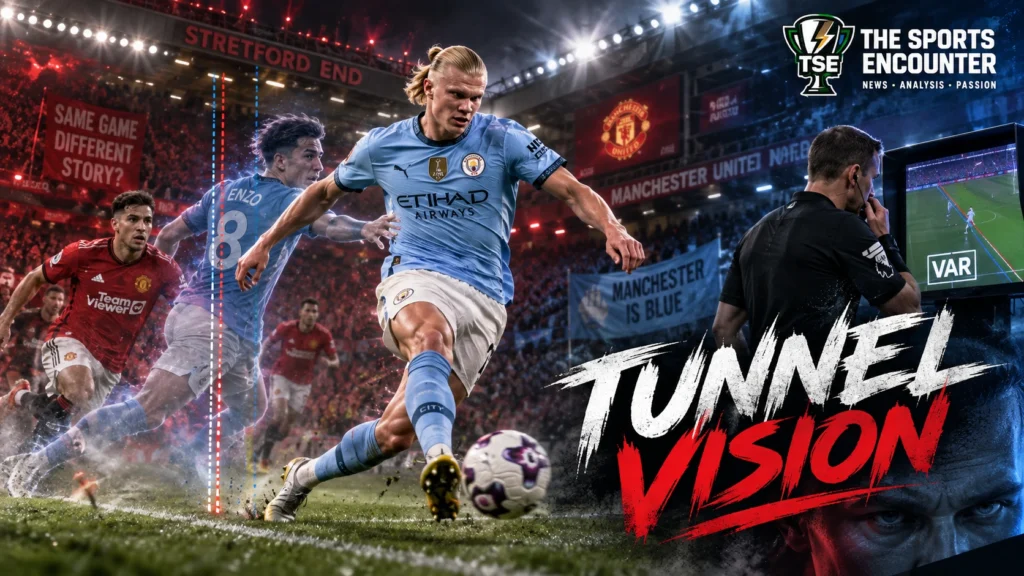
LONDON, United Kingdom, September 15, 2026: The most revealing part of the Manchester derby VAR controversy is that the technology appears to have worked.
The decision still ended up wrong.
Howard Webb, English professional soccer’s chief refereeing officer, has acknowledged that VAR officials developed what he described as “tunnel vision” while reviewing Erling Haaland’s winning goal in Manchester City’s 1-0 victory over Manchester United at Old Trafford.
Haaland had initially been flagged offside when he scored from Josko Gvardiol’s cross in the 60th minute.
VAR then established through semi-automated offside technology that Haaland himself was onside, reportedly by only a few centimeters.
That part of the review was correct.
The mistake came next.
City midfielder Enzo Fernández had been in an offside position and made a clear attempt to play the cross before Haaland finished. The VAR team checked whether Fernández actually touched the ball, concluded that he had not, and then moved toward awarding the goal without properly assessing whether his action had interfered with Manchester United’s defenders.
Under football’s offside law, touching the ball is not required for an offence.
A player in an offside position can still be penalized if he clearly attempts to play a nearby ball and that action affects an opponent.
That distinction is exactly where the Manchester derby decision collapsed.
Webb’s explanation therefore raises a more serious question than whether VAR can draw accurate offside lines.
What happens when the technology answers one question correctly, but the officials reviewing the incident stop asking the others?
Manchester Derby VAR Error: Key Facts
- Manchester City beat Manchester United 1-0 at Old Trafford.
- Erling Haaland scored the winning goal in the 60th minute.
- The goal was initially disallowed for offside.
- Semi-automated offside technology found Haaland to be onside.
- Enzo Fernández was in an offside position during the same attacking phase.
- Fernández attempted to play the cross but did not touch the ball.
- VAR failed to fully assess whether his action interfered with Manchester United defenders.
- Howard Webb described the VAR team’s mistake as “tunnel vision.”
- VAR Matt Donohue and assistant VAR Blake Antrobus have been removed from appointments until after the international break.
- Pro Ref contacted Manchester United to acknowledge the error.
What Was the VAR Error in Manchester United vs Manchester City?
The error was not the judgment of Haaland’s position.
VAR correctly established that the Manchester City striker was onside when Gvardiol delivered the cross.
The failure was that the review did not properly evaluate Fernández’s actions from an offside position.
Fernández moved toward the same cross and attempted to play it before Haaland scored.
The review appears to have concentrated on two narrower questions:
- Was Haaland offside?
- Did Fernández touch the ball?
Once officials concluded that Haaland was onside and Fernández had not made contact, the goal was allowed.
That skipped a crucial part of Law 11.
The official IFAB Law 11 states that an attacker can commit an offside offence without touching the ball if he clearly attempts to play it and that action affects an opponent’s ability to play or challenge for the ball.
That was the subjective question the VAR team failed to complete.
Why Did Howard Webb Call the Manchester Derby VAR Decision ‘Tunnel Vision’?
Webb’s description goes directly to the process failure.
According to his explanation, the VAR became heavily focused on determining whether Haaland was onside.
Once that was established, the review moved through the rest of the attacking possession phase without fully reassessing Fernández’s impact.
“In that moment, he gets tunnel vision.”
The phrase matters because it does not describe a technological malfunction.
It describes a cognitive one.
The VAR found the expected problem, corrected it, and then failed to recognize that another possible offence existed in the same sequence.
That creates an important distinction for supporters who often talk about “VAR” as though software itself makes decisions.
The system provides images, lines and replay tools.
Officials still have to interpret what those images mean.
The Sports Encounter examined this wider transparency problem before the season in our report on the Premier League’s new VAR review and referee transparency system.
The Manchester derby has now provided one of the first major tests of that promise.
Was Erling Haaland Actually Offside Against Manchester United?
No.
Haaland himself was onside.
The original assistant referee decision was overturned because semi-automated offside technology showed that Manchester United defender Patrick Dorgu was playing him onside.
That is why the controversy is frequently misunderstood.
The correct question is not:
Was Haaland offside?
It is:
Did Fernández commit an offside offence by interfering with an opponent?
Those are completely different judgments.
City’s striker could be legally positioned while another teammate in the same attacking phase still committed an offence.
Why Was Enzo Fernández Offside If He Did Not Touch the Ball?
Because football’s offside law does not require contact with the ball in every case.
A player standing in an offside position is not automatically committing an offence.
He becomes punishable when he becomes actively involved.
That can happen by playing the ball, challenging an opponent, blocking vision or making an obvious attempt to play a nearby ball that clearly affects an opponent.
Fernández’s attempted intervention therefore had to be judged on its impact, not merely on whether his head or foot made contact with the cross.
This is why Webb described the incident as a subjective offside issue.
The technology can identify where the player stood.
It cannot independently decide whether his movement materially affected a defender.
That still belongs to the officials.
Why Did VAR Need an On-Field Review for the Haaland Goal?
Once the question became whether Fernández interfered with an opponent, the decision moved from factual offside into subjective judgment.
Factual offside decisions can normally be resolved from calibrated technology.
Interference decisions require interpretation.
That is why the appropriate process would have been for VAR to recommend that referee Michael Oliver review the incident at the pitchside monitor.
Oliver could then have judged whether Fernández’s attempted play materially affected United’s defenders.
Pro Ref has since accepted that this should have happened.
The failure therefore involved more than reaching the wrong conclusion.
The review failed to trigger the correct decision-making mechanism.
Who Were the VAR Officials for Manchester United vs Manchester City?
Matt Donohue was the VAR for the derby.
Blake Antrobus served as assistant VAR.
Michael Oliver was the on-field referee.
| Role | Official |
|---|---|
| Referee | Michael Oliver |
| VAR | Matt Donohue |
| Assistant VAR | Blake Antrobus |
| Fourth official | Paul Tierney |
Donohue and Antrobus will not receive appointments again until after the international break.
Webb also said responsibility extended beyond one official because teamwork inside the VAR booth should have prevented the review from becoming so narrowly focused.
The Premier League’s official refereeing information explains that Pro Ref oversees match officials across the professional English game under Webb’s leadership.
What Did Michael Carrick Say About the Manchester Derby VAR Decision?
Manchester United manager Michael Carrick made his frustration clear after the match.
He described the failure to penalize Fernández’s intervention as “staggering.”
For Carrick, the anger was understandable because the disputed goal decided the match.
City played with 10 men from the 23rd minute after Phil Foden was sent off, yet Haaland’s second-half goal survived and gave the visitors all three points.
United also struck the woodwork twice and created a late opportunity that forced Gianluigi Donnarumma into an important save.
The loss left Carrick’s side with only four points from four Premier League matches.
That start sits awkwardly beside the optimism generated by his work last season, which TSE examined in our feature on Michael Carrick’s Manchester United rebuild.
Should Haaland’s Manchester Derby Goal Have Been Disallowed?
Yes, according to Pro Ref’s subsequent review.
The goal should not have stood because Fernández’s involvement from an offside position should have been judged as an offence.
This is an important distinction from debates where two reasonable interpretations remain possible.
Here, the refereeing organization itself has accepted that the process produced the wrong outcome.
The Premier League’s own match analysis now notes that the decision was subsequently acknowledged as incorrect.
That makes the incident an official refereeing error rather than simply a disagreement between supporters.
Can Manchester United Appeal the Result of the Manchester Derby?
No normal post-match process allows Manchester United to have the Premier League result changed because of this kind of refereeing error.
Manchester City therefore keep the 1-0 victory and the three points.
That is why officiating errors in decisive moments create such lasting frustration.
An apology can acknowledge the mistake.
It cannot recreate the match from the 60th minute onward.
City’s win kept their perfect league start intact after an impressive opening month that also included a 4-1 victory at Crystal Palace.
Haaland had also entered the derby in strong form after scoring twice against Porto in the Champions League.
Did VAR Technology Fail in the Manchester Derby?
This may be the most important question raised by the incident.
No, the primary failure was not technological.
The semi-automated system appears to have performed the factual task it was built to perform.
It correctly established Haaland’s position.
The human review failed afterward.
That difference matters because technology cannot solve every problem created by football’s laws.
Some decisions remain objective:
- Was a player beyond the second-last defender?
- Did the ball cross the line?
- Was contact inside or outside the penalty area?
Others require context:
- Did an offside player interfere with an opponent?
- Was contact sufficient for a foul?
- Was a handball deliberate or an unnatural enlargement?
- Did a challenge endanger an opponent?
VAR can provide better evidence.
It cannot eliminate judgment.
Why the Manchester Derby VAR Error Matters for Premier League Transparency
The timing of the controversy is particularly awkward for the Premier League.
This season introduced a major transparency initiative designed to give supporters more information about officiating decisions.
The league now publishes weekly findings from its independent Key Match Incident Panel and has expanded the release of referee and VAR communications.
TSE analyzed those changes before the season in Premier League Opens VAR Decisions to Public Scrutiny in Major Transparency Push.
The official Premier League transparency framework says those changes are intended to give supporters greater understanding of how major decisions are reached.
The Manchester derby demonstrates why that information can be useful.
The released explanation does not make the original decision correct.
It does allow supporters to see where the process broke.
That is better than a vague statement saying a mistake occurred.
It also exposes the next challenge.
Transparency only builds trust if the mistakes revealed by transparency lead to better procedures.
What Can VAR Learn From the Manchester Derby Error?
The immediate lesson is procedural.
A VAR check cannot end simply because the most obvious question has been answered.
The officials must complete the full attacking phase of play and evaluate every relevant potential offence.
In this case, the sequence should have been approached as:
- Was Haaland onside?
- Was every other City attacker in a legal position?
- Did any offside attacker become actively involved?
- Did Fernández’s attempt to play the ball affect an opponent?
- If that judgment was subjective, should Oliver review it on the monitor?
The first question was answered correctly.
The remaining sequence broke down.
That makes Webb’s use of “tunnel vision” particularly revealing.
VAR was introduced partly to prevent one missed detail from deciding a major match.
At Old Trafford, the review itself missed the detail.
Does the Manchester Derby Error Prove VAR Should Be Scrapped?
Not by itself.
In fact, the incident makes the argument more complicated.
Without video review, Haaland’s goal would originally have been ruled out because the assistant flagged him offside.
VAR correctly showed that Haaland was legal.
But VAR then failed to recognize another offence in the same move.
That means both extremes miss the point.
The technology was useful.
The process using it was flawed.
The more useful debate is therefore not simply “VAR or no VAR.”
It is whether review protocols, training, communication and accountability are strong enough to ensure that officials use the available evidence properly.
The league entered 2026-27 already promising greater openness around these questions. Our Premier League season preview identified managerial change and competitive uncertainty as major themes, but refereeing transparency is quickly becoming another.
What Does the VAR Error Mean for Manchester City and Manchester United?
For Manchester City, the table does not change.
They remain credited with a 1-0 victory and a fourth consecutive Premier League win.
Enzo Maresca’s transition has therefore begun with maximum league points, extending the positive start TSE tracked through City’s Champions League win in Porto and the earlier victory at Crystal Palace.
For United, the competitive damage cannot be reversed.
Carrick’s side had entered the derby after beating Sabah 4-0 in the Champions League, a result that appeared to reinforce the progress made since last season.
Instead, United leave the derby with no points and an official acknowledgment that the decisive goal should not have counted.
That is difficult to accept.
It is also why the story has moved beyond one Manchester rivalry.
The Real Problem Was Not the Offside Line
VAR debates often begin with pixels, lines and millimeters.
This one should not.
The system identified Haaland’s position correctly.
The officials had multiple angles.
They had time.
They had an assistant VAR.
They had access to the entire attacking sequence.
The information existed.
The problem was how it was processed.
That makes this incident more valuable as a lesson than a conventional marginal-offside controversy.
English refereeing cannot improve by asking technology to eliminate human judgment, because football contains too many subjective decisions for that ever to happen.
It can improve by building review processes that make it harder for one correct answer to distract officials from the next question.
Webb has acknowledged the failure.
Two officials have been removed from appointments temporarily.
The audio and explanation have been made public.
The final measure of accountability will be whether the same type of mistake becomes less likely next time.
For continuing Premier League coverage, refereeing analysis and major soccer stories, visit The Sports Encounter Premier League hub and our broader Soccer coverage.
Frequently Asked Questions About the Manchester Derby VAR Error
What was the VAR mistake in Manchester United vs Manchester City?
VAR correctly ruled that Erling Haaland was onside but failed to properly assess Enzo Fernández’s interference from an offside position before Haaland scored.
Was Erling Haaland offside for his Manchester derby goal?
No. Semi-automated offside technology showed that Haaland himself was onside.
Why should Manchester City’s goal have been disallowed?
Pro Ref determined that Fernández’s attempted play from an offside position interfered with Manchester United defenders, meaning the goal should not have stood.
Can a player be offside without touching the ball?
Yes. IFAB Law 11 allows a player to be penalized if he clearly attempts to play a nearby ball and that action affects an opponent.
What did Howard Webb say about the VAR error?
Webb said the VAR team developed “tunnel vision” by focusing too heavily on Haaland’s position and failing to fully evaluate Fernández’s involvement.
Who was the VAR in the Manchester derby?
Matt Donohue was the VAR, with Blake Antrobus serving as assistant VAR.
Have the Manchester derby VAR officials been suspended?
Donohue and Antrobus will not receive appointments again until after the international break.
Who refereed Manchester United vs Manchester City?
Michael Oliver was the on-field referee.
Did Pro Ref apologize to Manchester United?
Pro Ref contacted Manchester United and acknowledged that an officiating error had occurred.
Can Manchester United have the result changed?
No. Refereeing errors of this kind do not normally result in Premier League matches being replayed or results being altered.
What was the Manchester derby final score?
Manchester City beat Manchester United 1-0 at Old Trafford.
Who scored the winning goal in the Manchester derby?
Erling Haaland scored the only goal in the 60th minute.
Why was Phil Foden sent off?
Foden was shown a red card in the 23rd minute after retaliating against Bruno Fernandes. Webb later supported the dismissal.
What is subjective offside?
Subjective offside refers to situations where an official must judge whether a player in an offside position has interfered with an opponent or otherwise become actively involved without necessarily touching the ball.
Does semi-automated offside technology make VAR decisions automatically?
No. It can help establish player positions, but human officials must still judge subjective issues such as interference with an opponent.