
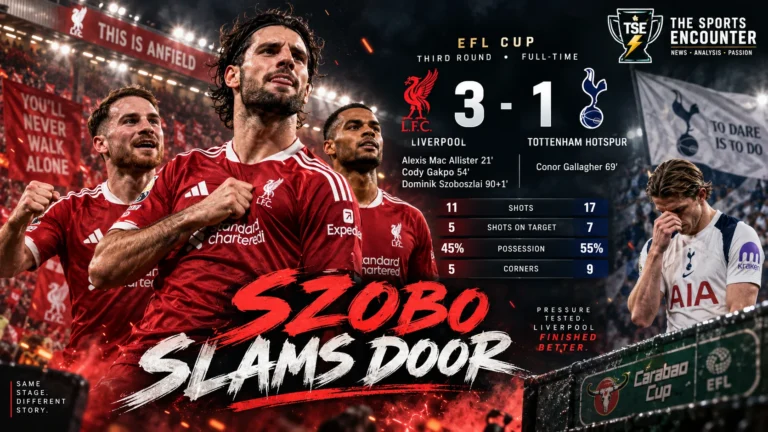
LIVERPOOL, England, September 15, 2026: Tottenham Hotspur had more possession, more shots, more efforts on target and more corners at Anfield. Liverpool had something far more useful: three finishes when the match gave them an opening.
Alexis Mac Allister and Cody Gakpo put Liverpool two goals ahead before Conor Gallagher finally gave Tottenham a route back into the Carabao Cup third-round tie. Spurs pushed for an equalizer, but Dominik Szoboszlai ended the argument with a spectacular stoppage-time strike that completed a 3-1 Liverpool victory.
The scoreline alone makes the night look comfortable. The match statistics tell a much tighter story.
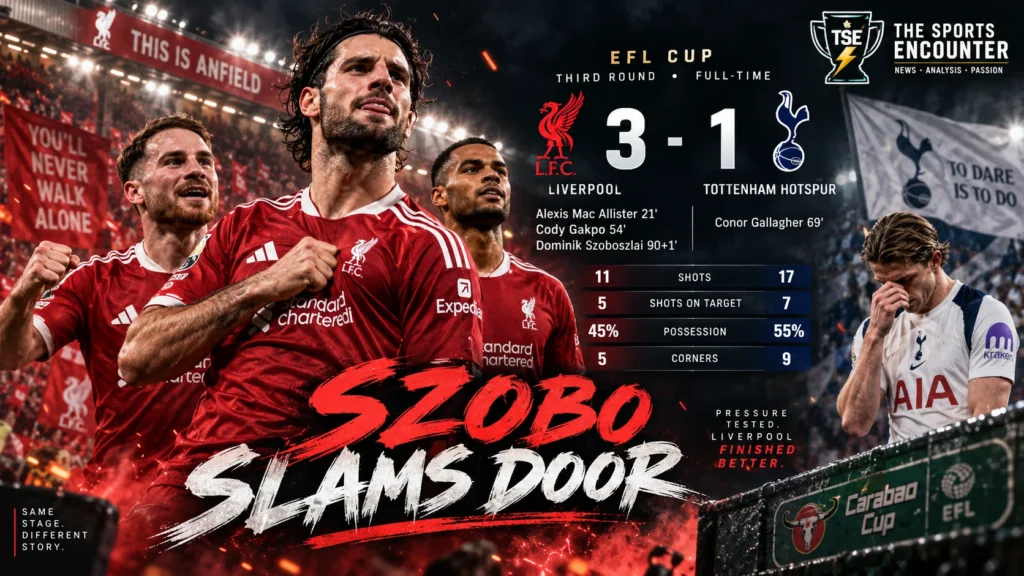
Tottenham attempted 17 shots to Liverpool’s 11, put seven on target compared with five and held 55% of possession. They also won nine corners to Liverpool’s five. Liverpool still advanced because three of their five shots on target became goals while Tottenham converted only one of seven.
Story at a glance
Liverpool vs Tottenham: Match at a Glance
The tie had originally been scheduled for September 16 before UEFA’s Champions League calendar forced it forward by 24 hours. Tottenham published the EFL’s explanation for the fixture change, part of a wider scheduling dispute that affected several clubs.
Tottenham Start Brighter, but Mac Allister Changes the Scoreboard
Tottenham’s early approach suggested a team determined to escape the attacking frustration that has followed them through the opening weeks of the Premier League season.
Cody Gakpo Turns His Return Into a Goal
Liverpool began the second half with a one-goal advantage rather than complete control.
Conor Gallagher Gives Tottenham a Reason to Believe
Tottenham’s response came in the 69th minute.
The Statistics Show Why Tottenham Felt the Equalizer Was Possible
Tottenham’s numbers were stronger in most attacking categories.
For continuing coverage of the English game, follow The Sports Encounter’s Soccer Hub and our dedicated Premier League coverage.
Liverpool vs Tottenham: Match at a Glance
| Match Detail | Information |
|---|---|
| Competition | Carabao Cup 2026-27 |
| Round | Third Round |
| Venue | Anfield |
| Final score | Liverpool 3-1 Tottenham Hotspur |
| Liverpool scorers | Alexis Mac Allister 21′, Cody Gakpo 54′, Dominik Szoboszlai 90+1′ |
| Tottenham scorer | Conor Gallagher 69′ |
| Shots | Liverpool 11, Tottenham 17 |
| Shots on target | Liverpool 5, Tottenham 7 |
| Possession | Liverpool 45%, Tottenham 55% |
| Key moment | Szoboszlai’s stoppage-time goal ends Tottenham’s late push |
The tie had originally been scheduled for September 16 before UEFA’s Champions League calendar forced it forward by 24 hours. Tottenham published the EFL’s explanation for the fixture change, part of a wider scheduling dispute that affected several clubs.
The Sports Encounter examined that chain reaction in detail when Liverpool’s Champions League schedule triggered multiple Carabao Cup fixture changes.
Tottenham Start Brighter, but Mac Allister Changes the Scoreboard
Tottenham’s early approach suggested a team determined to escape the attacking frustration that has followed them through the opening weeks of the Premier League season.
They carried possession forward, found space around Liverpool’s reshaped lineup and generated enough activity to make the opening phase uncomfortable for the hosts.
Liverpool did not need long periods of dominance to change the direction of the match.
Mac Allister struck in the 21st minute, finishing from the edge of the area and giving Andoni Iraola’s side the lead after Spurs had enjoyed some of the better early moments.
The Argentine has made a habit of producing consequential goals at Anfield this month.
Six days earlier, Mac Allister had scored Liverpool’s winner against Atlético Madrid in the Champions League after Szoboszlai had equalized. The Sports Encounter’s Liverpool 2-1 Atlético Madrid analysis highlighted how the pair turned a difficult European night around.
Against Tottenham, the sequence changed. Mac Allister struck first. Szoboszlai eventually finished the job.
Cody Gakpo Turns His Return Into a Goal
Liverpool began the second half with a one-goal advantage rather than complete control.
Gakpo changed that in the 54th minute.
The Dutch forward drove Liverpool into a 2-0 lead nine minutes after the restart, giving Spurs a much steeper problem at a stage when their territorial numbers still suggested they were involved in the contest.
Gakpo’s contribution was particularly useful after his recent fitness issue. Liverpool had brought him back into the matchday squad for the goalless league draw with Fulham only days earlier.
That Fulham result had raised fresh questions about Liverpool’s ability to convert control into goals. The Sports Encounter’s Premier League Saturday analysis examined both Liverpool’s 0-0 draw and Tottenham’s own scoreless afternoon against Everton.
Gakpo’s goal offered the kind of direct final action Liverpool had lacked in that league match.
He has already been central to several of Iraola’s better attacking performances this season. When Liverpool collected their first Premier League victory at Portman Road, Gakpo created both goals for Alexander Isak in a 2-0 win over Ipswich Town.
His return to the scoresheet gave Liverpool another reminder of how useful he can be when the attack needs a decisive action rather than another possession sequence.
Conor Gallagher Gives Tottenham a Reason to Believe
Tottenham’s response came in the 69th minute.
Gallagher found the net to cut Liverpool’s lead to 2-1 and suddenly gave the visitors more than statistical encouragement.
Spurs had spent the opening four Premier League matches without scoring. Their league drought remains unresolved because this was a cup tie, but Gallagher’s goal at least showed a side that had struggled badly in the final third could still turn sustained pressure into something tangible.
The Sports Encounter had already tracked the problem as it worsened. Tottenham failed to register a shot on target in their 0-0 draw at Nottingham Forest, a result covered in our Premier League Matchweek Three review.
A week later, another goalless draw against Everton left Spurs without a Premier League goal after four games.
Gallagher’s header at Anfield therefore carried a psychological value beyond making the score 2-1.
For the next 20 minutes, Tottenham had a genuine chance to force the tie toward penalties.
The Statistics Show Why Tottenham Felt the Equalizer Was Possible
| Statistic | Liverpool | Tottenham |
|---|---|---|
| Shots | 11 | 17 |
| Shots on target | 5 | 7 |
| Possession | 45% | 55% |
| Fouls | 14 | 12 |
| Yellow cards | 3 | 2 |
| Red cards | 0 | 0 |
| Offsides | 1 | 3 |
| Corners | 5 | 9 |
Tottenham’s numbers were stronger in most attacking categories.
Seventeen shots represented six more than Liverpool attempted. Seven efforts tested Giorgi Mamardashvili, compared with five Liverpool efforts on target. Spurs held 55% possession and generated nine corners.
Those figures explain why the match remained alive after Gallagher scored.
They also expose Tottenham’s larger problem.
Creating the conditions for goals and actually scoring them remain two different tasks for Roberto De Zerbi’s team.
Liverpool scored from three of their five efforts on target. Spurs needed seven accurate attempts to score once.
In knockout football, that gap in finishing carries more weight than territorial superiority.
Mamardashvili Helps Liverpool Survive Tottenham’s Volume
Tottenham’s seven shots on target ensured Liverpool’s goalkeeper remained involved.
Mamardashvili had to deal with periods when Spurs moved the ball quickly enough to make Liverpool’s rotated structure uncomfortable, especially as the visitors chased the match after falling behind.
Liverpool’s ability to absorb those sequences allowed Iraola to use the Carabao Cup for squad management without watching the tie slip away.
That becomes especially valuable during a September schedule already shaped by domestic and European commitments.
The Tottenham team update before the match showed De Zerbi dealing with his own availability issues, with Pedro Porro and Sandro Tonali unavailable while Destiny Udogie returned to contention.
Squad depth was therefore part of the story on both sides before kickoff.
Szoboszlai Removes the Last Bit of Uncertainty
At 2-1, Tottenham still had time.
Their shot volume suggested another chance could come, and Liverpool had already spent stretches of the match defending rather than controlling possession.
Szoboszlai made all of that irrelevant in first-half stoppage time.
The Hungarian midfielder struck from long range in the 91st minute, completing the 3-1 victory with the kind of goal that changes the emotional memory of a match.
Tottenham had spent the final stages looking for an equalizer.
They left Anfield two goals behind.
Szoboszlai’s contribution also continued a productive September. He had scored Liverpool’s equalizer against Atlético Madrid before Mac Allister completed that Champions League comeback.
Two major Anfield nights have therefore featured the same midfield pairing producing decisive goals in different sequences.
Liverpool’s Rotation Produces the Result Iraola Needed
Domestic cup nights are often where squad depth moves from theory into evidence.
Liverpool made extensive changes after the weekend draw against Fulham, giving opportunities to players including Trey Nyoni, James McConnell, Lewis Koumas and Rio Ngumoha while Joe Gomez returned after injury.
The experienced layer still mattered.
Mac Allister provided the opener. Gakpo supplied the second. Szoboszlai came from the bench and supplied the finish.
The blend gave Iraola a useful result because Liverpool advanced without requiring the same starting group to carry another 90-minute workload immediately after league and Champions League commitments.
The scheduling pressure around the competition had already made that issue impossible to ignore.
The Sports Encounter’s Premier League season preview identified European workload and squad depth as major factors for England’s clubs competing on several fronts.
Liverpool’s third-round performance offered an early example of why.
Tottenham Produced More Football Than the Scoreline Suggests
A 3-1 defeat will add pressure around Spurs because knockout competitions offer no consolation points for performance.
The match itself still contained signs De Zerbi can use.
Tottenham generated 17 shots at Anfield.
They put seven on target.
They had more possession.
They won nine corners.
Gallagher finally found a goal after weeks of attacking frustration.
The challenge is turning that activity into reliable scoring.
Tottenham’s summer rebuild was expensive and extensive. The Sports Encounter’s analysis of the Premier League’s record £3.46 billion transfer window noted that Spurs were among the clubs investing heavily in an attempt to change their competitive direction.
Their second-round cup performance showed what the attack can look like when it clicks.
Tottenham scored five against Charlton, with Savio scoring on debut during a night covered in The Sports Encounter’s Carabao Cup Round Two review.
The club’s own official report from that victory captured a very different attacking mood.
Since then, the goals have been much harder to find.
Liverpool’s Efficiency Was the Real Separation at Anfield
The most useful way to understand the result is to compare what each team did with its accurate attempts.
Tottenham put seven shots on target and scored once.
Liverpool put five on target and scored three times.
That difference explains more about the result than possession or total shot volume.
Mac Allister’s opener punished Spurs after a promising start.
Gakpo’s second arrived when Tottenham still had enough of the match to believe they could change it.
Szoboszlai’s third arrived when the visitors were committing themselves to finding an equalizer.
Each goal landed at a different point in the contest, and each changed what Tottenham needed to do next.
Liverpool were therefore able to win without dominating every phase.
For Iraola, that may be one of the more encouraging aspects of the performance.
What the Result Means for Liverpool and Tottenham
Liverpool advance to the Carabao Cup fourth round and remain alive across every competition available to them.
Their recent results have been uneven in the Premier League, but cup football has provided a stronger picture. They beat Atlético Madrid in Europe and have now eliminated Tottenham domestically.
The contrast with the 0-0 league draw against Fulham remains instructive.
When Liverpool finish their chances, the underlying attacking quality becomes obvious.
Tottenham return to league football with their Carabao Cup run over and their Premier League scoring problem still waiting for a solution.
Gallagher’s goal offers something positive to take from Anfield. Seventeen shots suggest the team is capable of creating attacking volume. Seven efforts on target show the final third was more active than it has been in recent league games.
The next step is converting that improvement into Premier League goals and points.
Liverpool’s next challenge is different. Iraola now has evidence that his wider squad can carry a knockout match, while Mac Allister, Gakpo and Szoboszlai continue producing decisive moments around a team still settling into its new structure.
Continue the Soccer Story
Frequently Asked Questions
What was the Liverpool vs Tottenham score?
Liverpool beat Tottenham Hotspur 3-1 at Anfield in the third round of the 2026-27 Carabao Cup.
Who scored for Liverpool against Tottenham?
Alexis Mac Allister scored in the 21st minute, Cody Gakpo made it 2-0 in the 54th minute and Dominik Szoboszlai completed the victory in first-half stoppage time.
Who scored for Liverpool against Tottenham?
Alexis Mac Allister scored in the 21st minute, Cody Gakpo made it 2-0 in the 54th minute and Dominik Szoboszlai completed the victory in second-half stoppage time.
Who had more shots in Liverpool vs Tottenham?
Tottenham had more shots, recording 17 attempts compared with Liverpool’s 11.
Who had more shots on target?
Tottenham put seven shots on target while Liverpool recorded five. Liverpool scored from three of those five accurate attempts.
How much possession did Tottenham have?
Tottenham had 55% possession compared with Liverpool’s 45%.
How many corners did Spurs win?
Tottenham won nine corners, while Liverpool had five.
Why was Liverpool vs Tottenham moved to September 15?
The Carabao Cup tie was moved from September 16 after UEFA’s Champions League scheduling created a fixture conflict on Merseyside and forced several domestic matches to be rearranged.
Which round have Liverpool reached?
Liverpool have advanced to the fourth round of the 2026-27 Carabao Cup.
Liverpool
- League Cup 2026: Szoboszlai Slams the Door as Liverpool Beat Spurs 3-1
- Premier League: Arsenal Stay Perfect, Hull Defy Chelsea as Spurs Hit Historic Low
- Liverpool Turn Pressure Into Champions League Points as Mac Allister Sinks Atlético 2-1 at Anfield
- Arsenal Beat Chelsea as Man City Stay Perfect and Hull Rise to Third in Premier League
- Ipswich Town 0-2 Liverpool: Isak Double Gives Iraola First Win as Gakpo Drives Ruthless Start