


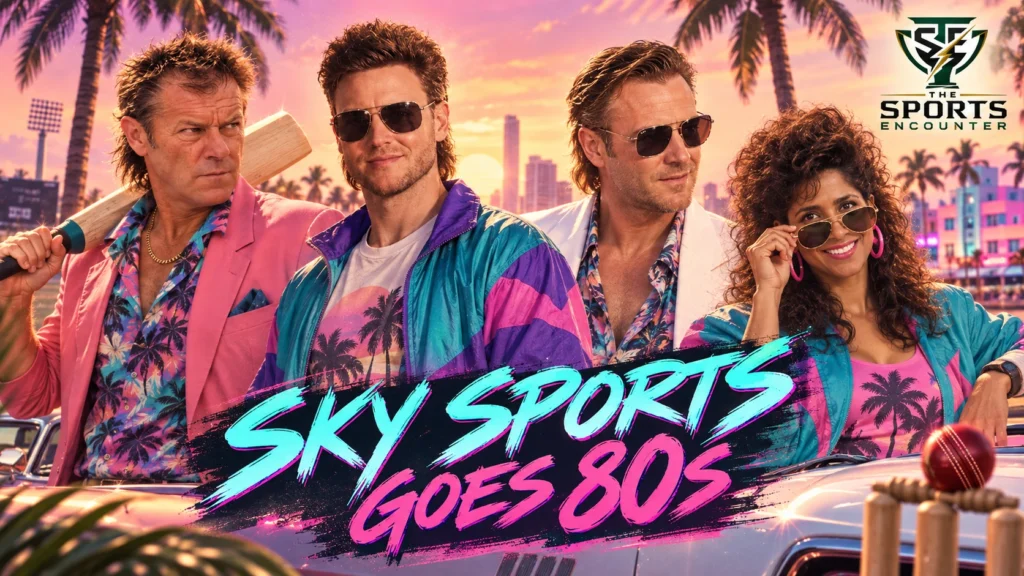
BIRMINGHAM, United Kingdom – September 9, 2026: Cricket commentary at Edgbaston briefly stopped looking like cricket commentary on Wednesday when Sky Sports decided its pundits needed less blazer, more beach shirt and considerably more 1980s attitude.
Nasser Hussain, Stuart Broad and Ian Ward found themselves laughing through a collection of AI-generated images that transformed members of the Sky Sports Cricket team into characters who appeared to have wandered straight out of Miami Vice.
The segment arrived during Sky’s coverage of the third England-Pakistan Test and quickly became one of the lighter moments of a series otherwise dominated by batting collapses, selection upheaval and England’s control on the field.
Sky Sports itself described the images as “Miami Vice-inspired” and said Hussain, Broad and Ward were left in hysterics as the pictures appeared on screen.
It was part cricket show, part reunion album, part imaginary 1986 television pilot.
What Was the Sky Sports Cricket 80s AI Photo Trend?
The idea was simple.
Take familiar members of the Sky Sports cricket team and reimagine them through the current social-media trend that uses generative AI to create photographs styled like the 1980s.
The resulting images leaned heavily into the visual language people now associate with that decade: bright patterned shirts, rolled sleeves, oversized sunglasses, resort settings, dramatic hair, glossy skin tones and the unmistakable confidence of someone who appears to own either a speedboat or a nightclub.
The clip shared with The Sports Encounter showed the Sky panel reacting to several of the transformations while the images appeared alongside their live discussion.
Sky later published the segment through its official cricket coverage under the headline “Nas, Broad and Ward left in hysterics at AI-generated images of Sky Sports pundits!”.
Why Were Nasser Hussain and Stuart Broad Laughing So Much?
Because the transformations were just believable enough to make them ridiculous.
That is usually what makes this trend work.
A completely absurd face swap is easy to dismiss.
An image that still looks recognizably like the person while placing them in an aggressively 1980s wardrobe creates a very different reaction.
Another commentary box classic 🤣 pic.twitter.com/gy5rhLYO3x
— Sky Sports Cricket (@SkyCricket) September 9, 2026
The clip repeatedly cuts back to the studio as Broad and the others examine the details, compare the looks and laugh at how naturally some members of the team seem to fit the era.
Hussain, in particular, appears to become part of the joke rather than merely someone observing it.
One of the on-screen captions even marvels at how “slick and cool” the 1980s version looks.
What Did the AI Images Make the Sky Sports Commentators Look Like?
The dominant style was unmistakably retro American television.
Some images featured open shirts, patterned tops and sunglasses.
Others placed the pundits against tropical or resort-style backgrounds that made the whole collection look less like a cricket broadcast and more like an abandoned casting session for an 80s detective show.
Eoin Morgan appeared in one of the recreations with the kind of relaxed styling that instantly drew attention from the group.
Urooj Mumtaz also appeared in the sequence with a full period makeover, while other members of the wider Sky cricket team were given their own deliberately exaggerated retro treatment.
The fun came from seeing serious former international cricketers temporarily transformed into people who looked as if they should be discussing convertibles, cassette tapes and beachfront property rather than seam position.
Who Appeared in the Sky Sports 80s AI Segment?
The Sky Sports clip prominently featured Nasser Hussain, Stuart Broad and Ian Ward reacting in the studio.
The AI-generated sequence also included recreations of members of the wider commentary and analysis team, including Eoin Morgan, Mark Butcher, Urooj Mumtaz and others who have appeared across Sky’s coverage of the England-Pakistan series.
That is part of what made the segment work so well.
This was not one isolated joke aimed at a single pundit.
It became a full commentary-team makeover.
Why Is the 80s AI Photo Trend Everywhere Right Now?
The format has spread quickly because it combines nostalgia with personalization.
Instead of asking people to admire generic retro photography, AI allows them to see a version of themselves inside an era they may remember, admire or never actually experienced.
Social media has been filling with recreations built around old studio portraits, holiday photographs, American high-school yearbooks, 1980s Karachi street fashion, big hair, aviator glasses and washed-out film colors.
The technology is doing something very modern while deliberately trying to look old.
That contradiction is a large part of the appeal.
Why Did the Sky Sports Version Work Better Than a Normal Social-Media Post?
The reaction made the difference.
Anyone can upload an AI image.
Watching the people depicted in those images judge their own fake 1980s selves turns the idea into entertainment.
Broad’s laughter, Hussain’s responses and the panel’s running commentary gave the segment the feel of teammates going through embarrassing old photographs together.
Except, of course, none of these photographs ever existed.
That made the whole thing even better.
Did Eoin Morgan Win the Sky Sports 80s Makeover?
There is a strong case.
One of the images shown in the clip gave Morgan the full resort-era treatment, complete with sunglasses and a look that would not have seemed out of place beside Don Johnson on 1980s television.
The reaction in the studio suggested everyone understood exactly what the image generator was going for.
Morgan already carries the calm demeanor of someone who rarely looks rushed.
Add 1980s styling and suddenly the former England captain looks like he has an entirely separate career solving crimes in Florida.
How Did Urooj Mumtaz Look in the 80s AI Trend?
Urooj Mumtaz’s recreation took a different route.
Rather than the exaggerated action-hero styling attached to some of the men, her image leaned into the polished fashion and hair associated with glossy 1980s television.
The result looked surprisingly natural.
That is another reason these images became such good material for the broadcast.
Some were funny because they looked ridiculous.
Others were funny because they almost looked real.
Why Was the Timing So Good During England vs Pakistan?
The England-Pakistan Test series has not exactly been short of serious talking points.
Pakistan arrived at Edgbaston already 2-0 down, having repeatedly failed with the bat and changed large parts of the squad and coaching setup.
The Sports Encounter’s analysis of Nasser Hussain and Michael Atherton’s criticism of Pakistan cricket showed just how serious the conversation around the tour had become.
That pressure intensified when Pakistan responded to the series defeat with another round of squad and staff changes.
Our third Test preview asked whether Babar Azam could salvage some pride before England completed the sweep.
Day 1 then brought another Pakistan collapse.
The tourists were dismissed for 133 before England reached 156 for four, with Josh Tongue taking four wickets and Harry Brook finishing unbeaten on 52.
Against that backdrop, five minutes of fake moustaches, tropical shirts and suspiciously expensive-looking sunglasses was probably exactly what the commentary box needed.
What Role Has Nasser Hussain Played in the England-Pakistan Series?
Hussain has been one of the most prominent analytical voices throughout the tour.
His comments about Pakistan’s cricket structure became a major story after the first two Tests, especially as England exposed recurring problems in Pakistan’s batting and selection.
The Sports Encounter examined those remarks in detail in our report on Hussain’s warning about Pakistan cricket’s wider crisis.
Seeing the former England captain laughing over an AI version of himself therefore offered an unusual contrast with the analytical role viewers had watched him perform throughout the series.
How Has Stuart Broad Become Part of Sky Sports Cricket?
Broad has become an increasingly familiar part of Sky’s analysis since retiring from international cricket.
His value comes partly from being close enough to the modern game to understand current players, bowling workloads and dressing-room thinking while still being comfortable enough on television to engage in lighter moments.
The official Sky Sports video is a good example of that transition.
Broad was not analyzing wrist position or new-ball lengths.
He was laughing at imaginary versions of his colleagues from four decades ago.
Who Else Has Been Part of Sky’s England-Pakistan Coverage?
Sky’s cricket coverage during the series has featured a rotating group of former internationals and analysts.
Mark Butcher, Urooj Mumtaz and Stuart Broad appeared together on the Sky Sports Cricket Podcast during the Headingley Test.
Eoin Morgan has also appeared regularly during the series, including alongside Urooj during coverage from Lord’s.
That familiarity helped the AI segment because viewers already recognize the different personalities involved.
Why Do Sports Fans Respond So Well to Moments Like This?
Sports broadcasting works best when analysts are allowed to behave like people rather than permanent tactical diagrams.
Fans spend hours watching the same commentary teams across a Test match.
Small moments of humor create familiarity.
They also reveal relationships that already exist behind the microphones.
The laughter in the clip feels less like a scripted television segment and more like colleagues winding each other up.
That authenticity is difficult to manufacture.
Does AI Have a Place in Sports Broadcasting Beyond Jokes?
Yes, although the fun segment also illustrates why broadcasters have to use it carefully.
AI can generate graphics, simulations, historical recreations and visual explanations far faster than traditional workflows.
It can also create images that look convincing enough to blur the line between parody and reality.
In this case, the context was obvious.
Everyone knew the photographs were fake and the entire point was to laugh at them.
That transparency is what makes a harmless trend different from misleading synthetic media.
Why Is This a Different Kind of England-Pakistan Story?
The Sports Encounter has spent most of this tour covering collapses, tactical failures, injuries and selection decisions.
Our Lord’s analysis focused on what Pakistan needed to rebuild after losing the series.
The opening day at Lord’s was about Pakistan creating opportunities but failing to take complete control.
Earlier, Day 2 at Lord’s brought another collapse under England’s seam attack.
The current Edgbaston Test has continued many of those themes.
This story does not.
Sometimes cricket coverage is allowed to be fun.
Could the 80s AI Trend Become a Regular Broadcast Feature?
Probably not, and that may be why it worked.
A recurring segment would quickly lose the surprise.
The humor came from dropping something completely unexpected into an otherwise normal cricket broadcast.
The Sky team did not need to explain the trend for ten minutes.
They simply showed the pictures and let the reactions do the work.
What Was the Best Part of the Sky Sports 80s AI Segment?
The images were funny.
The reactions were better.
Broad trying to hold it together, Hussain reacting to the details and the studio debating who looked best made the segment much more memorable than simply posting the pictures online.
The entire exercise also proved something important about the trend.
The best AI recreation is not necessarily the most technically perfect one.
It is the one your friends cannot stop laughing at.
Frequently Asked Questions About the Sky Sports 80s AI Trend
Did Sky Sports create AI images of its cricket commentators?
Yes. Sky Sports showed a collection of Miami Vice-inspired AI recreations of members of its cricket team during coverage on September 9, 2026.
Who reacted to the AI images on Sky Sports?
Nasser Hussain, Stuart Broad and Ian Ward were prominently featured reacting to the images.
Which Sky Sports cricket personalities appeared in the 80s-style images?
The sequence featured recreations of members of the wider Sky cricket team, including personalities such as Eoin Morgan, Mark Butcher and Urooj Mumtaz.
What style were the AI pictures?
Sky described them as Miami Vice-inspired, with 1980s clothing, hairstyles, sunglasses and tropical styling.
When did Sky Sports show the 80s AI images?
Sky published the segment on September 9, 2026 during its coverage of the England-Pakistan Test series.
Was the segment serious?
No. It was presented as a lighthearted piece, and the commentators openly laughed at the generated versions of themselves and their colleagues.
What is the 80s AI photo trend?
It is a social-media trend in which AI image tools recreate people as if they had been photographed during the 1980s, using period clothing, hairstyles, photographic effects and settings.
Where can fans follow more England-Pakistan coverage?
Readers can follow the series and wider international cricket coverage through The Sports Encounter Cricket Hub.
Final Verdict: Cricket’s Serious Men Discover Their Miami Vice Era
Nasser Hussain has spent much of this England-Pakistan series explaining batting technique, selection problems and the structural weaknesses of Pakistan cricket.
Stuart Broad has been discussing seam movement, fast bowling and Test-match tactics.
Ian Ward has been trying to keep everybody on topic.
Then somebody gave the commentary team 1980s haircuts.
That was pretty much the end of serious conversation.
The AI images worked because nobody pretended they were anything important.
They were silly, nostalgic and occasionally far more convincing than anyone in the studio seemed comfortable admitting.
For a few minutes at Edgbaston, Test cricket met Miami Vice.
Miami Vice probably won.