


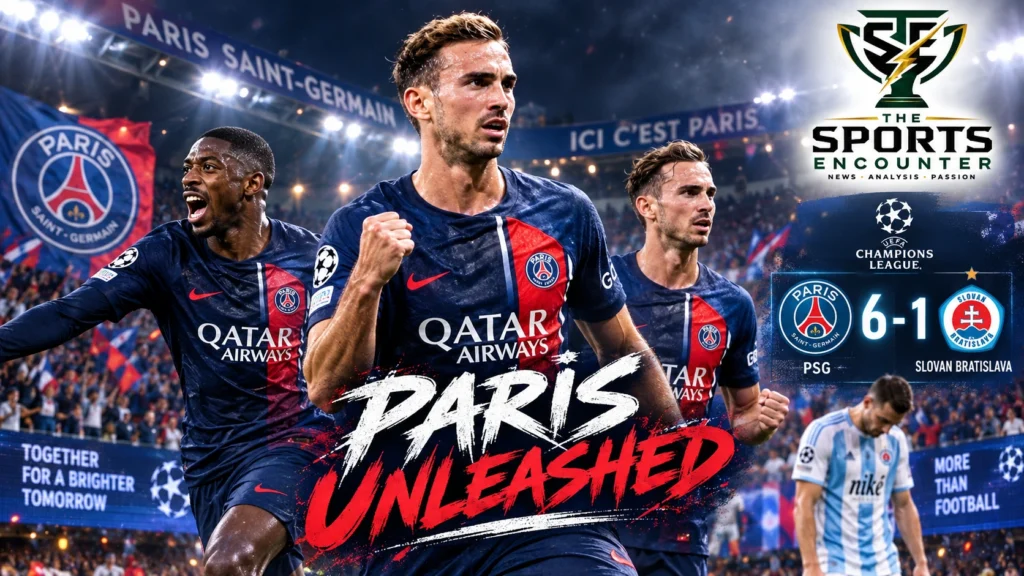
PARIS, France, September 9, 2026: Paris Saint-Germain had spent the opening weeks of the season looking unusually human. Four Champions League goals in 40 first-half minutes reminded Europe how quickly that impression can disappear.
Ferran Fornes scored a hat-trick, Ousmane Dembélé struck twice and Fabián Ruiz added a late sixth as PSG dismantled Slovan Bratislava 6-1 at the Parc des Princes in their opening UEFA Champions League league-phase match.
Slovan arrived in Paris after surviving a demanding qualifying route and entered the night unbeaten in seven European matches this season. That resistance lasted 17 minutes.
Dembélé scored twice in six minutes, Fornes added another before halftime and then completed his hat-trick with goals in the 47th and 57th minutes. Suleiman Camara pulled one back for Slovan in the 59th, but the contest had already moved beyond recovery. Fabián Ruiz completed the scoring in the 88th minute.
The 6-1 result gave PSG the kind of European opening they badly needed after a domestic start that had produced two draws and a home defeat to Monaco. The Sports Encounter’s analysis of PSG’s 2-2 draw at Lille had already exposed how often Luis Enrique’s side were being forced to repair matches after poor starts.
Against Slovan, Paris did the opposite. They imposed the game before the visitors could settle into it.
PSG 6-1 Slovan Bratislava: Match at a Glance
| Statistic | PSG | Slovan Bratislava |
|---|---|---|
| Final score | 6 | 1 |
| Goals | Ousmane Dembélé 17′, 23′; Ferran Fornes 31′, 47′, 57′; Fabián Ruiz 88′ | Suleiman Camara 59′ |
| Shots | 32 | 6 |
| Shots on target | 12 | 4 |
| Possession | 68% | 32% |
| Passes | 725 | 288 |
| Pass accuracy | 93% | 77% |
| Fouls | 8 | 6 |
| Yellow cards | 0 | 1 |
| Offsides | 4 | 1 |
| Corners | 7 | 2 |
The numbers are as one-sided as the score.
PSG attempted 32 shots, more than five times Slovan’s total. They completed 725 passes at 93% accuracy and controlled 68% possession, but the real difference came in how quickly that circulation turned into pressure around the penalty area.
Slovan were not simply starved of the ball. They were repeatedly forced backward until every clearance became the start of another PSG attack.
Dembélé Broke the Resistance in Six Minutes
For the opening quarter-hour, Slovan could at least point to the scoreboard and believe their plan was holding.
That changed in the 17th minute when Dembélé opened the scoring.
Six minutes later, he scored again.
The double strike changed more than the margin. It removed Slovan’s ability to defend patiently and wait for PSG frustration to grow. Once the visitors were two goals down, they had to decide whether to keep protecting space or step higher and risk leaving even more of it behind.
That tactical problem is exactly what elite European sides create when they score early.
Dembélé has already been central to PSG’s recent continental success. He also changed the 2026 UEFA Super Cup after coming on at halftime, creating the move that helped PSG beat Aston Villa 2-1 in Salzburg.
Against Slovan, he did not need a second-half intervention.
He dismantled the visitors before halftime.
Ferran Fornes Turned Control Into a Hat-Trick
Dembélé created the opening, but Fornes made sure the game became a rout.
His first goal arrived in the 31st minute, extending PSG’s advantage to 3-0 before Slovan had found any sustained way out of their defensive third.
The second came two minutes after halftime.
The third followed in the 57th.
That 26-minute hat-trick tells the story of a player benefiting from a team that kept forcing the same defensive questions until Slovan stopped finding answers.
PSG’s passing volume mattered because it was not sterile. The 725 passes continually moved the Slovak champions from side to side, forcing midfielders to cover wider distances and defenders to make repeated decisions about whether to step toward the ball or protect the box.
Once those distances widened, Fornes kept appearing where the defensive structure was weakest.
The five-goal lead after 57 minutes also gave Luis Enrique the luxury elite teams want from opening league-phase fixtures: the ability to manage the final half-hour without placing the result at risk.
Slovan’s Qualifying Strength Could Not Survive the Step Up
The result looks brutal, but Slovan did not arrive in Paris as a side that had stumbled into the competition.
They had earned their place.
The Slovak champions defeated Iberia Tbilisi, Mjällby and Celje during qualifying, with the final tie requiring extra time before Cristian Martínez scored the goal that secured a 3-2 aggregate victory.
The Sports Encounter followed Slovan’s dramatic qualification against Celje, where they needed 210 minutes across two legs to reach the league phase.
UEFA also noted before Wednesday’s game that Slovan had entered the fixture unbeaten in seven European matches this season, winning five and drawing two. Their only previous Champions League proper appearance came in 2024-25, when they lost all eight league-phase games. The official UEFA Matchday 1 preview documented both that record and the scale of the challenge waiting in Paris.
That contrast became the real story of the night.
Qualifying tests resilience against teams closer to your level.
The league phase can suddenly place you against the defending champions.
Slovan discovered the difference in less than an hour.
Camara’s Goal Changed the Score, Not the Contest
Suleiman Camara scored Slovan’s only goal in the 59th minute, two minutes after Fornes had completed his hat-trick.
The strike mattered to the visitors because opportunities at the Parc des Princes had been scarce.
Slovan finished with only six shots, but four reached the target. That tells us their problem was not exclusively finishing. The larger issue was creating enough opportunities to make efficiency meaningful.
PSG attempted 32 shots.
When the shot-volume gap reaches 26, a team can finish its limited chances well and still remain nowhere near the result.
Camara’s goal briefly made the score 5-1, but Paris never looked as if they had lost control.
Fabián Ruiz Put the Final Number on PSG’s Dominance
Fabián Ruiz scored the sixth goal in the 88th minute.
By then, the result had long been settled, but the goal completed a statistical picture that will matter when the league-phase table begins tightening later in the season.
The current Champions League format rewards the top eight clubs with direct qualification for the round of 16. Teams ranked ninth through 24th enter the knockout-phase play-offs, while the bottom 12 are eliminated.
Our complete Champions League draw analysis examined why goal difference can become important across a league table containing 36 clubs that do not all face the same opponents.
PSG therefore gained more than three points.
A five-goal winning margin immediately gives them useful protection in an eight-match league phase where table positions can eventually be separated by very small differences.
The Performance Was a Sharp Reversal From PSG’s Domestic Start
The most interesting part of PSG’s night was how little it resembled their opening weeks in Ligue 1.
Paris began the domestic season with a 2-2 draw at Rennes.
They followed that with another 2-2 draw against Lille after needing late goals from Vitinha and Marquinhos to recover from 2-0 down.
Then Monaco won 2-1 at the Parc des Princes.
That sequence had created legitimate questions about whether the back-to-back European champions were carrying the same control into the new campaign.
Wednesday offered a forceful answer, even allowing for the quality gap between PSG and Slovan.
The comparison matters because PSG’s European schedule becomes significantly harder after Matchday 1.
Their next Champions League opponent is Manchester City, who opened their own campaign with a controlled 2-0 victory over Porto.
After that comes Barcelona at the Parc des Princes.
This was the fixture PSG were expected to win.
The scale of the win is what makes it significant.
A Third Straight Champions League Title Is the Standard Paris Have Created
Winning Europe once changes a club’s history.
Winning it twice consecutively changes expectations.
PSG enter 2026-27 attempting something that few teams in the modern Champions League era have managed: three successive titles.
UEFA’s official pre-match record noted that Luis Enrique’s team scored 45 goals in last season’s competition, equaling Barcelona’s record for the most goals in a single Champions League campaign.
Paris also entered Wednesday unbeaten in 11 European matches.
Those numbers explain why a 6-1 opening victory cannot simply be dismissed as a favorite beating an outsider.
PSG are now being judged against the standard they created themselves.
Their UEFA Super Cup meeting with Aston Villa had already underlined how every European fixture now comes with the expectation that the champions will impose themselves.
Wednesday was the first Champions League evidence that this season’s version may still be capable of doing exactly that.
Paris’ Next Three European Games Will Tell Us Much More
Slovan were the softest landing available in PSG’s league-phase schedule.
The next stretch is very different.
Paris travel to Manchester City on October 14, host Barcelona six days later and then visit Villarreal on November 3. Roma, Aston Villa, Como and Galatasaray complete the remaining schedule.
The official PSG Champions League schedule confirms how quickly the difficulty rises after the opener.
City have already shown their own European efficiency, while Barcelona opened their campaign with major expectations after Lamine Yamal publicly identified the Champions League as the club’s primary target. The Sports Encounter examined Barcelona’s European ambitions before Matchday 1.
Those games will provide a better measurement of whether PSG have fully corrected the weaknesses visible in Ligue 1.
Slovan could not apply enough pressure to expose them.
Manchester City and Barcelona almost certainly will.
Matchday 1 Is Already Producing Different Versions of Control
PSG’s victory also adds another tactical example to an opening round that has produced very different ways of winning.
Manchester City controlled Porto through shot volume and territory.
Sporting CP used only 41% possession but punished Galatasaray 3-1 by making their attacking moments count.
Borussia Dortmund needed Serhou Guirassy’s second-half intervention to survive Villarreal 3-2 in a far more chaotic opener.
Paris offered another model.
They had the ball.
They had the territory.
They had the shots.
Most importantly, they converted enough of that superiority early enough that the match never developed into a contest of nerves.
The Sports Encounter Verdict
Slovan Bratislava did not lose because they lacked courage or because their qualifying run had somehow been misleading.
They lost because Paris made the difference between surviving Europe and controlling Europe look enormous.
Dembélé needed six minutes to turn a cautious opening into a two-goal lead. Fornes then converted PSG’s territorial dominance into a hat-trick, while Fabián Ruiz supplied the final reminder that the pressure had never really stopped.
For Luis Enrique, the most encouraging part may not be the six goals.
It may be the absence of the chaos that had defined PSG’s domestic opening.
No two-goal deficit to repair.
No desperate stoppage-time rescue.
No period in which the opposition appeared capable of dictating where the game was heading.
PSG entered Europe carrying questions from Ligue 1.
They left Matchday 1 carrying a 6-1 victory, a five-goal advantage in the league-phase table and a warning for the stronger opponents still to come.
Slovan survived qualifying to reach the Champions League.
Paris used 90 minutes to remind everyone why they have won it twice in a row.
Follow The Sports Encounter’s UEFA Champions League 2026-27 coverage for continuing Matchday 1 reports, tactical analysis and the road through the league phase.